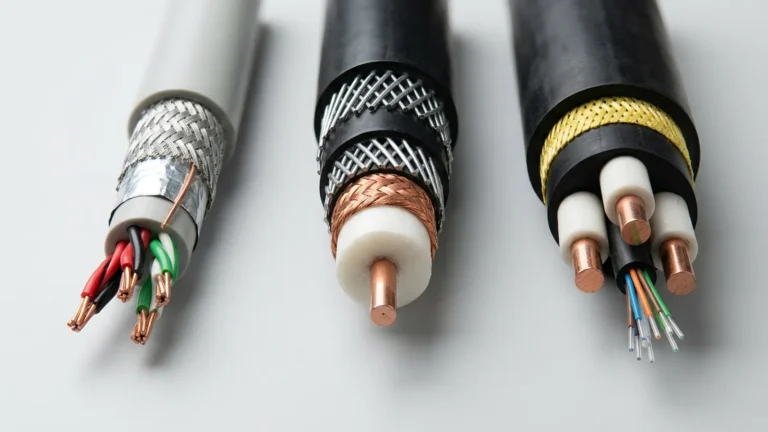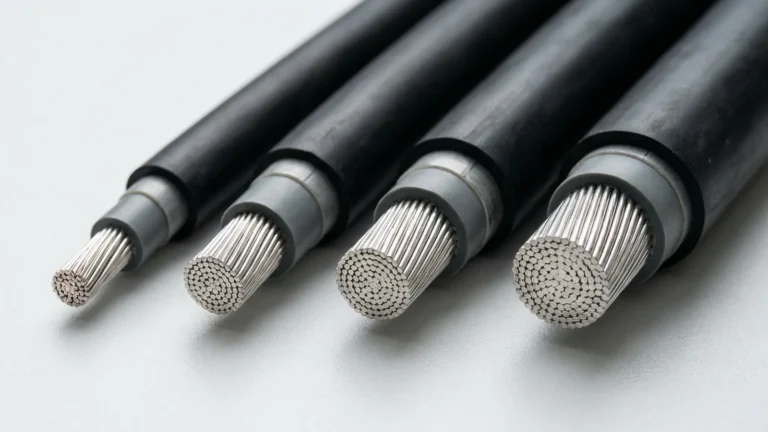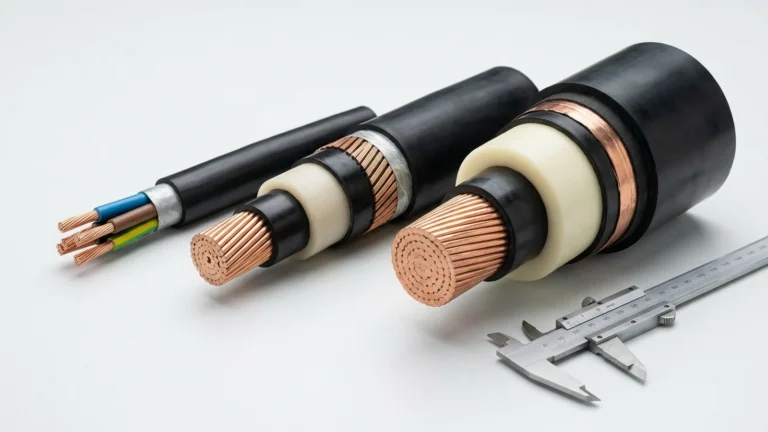

Engineering summary: Electrical and industrial cables are classified across four design axes: circuit function (power, control, instrumentation, data, or composite hybrid), rated voltage (LV, MV, or HV), insulation and sheath chemistry (PVC, XLPE, EPR, PCP, PUR, LSZH, silicone, or fluoropolymer), and mechanical installation duty (fixed routing versus continuous trailing, reeling, festoon, or drag-chain motion).
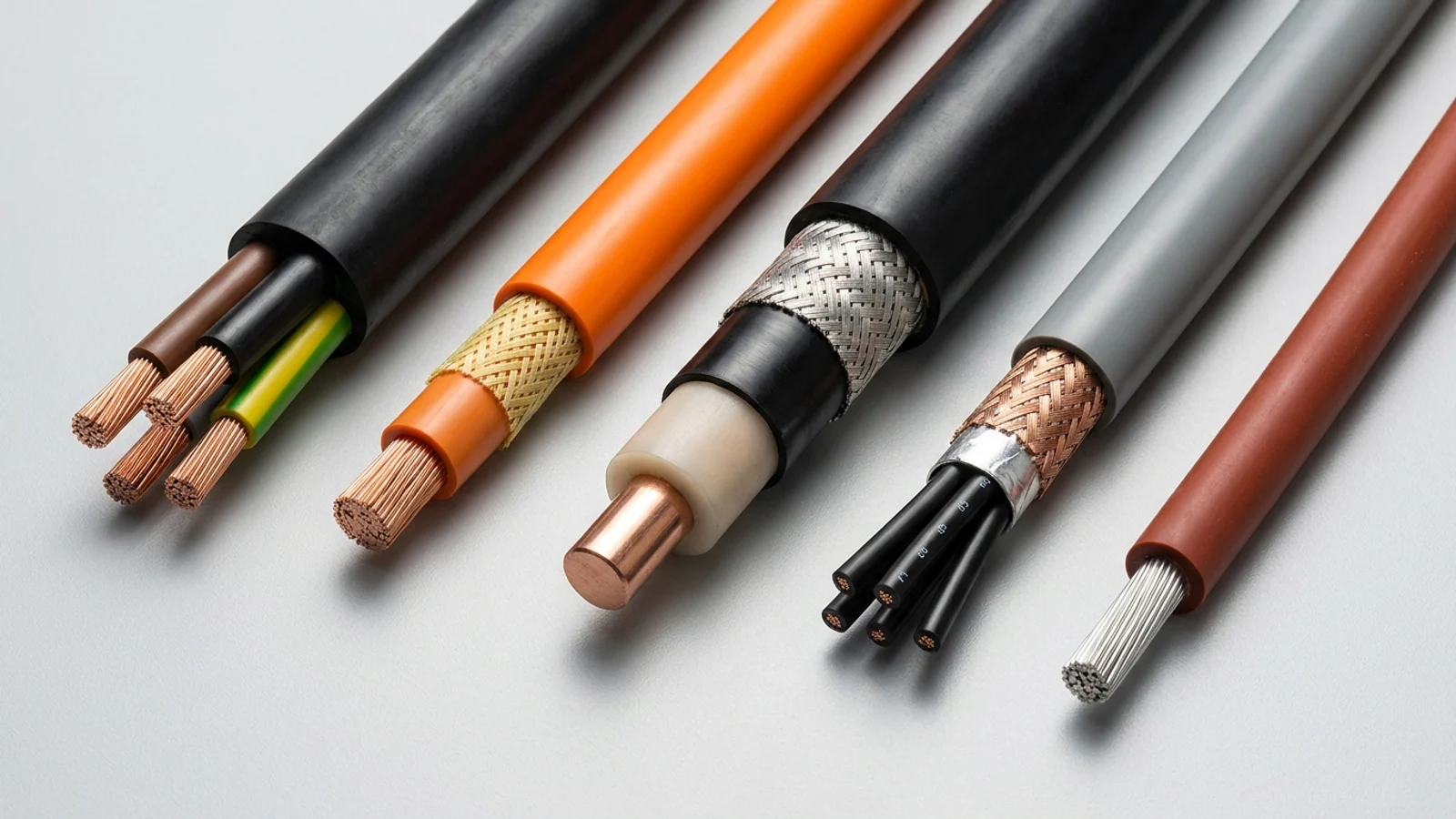
Searching for generic cable categories often returns residential wiring lists—coaxial television leads, twisted-pair office Ethernet, and non-metallic building wire—that fail rapidly when installed on heavy industrial machinery, mobile mining equipment, or port cranes. For electrical engineers and EPC procurement teams, selecting the right cable family requires matching conductor stranding class, dielectric compound, metallic screening, and outer jacket mechanics to the real operating duty.
What Are the Main Types of Electrical and Industrial Cables by Function?
By electrical circuit function, industrial cables divide into five primary groups: power distribution cables, multi-core control cables, low-level instrumentation cables, high-frequency data lines, and composite hybrid cables that combine power phases, pilot cores, and optical fibres under one outer sheath to save reeling drum or festoon space.
| Functional Cable Type | Primary Electrical Job | Typical Conductor & Core Architecture | Standard Voltage Window | Representative Industrial Models |
|---|---|---|---|---|
| Low-Voltage Power Cables | Deliver main three-phase or DC current to motors, drives, switchgear, and mobile equipment | 1 to 5 cores (1.5 mm² to 500 mm² / 4/0 AWG to 777.7 kcmil); IEC 60228 Class 2 (fixed) or Class 5/6 (flexible) | 450/750 V, 0.6/1 kV, 600 V, 2 kV | H07RN-F, NSHÖU / NSSHÖU, 2 kV DLO, SOOW |
| Medium-Voltage Trailing & Reeling Cables | Feed high-power excavators, tunnel boring machines (TBMs), ship-to-shore cranes, and substations | 3 phase cores with extruded semiconductive screens + concentric or split earth + ground-check pilot | 1.9/3.3 kV to 18/30 kV (NEC 5 kV to 35 kV) | (N)TSCGEWÖU, Type SHD-GC, Type MV-105, RG7H1OR |
| Multi-Core Control & Servo Cables | Carry contactor switching, limit-switch feedback, and VFD/servo motor power with EMC containment | 2 to 61 numbered or colour-coded cores (0.5 mm² to 6 mm²); unscreened, copper-braided (CY), or steel-braided (SY) | 300/500 V, 600 V, 0.6/1 kV | YY / YSLY, SY LSZH, S-200-C Drag Chain |
| Instrumentation & Sensor Cables | Transmit millivolt, 4–20 mA, thermocouple, RTD, and fieldbus signals with low crosstalk | Twisted pairs or triads (0.5 mm² to 2.5 mm²) with individual and collective foil/braid electrostatic screens | 150/250 V, 300 V, 300/500 V | Shielded Instrumentation & RTD Cables, EN 50288 / BS 5308 |
| Composite Power + Fibre-Optic Cables | Combine high-voltage power supply and gigabit crane/mining telemetry inside one dynamic cable | 3 power cores + protective earth + buffered single-mode or multi-mode optical fibre tube assembly | 0.6/1 kV to 12/20 kV | (N)TSCGEWÖU-SR-FO, Spreader Basket Cables |
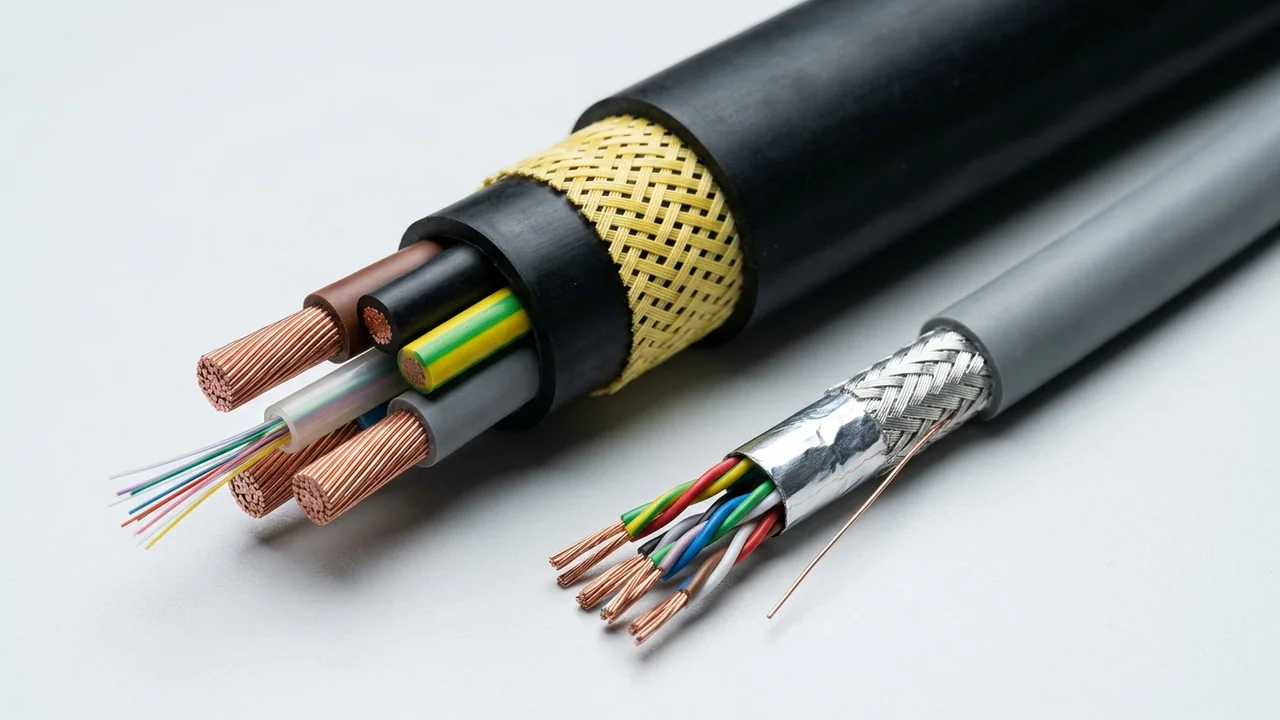
Anatomy Comparison: Composite Reeling vs. Shielded Instrumentation
- Composite Power + Fibre Core (Left): Combines fine-stranded bare copper power phases, green/yellow PE, and a buffered loose-tube optical fibre bundle beneath an yellow aramid anti-torsion braid and heavy elastomer jacket.
- Instrumentation Pair Build (Right): Uses twisted signal pairs, aluminized foil with drain wire, and a tinned-copper braid shield to reject electromagnetic noise on 4–20 mA and sensor loops.
Never route low-level millivolt sensor pairs unshielded inside high-current VFD power cables.
Understanding circuit role is only the first filter. Two 0.6/1 kV 4×50 mm² cables can share identical voltage and current ratings on paper, yet a rigid PVC/XLPE feeder pulled into a cable tray will suffer core birdcaging and copper work-hardening within days if mounted on a motorized crane drum. For the full parameter verification sequence, see our industrial cable selection guide.
How Does Fixed Installation Differ from Dynamic Trailing, Reeling and Drag-Chain Cables?
Fixed installation cables use coarse Class 1 solid or Class 2 stranded conductors designed to remain stationary after pulling, whereas dynamic industrial cables require IEC 60228 Class 5 or Class 6 fine-stranded conductors, short-pitch core lay-up, elastomeric inner sheaths, and anti-torsion or central tensile elements to survive millions of bending cycles.
| Mechanical Duty Class | Dominant Mechanical Stress | Required Structural Features | Typical Minimum Bend Radius | Target Equipment & Catalog Link |
|---|---|---|---|---|
| Fixed / Static Routing | Pulling tension during installation; static radial crushing or soil load | Class 1/2 copper; extruded bedding; optional galvanized steel wire armour (SWA) | 6×D to 15×D (once during installation) | Fixed plant feeders, cable trays, buried ducts (RG7OZR) |
| Portable & Free-Flexing | Manual handling, occasional relocation, floor abrasion, oil and water splashes | Class 5 flexible copper; cross-linked rubber insulation and heavy polychloroprene sheath | 4×D fixed / 6×D to 8×D mobile | Generators, site welders, stage & pump power (Rubber & Flexible Cables) |
| Heavy Trailing Duty | Ground dragging over sharp rock, high axial pull, vehicle run-over impact, mud immersion | Reinforced double-layer rubber or chlorinated elastomer jacket; elastomeric cradle separator; earth monitoring | 6×D to 10×D under tension | Shovels, drill jumbos, coalcutters (Mining & Tunneling Cables) |
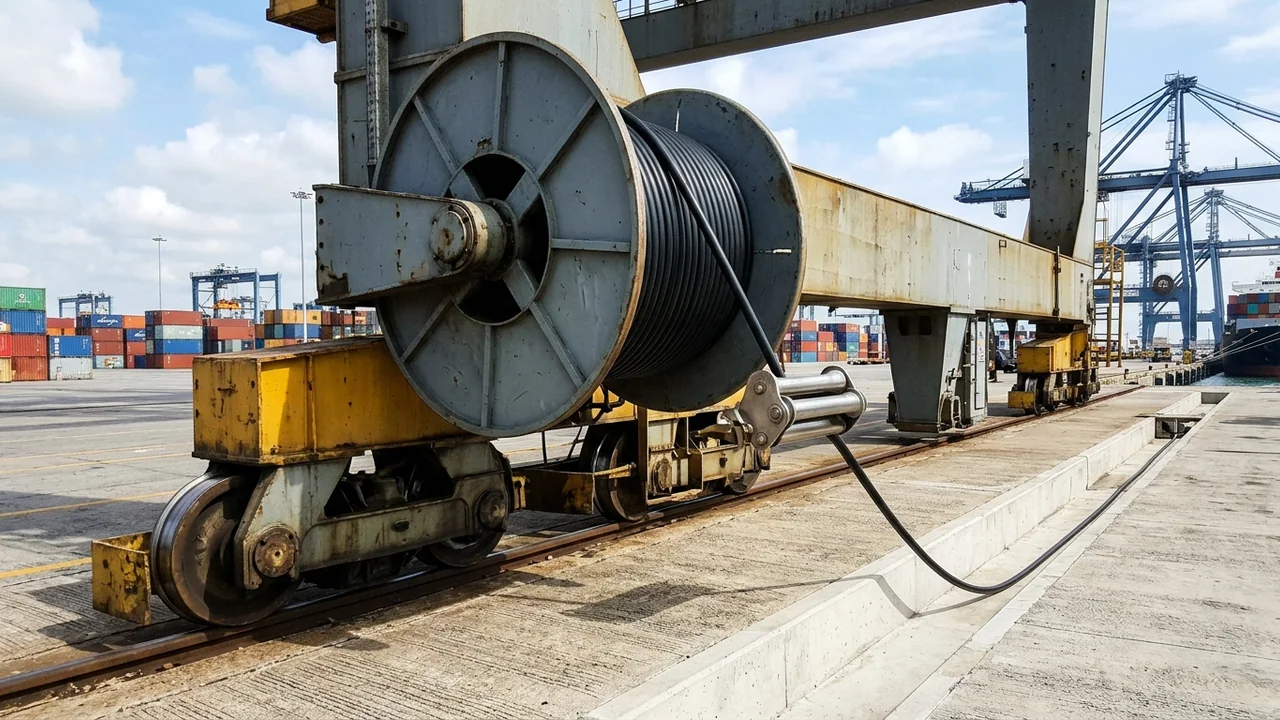
| Drum Reeling & Spreader Duty | Continuous monospiral or level-wind drum reeling, dynamic axial tension (up to 15–25 N/mm²), torsional twist | Vulcanized inner sheath bonded to outer jacket; open-weave aramid or polyester anti-torsion braid; central support core | 7.5×D to 12×D dynamic over sheaves | STS, RTG, RMG cranes, stacker-reclaimers (Port, Crane & Festoon Cables) |
| Festoon & Energy Drag Chain | High-speed horizontal acceleration, tight repetitive single-plane or multi-axis flexing | Class 6 extra-fine stranding; low-adhesion TPE/EPR core insulation; pressure-extruded PUR or flat rubber jacket | 5×D to 7.5×D in continuous chain travel | Overhead crane trolleys, CNC gantry robotics (PUR Drag Chain Series) |
Critical reeling failure mode (Corkscrewing): Never mount a standard unreinforced portable rubber cord on a high-speed motorized crane drum. Without an integrated anti-torsion braid and a pressure-vulcanized inner sheath locking the core lay, S-bends and guide-roller deflection twist the internal conductors until cores rupture inside an intact outer jacket.
How Do Cable Insulation and Outer Sheath Materials Compare?
Insulation compounds govern dielectric strength, capacitance, and maximum conductor temperature (typically 70 °C for PVC, 90 °C for EPR/XLPE, and 180 °C to 250 °C for silicone or fluoropolymers), while the outer sheath compound determines resistance to tear propagation, mineral oils, UV ozone, seawater submergence, and halogen-free fire performance.
Thermoplastic compounds such as PVC soften when overheated and stiffen sharply below −15 °C. Cross-linked thermoset elastomers—including ethylene propylene rubber (EPR / 3GI3), polychloroprene (PCP / EM2), and chlorosulfonated polyethylene (CSP)—cannot remelt after vulcanization, allowing higher short-circuit thermal withstand (up to 250 °C for EPR) and reliable flexibility down to −40 °C. Polyurethane (PUR / 11Y) bridges thermoplastic processing with extreme cut, tear, and microbe resistance. Detailed material trade-offs are covered in our XLPE vs EPR insulation comparison and PUR vs PVC cable comparison.
| Compound Family | Role | Typical Conductor / Ambient Temp | Key Strengths | Primary Limitations |
|---|---|---|---|---|
| PVC (Polyvinyl Chloride) | Insulation & Sheath | −5 °C (flex) to +70 °C (+90 °C heat-grade) | Cost-effective, self-extinguishing, clean core numbering for control cabinets | Poor cold-bend flexibility, moderate abrasion resistance, emits acidic HCl gas in fire |
| EPR / HEPR (3GI3) | Core Insulation | −40 °C to +90 °C (250 °C short-circuit) | High flexibility, corona and ozone resistance, stable dielectric properties in LV & MV cables | Requires protective outer elastomer or PUR sheath against mechanical cut and oil |
| PCP / CPE (5GM3 / EM2 Rubber) | Heavy-Duty Sheath | −40 °C to +80/+90 °C | Flame-retardant, weather/ozone proof, strong oil resistance and mechanical impact absorption | Higher outer diameter and weight than thin-wall PUR drag-chain jackets |
| PUR (Polyurethane / 11Y) | Dynamic Sheath | −40/−50 °C to +80/+90 °C | Exceptional notch, cut, abrasion, hydraulic oil, and hydrolysis resistance; halogen-free options | Lower continuous thermal ceiling than thermoset rubber under prolonged radiant heat |
| LSZH / SHF1 / SHF2 | Fire-Safe Sheath | −40 °C to +90 °C | Zero halogen acid gas (IEC 60754), low smoke density (IEC 61034) for tunnels and offshore platforms | Must specify cross-linked elastomeric SHF2 (not rigid SHF1) if dynamic flexing or mud resistance is needed |
| Silicone & PTFE / FEP / PFA | High-Temp Insulation & Sheath | −60 °C to +180 °C (Silicone) / +250 °C (PFA) | Withstands furnace radiant heat, molten metal splash (with fiberglass braid), and chemical solvents | Silicone has low tear resistance unless reinforced with fiberglass braid (e.g., SiAF-GL) |
Which Specialty Cable Family Matches Your Industrial Sector?
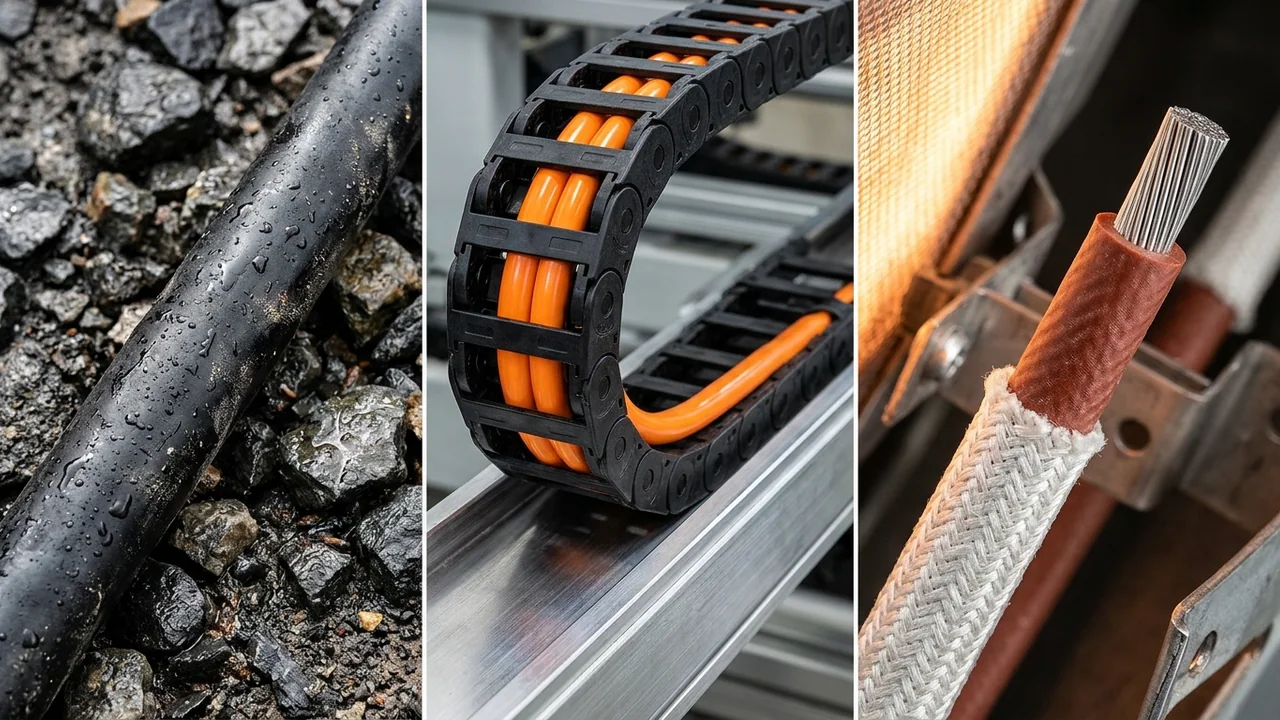
Industrial buyers achieve the longest service life by selecting cables built to sector-specific construction standards—such as DIN VDE 0250 and ICEA S-75-381 for mining, NEK 606 and BS 6883 for offshore oil and gas, AD8 submergence standards for deep pumps, and UL/VDE high-temperature specifications for steelworks.
- Open-Pit & Underground Mining: Specify heavy rubber trailing and reeling cables incorporating ground-check pilot cores and semiconductive/metallic screens, such as DIN VDE 0250-812/813 ((N)TSCGEWÖU, (N)3GHSSHCH), North American SHD-GC, or British BS 6708 coalcutter trailing cables.
- Port Terminals & Bulk Material Handling: Choose anti-torsion monospiral/random reeling cables, flat festoon cables, and aramid-supported gravity basket cables (NSHT11Y, 3GSLTÖ). Review our port and crane reeling cable guide.
- Offshore Platforms & Shipboard Systems: Use flame-retardant or mica-tape fire-resistant mud-resistant cables compliant with NEK 606 and IEC 60092 (RFOU, BFOU) inside Oil, Gas & Marine Cables.
- Submersible Pumps, Dredgers & ROVs: Require AD8 permanent water-immersion rubber cables (H07RN8-F), 300 m deep-well pump feeders, or neutrally buoyant PUR subsea tethers under Submersible & Underwater Cables.
- Metallurgy, Furnaces & Aerospace Ground Support: Deploy 180 °C–450 °C silicone, PTFE/PFA, and mica-glass cables (High-Temp & Specialty Cables) or specialized 400 Hz aircraft ground power cables.
Frequently Asked Questions
What is the difference between a wire and an electrical cable?
In industrial engineering, a wire refers to a single solid or stranded metallic conductor (bare or insulated, such as a single-core panel hook-up wire), whereas a cable is a complete assembly of one or more insulated cores enclosed within a protective inner bedding, metallic screen or armour, and an overall outer sheath rated to a specific mechanical and voltage standard.
When should I specify a rubber cable instead of a PVC or XLPE cable?
Specify cross-linked rubber (EPR/PCP, such as H07RN-F or NSSHÖU) whenever the installation involves portable equipment, sub-zero outdoor ambient temperatures down to −40 °C, mechanical impact, reeling or trailing movement, or high short-circuit thermal stress where rigid PVC/XLPE cables crack or deform.
Can a drag-chain cable be used on a motorized crane reeling drum?
Not without engineering verification. Drag-chain cables are optimized for tight single-plane bending inside guided carriers without high axial pulling tension, whereas crane reeling cables must withstand continuous dynamic tensile pull and torsional twist via integrated aramid/polyester anti-torsion braids and bonded sheaths.
What parameters are needed to get an accurate industrial cable quotation?
Provide the target standard or model designation, rated voltage (U0/U), core count and conductor cross-section (mm² or AWG/kcmil), movement type (fixed, trailing, reeling speed/travel length, or drag chain), minimum bending radius, ambient media (oil, mud, water depth, temperature), and required drum lengths.
Request Technical Cable Verification and Factory Quotation
TEBAOFLEX manufactures flexible rubber, mining trailing, port crane reeling, marine offshore, and high-temperature specialty cables at our 20,000+ m² facility in Taicang, Suzhou. Before issuing a quotation, our engineers verify your conductor sizing, sheath chemistry, bending radius, and standard compliance against your actual equipment duty.
- Share your required standard (DIN VDE, IEC, UL/NEC, BS, NEK 606, or JIS), voltage, and core cross-section.
- Describe movement conditions (fixed tray, ground trailing, monospiral/random reel, festoon, or drag chain).
- Include total order length, individual drum cut lengths, and destination port for landed delivery planning.
Standards & technical references: IEC 60228 (Conductors of insulated cables, Classes 1, 2, 5, and 6); DIN VDE 0250 / EN 50525-2-21 (Flexible rubber power and reeling cables); IEC 60092 & NEK 606 (Marine and offshore cables); UL 62 & ICEA S-75-381 (Portable cords and mining cables). Always confirm project-specific approvals and installation derating prior to final specification.