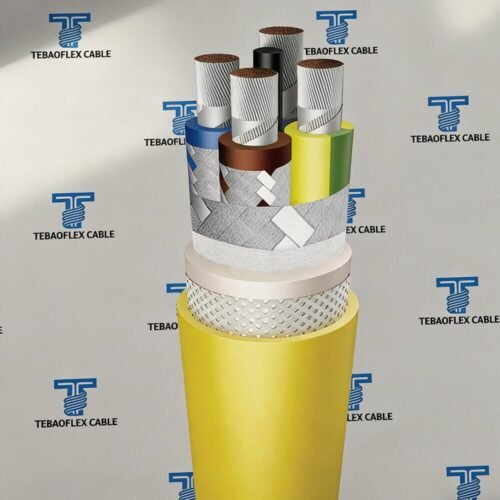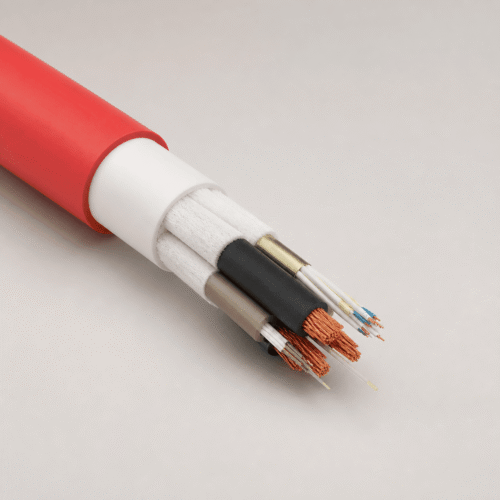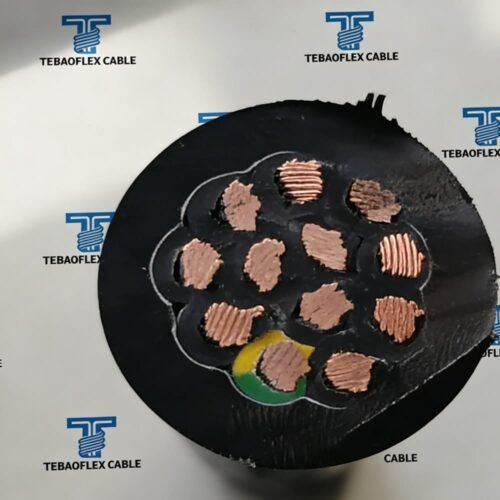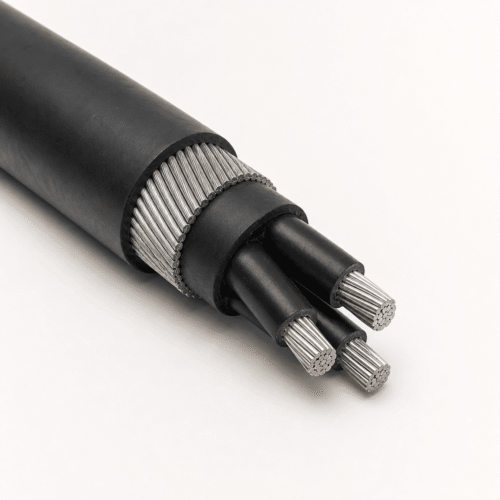
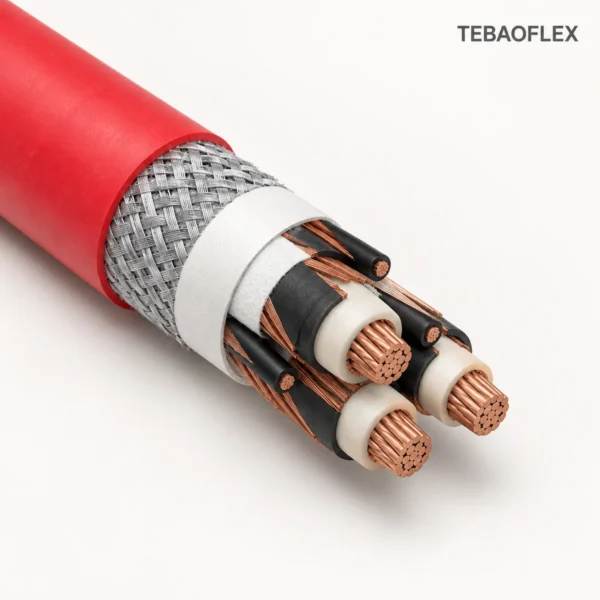
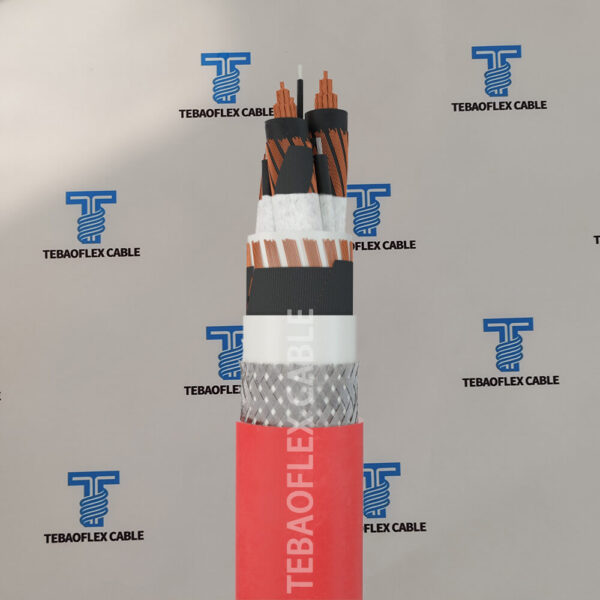
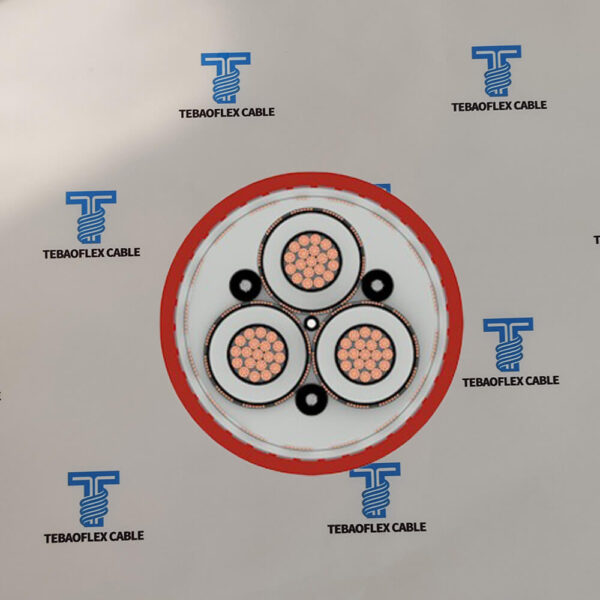
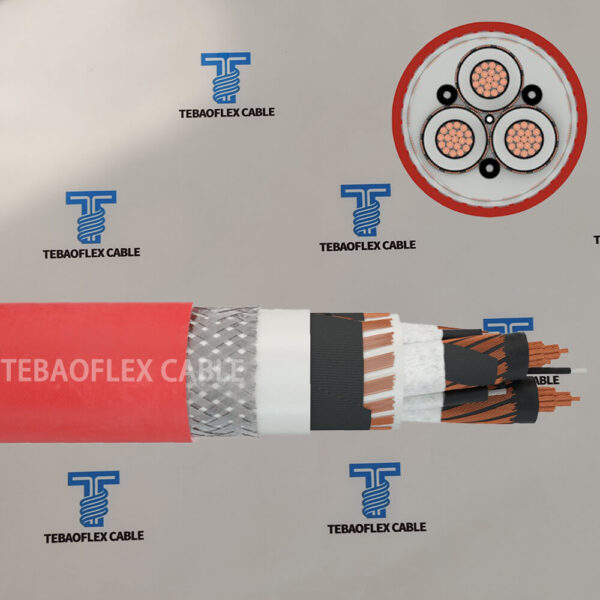
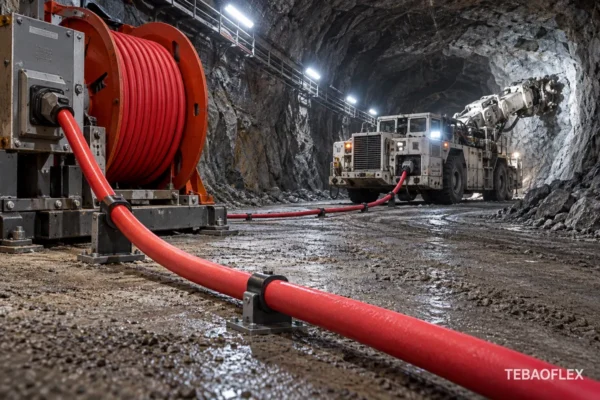
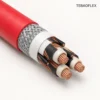
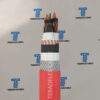
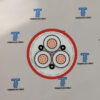
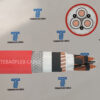
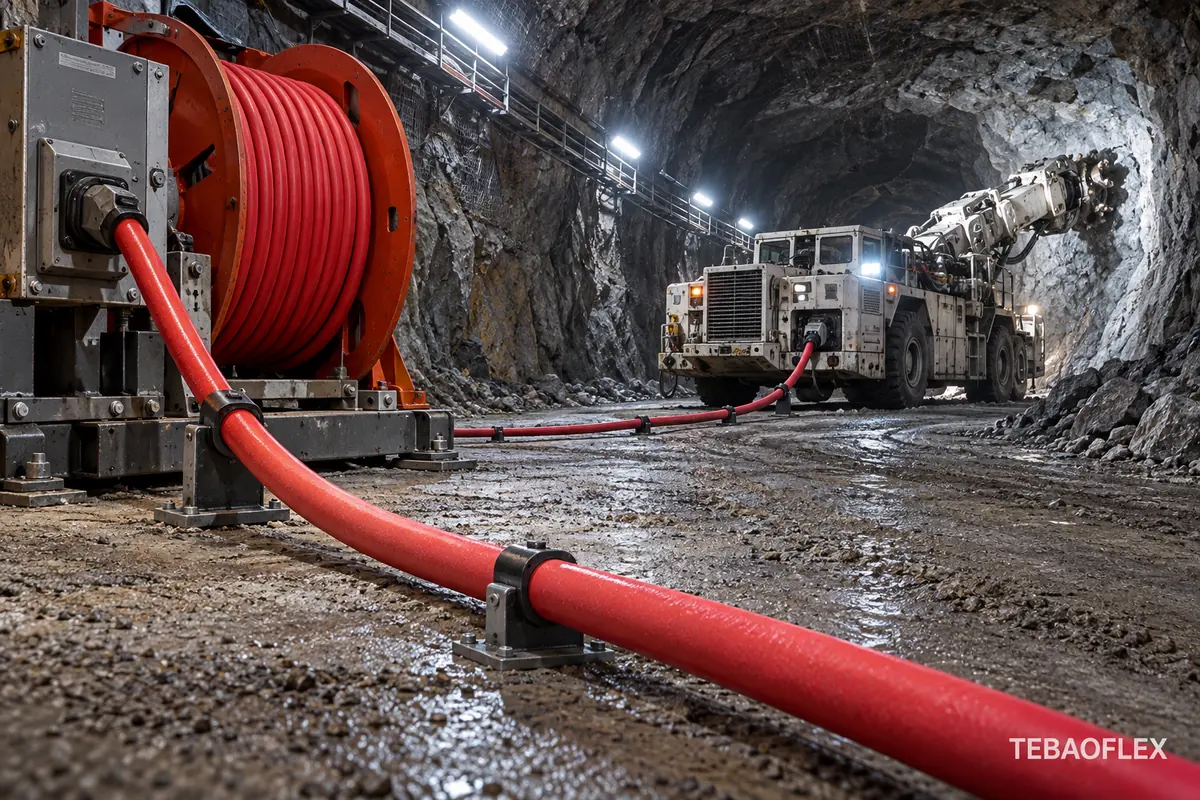
(N)3GHSSHCH 3.6/6 kV mining cable is a flexible screened power cable for mobile equipment in mines and underground excavations, as well as selected stationary installations. It combines flexible copper conductors, 3GI3 EPR insulation, concentric protective conductors, an integrated monitoring conductor, HFFR inner and outer sheaths, and a galvanized steel-wire braid.
Because underground power routes can involve mechanical stress, moisture, movement and limited installation space, the complete cable construction must be matched to the equipment and routing conditions. Therefore, TEBAOFLEX reviews conductor size, mobile or fixed duty, bending conditions, sheath colour, documentation and order quantity before confirming supply.
Applications of (N)3GHSSHCH Mining Cable
The supplied technical reference describes the cable for connecting mobile operating equipment in mines and tunneling projects with hazardous environmental conditions. For example, the cable can be evaluated for tunnel-boring support equipment, mobile mining machinery and other medium-voltage equipment that requires a flexible, mechanically protected power connection.
In addition, the cable can be considered for selected stationary duties, including connections to high-voltage transformers in mining and tunneling installations. However, the cable designation does not by itself confirm suitability for every hazardous-area classification, machine or national approval scheme; the complete project requirements must be reviewed.
For related designs, review the mining and tunneling cable range and the broader rubber and flexible cable category.
Cable Construction
- Conductors: flexible electrolytic copper wires, referenced as DIN VDE 0295 Class 5.
- Main-core insulation: 3GI3 type EPR compound.
- Pilot control cores: 3GI3 type EPR compound; black insulation with number coding.
- Protective conductor: plain copper wires or copper-wire braid laid concentrically around each main core.
- Electrical field control: extruded inner and outer semiconductive rubber layers.
- Core assembly: three main conductors with three pilot control cores placed in the outer interstices.
- Inner sheath: special halogen-free, flame-retardant HFFR compound.
- Monitoring conductor: semiconductive tape with overall concentric copper wires and synthetic tape.
- Armour: galvanized steel-wire braid with a minimum stated coverage of 75%.
- Outer sheath: special halogen-free, flame-retardant HFFR compound in red or black.
As a result, the cable combines electrical screening, protective conductors, monitoring elements and braided mechanical protection in one flexible assembly. Nevertheless, the ordered construction should be confirmed against the final TEBAOFLEX datasheet because dimensions and component details can vary with size and manufacturing tolerance.
Operating Characteristics for the 3.6/6 kV Configuration
- Rated voltage: First, confirm that this SKU is the 3.6/6 kV configuration.
- AC test voltage: In addition, the supplied reference specifies 11 kV.
- Maximum operating voltage, AC: Moreover, the stated limit is 4.2/7.2 kV.
- Maximum operating voltage, DC: Similarly, the stated limit is 5.4/10.8 kV.
- Working temperature, fixed: For example, the stated fixed-installation range is -40°C to +90°C.
- Working temperature, mobile: However, mobile operation has a narrower stated range of +5°C to +90°C.
- Minimum bending radius: Therefore, determine the required radius according to DIN VDE 0298-3 and the actual cable diameter.
- Current-carrying capacity: Finally, calculate current capacity according to DIN VDE 0298-4 and the actual installation conditions.
Moreover, the supplied reference lists a maximum tensile load of 15 N/mm², maximum torsion of 25°/m, travel speed up to 30 m/min and a minimum direction-change distance of 20 × D. These values are selection inputs rather than universal installation guarantees; therefore, confirm them together with the cable size, machine motion and routing system.
3.6/6 kV Dimensions and Electrical Data
The following values are transcribed from the supplied technical reference for the 3.6/6 kV product scope. However, overall diameter and weight may vary because of manufacturing tolerances.
| Cable construction | Overall diameter, min-max | Resistance and approximate weight |
|---|---|---|
| 3 × 25 + 3 × 16/3E + 3 × 2.5 ST + ÜL | 47.0-51.0 mm | 0.780 Ω/km at 20°C; 3,600 kg/km |
| 3 × 35 + 3 × 16/3E + 3 × 2.5 ST + ÜL | 49.0-54.0 mm | 0.554 Ω/km at 20°C; 4,170 kg/km |
| 3 × 50 + 3 × 25/3E + 3 × 2.5 ST + ÜL | 52.0-57.8 mm | 0.386 Ω/km at 20°C; 4,850 kg/km |
| 3 × 70 + 3 × 35/3E + 3 × 2.5 ST + ÜL | 56.1-61.2 mm | 0.272 Ω/km at 20°C; 5,900 kg/km |
| 3 × 95 + 3 × 50/3E + 3 × 2.5 ST + ÜL | 60.3-66.2 mm | 0.206 Ω/km at 20°C; 5,900 kg/km |
| 3 × 120 + 3 × 70/3E + 3 × 2.5 ST + ÜL | 63.8-70.2 mm | 0.161 Ω/km at 20°C; 8,620 kg/km |
| 3 × 150 + 3 × 70/3E + 3 × 2.5 ST + ÜL | 66.0-72.0 mm | 0.129 Ω/km at 20°C; 9,860 kg/km |
| 3 × 185 + 3 × 95/3E + 3 × 2.5 ST + ÜL | 70.0-74.0 mm | 0.106 Ω/km at 20°C; 11,300 kg/km |
The ST and ÜL designation elements are retained from the supplied construction table. Consequently, buyers should include the complete construction notation in the enquiry so that pilot and monitoring conductor details can be confirmed without ambiguity.
Environmental Performance
The reference identifies resistance to ozone, weather, cold, moisture, tearing and ultraviolet exposure. In addition, it specifies a halogen-free and flame-retardant sheath system. These characteristics support demanding mining and tunneling environments, but application suitability still depends on exposure duration, mechanical duty and the final cable construction.
Standards and Project Verification
The supplied technical document references DIN VDE 0250-605 and IEC 60502-2 for construction, DIN VDE 0298-3 for use, DIN VDE 0298-4 for current-carrying capacity, and IEC 60332-1 / DIN EN 60332-1-2 for flame testing. Because the scope of a standard can differ from a customized HFFR mining-cable construction, these references should not be interpreted as product certification for every size.
Therefore, if VDE approval, REACH documentation, flame-test evidence or another market-specific certificate is mandatory, state the required document and destination market before ordering. Buyers can also review TEBAOFLEX cable certification and testing support, the official DIN VDE 0250-605 scope and the official IEC 60502-2 publication.
How to Request a Quote
First, provide the complete cable construction, main-core size, required length and sheath colour. Next, state whether the cable will operate in fixed or mobile service, together with the working temperature, bending route, torsion, travel speed and connection equipment. Finally, identify the required test reports, approvals, drum length, delivery destination and project schedule.
Send your (N)3GHSSHCH cable requirements to the TEBAOFLEX technical team for a configuration review and quotation.
Technical data reviewed against the supplied reference document in September 2026. Final values and compliance documents are subject to the confirmed order specification.