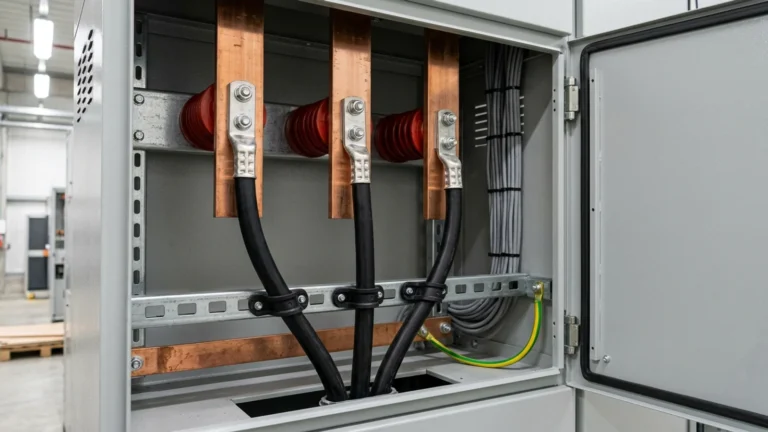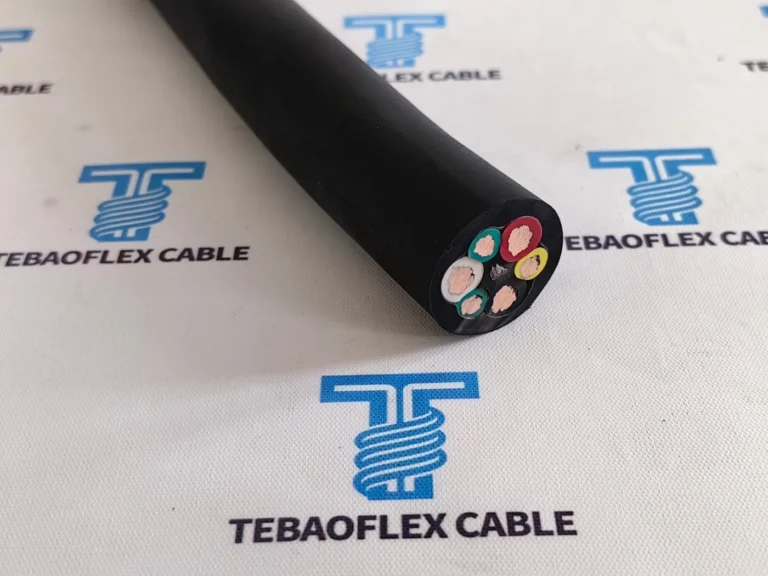

Engineering summary: In the oil and gas industry, upstream covers subsurface wellbores and offshore production platforms, midstream spans transmission pipelines, compressor stations, and LNG terminals, and downstream encompasses refineries and petrochemical cracking complexes. Each sector imposes distinct hydrostatic pressure, drilling-mud, sour-gas, and hydrocarbon-fire hazards that dictate completely different cable architectures.
Procurement engineers comparing upstream vs. downstream oil and gas equipment quickly discover that a standard industrial armoured PVC/XLPE cable cannot survive across the entire hydrocarbon value chain. Drilling mud containing calcium bromide and aromatic base oils swells ordinary rubber jackets on offshore rigs; downhole H2S gas permeates polymer sheaths at 1,000+ bar wellbore pressure; and spilled benzene or xylene in a downstream refinery dissolves buried thermoplastic bedding. Specifying compliant cables starts with mapping each sector’s exact chemical, mechanical, and fire-survival envelope.
Upstream vs. Midstream vs. Downstream: How Sector Hazards Dictate Cable Construction
Upstream cables operate at the wellhead, downhole reservoir, and offshore rig, prioritizing high-pressure H2S hermetic sealing and NEK 606 drilling-mud resistance. Midstream cables protect long-distance pipelines, compressor skids, and cryogenic LNG tanks against mechanical impact, EMI, and freezing, while downstream cables resist aromatic solvents, 250–450 °C cracking heat, and high-voltage flare ignition.
| Value-Chain Sector | Core Facilities & Assets | Dominant Environmental Hazards | Mandatory Metallic & Sheath Barriers | Governing Standards & Models |
|---|---|---|---|---|
| Upstream (Subsurface & Subsea) | Production tubing, PDG gauges, logging winches, subsea trees, work-class ROVs | 150–260 °C bottom-hole heat, up to 25,000 psi hydrostatic pressure, sour H2S/CO2 brine, tensile winch load | Seamless welded Inconel 825 / SS 316L capillary tube + PVDF/FEPM bumper; or contra-helical galvanized steel wireline armor | API 17E / NACE MR0175; Inconel 825 TEC, 7.31 mm Wireline, ROV Umbilical |
| Upstream (Offshore Topsides & FPSOs) | Jack-up rigs, drillships, fixed platforms, FPSO process modules, mud-pump rooms | Oil-based drilling mud (IRM 902/903), CaBr2 completion brine, salt fog, confined-space smoke/fire | Tinned Class 2/5 copper + EPR (3GI3) + optional mica fire tape + TCWB/GSWB braid + cross-linked halogen-free SHF2 MUD sheath | NEK TS 606, IEC 60092, BS 6883, IEEE 1580; RFOU, BFOU, Type P |
| Midstream (Pipelines, Compressors & LNG) | Cross-country pipelines, gas compressor stations, tank farms, LNG jetties | Long instrumentation runs, VFD compressor EMI, direct-burial crushing, sub-zero ambient (−40 °C to −50 °C), pipe waxing | Individual & collective Al-Mylar screens (IS+OS), galvanized steel wire armour (SWA), UV/cold-resistant PE/LSZH, self-regulating matrix | EN 50288-7, BS 5308, IEC 60079-14 (Ex i); SWA Screened Inst., MCA Heat Trace |
| Downstream (Refineries & Petrochemical) | Crude distillation units, catalytic crackers, aromatics plants, elevated flare stacks | Benzene/toluene/xylene ground spills, 200–450 °C furnace radiant heat, 10–25 kV high-altitude pilot ignition | Aliphatic/aromatic chemical barriers (polyamide/fluoropolymer/lead), PTFE moisture barrier + mica/fiberglass, 25 kV silicone/PTFE dielectric | UL, IEC 60331/60332; 25 kV Flare Igniter, 450 °C Mica-PTFE |
Upstream Cable Selection: Downhole Wellbore (TEC & Wireline) vs. Offshore Topsides (RFOU, BFOU & Type P)
Upstream operations split cleanly at the wellhead Christmas tree: below the hanger, polymeric jackets alone cannot block high-pressure gas permeation, requiring metal-tube encapsulated TEC or armored logging wirelines; above the deck on rigs and FPSOs, cables must combine halogen-free fire safety with certified NEK 606 drilling-mud immersion resistance.
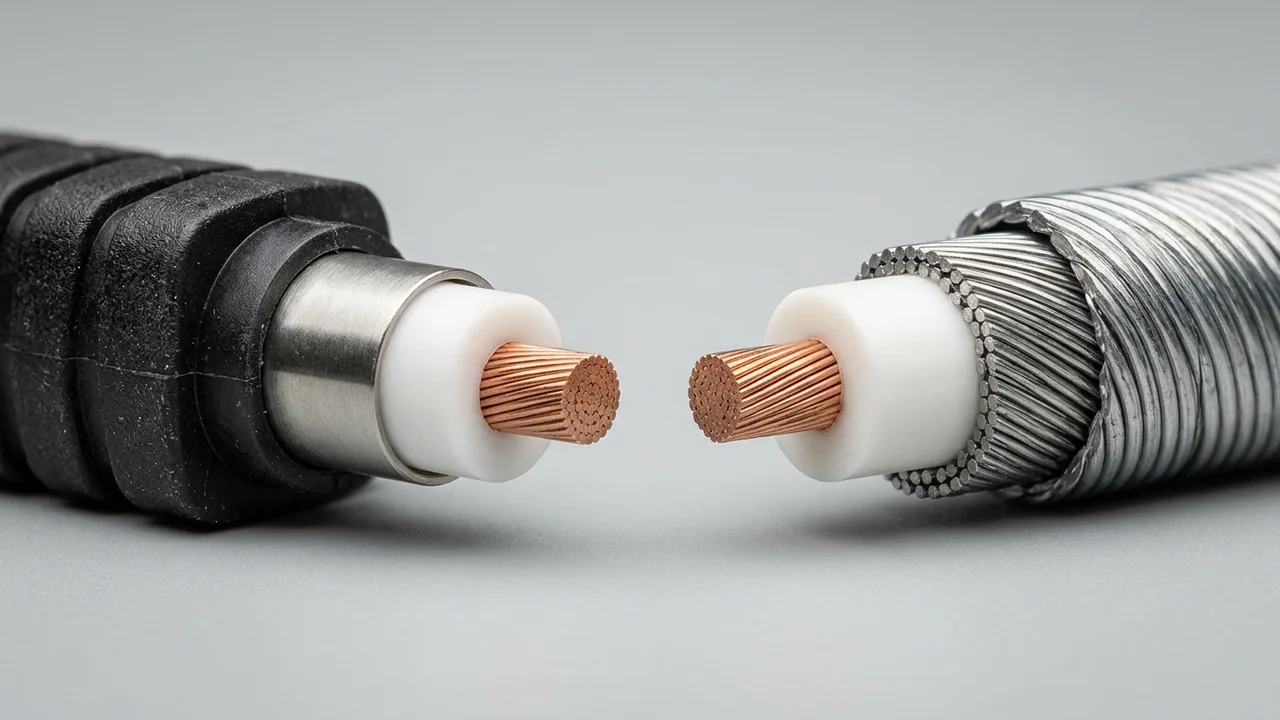
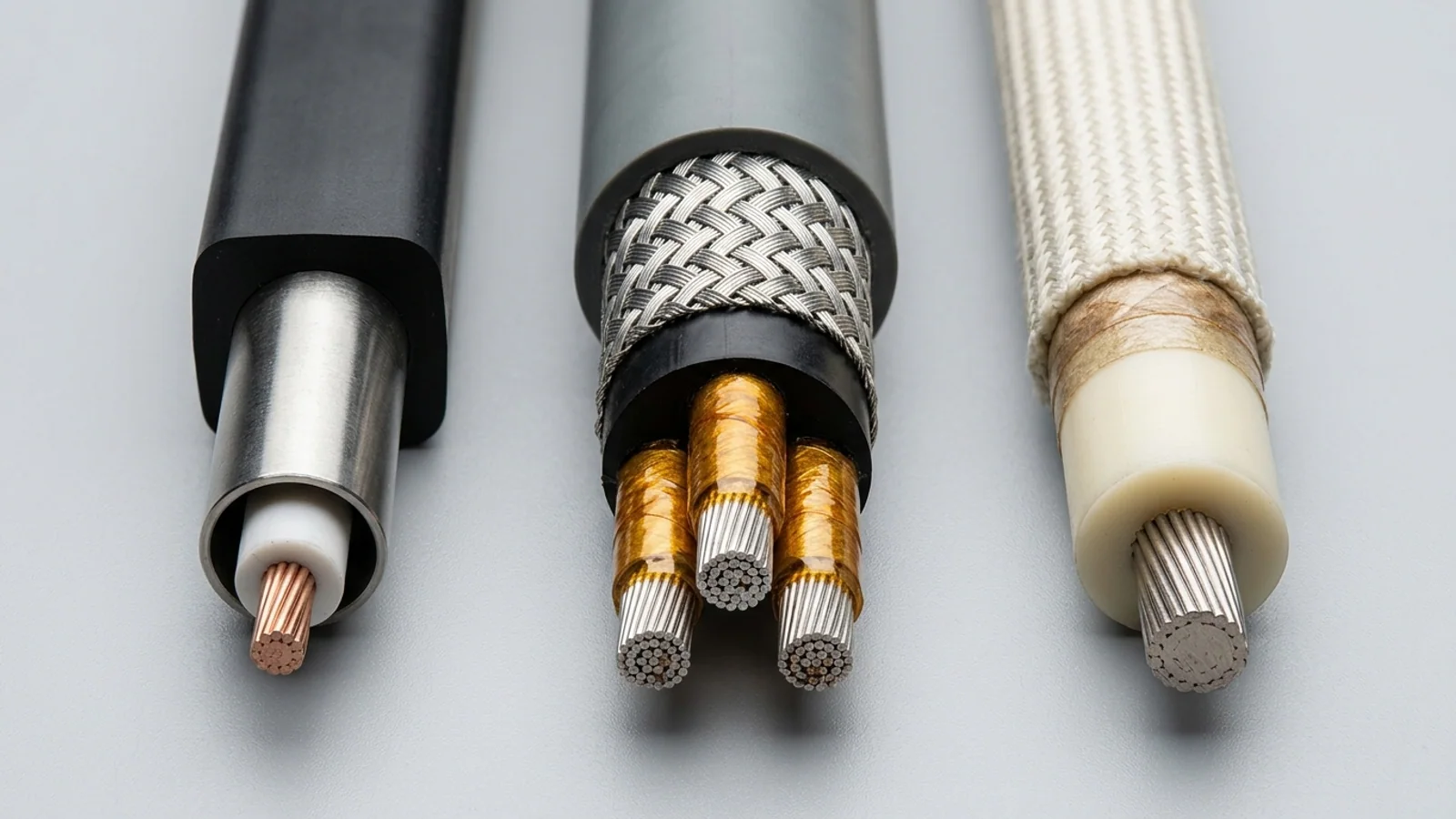
Subsurface Wellbore Anatomy: Permanent TEC vs. Dynamic Wireline
- Inconel 825 Encapsulated TEC (Left): Continuous 1/4-inch seamless nickel-chromium-molybdenum alloy tubing blocks H2S/CH4 gas ingress around permanent downhole gauge (PDG) conductors, shielded against casing crush by a square PVDF/elastomer bumper.
- Contra-Helical Armored Wireline (Right): Dual counter-wound layers of high-tensile galvanized or alloy steel armor wires balance rotational torque while supporting its own multi-kilometer weight during live well logging.
Never use galvanized carbon-steel armor in sour H2S completions without corrosion-inhibited or super-alloy metallurgy.
- Permanent Downhole & Intervention Lines: Clamp-to-tubing permanent reservoir pressure/temperature gauges use 16 AWG Inconel 825 encapsulated TEC downhole cables or multi-conductor TEC power/instrumentation cables (detailed in our TEC cable selection guide). Dynamic perforating and cased-hole logging trucks run torque-balanced 7.31 mm and 8.89 mm armored downhole wireline cables (see our mono-conductor wireline sizing guide).
- Offshore Platform & FPSO Topsides (RFOU vs. BFOU): Under Norwegian standard NEK TS 606 and IEC 60092-353/376, both RFOU (flame-retardant) and BFOU (fire-resistant) utilize tinned copper conductors, tinned copper wire braid (TCWB), and SHF2 MUD thermoset outer sheaths. Specify BFOU (incorporating phlogopite mica glass fire tape per IEC 60331-21) for emergency shutdown (ESD), firewater pumps, and deluge circuits that must continue operating through a hydrocarbon fire; specify RFOU for normal process power and lighting. Compare full specs in our BFOU vs RFOU offshore comparison.
- Drilling Drives & UKCS Offshore Modules: North American jack-up top-drives and mud pumps commonly specify extra-flexible IEEE 1580 / UL 1309 Type P and Type LSX 1–2 kV marine power cables, whereas UK North Sea FPSOs often mandate BS 6883 SW4/GSWB offshore cables across 0.6/1 kV to 6.6 kV voltage classes.
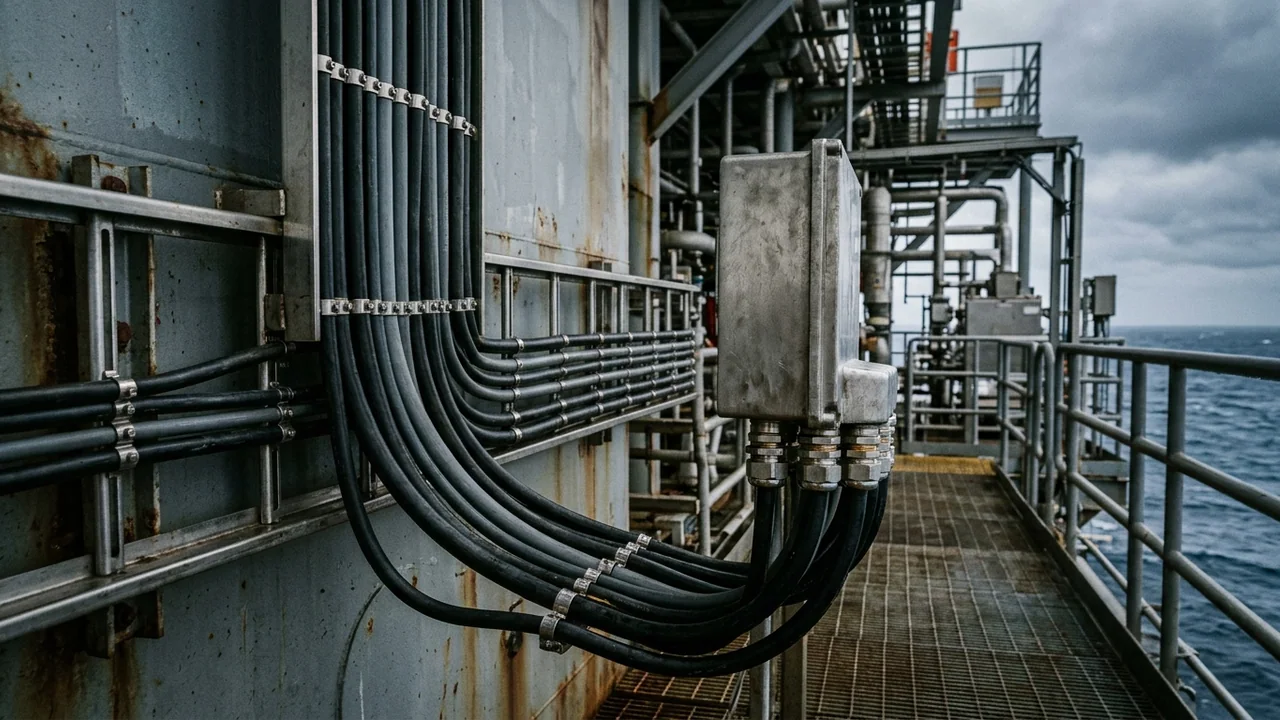
Midstream Cable Requirements: Pipeline Custody Metering, Compressor Stations & LNG Terminals
Midstream infrastructure moves crude oil, natural gas, and natural gas liquids (NGLs) across hundreds of kilometers between wellhead gathering hubs and coastal refineries or LNG liquefaction plants, demanding mechanically armoured low-capacitance instrumentation loops, intrinsically safe (Ex i) circuit segregation, and freeze-protection heat tracing.
- Screened & SWA Armoured Process Instrumentation: Emergency block valves (EBVs), ultrasonic custody-transfer flowmeters, and turbine compressor vibration probes rely on individual-and-overall screened (IS+OS) SWA armoured instrumentation cables (built to EN 50288-7 / BS 5308) and shielded 3- and 4-wire RTD temperature sensor cables. Where fixed Class 1 solid conductors are required for gas-tight hazardous-area terminal clamping, review our solid-pair instrumentation cable guide.
- Intrinsically Safe (Ex i) Blue Sheath Identification: Circuits passing through Zener barriers or galvanic isolators into Zone 0 / Zone 1 gas metering skids use light-blue outer sheaths (RAL 5015) and strict inductance-to-resistance (L/R) limits per IEC 60079-14 so stored cable energy cannot ignite a methane leak.
- Pipeline Viscosity & Freeze Maintenance: Heavy waxy crude lines, impulse tubing, and condensate drain manifolds use self-regulating parallel heat-trace cables that automatically throttle watt-per-meter output according to local pipe wall temperature without overheating at insulation overlaps.
Downstream Refinery & Petrochemical Cables: Hydrocarbon Barriers, Cracking Heat & 25 kV Flare Ignition
Downstream refineries, steam crackers, and aromatics plants expose cables to liquid aromatic hydrocarbons (benzene, toluene, xylene), corrosive acid/caustic catalysts, 200–450 °C furnace zones, and continuous high-voltage spark ignition atop flare stacks—conditions that rapidly degrade standard offshore or utility cables.
Why offshore MUD resistance does not equal underground refinery solvent protection: NEK 606 SHF2 MUD sheaths withstand splash and periodic immersion in drilling fluids on open steel decks, whereas cables buried in contaminated refinery soil sit permanently in pooled aromatic solvents (BTX) that diffuse through elastomers unless blocked by an extruded polyamide (nylon) + aluminium-copolymer chemical barrier or continuous lead sheath.
- High-Voltage Flare Stack Pilot Ignition (10 kV AC / 25 kV DC): Elevated and ground flare pilots require continuous spark discharge in wind, acid rain, sulfur flue gas, and intense radiant tip heat. TEBAOFLEX manufactures 25 kV DC / 10 kV AC composite silicone-mica-fluoropolymer flare igniter cables as well as fluoropolymer-jacketed and fiberglass-braided 25 kV igniter leads. Compare jacket selection in our flare stack igniter jacket comparison.
- Coker, Reformer & Cracking Furnace Hot Zones: Thermocouple, burner-management, and soot-blower circuits mounted directly on reformer casings use 450 °C mica-fiberglass multicore cables with PTFE moisture barriers to prevent insulation carbonization and moisture absorption during steam-out turnarounds. Browse the full Oil, Gas & Marine Cables catalog for sector-matched specifications.
Frequently Asked Questions
What is the main difference between upstream and downstream oil and gas cables?
Upstream cables serve exploration, subsurface wellbores, and offshore rigs—requiring hermetic metal-tube encapsulation (Inconel 825 TEC) or contra-helical steel wireline armor downhole, and halogen-free NEK 606 SHF2 mud-resistant sheaths (RFOU/BFOU) topside. Downstream cables serve onshore refineries and chemical plants, prioritizing aromatic hydrocarbon (BTX) chemical barriers, SWA mechanical armour, and 200–450 °C furnace and 25 kV flare-ignition thermal endurance.
When must I specify BFOU instead of RFOU on an offshore platform or FPSO?
Both RFOU and BFOU meet NEK TS 606 SHF2 mud-resistance and IEC 60332-3-22 Category A flame-retardance, but only BFOU incorporates phlogopite mica glass fire-barrier tape over the conductors to pass IEC 60331-21 circuit integrity (continuing to carry rated power at 750–950 °C during an active fire). Specify BFOU for emergency shutdown, fire-pump, PA/GA, and escape lighting circuits.
Why are tinned copper conductors standard in offshore and sour-gas environments?
Trace hydrogen sulfide (H2S) gas and marine chloride moisture rapidly attack bare copper strands, forming brittle black copper sulfide scale that elevates contact resistance and prevents clean lug crimping. Electroplated tin (or nickel plating above 200 °C) passivates each strand against sulfidation and salt corrosion.
Can TEBAOFLEX supply project-lot quantities for refinery turnarounds and offshore skids?
Yes. TEBAOFLEX supports both full EPC project cable schedules and fast-turnaround maintenance lots across Inconel 825 TEC, armored wireline, NEK 606 RFOU/BFOU, BS 6883, Type P, SWA instrumentation, and 25 kV flare igniter cables, complete with factory mill test reports and export drum packing.
Request Upstream, Midstream or Refinery Cable Engineering Review
From 1/4-inch Inconel 825 downhole gauge cables and NEK 606 SHF2 MUD topside feeders to SWA screened process instrumentation and 25 kV flare stack igniter leads, TEBAOFLEX manufactures oil and gas cables engineered for documented chemical, thermal, and mechanical hazards.
- Specify your sector application (wellbore, offshore topsides, pipeline/LNG skid, or refinery/flare unit) and target standard.
- Include conductor count, cross-section, armour/braid type (TCWB, GSWB, SWA, or Inconel tube), and hazardous-area Ex gland constraints.
- Request technical datasheets, sample inspection cuts, and drum delivery lead times for tender or turnaround schedules.
Standards & technical references: NEK TS 606 (Cables for offshore installations — halogen-free and mud-resistant); IEC 60092-350/353/376 (Electrical installations in ships and offshore units); BS 6883 & IEEE 1580 / UL 1309 (Offshore and marine rig cables); IEC 60331-21 & IEC 60332-3-22 (Fire integrity and bunched flame propagation); EN 50288-7 & IEC 60079-14 (Process instrumentation and explosive atmospheres).