
BFOU vs RFOU: What’s the Difference?
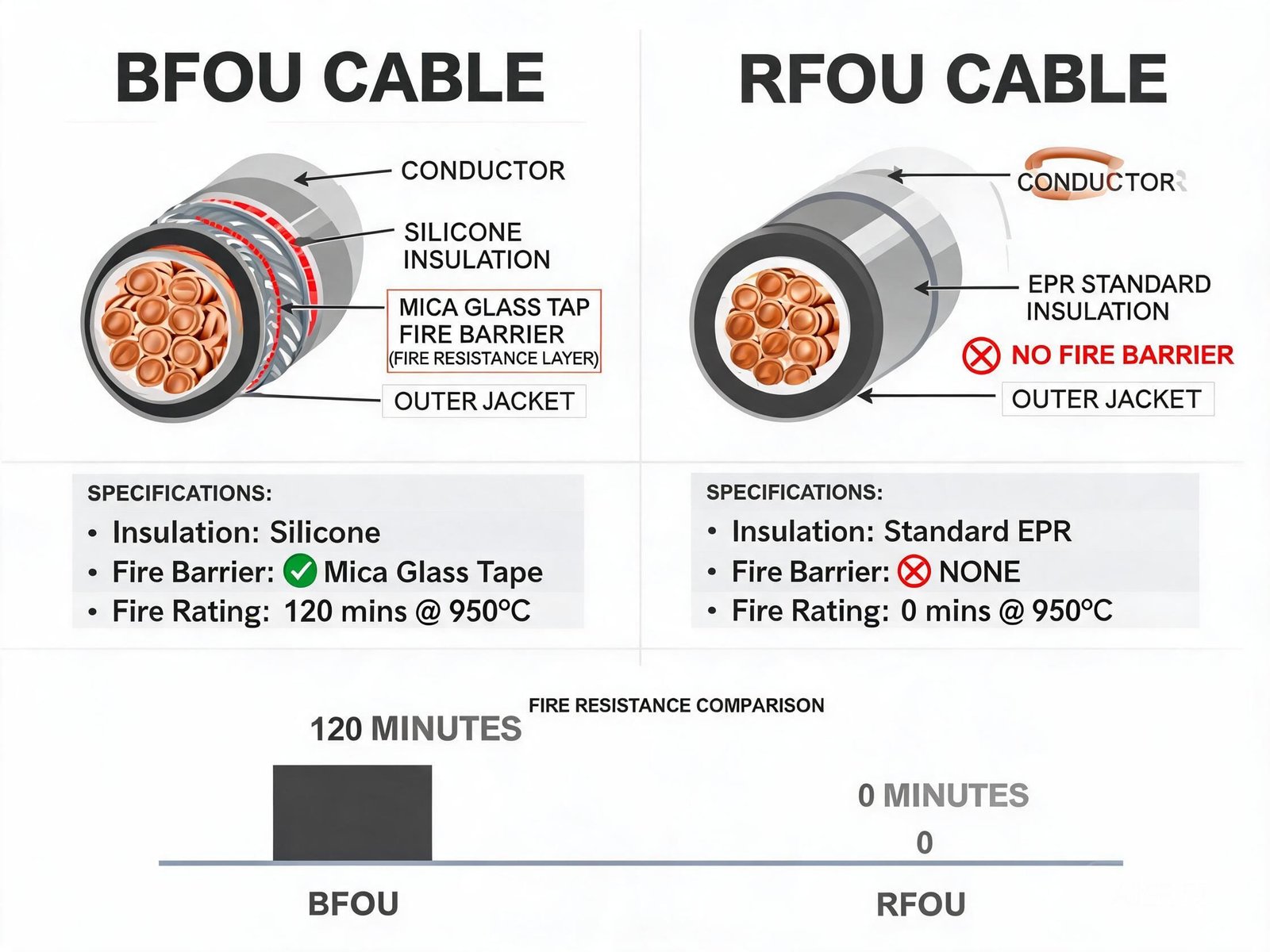
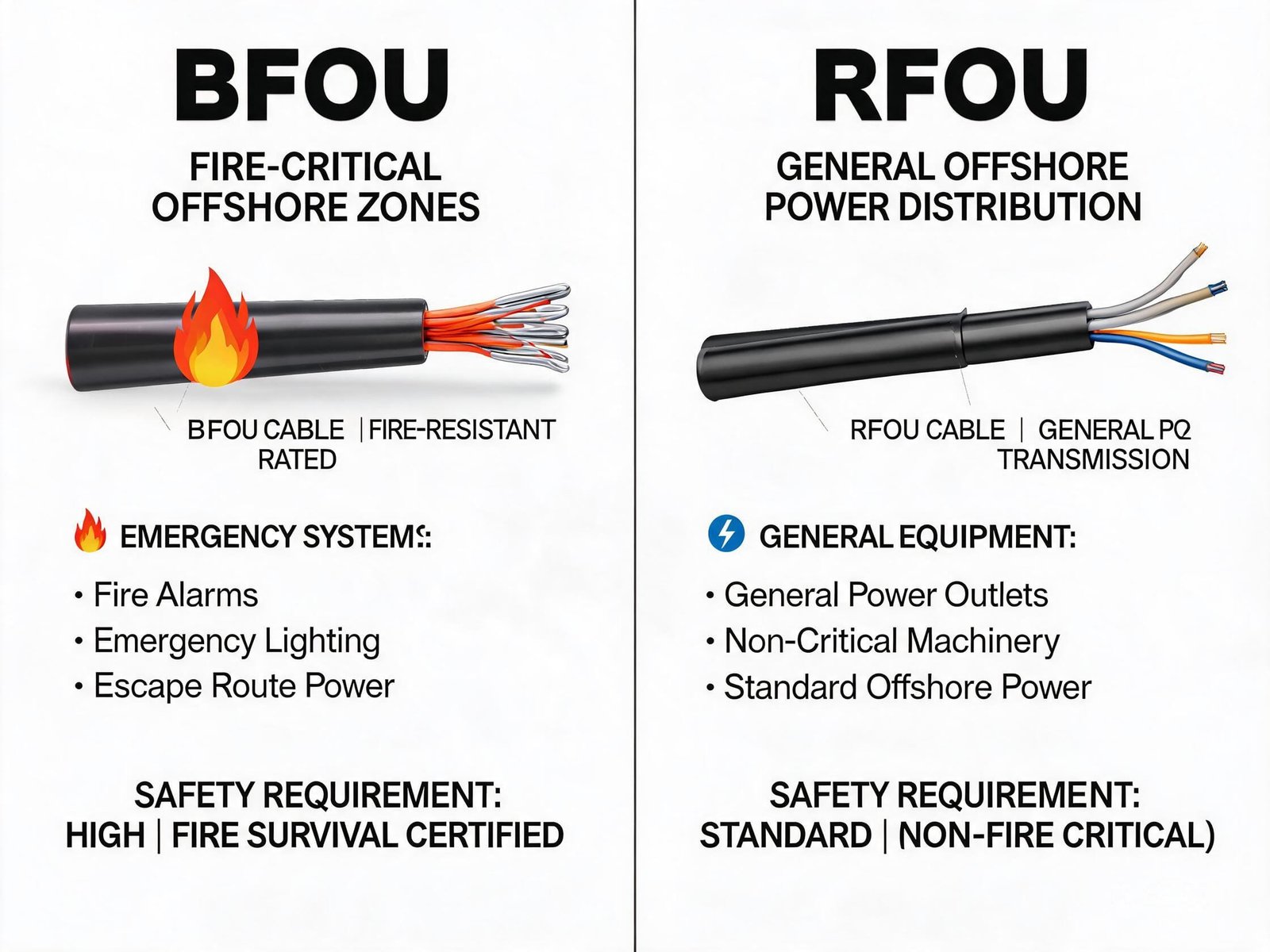
Both BFOU and RFOU are offshore and marine power cables rated 0.6/1kV, but they serve fundamentally different purposes. The key difference: BFOU is fire-resistant (maintains circuit integrity during fire per IEC 60331), while RFOU is flame-retardant only (self-extinguishing but does not maintain circuit integrity). This makes BFOU essential for critical safety circuits and RFOU suitable for general offshore power distribution.
TEBAOFLEX manufactures both types. View BFOU product page and RFOU product page for specifications.
Designation Breakdown
| Element | BFOU | RFOU |
|---|---|---|
| B vs R | B = Fire resistant (IEC 60331) | R = Rubber insulated (standard) |
| F | Flexible conductor | Flexible conductor |
| O | Oil-resistant sheath | Oil-resistant sheath |
| U | LSZH outer sheath | LSZH or rubber outer sheath |
| Standard | NEK 606 / IEC 60331 | NEK 606 / IEC 60502 |
| Fire Barrier | Mica glass tape (yes) | No fire barrier |
Performance Comparison
| Property | BFOU | RFOU | Advantage |
|---|---|---|---|
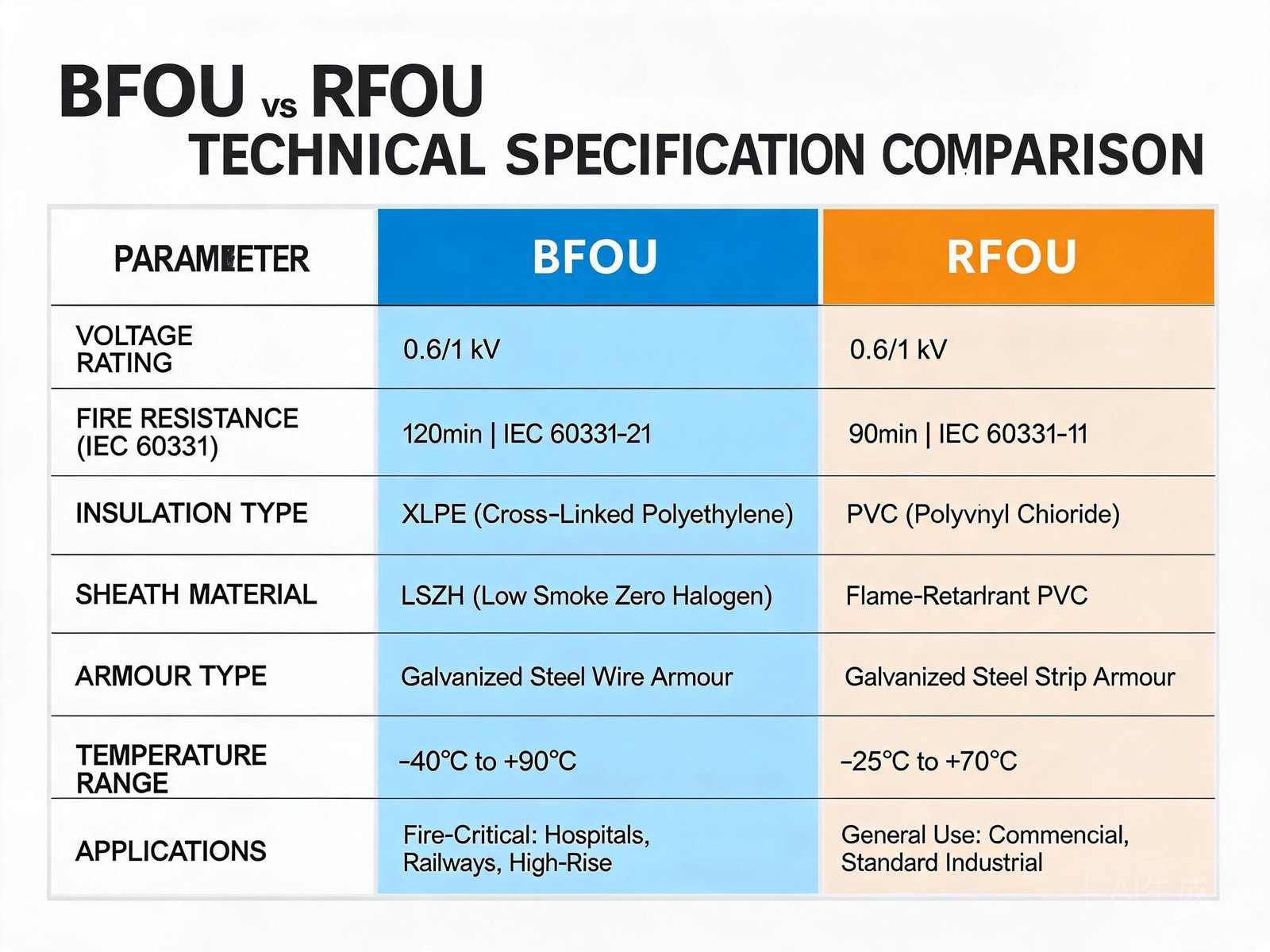
| Fire resistance (IEC 60331) | Yes (750-950°C, 90+ min) | No | BFOU |
| Flame retardancy | IEC 60332-3-22 Cat A | IEC 60332-3-22 Cat A | Tie |
| Smoke density | IEC 61034 (>60% transmittance) | IEC 61034 (>60%) | Tie |
| Halogen content | Zero halogen (LSZH) | Zero halogen (LSZH) | Tie |
| Voltage rating | 0.6/1kV | 0.6/1kV | Tie |
| Conductor temp | 90°C | 90°C | Tie |
| Oil resistance | Good (IR2) | Good (IR2) | Tie |
| Mechanical protection | Steel wire braid armour | Steel wire braid armour | Tie |
| Cost | Higher (~20-30% premium) | Lower | RFOU |
When to Choose BFOU
- Fire pump power supply: Must maintain power during fire — only BFOU (IEC 60331) guarantees this
- Emergency lighting: Escape route lighting must remain lit during fire event
- Emergency shutdown (ESD): Process shutdown systems require fire-survivable power
- Emergency generator output: Generator power must reach emergency switchboard during fire
- Alarm and communication: PA systems and fire alarms need continuous power
- Mandatory by code: SOLAS and classification rules require IEC 60331 cable for critical safety circuits
When to Choose RFOU
- General power distribution: Non-fire-critical circuits don’t require fire resistance
- Process equipment power: Production equipment that will be shut down during emergency
- Lighting (non-emergency): Normal lighting circuits
- HVAC (non-emergency): Standard ventilation and air conditioning
- Control circuits (non-safety): Process control and instrumentation
- Cost optimization: RFOU is 20-30% less expensive and sufficient for non-critical circuits
Cost Comparison
BFOU typically costs 20-30% more than RFOU due to:
- Mica glass tape fire barrier material and wrapping process
- More stringent testing (IEC 60331 fire test is expensive and time-consuming)
- Additional quality control for fire-critical applications
The premium is justified for fire-critical circuits. Using RFOU where BFOU is required would compromise fire safety and violate classification rules. Conversely, using BFOU where RFOU suffices adds unnecessary cost.
Can BFOU and RFOU Be Interchanged?
BFOU can replace RFOU — it has all the properties of RFOU plus fire resistance. However, this adds unnecessary cost for non-critical circuits.
RFOU cannot replace BFOU — RFOU lacks the fire barrier and IEC 60331 rating. Substituting RFOU for BFOU in fire-critical circuits violates classification rules and compromises safety.
Summary: Which Cable Should You Choose?
| If your application is… | Recommended cable |
|---|---|
| Fire pump, emergency systems, ESD | BFOU (mandatory) |
| Escape route emergency lighting | BFOU (mandatory) |
| Emergency generator output | BFOU (mandatory) |
| General offshore power distribution | RFOU |
| Process equipment power | RFOU |
| Non-emergency lighting | RFOU |
| Cost-sensitive non-critical circuits | RFOU |
Contact TEBAOFLEX engineering for expert offshore cable selection and competitive pricing on both BFOU and RFOU cables.