
TEBAOFLEX ROV Subsea Umbilical Cable (Model ROV-UMB-3300V-22MM) is a torque-balanced electro-opto-mechanical main lift umbilical engineered for work-class remotely operated vehicles (ROVs), Tether Management Systems (TMS), offshore wireline well logging, and deepwater oceanographic winches. Combining three #11 AWG (4.3 mm²) 3,300 V HDPE-insulated power conductors with nine single-mode (8.8/125/245 µm) optical channels inside a void-filled, triple-layer galvanized steel wire armor (106 wires total), it delivers 305 kN (68,500 lbf) breaking strength and 67 kN (15,000 lbf) working load within a compact 22.23 mm (0.875 in) armor profile.
1. Deepwater Application Scope & Subsea Cable Architecture Comparison
Deepwater intervention vessels require a single load-bearing umbilical that transmits medium-voltage three-phase thruster power and multi-gigabit HD video/sonar telemetry across high-tension heave-compensated traction winches:
- Work-Class ROV & TMS Main Lift Umbilicals: Primary surface-to-cage deployment cable supporting electro-hydraulic ROV thrusters, tooling skids, HD cameras, and multibeam sonars.
- Offshore Oil & Gas Wireline & Subsea Inspection: High-tension electro-optical umbilical for downhole well logging, BOP intervention, pipeline inspection, and subsea tree commissioning.
- Oceanographic Towed Bodies, Trenchers & Offshore Wind: Deep-tow side-scan/sub-bottom survey sleds, seabed cable-lay monitoring, and offshore wind turbine foundation inspection.
Compare our complementary subsea and marine tether constructions below, or browse the submersible and underwater cable range:
| TEBAOFLEX Subsea / Marine Cable | Strength Member | Buoyancy / SG | Primary Subsea Role |
|---|---|---|---|
| ROV Subsea Umbilical (This Page) | 3-Layer Galvanized Steel Armor (305 kN) | Negative (SG 4.81) | Heavy main lift winch umbilical: 3.3 kV power + 9 SM fibers |
| Buoyant ROV Tether Cable | Aramid Fiber Braid | Neutral / Floating | Free-swimming ROV excursion tether from TMS cage or surface |
| Composite Hybrid Umbilical Cable | Aramid / Braided Reinforcement | Elastomer / PUR Jacketed | Deck-to-subsea hybrid power, twisted-pair & control umbilical |
| Hybrid Coaxial Armoured Cable | Contra-Helical Steel Wire Armor | Negative (Armored) | CTD rosette, geophysical & well-logging coax + power tow cable |
| Coax Armoured Tow Cable (40/45/50 Ω) | Double Galvanized Steel Armor | Negative (Armored) | Side-scan sonar & deepwater oceanographic coaxial towline |
2. Concentric Step-by-Step Cable Construction (Model ROV-UMB-3300V-22MM)
Every internal element is dimensionally matched and void-filled to eliminate hydrostatic crushing, water hosing, and torsional spin under cyclic deepwater tension:
| Layer / Component | Engineering Specification | Diameter (in) | Diameter (mm) |
|---|---|---|---|
| Element A: Three-Phase Medium-Voltage Power Cores (× 3) | |||
| Power Conductor | #11 AWG (4.3 mm²) high-conductivity stranded copper | 0.102 | 2.59 |
| Core Insulation | High-Density Polyethylene (HDPE), 3,300 V dielectric rating | 0.202 | 5.13 |
| Element B: Steel-Armored Single-Mode Optical Units (× 3 = 3 Fibers) | |||
| Optical Fiber | 8.8 / 125 / 245 µm Single-Mode (SM) fiber (1 per unit) | 0.010 | 0.25 |
| Tight Buffer | Thermoplastic elastomer protective buffer | 0.024 | 0.61 |
| Micro-Armor | 8 × 0.015 in (0.38 mm) high-tensile plow steel wire armor | 0.054 | 1.37 |
| Unit Belt | Extruded HDPE protective belt layer | 0.095 | 2.41 |
| Element C: Gel-Filled Stainless-Steel Optical Tubes (× 3 = 6 Fibers) | |||
| Optical Fibers | 8.8 / 125 / 245 µm Single-Mode fibers (2 fibers per tube) | 0.010 | 0.25 |
| Hermetic Tube | Thixotropic gel-filled stainless-steel tube (hydrostatic barrier) | 0.046 | 1.17 |
| Core Cabling & Extruded Inner Belt | |||
| Center Core Rod | Precision thermoplastic center fill rod | 0.035 | 0.89 |
| Cabled Layer #1 | 3 × Element A + 3 × Element B + 3 × Element C, water-blocked void filler, adhesive/poly tape bound | 0.442 | 11.23 |
| Inner HDPE Belt | Pressure-extruded High-Density Polyethylene (HDPE) bedding belt | 0.536 | 13.61 |
| Contra-Helical Galvanized Steel Wire Armor (106 Wires Total) & Outer Finish | |||
| Armor Layer #1 | 35 × 0.0475 in (1.21 mm) galvanized extra-improved plow steel (GEIPS), void-filled & taped | 0.635 | 16.12 |
| Armor Layer #2 | 35 × 0.056 in (1.42 mm) galvanized steel wire | 0.747 | 18.97 |
| Armor Layer #3 | 36 × 0.064 in (1.63 mm) galvanized steel wire (standard bare-armor traction OD) | 0.875 | 22.23 |
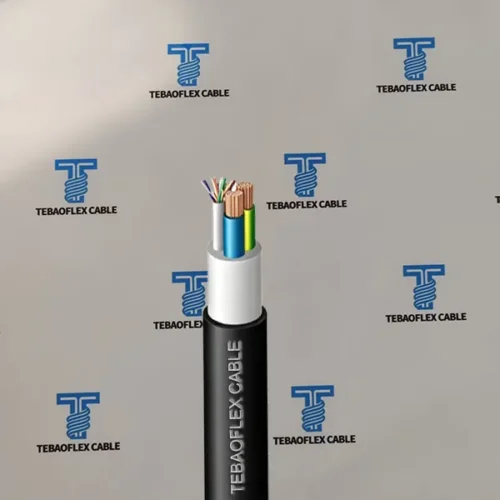
| Optional Outer Jacket | Optional extruded black HDPE or marine PUR outer sheath over Armor Layer #3 (as shown in cutaway) | Per Project Drawing | |
3. Physical, Mechanical, Electrical & Optical Specifications
Nominal performance metrics measured at 20°C for the standard 22.23 mm (0.875 in) armored construction:
| Engineering Category | Parameter | Metric Value | Imperial Value |
|---|---|---|---|
| Physical | Overall Armor Diameter | 22.23 mm | 0.875 in |
| Physical | Nominal Weight in Air | 1,768 kg/km | 1,188 lb/kft |
| Physical | Submerged Weight in Seawater | 1,394 kg/km | 937 lb/kft |
| Physical | Specific Gravity | 4.81 | 4.81 |
| Mechanical | Minimum Breaking Strength | 305 kN | 68,500 lbf |
| Mechanical | Safe Working Load (at 0.38% strain) | 67 kN | 15,000 lbf |
| Mechanical | Minimum Recommended Bend Radius | 45 cm | 18 in |
| Electrical | Operating Voltage Rating (95 V/mil) | 3,300 V | 3,300 V |
| Electrical | Power Conductor DC Resistance (20°C) | 4.5 Ω/km | 1.36 Ω/kft |
| Electrical | Minimum Insulation Resistance | 3,000 MΩ-km | 10,000 MΩ-kft |
| Optical | Single-Mode Fiber Attenuation @ 1310 nm | ≤ 0.45 dB/km | ≤ 0.45 dB/km |
| Optical | Single-Mode Fiber Attenuation @ 1550 nm | ≤ 0.35 dB/km | ≤ 0.35 dB/km |
Winch Sheave & ROV Umbilical Inspection Guideline: Size all overboard sheaves and traction drums to at least 90 cm (36 in) groove root diameter (2 × 45 cm minimum bend radius) and cap dynamic heave tension at 67 kN (15,000 lbf). Before mobilization, inspect outer armor wires near the socket termination for broken strands or birdcaging, verify 3,000 MΩ-km insulation resistance, and record baseline 1310 / 1550 nm OTDR traces across all 9 fibers.
4. Custom Subsea Umbilical Configuration Matrix
In addition to the documented ROV-UMB-3300V-22MM build, TEBAOFLEX custom-manufactures electro-optical armored umbilicals matched to existing offshore traction winches and TMS slip-ring assemblies (clean engineering model codes):
| Model Reference | Power Cores & Voltage | Optical / Signal Channels | Armor / Jacket Finish | Typical ROV / Winch Class |
|---|---|---|---|---|
| ROV-UMB-3300V-22MM | 3 × #11 AWG (4.3 mm²) | 3.3 kV | 9 × SM Fibers (3 Arm. + 3 SS Tubes) | 22.23 mm 3-Layer Steel Armor (305 kN) | Medium / Work-Class ROV & Well Logging |
| ROV-UMB-3300V-25HDPE | 3 × #11 AWG (4.3 mm²) | 3.3 kV | 9 × SM Fibers (3 Arm. + 3 SS Tubes) | 3-Layer Steel Armor + Extruded Black HDPE | Jacketed Umbilical for Chute / Corrosion Protection |
| ROV-UMB-3000V-17MM | 3 × #14 AWG (2.1 mm²) | 3.0 kV | 6 × SM Fibers in Gel SS Tubes | ~17.3 mm 2-Layer Steel Armor (~170 kN) | Observation / Light Work-Class ROV & CTD Winch |
| ROV-UMB-4500V-32MM | 3 × #6–#8 AWG (8.4–13.3 mm²) | 4.5 kV | 12–18 × SM / MM Fibers + Control | ~30–34 mm Contra-Helical Armor (>450 kN) | Heavy Trenching & High-HP Work-Class ROV |
5. Frequently Asked Engineering Questions & Custom RFQ
What is the difference between a steel-armored ROV main lift umbilical and a buoyant ROV excursion tether?
A steel-armored ROV umbilical (SG 4.81, 305 kN breaking strength, 67 kN working load) serves as the primary load-bearing winch cable lowering the ROV and Tether Management System (TMS) cage from the surface vessel to working depth. A neutral or positively buoyant ROV tether connects the submerged TMS cage to the free-swimming vehicle so cable weight does not drag the ROV onto the seabed.
Why does this umbilical combine 3 steel-armored fibers (Element B) with 3 gel-filled stainless-steel tubes (Element C)?
Combining three 2.41 mm HDPE-belted plow-steel armored single-fiber units (Element B, 3 fibers) with three 1.17 mm gel-filled stainless-steel dual-fiber tubes (Element C, 6 fibers) fills the outer and inner interstices around the three 5.13 mm power cores symmetrically. That geometry locks circular core packing at 11.23 mm assembly diameter while giving redundant hydrostatic crush protection across all 9 single-mode channels.
Is the 22.23 mm (0.875 in) umbilical supplied with exposed galvanized steel armor or an outer HDPE jacket?
The baseline 22.23 mm (0.875 in) specification uses bare triple-layer contra-helical galvanized steel wire armor as the outer load-bearing surface for maximum heat dissipation and traction-winch grip. When additional corrosion barrier, reduced sheave wear, or smooth overboard chute handling is required (as illustrated in the jacketed cross-section), TEBAOFLEX can extrude an HDPE or marine PUR outer sheath to confirmed finished OD.
How are minimum sheave diameter and safe working tension determined for 305 kN ROV winches?
Maintain a minimum bend radius of 45 cm (18 in), corresponding to a minimum 90 cm (36 in) pitch-circle sheave and winch drum diameter, and keep continuous dynamic working tension within 67 kN (15,000 lbf at 0.38% axial strain) so optical fiber strain remains below proof limits during vessel heave.
What should offshore teams check during routine ROV umbilical cable inspection?
Routine ROV cable inspection should verify outer armor wire wear, broken strands, birdcaging, or localized kinking near the mechanical termination socket; measure power-core insulation resistance (nominal 3,000 MΩ-km) and conductor loop resistance (4.5 Ω/km); and run OTDR optical traces at 1310 nm and 1550 nm to catch micro-bend attenuation spikes before deployment.
Can TEBAOFLEX customize voltage, conductor gauge, fiber count, or continuous umbilical length?
Yes. Share your ROV hydraulic/thruster kVA load, operating voltage (e.g., 3.0 kV, 3.3 kV, or 4.5 kV), single-mode or multimode fiber count, maximum operating depth, traction/storage winch drum geometry, and continuous length for a tailored umbilical cross-section and factory quote.
Engineer Your Custom ROV Subsea Umbilical or Wireline Tow Cable
Send your continuous drum length, operating depth, kVA/voltage requirement, optical channel count, sheave diameter, and bare-armor or HDPE-jacketed preference. TEBAOFLEX subsea engineers respond within 24 hours with a cross-sectional drawing and factory quote.