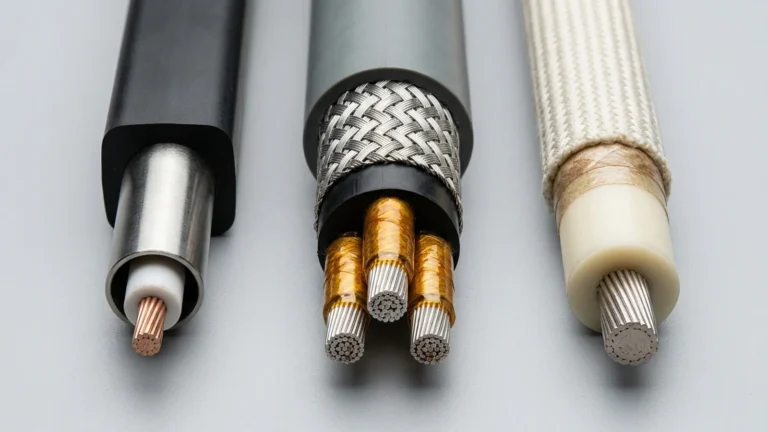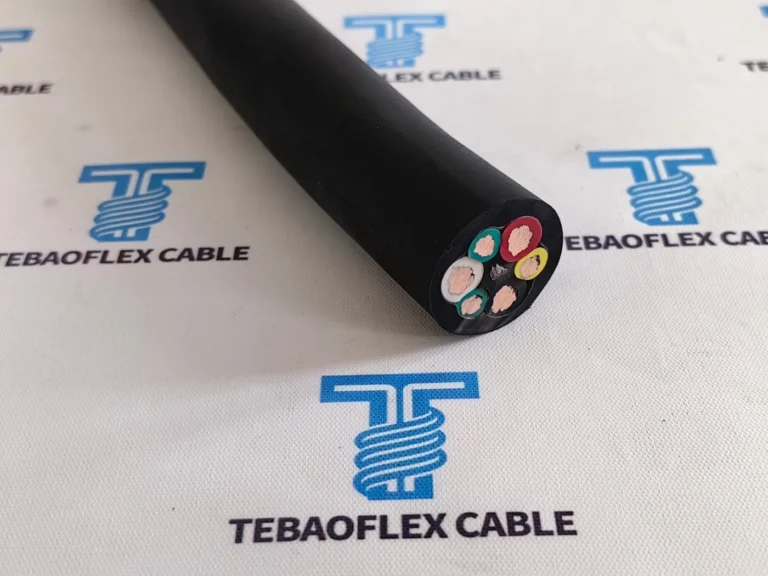

Engineering summary: Electrical switchgear, modular E-houses, and mobile mining substations require distinct cable constructions across four circuit zones: medium-voltage screened incoming feeders, tight-bend fine-stranded single-core power jumpers (2 kV DLO, H07RN-F, or NSSHÖU) between transformers, breakers, and busbars, EMC-screened control/CT/VT wiring, and fault-rated protective earth bonding leads.
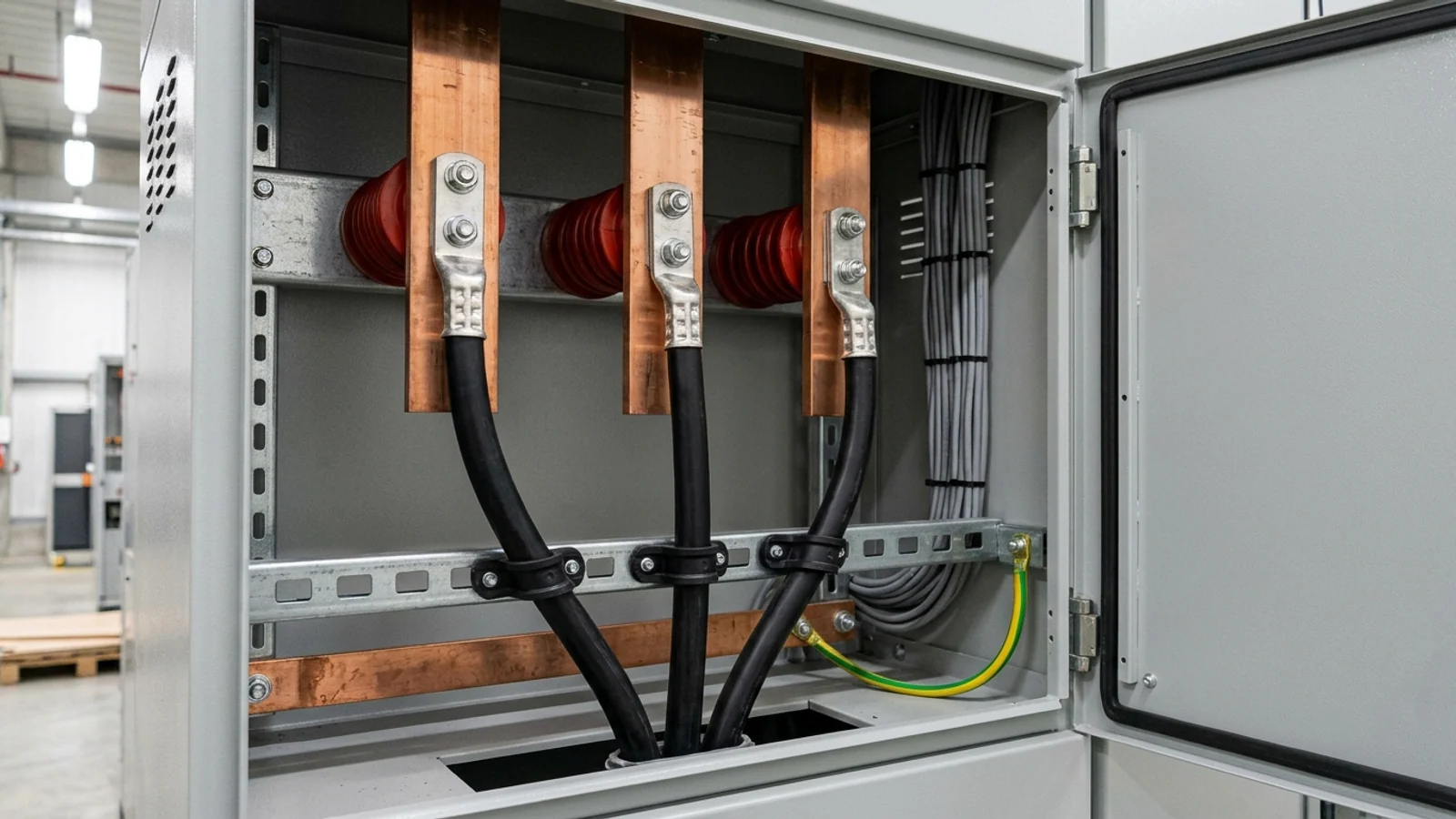
Modern low-voltage and medium-voltage electrical switchgear assemblies (IEC 61439, IEC 62271-200, IEEE C37.20) pack higher amperage into shallower bottom-entry cable compartments than legacy switchboards. Attempting to bend coarse Class B / IEC Class 2 building cables onto compact breaker pads or dry-type transformer spades transfers severe mechanical lever torque onto epoxy bushings and bolted busbar joints—a leading trigger of localized hot spots and arc faults.
Which Cable Types Are Used Across Electrical Switchgear Zones?
A complete switchgear or modular E-house cable schedule separates conductors into four functional zones—MV primary infeed, high-current LV power bus/breaker jumpers, secondary protection and PLC control wiring, and main protective earthing—each governed by different voltage, bending-radius, flame, and short-circuit withstand rules.
| Switchgear Circuit Zone | Operating Duty & Constraints | Recommended Conductor & Insulation | Verified Industrial Cable Options |
|---|---|---|---|
| MV Incoming & Inter-Panel Feeders (3.3 kV – 35 kV) | High dielectric stress, compact cable-box stress-cone height, fault current screen continuity | Class 2 or Class 5 copper; triple-extruded 90 °C / 105 °C EPR + copper tape/wire screen; armoured or flexible rubber jacket | RG7H1OR / RG7OZR, Flexible Type MV-105, (N)3GHSSYCY |
| LV Busbar, Breaker & Transformer Jumpers (600 V – 2 kV) | Tight 4×D–6×D cabinet routing, parallel single-core phase runs (120–500 mm² / 4/0–777.7 kcmil), vibration isolation | IEC Class 5 or ASTM Class I/K fine-stranded tinned or bare copper; 90 °C EPR + oil/flame-resistant CPE/PCP or EVA jacket | 2 kV DLO (RHH/RHW-2), 1-Core H07RN-F, NSHÖU 0.6/1kV |
| High-Ambient Internal Panel & Resistor Bank Wiring | Elevated enclosure temperatures near busbars, braking resistors, or VFD heatsinks (+90 °C to +180 °C) | Class 5 tinned copper or Class 1/2 EVA; cross-linked EVA rubber (110 °C) or silicone/fiberglass (180 °C) | H07G-R / H07G-U (110 °C EVA), SiAF-GL Silicone |
| Protection Relays, CT/VT Loops & Control Interlocks | High electromagnetic interference (switching transients), dense trunking ducts, clear terminal identification | Numbered 0.75–2.5 mm² Class 5 copper cores; PVC or halogen-free LSZH; tinned-copper or steel-wire braid screen | SY LSZH Braided Control, YY / YSLY Control Cable |
| Protective Earth (PE) & Door/Frame Bonding | Must carry prospective earth-fault I²t energy without fusing insulation; hinged cabinet door flexing | Fine-stranded Class 5/6 bare or tinned copper with green/yellow EPR, PVC, or LSZH insulation | Single-core green/yellow flexible earth leads (sized per PE conductor sizing rules) |
Why Replace Rigid Building Wire with DLO or Single-Core Flexible Rubber in Switchgear?
Fine-stranded flexible power cables such as 2 kV DLO (UL RHH/RHW-2), single-core H07RN-F, and NSSHÖU reduce minimum fixed bending radius from 12×D down to 4×D–6×D, isolate generator or transformer vibration from switchgear busbars, and speed up parallel-conductor pulling in cramped bottom cable plenums.
In North American UL 891 and IEEE switchgear, Diesel Locomotive Cable (DLO) dual-listed as UL RHH/RHW-2 has become the standard specification for high-amperage bus-duct drops, generator docking panels, battery energy storage systems (BESS), and UPS cabinets. Its tinned Class I/K copper strands resist sulfur/humidity corrosion in industrial atmospheres while its 90 °C EPR insulation and chlorinated polyethylene (CPE) jacket pass vertical tray flame tests. In IEC 61439 assemblies, single-core 0.6/1 kV NSSHÖU or 1.8/3 kV short-circuit-proof rubber single-core cables fulfill the same role between main air circuit breakers (ACBs) and busbars.
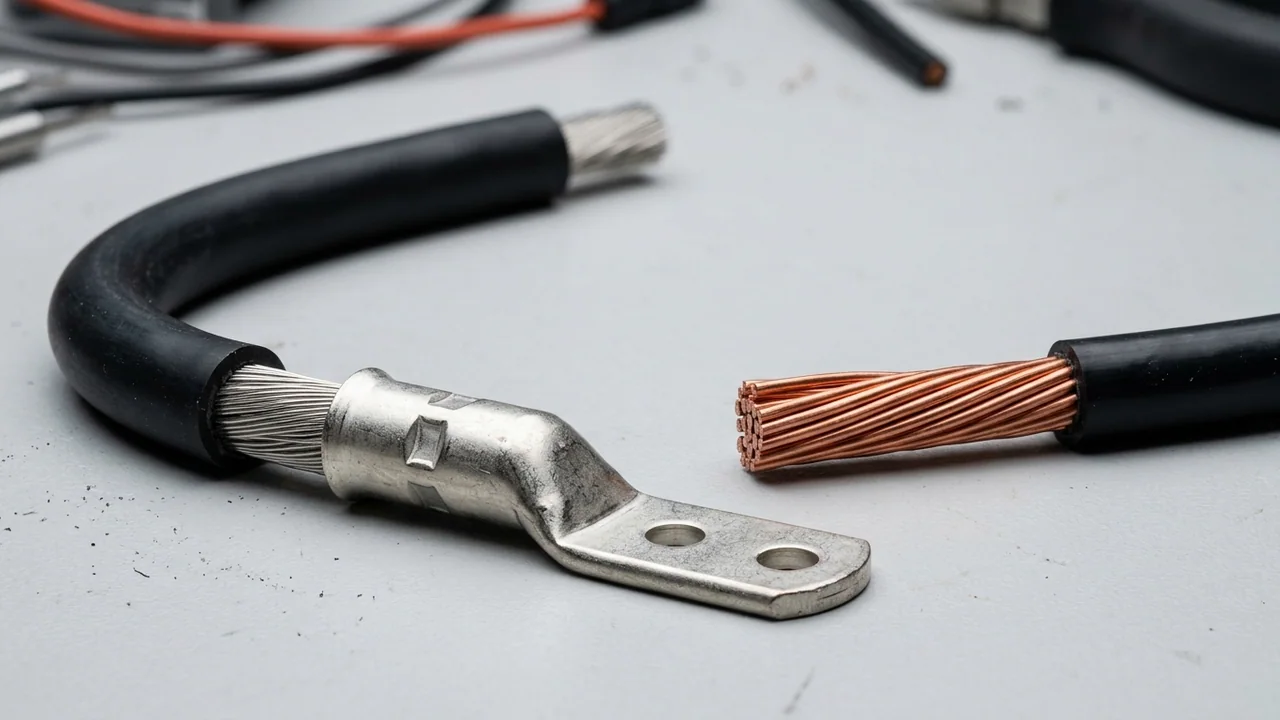
Fine-Stranded Class K / Class 5 vs. Coarse Class B / Class 2
- Tinned Class K / Class 5 Jumper (Left): Hundreds of fine tinned strands route cleanly at 4×D–6×D without transferring mechanical springback force onto breaker stabs.
- Flared-Barrel Two-Hole Lug: Bell-mouthed entry guides every fine strand into the barrel; hexagonal die crimps prevent strand relaxation and lug rotation.
- Coarse 19-Wire XLPE (Right): High bending stiffness risks cracked transformer bushings in shallow plenums.
Crucial lug & ferrule rule for Class 5 / Class K conductors: Never clamp fine-stranded switchgear cables into standard Class B set-screw mechanical lugs or compress them with mismatched standard dies. Fine strands splay and relax under thermal cycling, causing connection overheating. Always use flared-barrel compression lugs specifically UL-listed / IEC 61238-tested for fine-stranded Class 5/6 or Class I/K conductors.
How Do Mobile Mining Substations and Skid E-Houses Change Cable Selection?
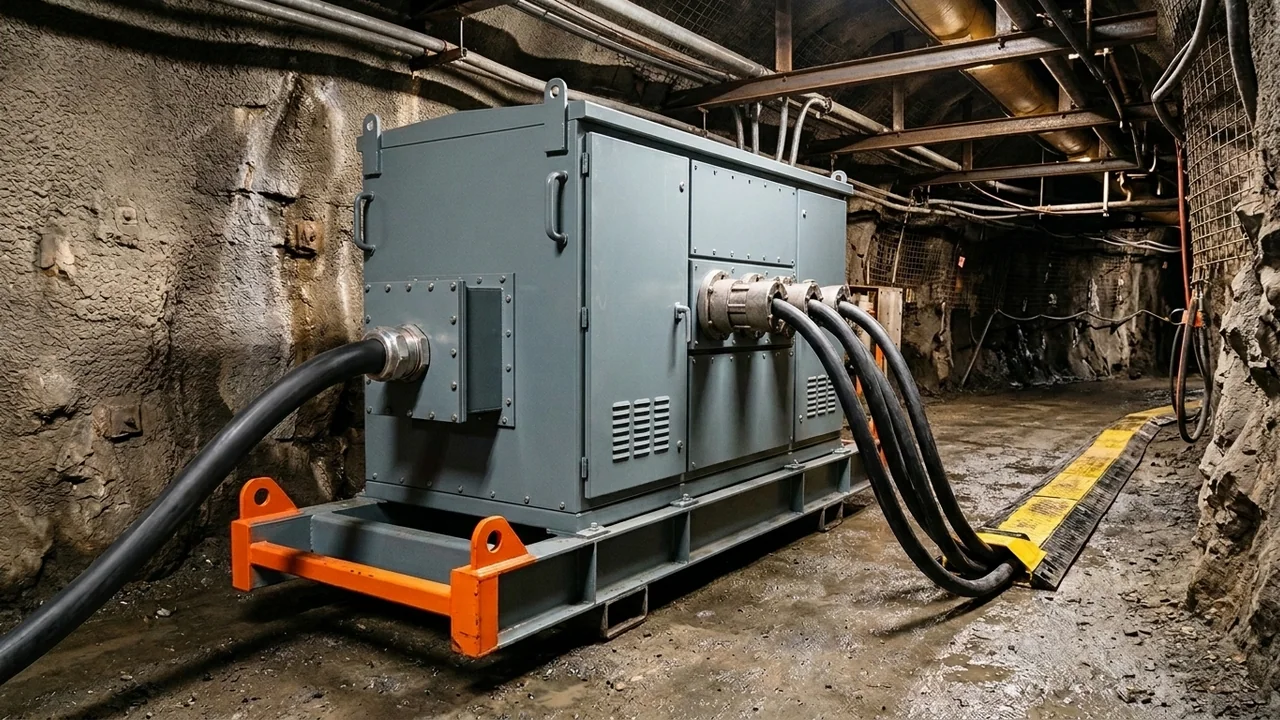
Unlike stationary concrete-room switchgear, skid-mounted mining load centers, TBM step-down substations, and dockside shore-power kiosks undergo repeated towing, blast vibration, mud/water splash, and rapid coupler disconnection—requiring armoured or heavy-duty rubber trailing cables on both the MV primary and LV/MV outgoing sides.
- Primary MV Infeed to Mobile Skid (3.6/6 kV to 18/30 kV): Stationary armoured XLPE cables fracture when dragged behind advancing mine faces. Specify pliable steel-wire armoured rubber mining feeders such as (N)3GHSSHCH (halogen-free tunnel build), BS 6708 Type 621 / 631, or heavy trailing Type SHD-GC.
- Secondary Outgoing Machine Feeders (640/1100 V to 2 kV): Outgoing breaker outlets on mining power centers require integrated pilot/ground-check cores to trip the vacuum contactor instantly if a coupler opens or an earth conductor breaks—matched to BS 6708 Type 7 / Type 11 or 2 kV Type G-GC trailing cables.
- Enclosed Tunnel & Offshore Switchrooms: Where switchgear sits inside underground caverns, metro substations, or offshore modules, replace chlorinated/PVC control and power jackets with low-smoke zero-halogen (LSZH) constructions such as NEK 606 RFOU, fire-resistant BFOU, and SY LSZH control cable to protect switchgear electronics from corrosive halogen acid soot.
Three Mandatory Engineering Checks Before Approving Switchgear Cables
Even when conductor cross-section satisfies open-air ampacity tables, switchgear cables frequently fail inspection over terminal temperature limits, parallel-phase impedance imbalance, or upstream short-circuit let-through energy.
- Enforce the 75 °C / 90 °C switchgear terminal ceiling: Most UL 489 / UL 1066 circuit breakers and IEC 60947 switchgear terminals are rated for 75 °C (or 90 °C only when explicitly marked, and busbars under IEC 61439 have strict temperature-rise limits). Using a 90 °C EPR or 180 °C silicone cable inside a cabinet does not let you load the conductor to its 90 °C or 180 °C free-air ampacity if that current heats the breaker lug above 75 °C. Cross-check derating in our cable ampacity calculation guide.
- Verify short-circuit thermal (I²t) and electrodynamic bracing: Short jumpers on the transformer secondary experience near-bolted bus fault currents (often 35 kA to 65 kA RMS). Confirm conductor and screen adiabatic thermal withstand (I²t ≤ k²S²) per our short-circuit withstand guide, and lash parallel single-core cables in trefoil or cleated formations rated for peak magnetic repulsive force.
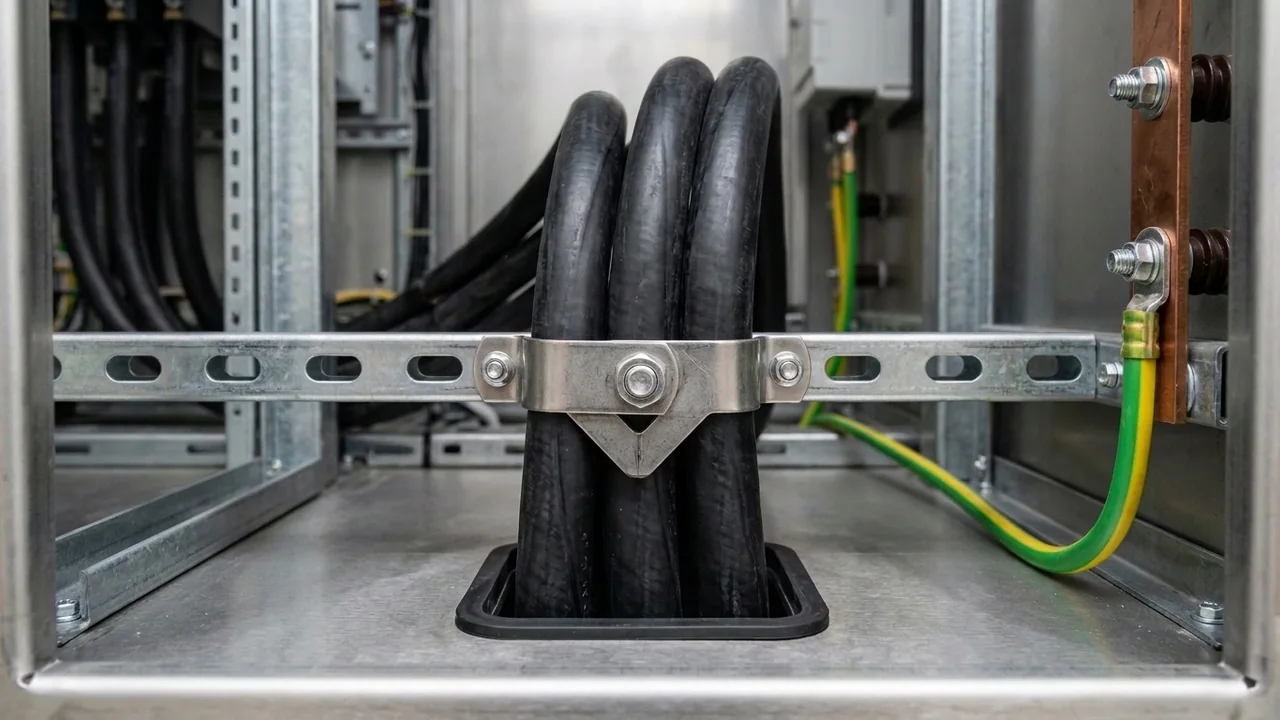
- Prevent gland-plate eddy-current heating on single-core AC feeders: Never pass individual single-core phase cables (above ~200 A) through separate holes in a magnetic carbon-steel switchgear gland plate. Circulating magnetic flux will inductively heat the steel plate above 100 °C; use a non-magnetic Grade 304/316 stainless steel or aluminum gland plate, or pass all three phases + neutral together through one common aperture.
Frequently Asked Questions
Can single-core H07RN-F or DLO cable be run in parallel per phase inside switchgear?
Yes, parallel single-core runs (typically 120 mm² to 400 mm² or 4/0 AWG to 535/777.7 kcmil) are standard for 1,600 A to 4,000 A switchgear feeders. Every parallel conductor in a phase group must have the exact same conductor size, material, stranding construction, cut length, termination geometry, and symmetrical trefoil grouping so current divides evenly without inductive circulating currents.
Why are tinned copper conductors preferred in switchgear and substation cables?
Tin plating prevents copper oxide tarnishing in humid, coastal, or sulfur-bearing industrial switchrooms, keeps contact resistance low inside compression lugs over decades of thermal cycling, and prevents sulfur vulcanization reaction with rubber insulation compounds.
What cable should be used for current transformer (CT) secondary loops in MV switchgear?
CT secondary circuits typically use 2.5 mm² to 6 mm² (12 AWG to 10 AWG) Class 5 copper multi-core or single-core cables (minimum 2.5 mm² is commonly specified to keep loop burden low and mechanical integrity high), often with LSZH or flame-retardant PVC insulation and copper braid screening where routed near power busbars.
Do switchgear cables require halogen-free (LSZH) jackets?
Indoor substations, data centers, underground tunnels, and offshore E-houses increasingly mandate IEC 60754-1/2 halogen-free and IEC 61034 low-smoke cables because even a minor electrical fire in PVC/chloroprene wiring releases hydrochloric acid gas that permanently corrodes copper busbars, silver breaker contacts, and digital protection relays across the entire room.
Get Factory-Direct Switchgear & Substation Cable Support
TEBAOFLEX supplies fine-stranded LV busbar jumpers (DLO, H07RN-F, NSSHÖU, H07G-R), screened MV substation feeders (RG7H1OR, Type MV-105, (N)3GHSSHCH, BS 6708), and EMC-braided control cables engineered for OEM panel builders, E-house integrators, and EPC contractors.
- Specify voltage rating, prospective fault current (kA / clearing time), and continuous current or conductor size.
- Indicate fixed switchroom routing vs mobile skid/trailing duty, plus flame/LSZH or oil-resistance requirements.
- Request sample cut lengths, conductor outer diameters for compression lug matching, and factory routine test reports.
Standards & technical references: IEC 61439-1/2 (Low-voltage switchgear and controlgear assemblies); IEC 62271-200 (AC metal-enclosed switchgear for >1 kV up to 52 kV); UL 44 / UL 1072 & NEC Article 310 (RHH/RHW-2 DLO and MV-105 conductors); IEC 61238-1 (Compression and mechanical connectors for power cables); IEC 60949 (Short-circuit thermal withstand calculation).