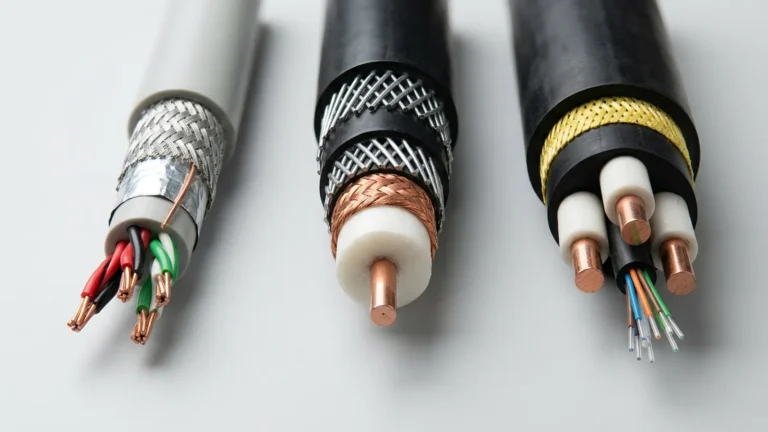

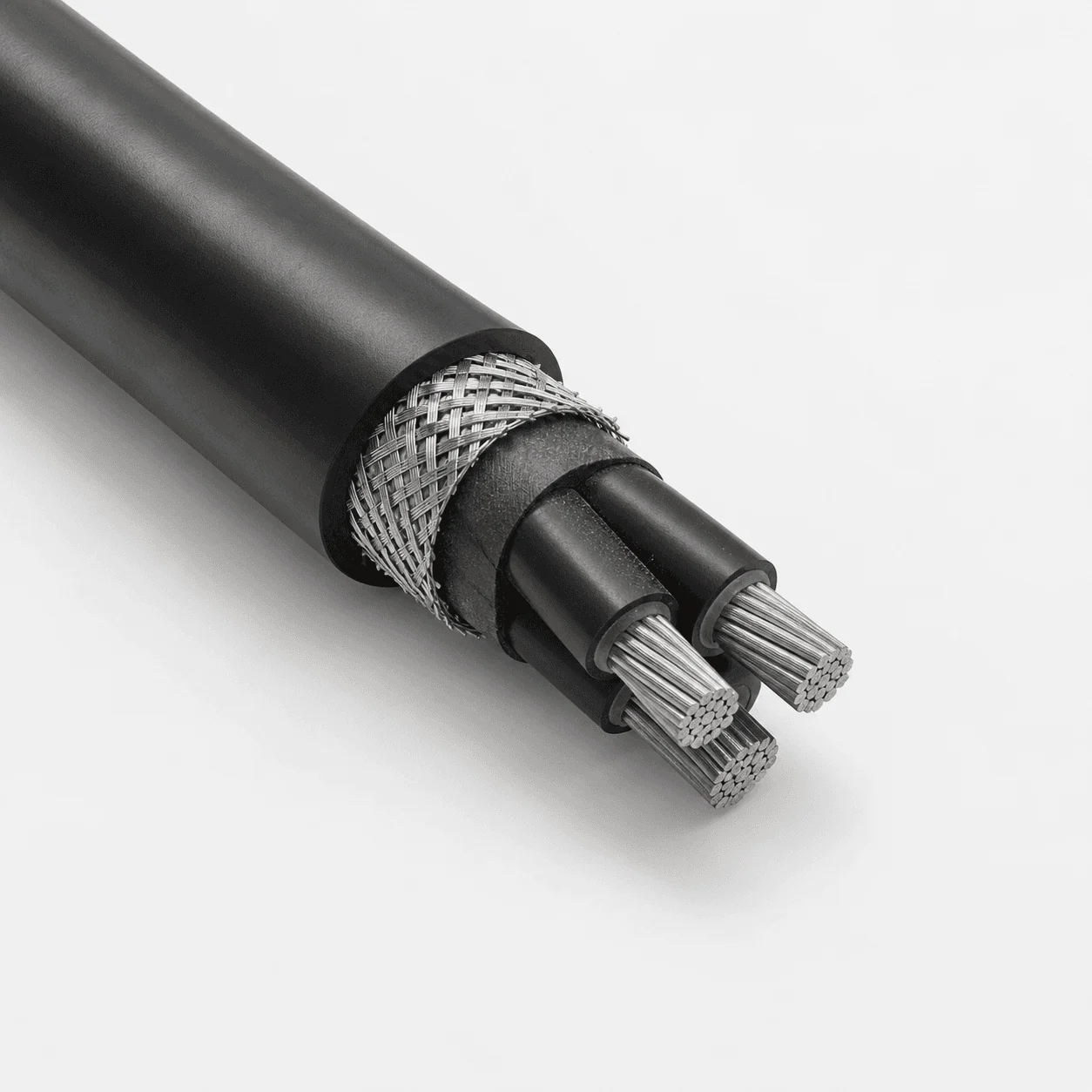
Quick answer: RFOU (designated P1 or P8 under NEK TS 606) is a Norwegian offshore 0.6/1 kV (1.2 kV) flame-retardant, halogen-free, mud-resistant power and control cable built with tinned copper conductors, 90 °C EPR insulation, extruded SHF2 inner covering, a tinned copper wire braid (TCWB) armour, and an SHF2 MUD thermoset outer sheath. Closest international counterparts include BS 6883 SW4 elastomer cables, IEEE 1580 Type P armoured marine cables, and braided IEC 60092-353 constructions.
Applicable standards: NEK TS 606, IEC 60092-350/353/360, IEC 60332-3-22 Cat A, IEC 60754-1/2, IEC 61034-2, BS 6883, IEEE 1580.
What Does the RFOU Designation Mean Under NEK 606?
Under Norwegian offshore standard NEK TS 606, the four-letter RFOU code specifies every radial layer of a fixed low-voltage topside or FPSO power cable from dielectric to outer jacket. Each letter carries a strict material and mechanical rule that distinguishes RFOU from general shipboard cables and steel-braided industrial constructions.
A frequent specification error in cross-reference schedules is confusing the braid code O with galvanized steel wire braid. In NEK 606 nomenclature, O strictly denotes a tinned copper wire braid, whereas galvanized steel wire braid uses the letter A (as in RFAU).
| NEK 606 Code | Cable Layer | Engineering Requirement (NEK TS 606 / IEC 60092) |
|---|---|---|
| R | Insulation | Halogen-free ethylene propylene rubber (EPR per IEC 60092-360), rated 90 °C continuous conductor temperature and 250 °C short-circuit. |
| F | Inner covering | Extruded, flame-retardant, halogen-free thermoset bedding (SHF2) filling interstices to block gas migration through Ex-d/Ex-e glands. |
| O | Metallic braid armour | Tinned copper wire braid (TCWB) providing mechanical protection, low transfer impedance EMC screening, and corrosion resistance in salt spray. |
| U | Outer sheath | Thermoset halogen-free elastomer compound (SHF2 MUD) tested against oil-based drilling fluids (IRM 902/903) and calcium bromide brine. |
| P1 / P8 | NEK TS 606 type code | P1 denotes standard Class 2 stranded tinned copper RFOU; P8 denotes extra-flexible Class 5 tinned copper RFOU for tight module routing. |
Review full multi-core dimensional and current-carrying data on our NEK 606 RFOU 0.6/1 kV offshore power cable datasheet, or inspect field deployment details in our Guyana FPSO RFOU power cable case study.
How Does NEK 606 RFOU Cross-Reference Across International Offshore Standards?
No non-Norwegian cable code automatically includes NEK TS 606 calcium bromide and ester/oil-based drilling-mud immersion tests unless explicitly specified on the purchase order. When cross-referencing RFOU across UK, IEC, North American, or Japanese marine standards, engineers must reconcile voltage ratings, armour metallurgy, and mud-resistance class.
| Standard / Region | Closest Public Designation | Nominal Voltage | Conductor & Dielectric | Armour & Outer Sheath | Key Engineering Differences |
|---|---|---|---|---|---|
| NEK TS 606 (Norway / Global FPSO) | RFOU (P1 / P8) | 0.6/1 kV (Um = 1.2 kV) | Class 2 or Class 5 tinned Cu; 90 °C EPR | Tinned Cu wire braid (TCWB); SHF2 MUD thermoset | Reference standard for topside drilling modules; certified to IEC 60332-3-22 Cat A and NEK 606 MUD immersion. |
| BS 6883 (UK North Sea) | EPR / SW4 / PB or GSWB / SW4 | 0.6/1 kV | Class 2 or Class 5 tinned Cu; GP4 EPR (90 °C) | Phosphor bronze or GSWB braid; SW4 LSZH elastomer | Very close mechanical match; specify phosphor-bronze/tinned-copper braid and oil/drilling-fluid resistance to align with RFOU. |
| IEC 60092-353 (International Marine) | Shipboard Braided Power (EPR / SHF2) | 0.6/1 kV | Tinned or bare Cu; EPR or HEPR (90 °C) | Copper or steel wire braid; SHF1 or SHF2 jacket | Standard shipboard cables often use thermoplastic SHF1 and omit extruded inner bedding and drilling-mud resistance. |
| IEEE 1580 / UL 1309A (USA / Gulf of Mexico) | Type P (Armoured Multi-Core) | 600 V / 1000 V | Flexible ASTM B172 tinned Cu (AWG/kcmil); Type P cross-linked polyolefin/EPR | Bronze or tinned Cu braid; thermoset CPE/LSZH arctic-mud jacket | Higher strand count than P1 RFOU; sized in AWG/kcmil and tested under IEEE 1202 flame protocol rather than IEC 60332-3-22. |
| JIS C 3410 (Japan Shipboard) | TPYC / DPYC (HF) | 0.6/1 kV | Stranded tinned Cu; 90 °C EPR | Galvanized steel wire braid; halogen-free sheath | Uses magnetic steel braid instead of copper braid and lacks NEK TS 606 drilling-mud qualification for shaker rooms. |
Compare compatible offshore and marine cable families in our oil, gas, and marine cables catalog, including BS 6883 EPR/SW4 armoured offshore cables and IEEE 1580 Type P 600/1000 V marine power cables.
How Do NEK 606 Variants and Class Approvals Align?
Within a single FPSO or offshore platform package, RFOU serves normal power and lighting feeders, while emergency shutdown (ESD), firewater pump, and dynamic skid circuits require companion NEK 606 or IEEE 1580 constructions. Selecting the exact code prevents failing DNV, ABS, Lloyd’s Register, or Bureau Veritas electrical inspections.
| Offshore Cable Code | Fire Rating | Armour Type | Target Topside / Vessel Circuit |
|---|---|---|---|
| RFOU (P1 / P8) | Flame-retardant (IEC 60332-3-22 Cat A) | Tinned copper wire braid (O) | General 0.6/1 kV power, MCC feeders, deck lighting, and VFD-fed process motors in mud-exposed zones. |
| BFOU (P4 / P11) | Fire-resistant (IEC 60331-21 / -1 / -2) | Tinned copper wire braid (O) + mica barrier | Emergency power, ESD valves, PA/GA, and fire-fighting circuits requiring 90–180 min survival in hydrocarbon fire. |
| RFAU | Flame-retardant (IEC 60332-3-22 Cat A) | Galvanized steel wire braid (A) | Heavy mechanical impact zones where high crush resistance outweighs EMC braid conductivity (multi-core only). |
| IEEE 1580 Type P | IEEE 1202 / IEC 60332-3-22 | Bronze or tinned copper braid | ABS-classed drilling rigs, top-drive service loops, and skid modules built to North American AWG specifications. |
For a side-by-side breakdown of normal versus emergency topside circuits, read our BFOU vs. RFOU offshore cable engineering comparison.
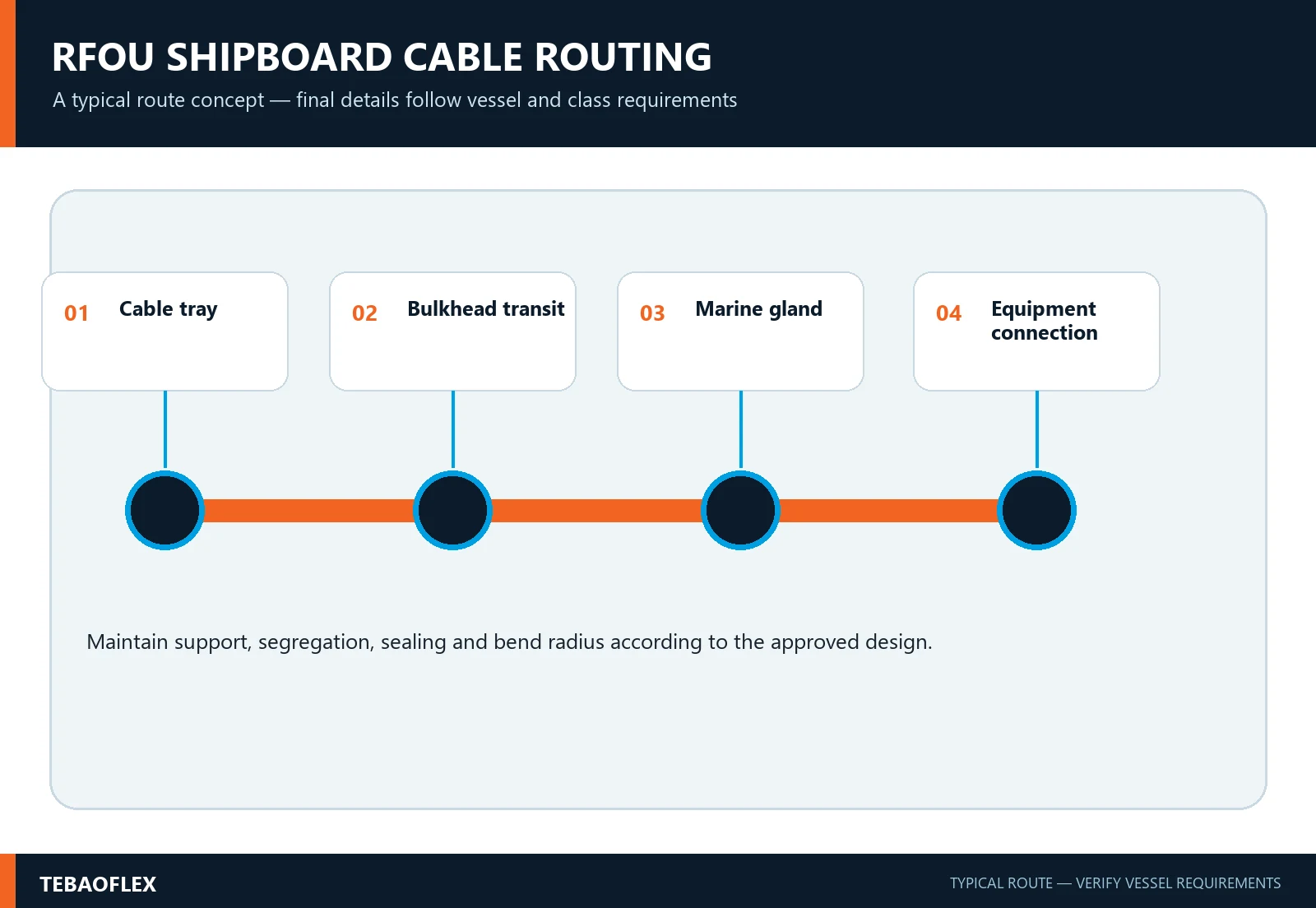
What Must Be Verified Before Approving an RFOU Substitute?
Substituting a generic shipboard LSZH cable or a regional marine standard for NEK 606 RFOU without verifying five construction parameters can compromise hazardous-area Ex gland certification and mud-pit durability. Offshore electrical lead engineers should audit every proposed cross-reference against the criteria below.
Engineering boundary: Ex-d gas-tightness and MUD swelling limits
Never substitute unbedded or tape-wrapped IEC 60092-353 cables using thermoplastic SHF1 jackets into Zone 1 or Zone 2 hazardous areas that specify extruded-bedding RFOU with Ex-d elastomer compression glands. Unfilled core interstices permit hydrocarbon gas migration, while non-MUD jackets swell and crack upon contact with synthetic ester or calcium bromide drilling fluids.
- 1. Extruded inner covering for Ex glands: Confirm that the cable features a solid extruded halogen-free inner covering (F) producing a circular, compact core profile suitable for Ex-e and Ex-d elastomer seal rings, or specify compound-filled barrier glands where required by IEC 60079-14.
- 2. SHF2 MUD fluid resistance qualification: Verify test reports against the latest NEK TS 606 mud table (including IRM 902, IRM 903, and calcium bromide brine immersion at elevated temperature) if the route traverses drilling modules, shale shakers, or mud pump rooms.
- 3. Braid armour material on single-core circuits: Single-core AC feeders (such as 1 × 185 mm² or 1 × 240 mm²) must strictly retain non-magnetic tinned copper or phosphor-bronze wire braid—never magnetic galvanized steel wire braid—to prevent severe hysteresis and eddy-current heating.
- 4. Outer diameter tolerance for MCT blocks: Check minimum and maximum outer diameter tolerances against modular multi-cable transit (MCT) frame inserts and stainless-steel trefoil/flat cleats prior to procurement.
- 5. Classification society type approval: Match the vessel or FPSO class notation (DNV, ABS, LR, BV, or CCS) and confirm bundled flame-propagation compliance to IEC 60332-3-22 Category A, zero halogen per IEC 60754-1/2, and smoke transmittance ≥ 60% per IEC 61034-2.
Frequently Asked Questions About RFOU Cable Cross-References
Offshore E&I engineers and shipyard buyers frequently ask how RFOU relates to fire-resistant BFOU, UK BS 6883 cables, and IEEE 1580 Type P constructions. The answers below clarify where cross-standard substitution is technically valid.
Can BFOU be installed as a higher-grade substitute for RFOU?
Yes, BFOU shares the same 0.6/1 kV voltage rating, tinned copper wire braid, and SHF2 MUD sheath as RFOU while adding a mica-glass flame barrier for IEC 60331 fire survival. Because the mica tape slightly increases core diameter, verify gland seal ranges and MCT block sizing before substituting.
Is BS 6883 directly interchangeable with NEK 606 RFOU?
BS 6883 EPR/SW4 cables with phosphor-bronze or tinned-copper wire braid and enhanced oil/drilling-fluid resistance closely match RFOU performance and are widely accepted on UKCS projects. However, if the project specification mandates galvanized steel braid under BS 6883, confirm EMC grounding and single-core AC magnetic losses first.
Can IEEE 1580 Type P replace RFOU on an FPSO or drilling rig?
Type P multi-core cables certified to UL 1309A / IEEE 1580 with mud-resistant thermoset jackets perform comparable duty on ABS-classed units, but they use AWG/kcmil conductor sizes (Class I/K stranding) instead of metric Class 2/Class 5 sizes. Always recalibrate crimping dies, lugs, and gland bores when crossing between metric and AWG standards.
What details are required for an engineering RFOU cross-reference review?
Provide the existing cable code or MTO line item, core count and cross-section, conductor stranding class (P1 Class 2 vs. P8 Class 5), hazardous-area zone classification, required mud resistance, and target classification society (DNV, ABS, LR, BV, or CCS).
Need a Verified NEK 606 RFOU Cross-Reference or Class Datasheet?
Send your offshore cable MTO schedule, required classification society (DNV, ABS, LR, BV, or CCS), gland/MCT constraints, and delivery schedule. TEBAOFLEX offshore cable engineers will verify dimensional and MUD-resistance compliance and return a complete technical quotation within 24 hours.
Request Offshore Cross-Reference ReviewTechnical references & review record: Construction codes, compound classifications, and fire/mud test parameters referenced from NEK TS 606 (Cables for Offshore Installations), IEC 60092-350/353/360, IEC 60332-3-22 Category A, IEC 60754-1/2, IEC 61034-2, BS 6883, and IEEE 1580 / UL 1309A. Technical review updated October 2026 by TEBAOFLEX Engineering.