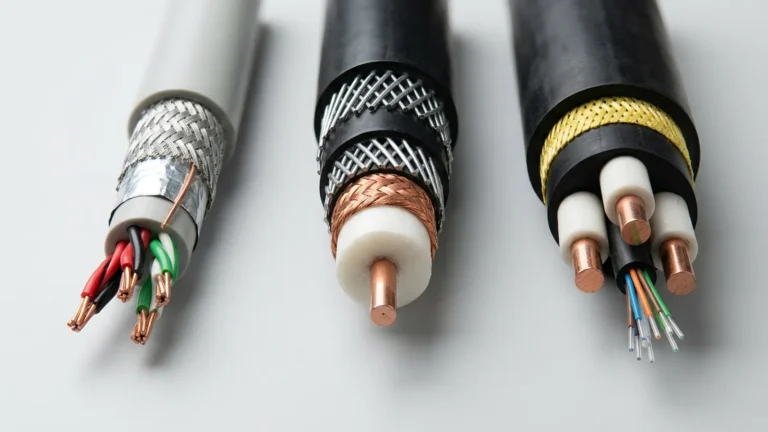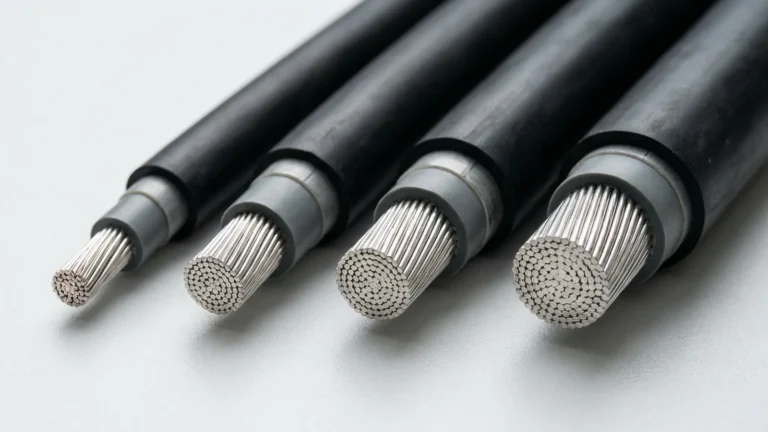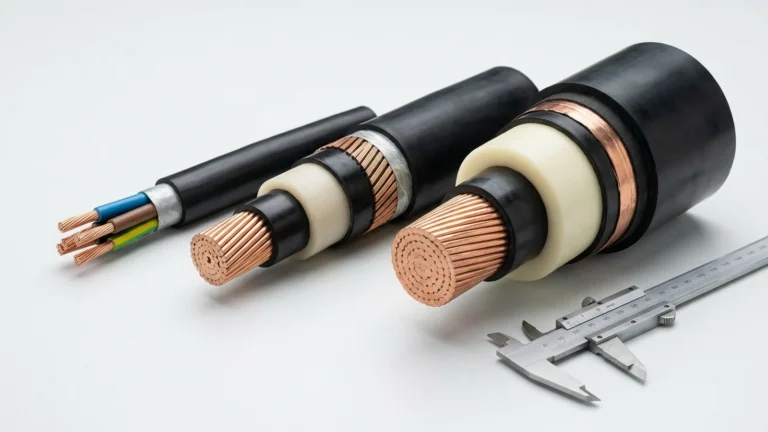

Quick answer: BFOU (designated P4 or P11 under NEK TS 606) is a Norwegian offshore 0.6/1 kV (1.2 kV) IEC 60331 fire-resistant, halogen-free, mud-resistant emergency power and control cable. It combines tinned copper conductors, a helically lapped mica-glass flame barrier, 90 °C EPR insulation, extruded SHF2 bedding, tinned copper wire braid (TCWB) armour, and an SHF2 MUD outer sheath. Closest international counterparts include BS 7917 offshore fire-resistant cables and fire-rated IEC 60092-353 or IEEE 1580 Type P constructions.
Applicable standards: NEK TS 606, IEC 60331-21 / IEC 60331-1/2, IEC 60332-3-22 Cat A, IEC 60092-353, BS 7917, IEEE 1580.
What Does the BFOU Designation Mean Under NEK 606?
Under NEK TS 606, the BFOU designation identifies a low-voltage offshore power or control cable engineered to maintain live electrical circuit integrity during an active topside or shipboard fire. Every letter in the code defines a mandatory radial barrier required for life-safety, emergency shutdown (ESD), and firewater pump circuits.
Unlike standard flame-retardant cables that merely resist spreading fire along a tray, the leading B code mandates a dual-layer mica-glass tape plus EPR insulation system capable of surviving direct flame at 750 °C to 850 °C without phase-to-phase or phase-to-earth shorting.
| NEK 606 Code | Cable Layer | Engineering Requirement (NEK TS 606 / IEC 60331) |
|---|---|---|
| B | Fire-resistant core system | Phlogopite/muscovite mica-glass flame barrier tape applied with controlled overlap under 90 °C halogen-free EPR dielectric. |
| F | Inner covering | Extruded, flame-retardant, halogen-free thermoset bedding (SHF2) ensuring round core geometry and Ex-d/Ex-e gas-tightness. |
| O | Metallic braid armour | Tinned copper wire braid (TCWB) delivering mechanical impact protection, EMC screening, and reliable earth-fault return. |
| U | Outer sheath | Thermoset halogen-free elastomer (SHF2 MUD) qualified against drilling fluids, ester muds, and calcium bromide brines. |
| P4 / P11 | NEK TS 606 type code | P4 specifies Class 2 stranded tinned copper BFOU; P11 specifies extra-flexible Class 5 tinned copper BFOU for compact skids. |
Inspect full multi-core cross-sections, current ratings, and outer diameters on our NEK 606 BFOU 0.6/1 kV fire-resistant offshore power cable product datasheet.

How Does NEK 606 BFOU Cross-Reference Across Fire-Resistant Offshore Standards?
Cross-referencing BFOU across British, IEC, North American, and Japanese marine frameworks requires matching three separate compliance pillars simultaneously: IEC 60331 circuit integrity under fire, braided mechanical protection, and offshore drilling-mud resistance. Onshore building fire-alarm cables must never be substituted on offshore installations.
| Standard / Region | Closest Public Designation | Fire Survival Test | Conductor & Barrier | Armour & Outer Sheath | Key Engineering Differences |
|---|---|---|---|---|---|
| NEK TS 606 (Norway / Global FPSO) | BFOU (P4 / P11) | IEC 60331-21 (750 °C, 90 min + cool-down) / IEC 60331-1/2 (830 °C shock) | Class 2 or Class 5 tinned Cu; mica tape + 90 °C EPR | Tinned Cu wire braid (TCWB); SHF2 MUD thermoset | Gold-standard FPSO and topside emergency cable combining fire survival, Cat A bundled flame test, and MUD resistance. |
| BS 7917 (UK Offshore Sector) | Elastomer Fire-Resistant Offshore (SW4) | IEC 60331 / BS 6387 Cat C, W, Z | Tinned Cu; mica-glass barrier + GP4 EPR (90 °C) | GSWB or phosphor-bronze wire braid; SW4 LSZH | True UK offshore fire-resistant counterpart to BS 6883; verify copper/bronze vs. steel braid and NEK 606 mud immersion. |
| IEC 60092-353 + IEC 60331 (International Shipboard) | Mica/EPR/TCWB/SHF2 Marine FR | IEC 60331-21 or IEC 60331-1/2 | Tinned Cu; mica tape + HEPR (90 °C) | Copper or steel wire braid; SHF1 or SHF2 sheath | SOLAS shipboard fire-resistant cables match electrical survival but lack drilling-mud resistance unless SHF2 MUD is specified. |
| IEEE 1580 / UL 1309A (USA / Gulf of Mexico) | Fire-Resistant Type P / Type LSX-FR | IEC 60331 / UL circuit-integrity protocol | Flexible ASTM B172 tinned Cu (AWG/kcmil); mica + cross-linked insulation | Bronze or tinned Cu braid; LSZH thermoset mud jacket | Sized in AWG/kcmil with fine stranding; confirm both IEC 60331 fire duration and IEC 60332-3-22 Cat A acceptance with class surveyor. |
| JIS C 3410 (Japan Marine) | FA-DPYC / FA-TPYC (HF) | IEC 60331-21 | Stranded tinned Cu; mica barrier + EPR | Galvanized steel wire braid; halogen-free sheath | Designed for merchant vessels; uses steel wire braid and lacks topside calcium bromide and oil-mud qualification. |
Explore related offshore power and shipboard constructions in our oil, gas, and marine cables catalog, as well as our 1 kV armoured low-smoke marine power cable and shipboard cable selection guide.
When Should Offshore Circuits Specify BFOU Instead of RFOU?
Offshore safety philosophies segregate topside cabling into normal process loads that trip de-energized upon gas or fire detection and essential safety systems that must remain energized during platform evacuation and fire suppression. Matching each circuit to the proper NEK 606 code avoids both safety non-conformities and unnecessary weight or cost.
| NEK 606 / Marine Code | Circuit Integrity in Fire | Sheath Color Convention | Mandatory Offshore Application Scope |
|---|---|---|---|
| BFOU (P4 / P11) | Yes (IEC 60331-21 / -1 / -2, 750–830 °C) | Black (power) or grey/blue (control/IS) with FR print; orange on select specs | Emergency generators, firewater pumps, ESD/F&G loops, lifeboat davits, emergency lighting, and PA/GA circuits. |
| RFOU (P1 / P8) | No (Flame-retardant IEC 60332-3-22 Cat A only) | Black (power) or grey (control) | Normal process motors, HVAC, drilling utility feeders, and general lighting tripped during emergency shutdown. |
| BFOU(i) / BFOU(c) (S1 / S5) | Yes (IEC 60331-21 / -23) | Grey (non-IS) or light blue (Ex-i intrinsically safe) | 250 V screened instrumentation pairs/triads for fire-and-gas detectors, ESD solenoid feedback, and subsea master control. |
| BFAU | Yes (IEC 60331) | Black | Multi-core fire-resistant feeders routed in extreme mechanical crush zones requiring galvanized steel wire braid (A). |
For full dimensional and weight differences caused by the mica-glass fire barrier, consult our BFOU vs. RFOU offshore cable engineering comparison.
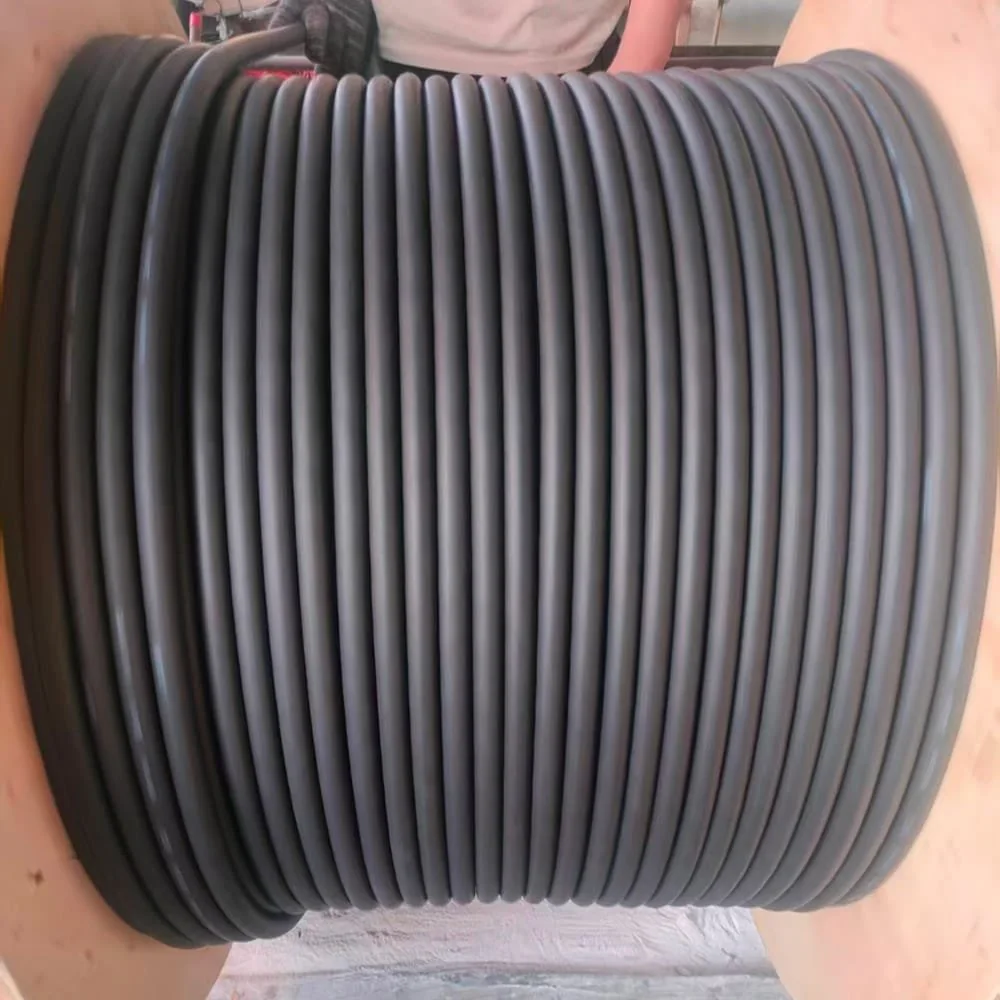
What Must Be Verified Before Approving a BFOU Substitute?
Approving an alternate fire-resistant cable on an offshore rig or FPSO requires auditing fire test severity—particularly mechanical shock and water-spray regimes—alongside hazardous-area gland compatibility. Failure on any of the five checkpoints below can invalidate DNV, ABS, LR, or BV safety certification.
Engineering boundary: IEC 60331 fire survival vs. IEC 60332 flame retardancy
Never accept IEC 60332-3-22 Category A flame-retardant test reports alone as proof of BFOU equivalence, and never substitute onshore building cables (such as unarmoured LSZH conduit wire or NEC FPL alarm cable) on offshore topsides. Under fire exposure above 750 °C, EPR insulation oxidizes into ash; without a properly overlapped mica-glass tape held radially intact by extruded bedding and metallic braid, the circuit shorts immediately under vibration or deluge water spray.
- 1. Fire survival test edition and mechanical shock: Confirm whether the project specification mandates IEC 60331-21 (750 °C for 90 minutes) or IEC 60331-1 / IEC 60331-2 (830 °C flame with periodic mechanical shock for cables above or below 20 mm OD), or enhanced hydrocarbon fire survival protocols.
- 2. Mica-glass tape overlap and stripping procedure: Verify at least two layers or ≥ 50% overlap of halogen-free phlogopite mica tape over tinned copper conductors, and ensure installation crews remove stray mica filaments before crimping lugs so contact resistance does not overheat terminals.
- 3. Outer diameter growth in glands and MCT transits: Because mica tape adds radial thickness over every core, BFOU has a slightly larger outer diameter than an identical-cross-section RFOU cable. Re-verify Ex-d/Ex-e gland clamping ranges and MCT insert module sizes before substituting.
- 4. NEK TS 606 SHF2 MUD qualification: Confirm full mud-resistance test certificates (oil-based muds IRM 902/903 and calcium bromide brine) whenever emergency circuits pass through drilling derricks, mud pits, or wellbay areas.
- 5. Active classification society certificate: Request valid type approval certificates from DNV, ABS, Lloyd’s Register (LR), Bureau Veritas (BV), or CCS matching the exact voltage class (0.6/1 kV) and core range on the purchase order.
Frequently Asked Questions About BFOU Cable Cross-References
Project electrical engineers and marine procurement teams routinely ask how BFOU compares with BS 7917, BS 6883, RFOU, and North American Type P cables. The technical answers below summarize the acceptance rules used by offshore classification societies.
Is BS 6883 an acceptable equivalent to NEK 606 BFOU?
Standard BS 6883 covers flame-retardant offshore cables equivalent to RFOU, not fire-resistant BFOU. For UK offshore circuits requiring active circuit integrity during a fire, the proper British cross-reference is BS 7917 (elastomer insulated fire-resistant offshore cables) certified to IEC 60331 and mud resistance.
Can RFOU ever be used in place of BFOU?
No. RFOU lacks the mica-glass flame barrier over its conductors and will short-circuit once fire temperatures char the EPR insulation. While BFOU can safely upgrade an RFOU circuit (provided glands fit its slightly larger OD), RFOU can never downgrade a safety-critical BFOU circuit.
Why are onshore fire-alarm or building FR cables rejected offshore?
Onshore fire-survival building cables typically use solid bare copper conductors, thin thermoplastic LSZH jackets without extruded gas-tight bedding, and foil screens instead of tinned copper wire braid. They corrode rapidly in salt mist, fail offshore vibration fatigue, cannot seal hazardous-area Ex-d glands, and degrade in drilling fluids.
What information is needed to quote a BFOU cross-reference?
Share the MTO line specification, voltage rating (0.6/1 kV or 250 V instrumentation), core count and conductor size, stranding class (P4 Class 2 vs. P11 Class 5), required IEC 60331 test standard, MUD requirement, and target classification society.
Need a Class-Approved NEK 606 BFOU Cross-Reference or Quotation?
Submit your topside or FPSO emergency cable schedule, required IEC 60331 fire rating, classification society (DNV, ABS, LR, BV, or CCS), and delivery port. TEBAOFLEX engineers will confirm dimensional gland fit and provide complete type-test documentation and pricing within 24 hours.
Request BFOU Technical ReviewTechnical references & review record: Construction codes, fire-survival test criteria, and compound standards referenced from NEK TS 606 (P4 / P11 BFOU), IEC 60331-21, IEC 60331-1/2, IEC 60332-3-22 Category A, IEC 60754-1/2, IEC 61034-2, IEC 60092-353, BS 7917, and IEEE 1580. Technical review updated October 2026 by TEBAOFLEX Engineering.