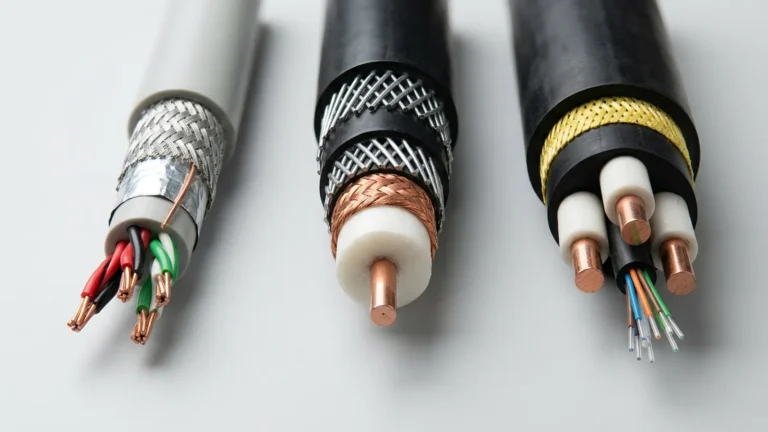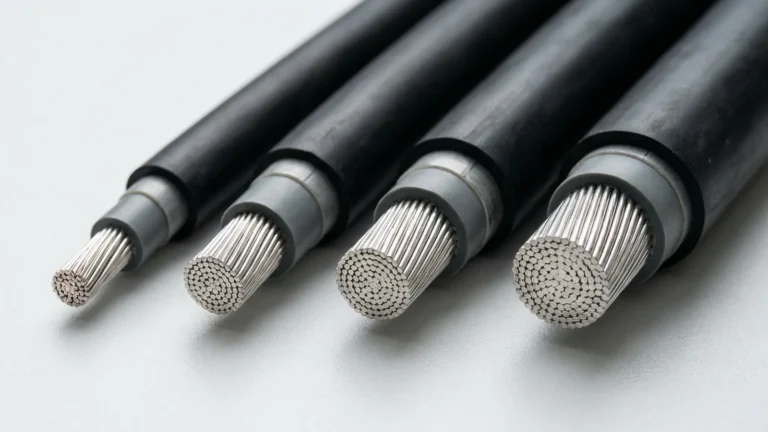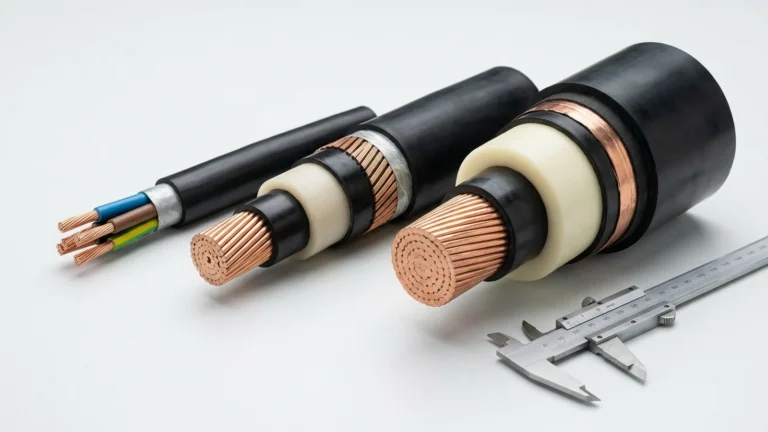

BFOU vs RFOU: What Is the Difference?
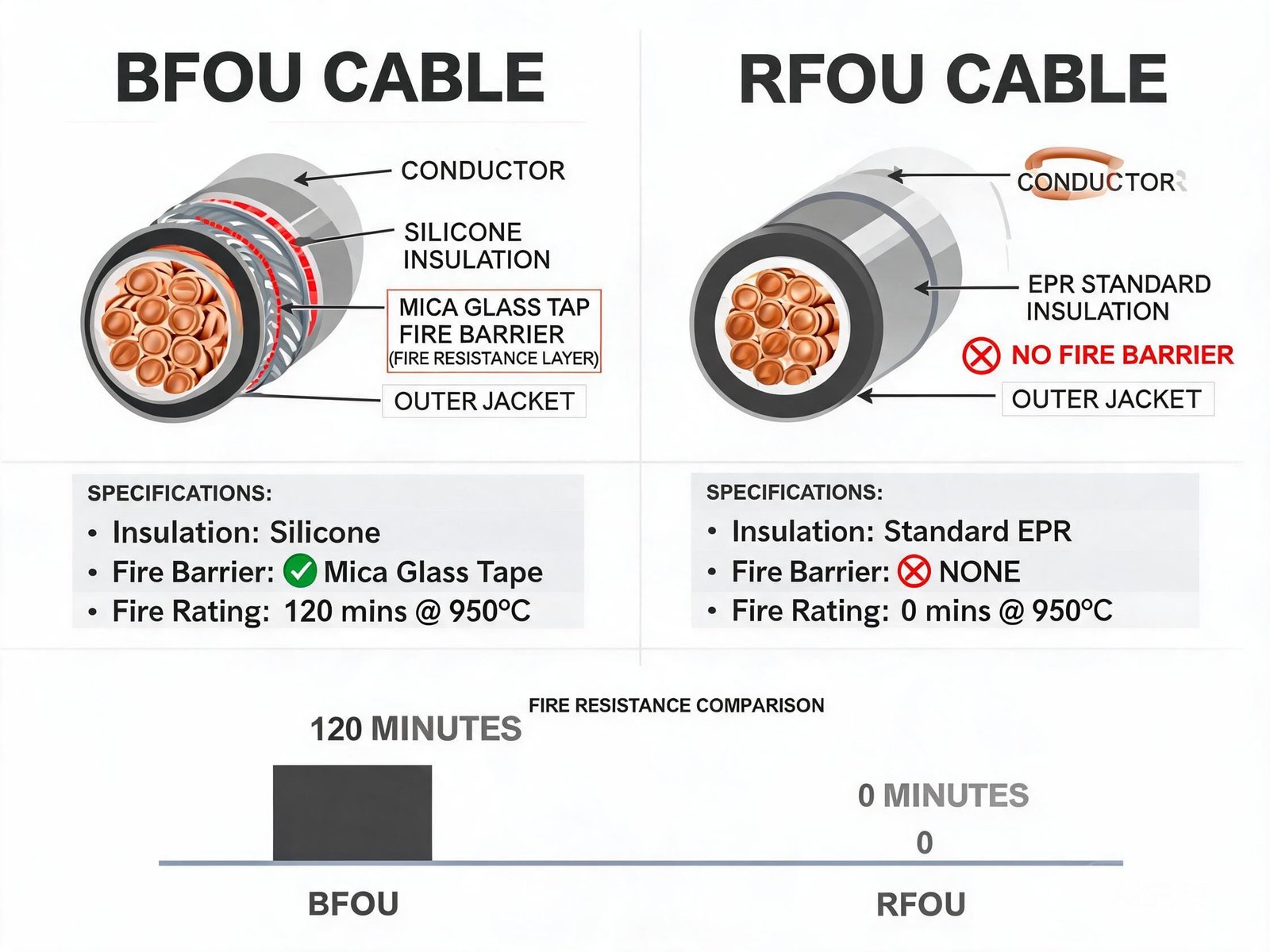
Direct Answer: Both BFOU and RFOU are 0.6/1kV halogen-free, mud-resistant offshore power and control cables governed by NEK 606 and IEC 60092-353. BFOU is fire-resistant per IEC 60331 (wrapped with a mica-glass tape fire barrier on each conductor to survive 750°C–950°C fire for 90+ minutes), while RFOU is flame-retardant only per IEC 60332-3-22 Cat A (self-extinguishing without a fire barrier).
TEBAOFLEX manufactures both NEK 606 offshore constructions with tinned copper conductors (Class 2 or Class 5), EPR insulation, galvanized steel or tinned bronze wire braid armour, and SHF2 / SHF Mud outer sheaths. Review our BFOU 0.6/1kV fire-resistant power cable and RFOU 0.6/1kV offshore power cable product datasheets for full core/cross-section tables.
NEK 606 Designation & Structural Breakdown
| Code Element / Layer | BFOU (NEK 606 Code S1 / S5) | RFOU (NEK 606 Code S2 / S6) |
|---|---|---|
| First Letter (B vs R) | B = Fire-resistant insulation system (Mica glass tape + EPR, IEC 60331) | R = Halogen-free EPR insulation (Flame-retardant only, no mica tape) |
| Second Letter (F) | Galvanized steel wire braid (GSWB) or tinned copper/bronze wire braid armour | Galvanized steel wire braid (GSWB) or tinned copper/bronze wire braid armour |
| Third Letter (O) | Halogen-free, oil- and mud-resistant thermoset sheath (SHF2 / SHF Mud) | Halogen-free, oil- and mud-resistant thermoset sheath (SHF2 / SHF Mud) |
| Fourth Letter (U) | Tinned annealed copper conductor (Class 2 stranded or Class 5 flexible) | Tinned annealed copper conductor (Class 2 stranded or Class 5 flexible) |
| Core Fire Barrier | Helically lapped phlogopite/muscovite mica-glass tape | None |
| Governing Standards | NEK 606, IEC 60092-353, IEC 60331-21, IEC 60332-3-22 | NEK 606, IEC 60092-353, IEC 60332-3-22 |
Electrical, Fire & Environmental Performance Comparison
| Technical Parameter | BFOU 0.6/1kV | RFOU 0.6/1kV | Selection Impact |
|---|---|---|---|
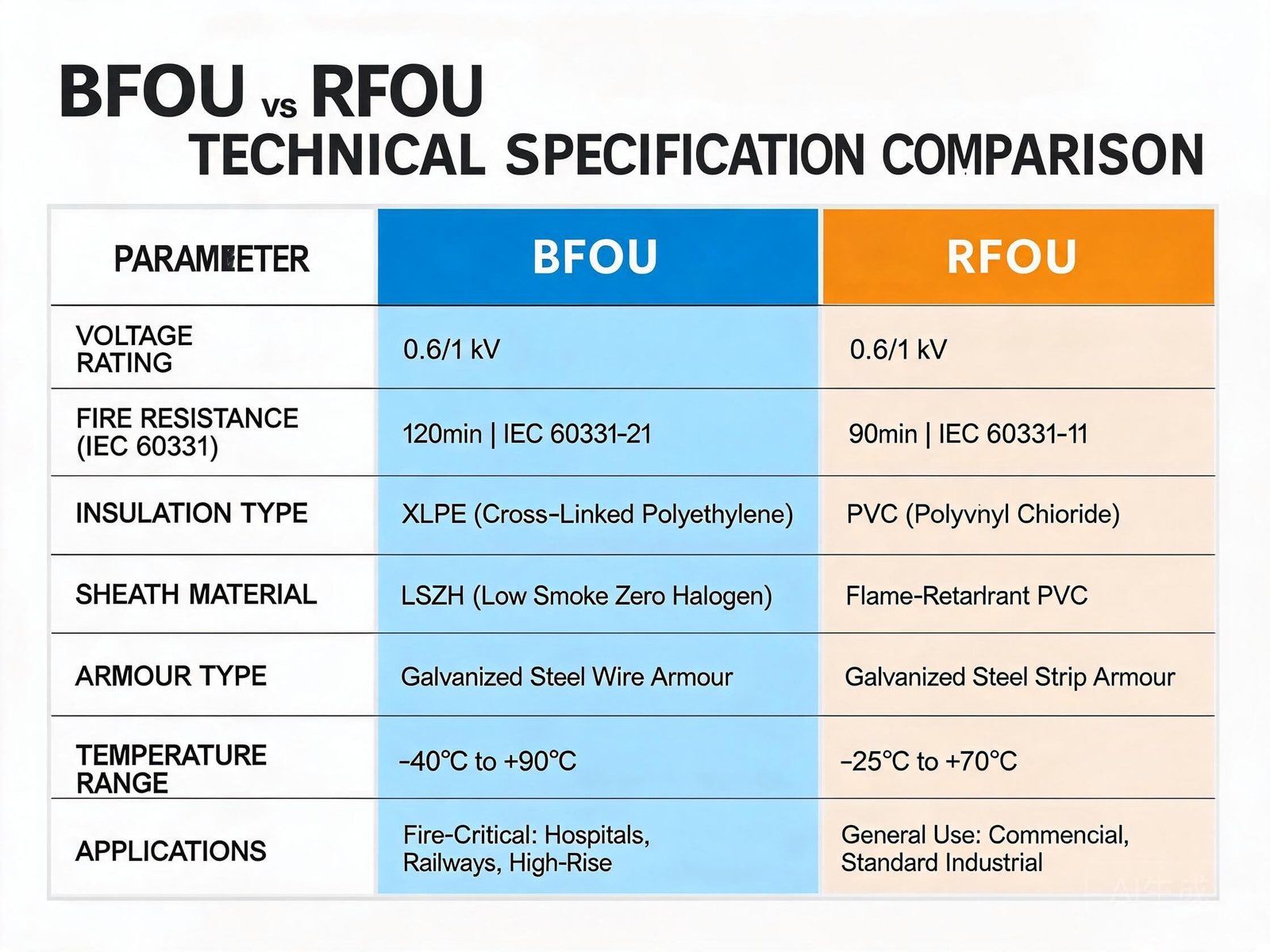
| Fire Resistance (Circuit Integrity) | Yes — IEC 60331-1/21 (750°C–950°C, 90–180 min) | No (circuit trips if flame melts insulation) | BFOU required for emergency safety loops |
| Bunched Flame Retardancy | IEC 60332-3-22 Category A | IEC 60332-3-22 Category A | Equal flame-spread suppression in cable trays |
| Smoke Density & Halogen Acid Gas | IEC 61034-2 (>60% light transmittance) & IEC 60754-1/2 (Zero Halogen) | IEC 61034-2 (>60% light transmittance) & IEC 60754-1/2 (Zero Halogen) | Equal personnel and electronics protection |
| Rated Voltage & Max Conductor Temp | 0.6/1kV (1.2kV max) | +90°C continuous (+250°C short-circuit) | 0.6/1kV (1.2kV max) | +90°C continuous (+250°C short-circuit) | Equal ampacity and thermal rating |
| Operating Ambient Temperature | -40°C to +85°C (fixed installation) | -40°C to +85°C (fixed installation) | Suitable for Arctic and tropical offshore zones |
| Oil & Drilling Mud Resistance | SHF2 & SHF Mud per NEK 606 / IEC 60092-360 | SHF2 & SHF Mud per NEK 606 / IEC 60092-360 | Equal mud-tank and shaker-room durability |
| Typical Outer Sheath Color | Orange (identifies fire-resistant circuit) or Black | Black (standard power/control) | Visual segregation on offshore cable ladders |
| Relative Procurement Cost | Higher (~20%–30% premium) | Baseline (20%–30% lower cost) | RFOU optimizes CAPEX on non-essential feeders |
When to Specify BFOU Cable
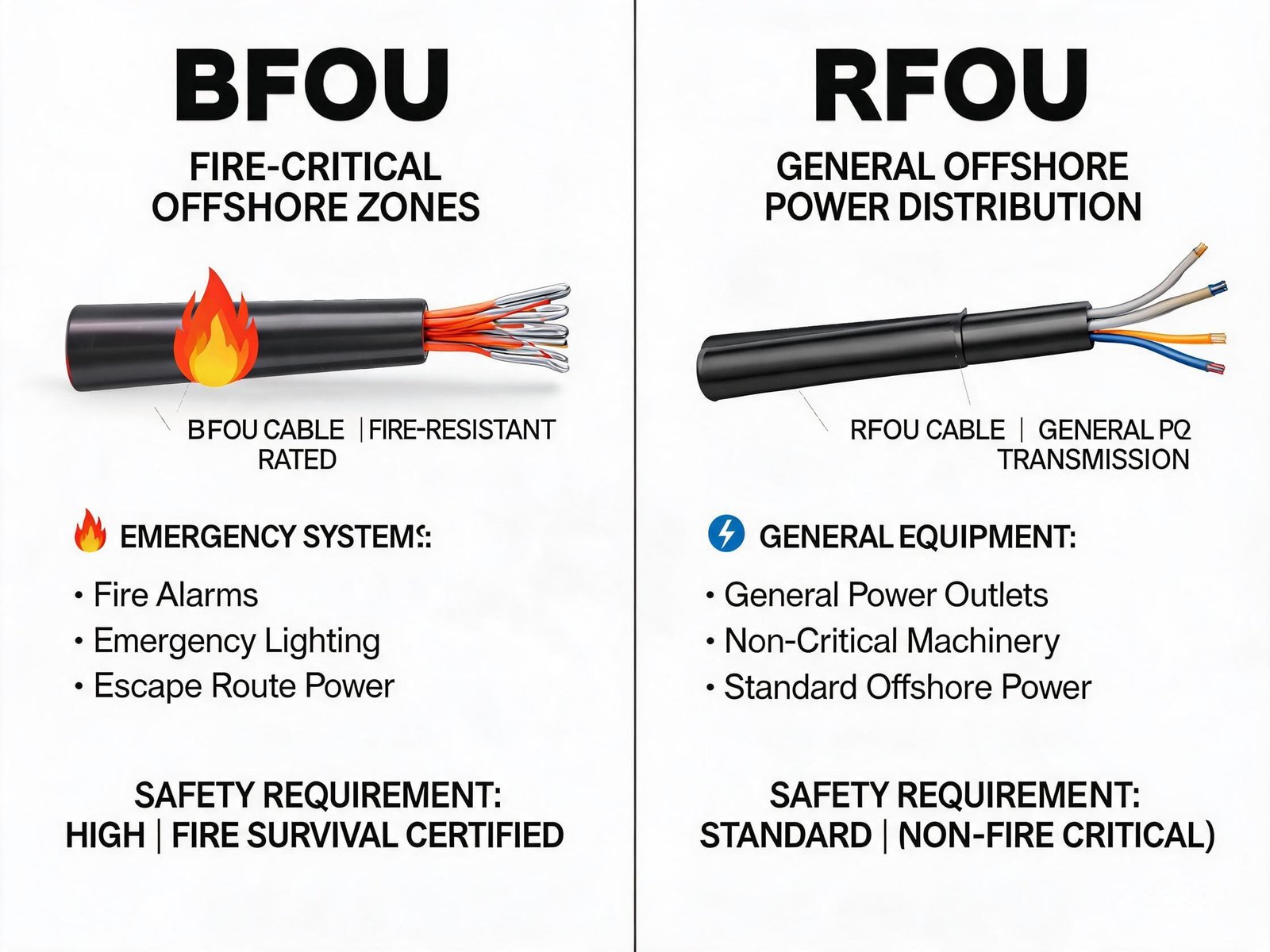
- Fire pump & deluge system feeders: Must continue operating during an active platform or vessel fire under SOLAS, DNV, and ABS rules.
- Emergency Shutdown (ESD) & blowout preventer (BOP) control: Requires uninterrupted power and signal integrity to isolate hydrocarbon risers during emergencies.
- Emergency generator to emergency switchboard interconnects: Critical life-safety power distribution.
- Escape route emergency lighting, PA/GA alarms & fire detection panels: Ensures safe personnel evacuation.
For detailed core sizes, ampacity, and outer diameters, see our BFOU cable specifications guide and BFOU offshore application guide.
When to Specify RFOU Cable
- General offshore power distribution: Main switchboard to non-emergency distribution panels on fixed platforms, FPSOs, and drilling rigs.
- Process compressors, pumps & drilling utility motors: Equipment designed to trip or de-energize automatically upon an ESD alarm.
- Normal accommodation & deck lighting / HVAC feeders: Non-emergency hotel load circuits.
- Project budget optimization: Specifying RFOU across non-essential circuits reduces total cable weight, outer diameter, and material cost by 20%–30% compared with 100% BFOU schedules.
Explore the RFOU 0.6/1kV offshore power cable product page and our RFOU technical specification guide for full sizing data.
Can BFOU and RFOU Be Interchanged?
Classification Compliance Rule: BFOU can substitute for RFOU during urgent field shortages because BFOU meets every mechanical, mud-resistance, and flame-retardant requirement of RFOU plus IEC 60331 fire survival. RFOU must never substitute for BFOU—doing so removes fire-circuit integrity and fails offshore classification inspection.
Quick Selection Matrix: BFOU vs RFOU vs BS 6883
| Offshore Circuit Type | Recommended NEK 606 Cable | UK / BS 6883 Equivalent Reference |
|---|---|---|
| Fire pumps, ESD valves, emergency generators, fire alarms | BFOU 0.6/1kV (S1/S5) | BS 7917 / UKOOA Fire-Resistant SW4 Armoured |
| Main process motors, HVAC, normal lighting, non-ESD feeders | RFOU 0.6/1kV (S2/S6) | BS 6883 Type SW4 EPR/GSWB |
| Fire-survivable 250V instrumentation pairs / triads | BFOU(i) / BFOU(c) 150/250V | BS 7917 Screened Armoured Instrumentation |
| Standard 250V instrumentation & PLC signals | RFOU(i) / RFOU(c) 150/250V | BS 6883 / EN 50288-7 Screened Pair |
Frequently Asked Questions
What is the main difference between BFOU and RFOU offshore cables?
Both BFOU and RFOU are 0.6/1kV halogen-free, mud-resistant offshore power and control cables built to NEK 606 and IEC 60092. BFOU is fire-resistant (IEC 60331-21, maintaining circuit integrity at 750°C–950°C for 90–180 minutes via a mica-glass tape fire barrier over each conductor), whereas RFOU is flame-retardant only (IEC 60332-3-22 Category A) without a mica fire barrier.
Can RFOU cable be used as a substitute for BFOU cable?
No. RFOU lacks the mica-glass fire barrier required by IEC 60331 and cannot maintain circuit integrity during a fire. Substituting RFOU for BFOU in emergency shutdown (ESD), fire pump, or escape lighting circuits violates SOLAS, DNV, and ABS offshore classification rules. BFOU can technically replace RFOU, though at a 20%–30% higher material cost.
What do the letters BFOU and RFOU stand for in NEK 606?
Under Norwegian offshore standard NEK 606: B stands for halogen-free fire-resistant insulation (EPR + mica tape), R stands for halogen-free EPR insulation (flame-retardant only), F denotes tinned copper or galvanized steel wire braid armour, O denotes an oil- and mud-resistant thermoset inner/outer sheath (SHF2 or SHF Mud), and U indicates a stranded circular or compacted tinned copper conductor.
Are BFOU and RFOU cables drilling-mud resistant?
Yes, when specified to NEK 606 S1/S5 or S2/S6 with an SHF Mud outer sheath, both BFOU and RFOU resist oil-based drilling fluids, calcium bromide brine, and ester/olefin mud systems tested per NEK 606 and IEC 60092-360.
Request BFOU & RFOU Offshore Cable Datasheets or Project Pricing
Share your offshore cable schedule (BFOU / RFOU, core count × mm², SHF2 vs. SHF Mud requirement, classification society rules, and drum lengths) for a rapid technical cross-reference and factory quotation.