
BFOU Cable FAQ: Most Common Questions
The BFOU cable is a specialized fire-resistant offshore cable, and engineers often have detailed questions about its fire rating, installation, and maintenance. This BFOU FAQ addresses the most frequently asked questions from TEBAOFLEX offshore customers.
For complete specifications, see our BFOU product page and specifications guide.
Fire Performance FAQ
Q1: What does IEC 60331 fire resistance mean?
A: IEC 60331 is the international standard for fire-resistant cables. It tests whether a cable can maintain circuit integrity (continue carrying current) during a fire:
- IEC 60331-21: Cable subjected to 750°C flame for 90 minutes while carrying rated voltage — must not short circuit
- IEC 60331-31: More severe — 950°C flame for 90 minutes with mechanical shocks applied during fire
BFOU cable with mica glass tape fire barrier meets these requirements. RFOU (without fire barrier) does not.
Q2: What is the difference between fire resistance and flame retardancy?
A: These are often confused but are fundamentally different:
- Fire resistance (IEC 60331): Cable continues to function during fire — power stays on. Required for safety circuits.
- Flame retardancy (IEC 60332): Cable will not propagate fire — self-extinguishing when flame removed. Does NOT maintain power during fire.
BFOU has both (fire resistant + flame retardant). RFOU has only flame retardancy. See our BFOU vs RFOU comparison for details.
Installation FAQ
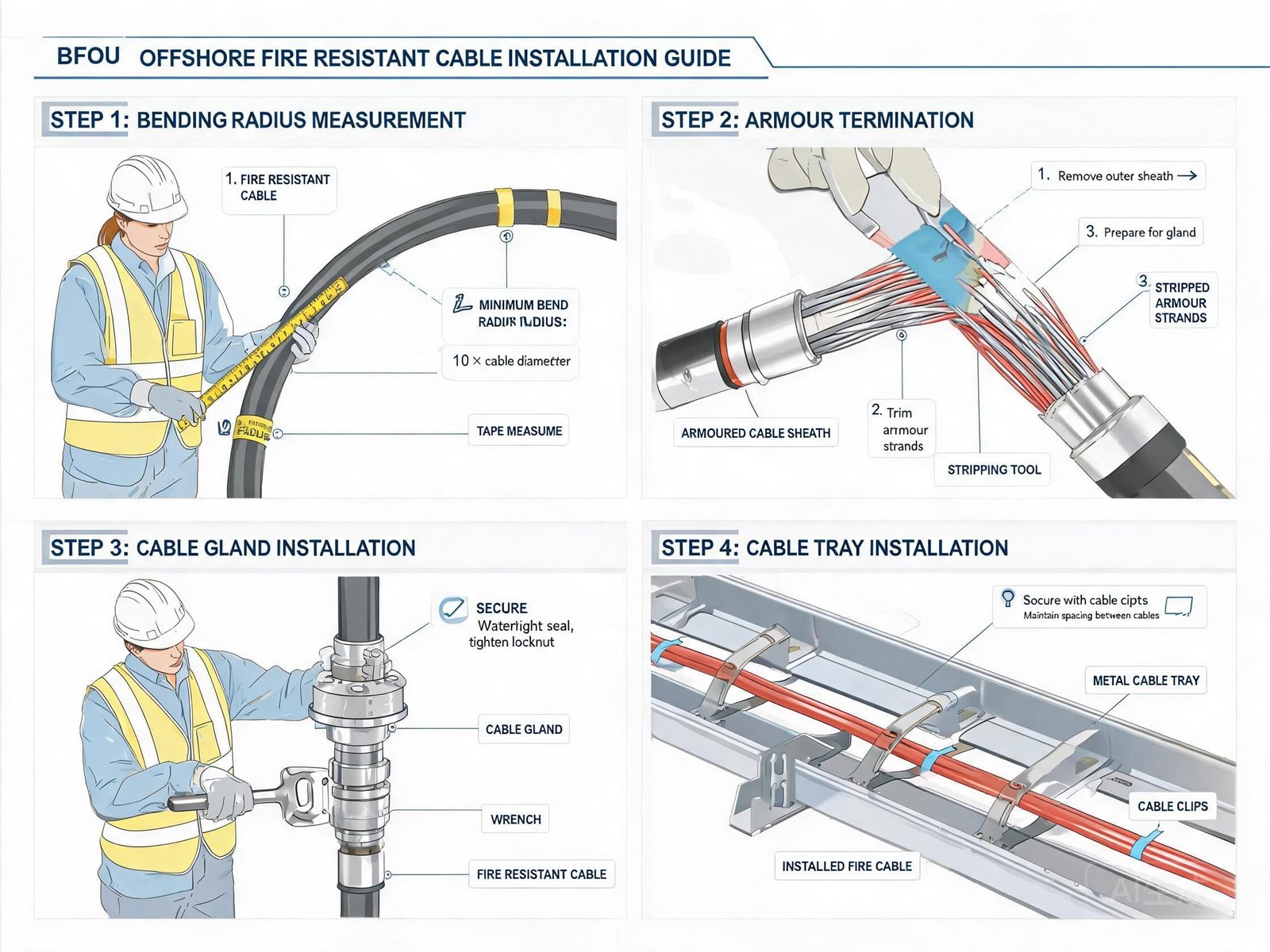
Q3: What is the minimum bending radius for BFOU cable?
A: Minimum bending radius for BFOU:
- Fixed installation: 8 × overall diameter (8D)
- During installation/pulling: 10 × overall diameter (10D)
For example, a BFOU cable with 30mm OD requires minimum 240mm fixed bending radius and 300mm during installation. Exceeding the minimum bending radius can damage the mica fire barrier and compromise fire resistance.
Q4: What cable glands should I use with BFOU?
A: Use weatherproof brass or stainless steel cable glands:
- Material: Nickel-plated brass or 316 stainless steel for offshore corrosion resistance
- IP rating: Minimum IP66 for outdoor deck, IP67/IP68 for splash zones
- Seal type: Compression seal rated for LSZH sheath material
- Approvals: DNV or ATEX certified glands for offshore installations
- Armour termination: Use glands with armour termination for steel wire braid
Q5: How should BFOU cable be routed through bulkheads?
A: Use fire-rated cable transit (MCT) systems:
- MCT frames: Steel frames welded or bolted to bulkhead
- MCT blocks: Fire-rated rubber blocks sized to cable OD
- Fire rating: MCT system must match cable fire rating (e.g., H-60, H-120, A-60 bulkhead rating)
- Compression: Properly compressed blocks seal around cable for fire and water tightness
- Spare blocks: Install spare transit blocks for future cable additions
Never pass BFOU cable through an unprotected bulkhead penetration — this compromises both fire resistance and watertight integrity.
Q6: Can BFOU cable be installed outdoors on deck?
A: Yes. BFOU is designed for offshore outdoor exposure:
- LSZH sheath is UV stabilized for outdoor use
- Orange ST1 sheath provides visual identification and UV resistance
- Temperature range: -20°C to +60°C (ambient)
- Oil and chemical resistant for deck exposure
- Steel wire braid provides mechanical protection
For extreme UV environments (tropical), consider additional sun protection or use black LSZH sheath variant.
Maintenance and Troubleshooting FAQ
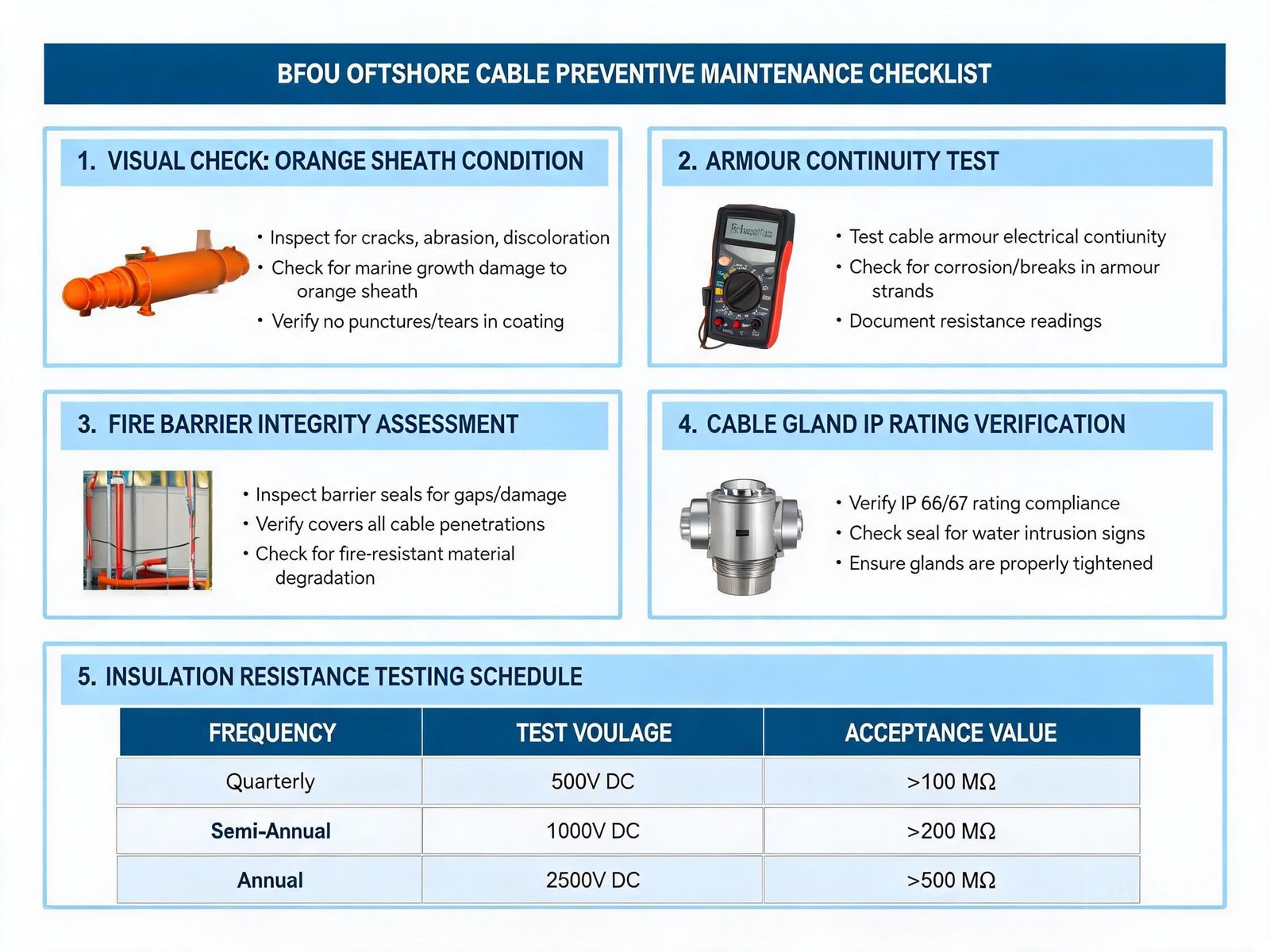
Q7: How often should I test BFOU cable insulation?
A: Recommended testing intervals for BFOU:
- New installation: 1kV Megger test before energizing (acceptance)
- Annual visual inspection: Check for sheath damage, gland condition, MCT transit tightness
- Annual insulation test: 1kV insulation resistance between cores and to ground
- After fire event: If cable was exposed to fire, replace it even if insulation test passes — fire barrier may be degraded
Minimum acceptable insulation: >100 MΩ for new cable, >10 MΩ for in-service cable. See our cable maintenance guide for procedures.
Q8: What are common causes of BFOU cable failure?
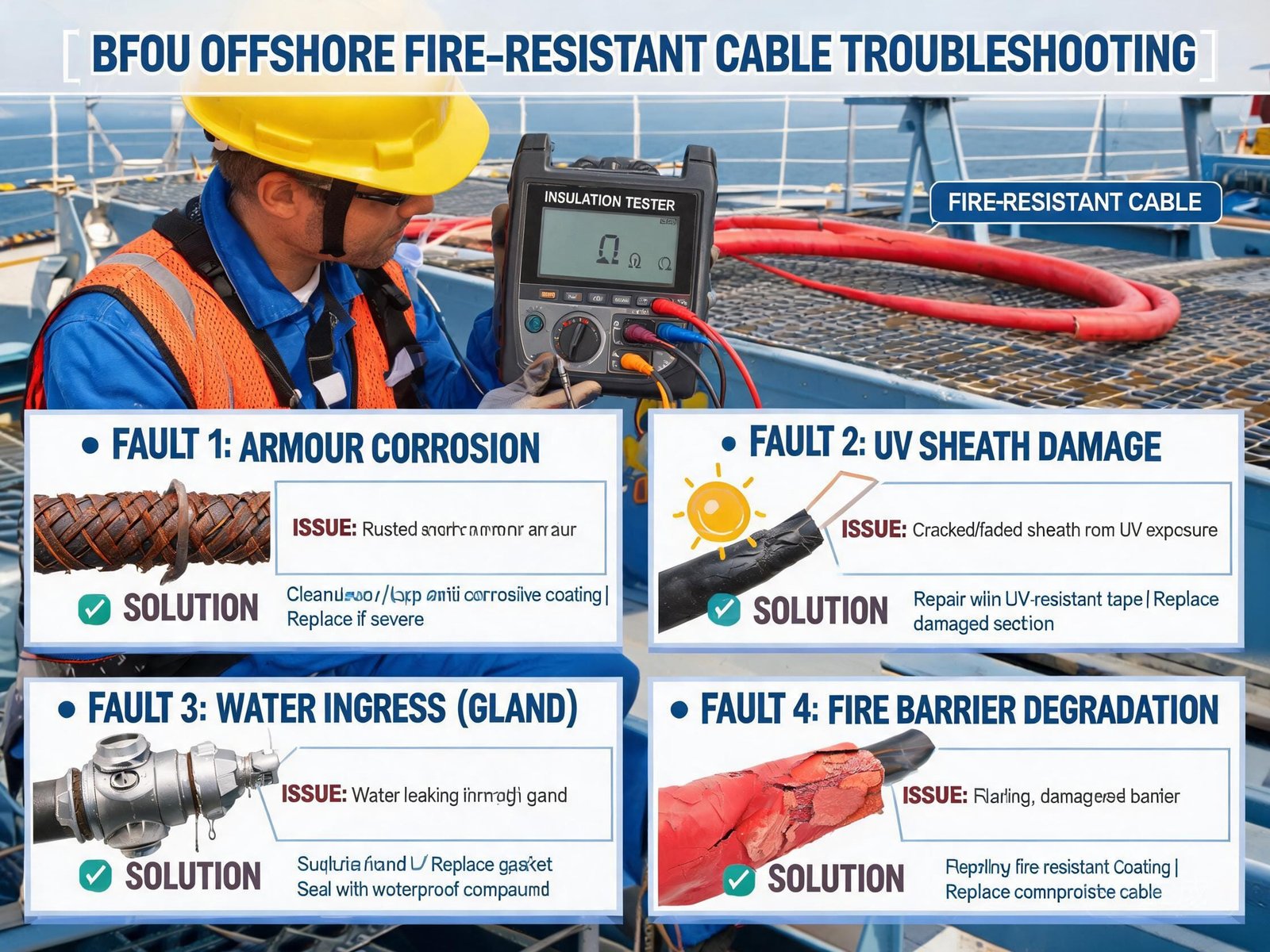
A: Common failure modes for BFOU offshore cables:
- Sheath damage: Mechanical damage from deck operations, dropped objects, or abrasion
- Gland failure: Water ingress through improperly sealed cable glands causing corrosion
- Fire damage: Cable exposed to fire — even if it survived, the fire barrier is degraded and must be replaced
- UV degradation: Long-term UV exposure on deck causing sheath cracking (rare with LSZH)
- Vibration fatigue: Conductor strand breakage at rigid terminations on vibrating platforms
- Corrosion: Steel wire armour corrosion through sheath damage
Q9: Can a BFOU cable that has been through a fire be reused?
A: No. Even if the BFOU cable maintained circuit integrity during the fire (passed the IEC 60331 test in service), it must be replaced because:
- Mica glass tape fire barrier is degraded and may not survive a second fire
- Silicone/EPR insulation may have thermal damage not visible externally
- LSZH sheath may have embrittled and lost mechanical strength
- Classification rules require replacement of fire-exposed cables
After any fire event affecting BFOU cable, replace the entire affected cable run and test all circuits before re-energizing.
Q10: How do I identify genuine BFOU cable?
A: Check for:
- Cable marking: “BFOU” with voltage (0.6/1kV), NEK 606 standard, manufacturer name, and fire rating
- Sheath color: Orange (ST1 LSZH) is standard for offshore BFOU
- Construction: Mica glass tape over each conductor (visible when disassembled)
- Armour: Galvanized steel wire braid visible under sheath
- Certifications: DNV, ABS, LR, or BV type approval certificate
- Fire test report: IEC 60331-21 or -31 type test certificate from manufacturer
Q11: What is the service life of BFOU cable?
A: Expected service life:
- Normal offshore service: 20-25+ years (no fire exposure)
- Deck exposure (UV, salt spray): 15-20 years
- After fire exposure: Must be replaced immediately
- Engine room (high temp): 15-20 years depending on ambient temperature
Still Have Questions?
TEBAOFLEX technical support is available for:
- BFOU cable sizing and selection for offshore fire safety systems
- Classification society compliance and certification
- Installation planning including MCT transit sizing
- Fire resistance rating selection (IEC 60331-21 vs -31)
- Quotation and delivery timeline
Contact TEBAOFLEX engineering for expert assistance and competitive pricing on BFOU fire-resistant offshore cables.