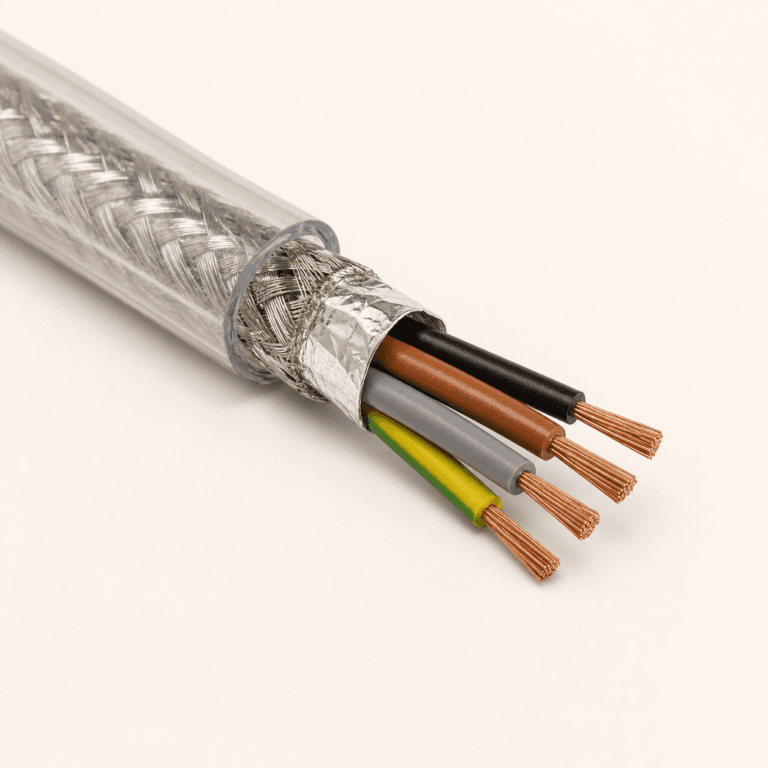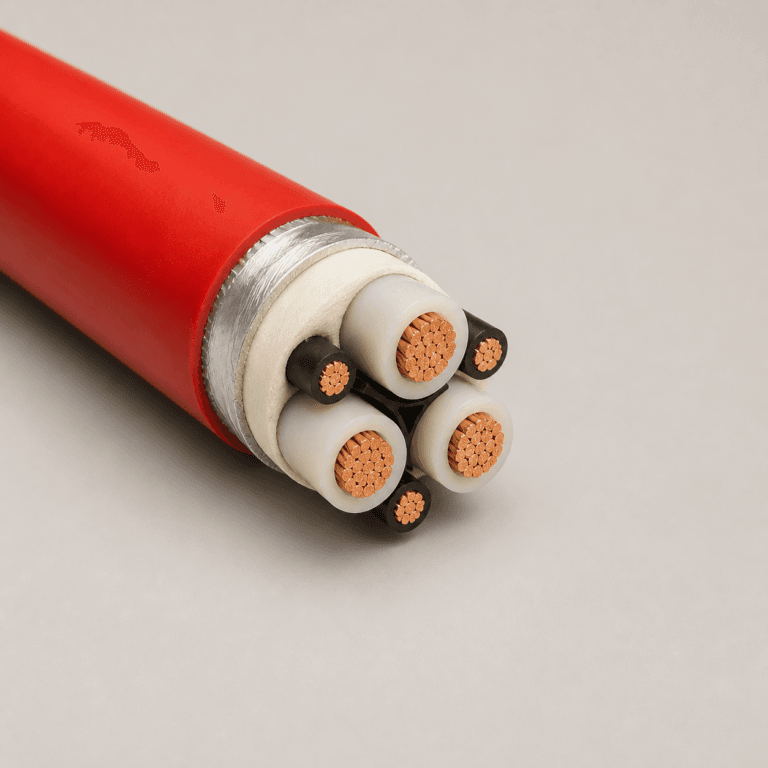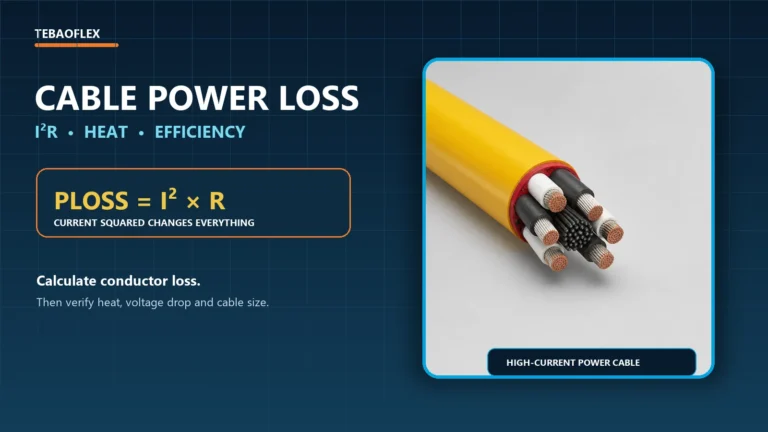

Converting watts to amps requires more than dividing power by voltage in many AC systems. The correct formula depends on whether the circuit is DC, single-phase AC or balanced three-phase AC. AC calculations may also need power factor and, when a motor rating describes mechanical shaft output, motor efficiency.
The calculated current is only the starting point for cable selection. Final conductor size must still be checked for cable ampacity, ambient and installation derating, route length, voltage drop, short-circuit duty and the mechanical demands placed on the cable. The practical engineering path is watts or kW → verified amps → design current → ampacity → conductor size → voltage drop → suitable industrial cable construction.
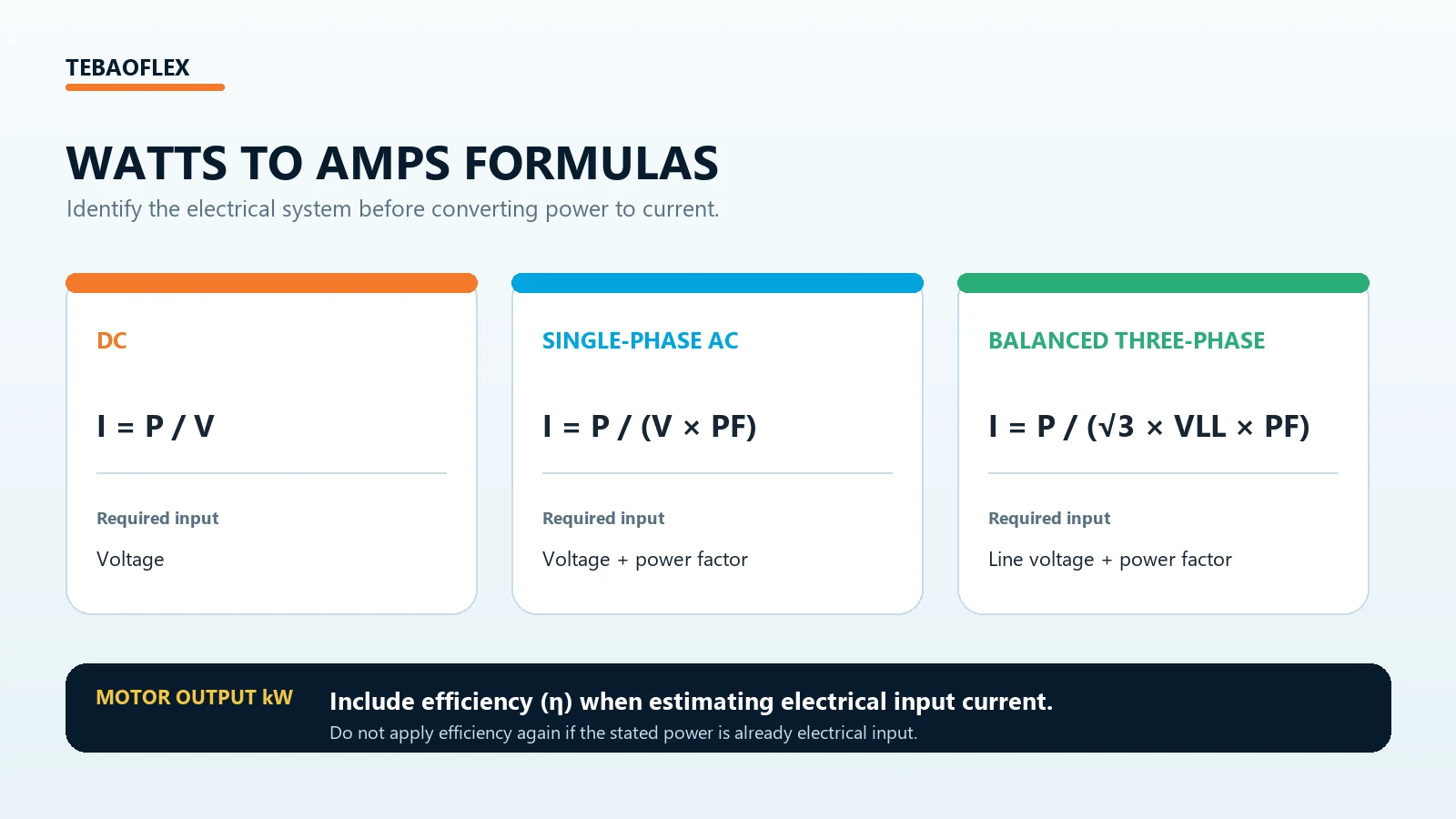
| Electrical system | Current formula* | Additional data required |
|---|---|---|
| DC | I = P / V | Voltage |
| Single-phase AC | I = P / (V × PF) | Voltage and power factor |
| Balanced three-phase AC | I = P / (√3 × VLL × PF) | Line-to-line voltage and power factor |
| Motor output kW | Include efficiency η as applicable | Voltage, power factor and efficiency |
*These formulas assume P is real electrical input power unless stated otherwise. If the stated motor kW is mechanical output power, include efficiency when estimating electrical input current.
Watts, Kilowatts and Amps: What Is the Difference?
Watts (W) measure real power. Kilowatts (kW) are the same quantity at a larger scale: 1 kW equals 1,000 W. Amperes (A) measure electric current. Power alone does not determine current; voltage and the circuit configuration matter, and AC loads can also require power factor.
This unit relationship is consistent with the SI definition of the volt, 1 V = 1 W/A, summarized by the U.S. National Institute of Standards and Technology. It also explains why kWh must not be entered into a watts-to-amps formula: kW is power, while kWh is energy accumulated over time. For the underlying voltage-current-resistance relationship, see Ohm’s Law for electrical cables.
Watts to Amps Formulas
DC watts to amps
For a DC load whose stated power is electrical input power:
I = P / V
I is current in amperes, P is power in watts, and V is voltage in volts. A 5,000 W load at 48 V therefore draws approximately 104.2 A: 5,000 / 48 = 104.2. This is why apparently modest power can create a demanding conductor and voltage-drop problem in a low-voltage DC system.
Single-phase watts to amps
For single-phase AC real electrical input power:
I = P / (V × PF)
PF is the load power factor. For a 5,000 W load at 230 V with PF 0.90, estimated current is 5,000 / (230 × 0.90) = 24.2 A. If the load is not purely resistive, using P/V alone understates current whenever PF is below 1.
Three-phase watts to amps
For a balanced three-phase load when VLL is line-to-line voltage:
I = P / (√3 × VLL × PF)
For 15 kW of real electrical input power at 400 V and PF 0.85, estimated line current is 15,000 / (1.732 × 400 × 0.85) = 25.5 A. This result is valid only for the stated basis: balanced three-phase operation, line-to-line voltage and electrical input kW.
How to Convert kW to Amps
Industrial equipment is commonly rated in kW rather than watts. Convert kW to watts first:
P(W) = P(kW) × 1,000
- DC: I = kW × 1,000 / V
- Single-phase AC: I = kW × 1,000 / (V × PF)
- Balanced three-phase AC: I = kW × 1,000 / (√3 × VLL × PF)
Before using any of these expressions, identify what the power rating represents. A heater’s electrical input, a drive’s input rating and a motor’s shaft-output rating are not interchangeable inputs.
Motor kW to Amps: Why Efficiency Matters
If kW means electrical input power
When P already represents real electrical input power, the formulas above apply directly. Do not divide by motor efficiency again. Applying efficiency twice produces an unnecessarily high current estimate and can distort preliminary conductor and protection decisions.
If kW means mechanical output power
A motor kW rating commonly describes mechanical output at the shaft. Electrical input must be higher because the conversion is not 100% efficient. For an estimate, include efficiency η:
- Single phase: I = Pout / (V × PF × η)
- Balanced three phase: I = Pout / (√3 × VLL × PF × η)
Power factor and efficiency describe different effects. Power factor relates real power to apparent power in an AC system; efficiency relates mechanical output to electrical input. Ignoring efficiency when kW is shaft output tends to understate current. Applying it when kW is already electrical input overstates current.
Use Motor Nameplate Current When Available
For final motor cable sizing, use verified motor or equipment nameplate current and manufacturer data whenever available. A generic kW-to-amps result is valuable for estimating, checking or early design, but it cannot capture every motor’s efficiency, power factor, design, voltage, duty or drive arrangement.
The U.S. Department of Energy’s Premium Efficiency Motor Selection and Application Guide treats input power, output power, efficiency, power factor and current as distinct motor quantities. Its motor guidance also makes clear that current behavior changes with voltage and loading. Record verified values rather than replacing them with a default PF or efficiency copied from a generic chart.
Worked Watts-to-Amps Examples
Example 1: 5 kW DC load at 48 V
Assume 5 kW is electrical input power. I = 5,000 / 48 = 104.2 A. The power is only 5 kW, but current exceeds 100 A because the supply voltage is low. Long positive and negative conductors also create loop resistance, so the next step should include DC cable voltage drop and sizing.
Example 2: 5 kW single-phase load at 230 V
With electrical input power of 5,000 W and PF 0.90, I = 5,000 / (230 × 0.90) = 24.2 A. That number does not by itself select 2.5, 4 or 6 mm². It is an input to the amps to cable size process, where the applicable ampacity basis, installation, derating and route length are evaluated.
Example 3: 15 kW three-phase motor at 400 V
Assume the 15 kW rating is mechanical shaft output, PF is 0.86 and efficiency is 0.91. Estimated current is:
I = 15,000 / (1.732 × 400 × 0.86 × 0.91) = 27.7 A
If efficiency were incorrectly omitted, the result would be about 25.2 A. The difference illustrates why motor output kW must not automatically be treated as electrical input kW. The final design should still use the verified rated current and applicable motor-circuit rules.
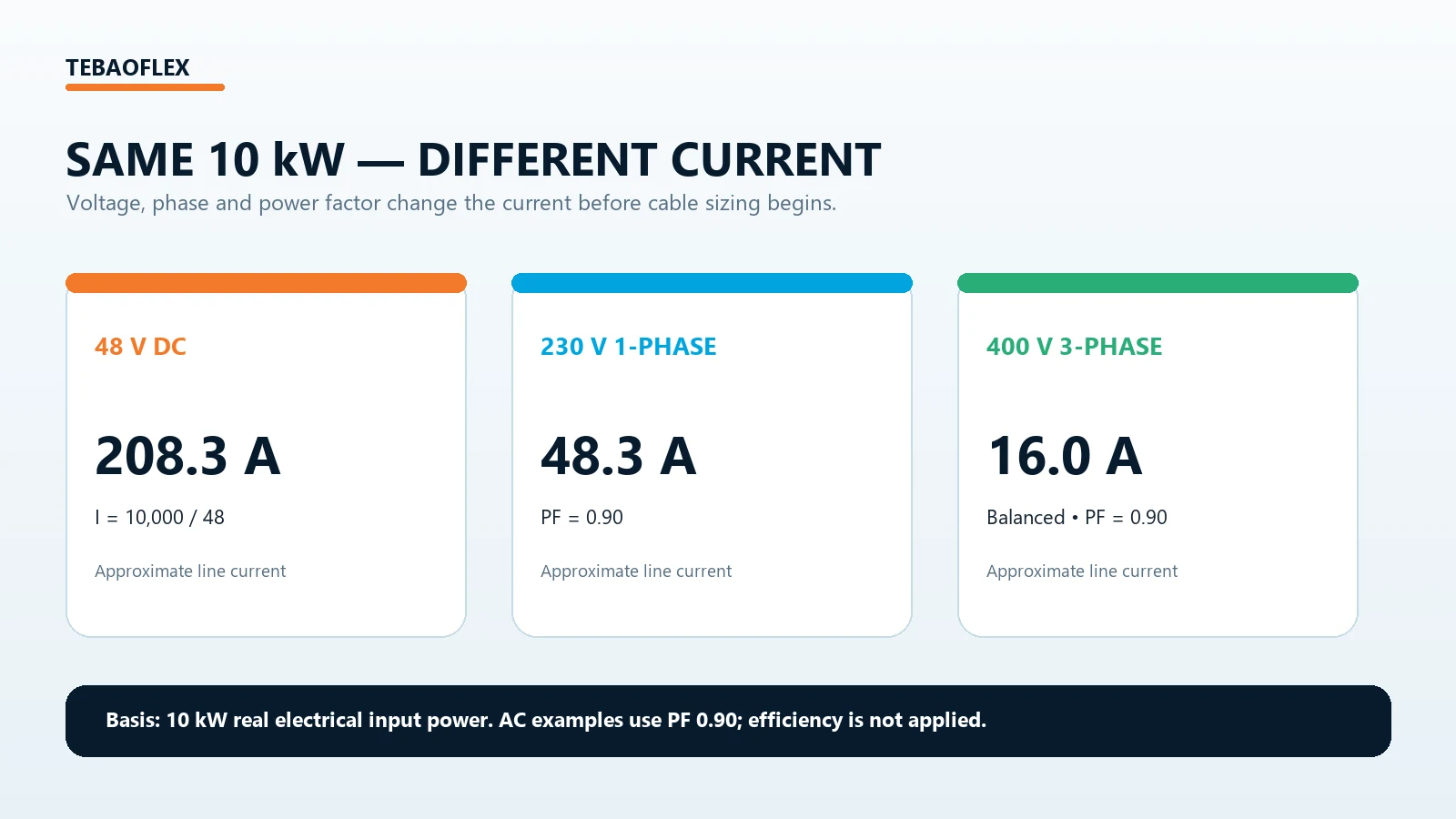
Why the Same kW Can Mean Different Amps
| Same 10 kW load | Voltage and system | Current tendency |
|---|---|---|
| DC load | 48 V DC | Very high current at low voltage |
| Single-phase load | 230 V AC | Lower current; PF still matters |
| Three-phase load | 400 V line-to-line | Lower line current for a balanced load |
| Three-phase load | 690 V line-to-line | Lower again, with the same power basis and PF |
kW alone is not enough to determine current. Voltage, phase configuration, power factor and, where applicable, efficiency are required. This is also why a universal “motor kW to cable mm²” chart without assumptions is not a reliable engineering tool.
Why Three-Phase Current Uses √3
In a balanced three-phase system, the line voltages are separated by 120 electrical degrees. The vector relationship between line-to-line voltage and phase voltage introduces √3, approximately 1.732, into the total-power expression: P = √3 × VLL × I × PF. The formula is not a general multiplier for every AC circuit; it belongs to the balanced three-phase relationship using line-to-line voltage.
Line-to-line vs line-to-neutral voltage
When using VLL, use P = √3 × VLL × I × PF. When using phase-to-neutral voltage VLN in a balanced wye system, use P = 3 × VLN × I × PF. Mixing a line-to-neutral value into the line-to-line formula creates a major error. Confirm the voltage shown on the equipment data, drawing or nameplate before calculating.
Power Factor: Why Watts ÷ Volts Is Not Enough for AC
For DC, or an ideal resistive AC load at PF 1, the simple relationship P = V × I is sufficient. Many motors, transformers and electronic loads draw current that is not represented by real watts alone. At the same real power and voltage, a lower power factor means higher current. Use equipment or manufacturer PF data whenever possible; do not assume that all motors share one value.
Watts-to-amps is also different from kVA-to-amps. kW is real power, whereas kVA is apparent power. If apparent power is already known, do not multiply or divide by PF again merely to recreate that same kVA value.
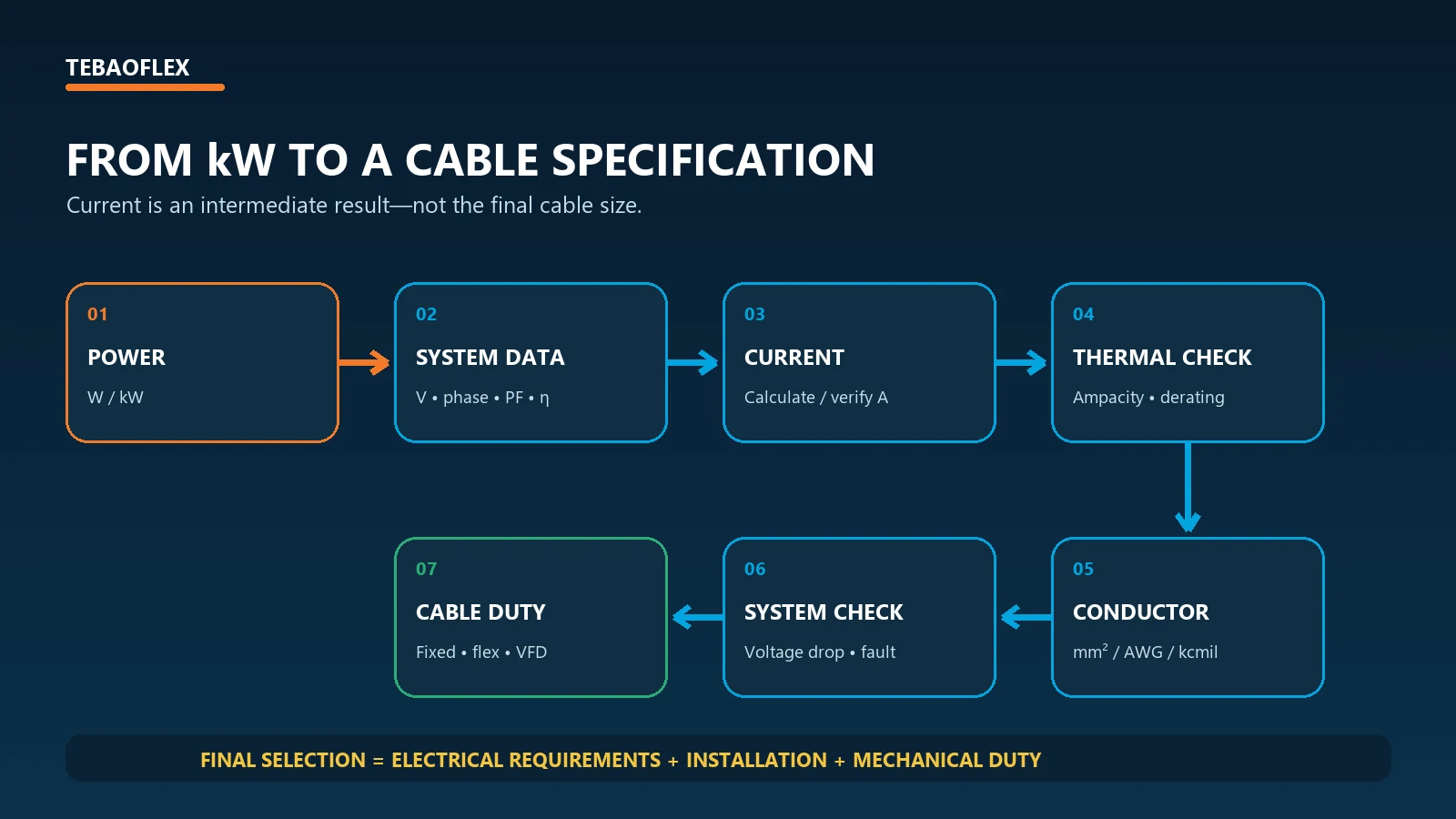
From Watts to Amps to Cable Size
Once current is known, use it as the beginning of a documented sizing workflow:
- Confirm whether power is electrical input or mechanical output.
- Calculate current for the correct DC, single-phase or three-phase system, then compare it with measured or nameplate current.
- Establish design current, duty cycle and relevant starting or peak conditions.
- Select an ampacity basis that applies to the actual cable and installation.
- Apply ambient-temperature, grouping and other required correction factors.
- Select a candidate mm², AWG or kcmil conductor.
- Check voltage drop, short-circuit withstand, protection and terminations.
- Confirm that the cable construction suits fixed, flexible, reeling, trailing or drive duty.
Calculated amps are not automatically cable ampacity. A 27.7 A motor estimate does not mean “choose a 27.7 A cable.” Allowable current depends on cable construction, conductor and insulation temperature, installation method, loaded-conductor count, grouping, ambient conditions and the governing rules. Use the cable ampacity calculation guide and the broader cable size and cross-section selection workflow.
Cable length can increase the final conductor size
A short and a long circuit may carry the same current, yet the long circuit has more conductor resistance and voltage drop. A candidate cable can pass its thermal ampacity check and still be too small to deliver acceptable voltage at the equipment. Compare how cable length affects voltage drop, then use the full cable voltage drop calculation with verified resistance, reactance and route data.
IEC 60364-5-52 addresses the selection and erection of low-voltage wiring systems, including cable-sizing and voltage-drop considerations; confirm the edition and national implementation applicable to the project. The current consolidated edition is listed by the International Electrotechnical Commission.
Motors, Pumps, Conveyors and Mobile Equipment
Industrial motors, pumps and fans
Start with rated motor current where available. If a pump or fan is described only by process or shaft output, do not treat that number as electrical input. Confirm the motor, supply, starter or drive, duty and manufacturer limits before sizing the circuit.
Conveyors, cranes and material handling
Multiple motors, brakes, frequent starts and intermittent peaks can make the current profile more important than a single steady-state kW value. Movement adds bend radius, tension, abrasion, torsion and cable-management constraints. The industrial cable selection guide connects those application details to the electrical checks.
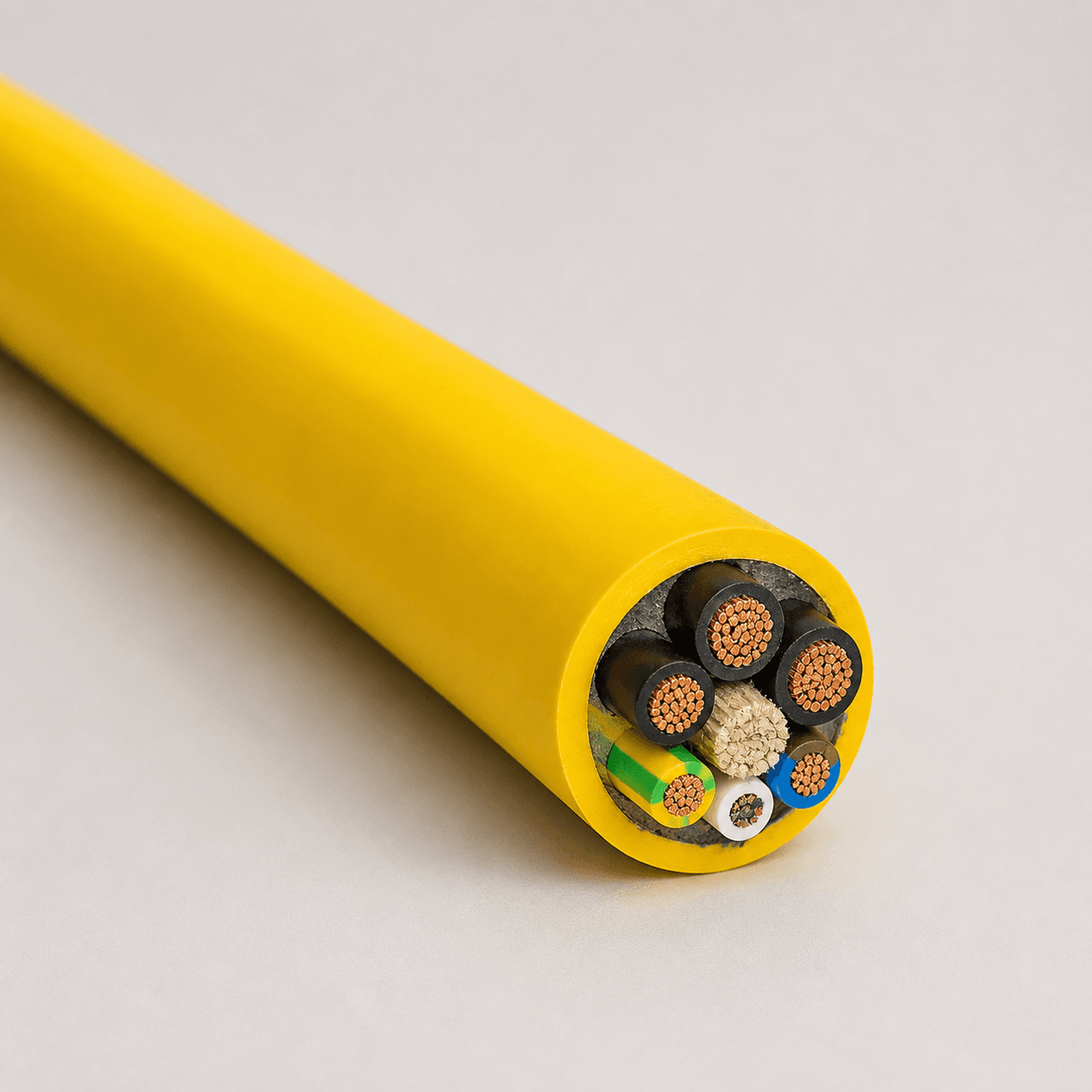
Cable-family examples after electrical sizing
Once the electrical requirement and conductor size are established, match the construction to the application. The BUFLEX-M flexible industrial power cable is a 0.6/1 kV Class 5 copper, XLPE-insulated, PUR-sheathed power/control construction published in phase-conductor configurations from 25 to 240 mm². A moving application must still confirm bend radius, movement and environment.
For a heavy-current single-conductor arrangement, DLO flexible single-conductor power cable is published from 14 AWG through 1111.1 kcmil for locomotives, switchgear, mining equipment and other flexible power connections. Its final ampacity remains installation-dependent.
For a frequency-converter motor connection, the shielded VFD and servo motor cable family includes 2YSLCY-JB, a 600/1000 V Class 5 construction with foil and tinned-copper braid screens. This is an application-family example—not a cable automatically selected from motor kW.
Motor Starting Current vs Running Current
Calculated running current is not starting current. A motor can draw substantially more current while accelerating, but the magnitude and duration depend on motor design, the driven load, supply stiffness and whether starting is direct, reduced-voltage, soft-start or VFD-controlled. Avoid a universal “six times” rule.
Cable sizing, starting voltage drop and protection coordination may require separate checks. A cable that is thermally adequate in normal operation can still allow excessive terminal-voltage reduction during acceleration, especially on a long route.
VFD Motors Need More Than a kW-to-Amps Calculation
A VFD system requires the drive output current, motor current, cable length, EMC design, screen termination, grounding, cable capacitance and drive-manufacturer limits to be reviewed together. A generic power cable selected only from kW and steady current may not provide the required screening or electrical behavior. Confirm the complete drive-cable-motor system and the mechanical route before specifying the cable.
Common Watts-to-Amps Calculation Mistakes
- Dividing watts by volts for every AC load: this ignores power factor and three-phase configuration.
- Confusing kW and W: 15 kW is 15,000 W.
- Confusing kW and kWh: kW is power; kWh is energy over time.
- Ignoring motor efficiency: output kW is lower than electrical input power.
- Applying efficiency twice: do not divide by η when P already means electrical input.
- Mixing line-to-line and line-to-neutral voltage: use the matching three-phase equation.
- Treating calculated current as cable ampacity: installation and temperature conditions still govern allowable current.
- Ignoring starting or peak current: pumps, cranes and conveyors may need transient checks.
Input Data Checklist Before Requesting a Cable
| Parameter | Example or required clarification |
|---|---|
| Power | 15 kW |
| Power basis | Electrical input or mechanical output |
| System | DC, single-phase or three-phase |
| Voltage | 400 V |
| Three-phase voltage basis | Line-to-line or line-to-neutral |
| Power factor | 0.86, preferably verified |
| Efficiency | 91%, when output power is the input |
| Rated/nameplate current | Use when available |
| Cable route | 80 m one-way routed length |
| Installation | Tray, free air, conduit, ground or mobile |
| Movement | Fixed, flexible, reeling, festoon or drag chain |
Frequently Asked Questions
How do you convert watts to amps?
Use the formula for the actual system. DC uses I = P/V, single-phase AC uses I = P/(V × PF), and balanced three-phase AC using line voltage uses I = P/(√3 × VLL × PF).
How do you convert kW to amps?
Multiply kW by 1,000 to obtain watts, then use the correct DC, single-phase or three-phase formula. Include efficiency only when the stated kW is mechanical output and electrical input current is being estimated.
How do you calculate three-phase watts to amps?
For a balanced load using line-to-line voltage, I = P/(√3 × VLL × PF). Confirm that P is real electrical input power; motor shaft-output power also requires efficiency.
How many amps is a 15 kW motor?
15 kW alone is not enough. You need voltage, phase, power factor, efficiency and the meaning of the kW rating. At 400 V three phase, PF 0.86 and efficiency 0.91, a 15 kW output example is about 27.7 A; use actual nameplate current for final work.
Do I need power factor to convert watts to amps?
Not for DC. For AC real-power calculations, power factor is normally required unless a PF of 1 is known to apply. Use verified equipment data rather than a generic assumption.
Do I need motor efficiency when converting kW to amps?
Yes when kW represents mechanical shaft output and you are estimating electrical input current. No when the stated kW is already real electrical input power.
Is calculated motor current the same as starting current?
No. Running and starting conditions differ. Starting current and duration depend on the motor, load and starting method, so voltage-drop and protection checks may need a separate starting case.
Can I select cable size directly from motor kW?
No. Convert or verify current, establish design current, check ampacity and derating, select a candidate conductor, then verify voltage drop, fault duty, terminations and application-specific cable construction.
Does the same kW require the same cable size at different voltages?
No. Voltage and phase change current, while installation, ambient temperature, route length, voltage drop, standard and mechanical duty can further change the final cable size.
Need Help Converting Equipment Power into a Cable Specification?
Send TEBAOFLEX the equipment power rating, whether the stated kW is electrical input or motor output, system voltage, phase, rated current if available, power factor, efficiency, cable length, installation method and movement requirements. We can review the current requirement together with ampacity, voltage drop and mechanical cable duty before confirming a suitable cable configuration.
Technical review basis: NIST SI unit relationships; U.S. Department of Energy motor-system guidance; IEC 60364-5-52:2009+AMD1:2024; verified TEBAOFLEX product data; and the linked calculation guides. Updated September 28, 2026. Calculations are instructional estimates. Final design must follow the equipment manufacturer’s data, applicable code, national implementation, product marking and project engineering requirements.