
Introduction to (N)TMCGCW11Y Cable Equivalents
When sourcing medium voltage reeling cables for industrial applications, engineers often encounter multiple cable designations that appear functionally similar. The (N)TMCGCW11Y cable by TEBAOFLEX is engineered to meet or exceed the performance specifications of numerous international PUR-sheathed medium voltage reeling cable brands. This comprehensive cross-reference guide helps you identify equivalent cables and understand the technical basis for equivalence.
True cable equivalence requires analysis of voltage rating, conductor stranding, insulation material, screening effectiveness, sheath compound formulation, flex life rating, and environmental resistance. This guide examines each parameter to provide confident specification and substitution decisions.
Designation Breakdown
The (N)TMCGCW11Y designation follows the German VDE cable coding system:
| Code Element | Meaning |
|---|---|
| (N) | National type (harmonized standard) |
| T | Reeling/Trailing cable for mining and industrial applications |
| M | Medium voltage rated |
| CG | Copper conductor with semiconductor screen |
| CW | Copper wire braid screen |
| 11 | EPR insulation (90°C) + semiconductor screen |
| Y | Polyurethane (PUR) outer sheath |
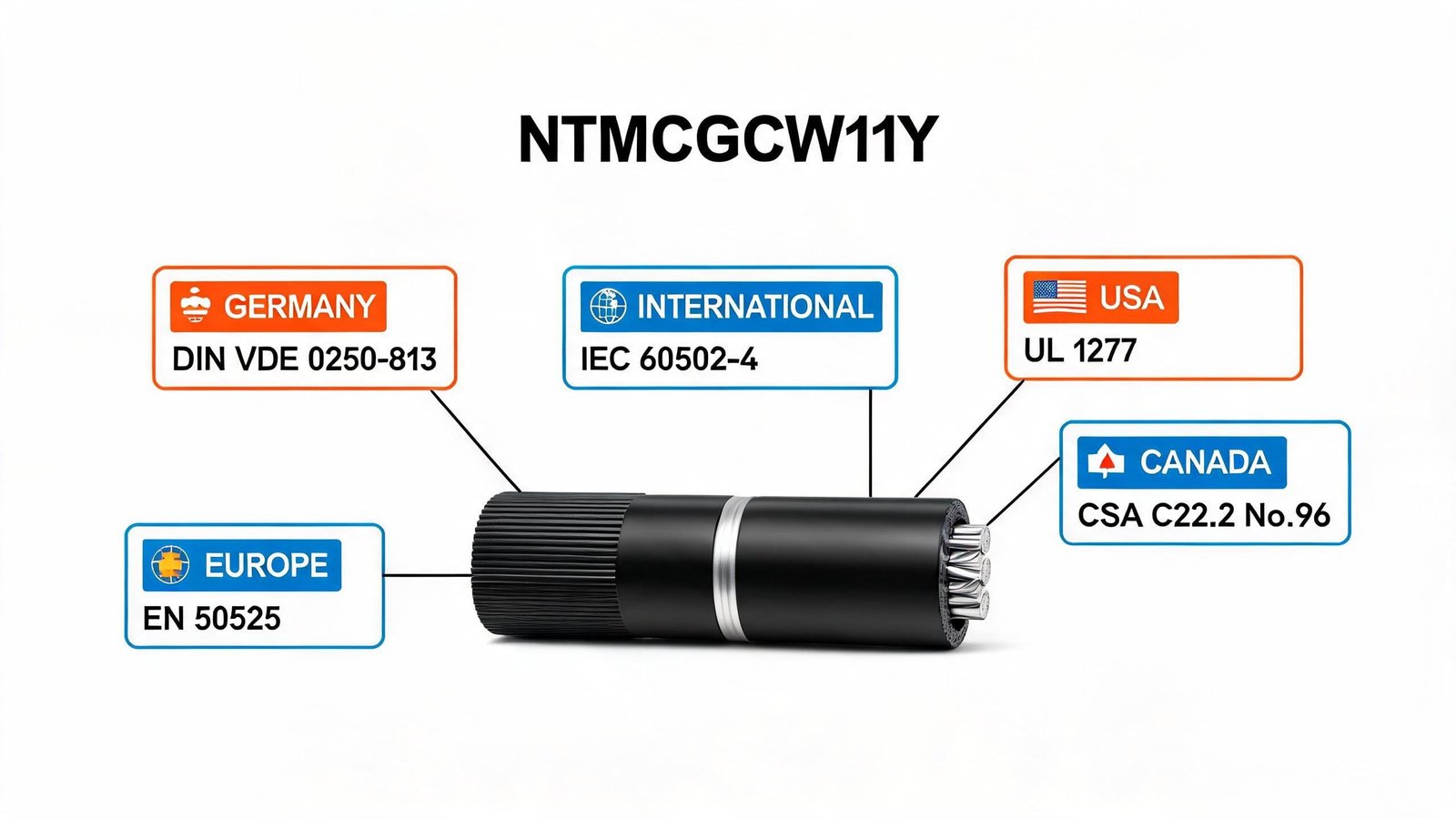
(N)TMCGCW11Y international standards compliance: DIN VDE, IEC, UL, CSA, and EN
International Standard Equivalents
| Standard | Designation | Scope | Equivalence |
|---|---|---|---|
| VDE | DIN VDE 0250-813 | German reeling cable standard | Direct compliance — primary standard |
| IEC | IEC 60502-4 | MV cables for power distribution | Compliant construction and materials |
| IEC | IEC 60228 Class 5 | Conductor stranding | Full compliance — finely stranded |
| IEC | IEC 60332-1-2 | Flame retardancy | Full compliance — self-extinguishing |
| UL | UL 1277 | Electrical power cable | Available with UL listing |
| CSA | CSA C22.2 No. 96 | MV cable standard | Available with CSA approval |
| EN | EN 50525-2-11 | European harmonized cables | Compliant with PUR sheath requirements |
Brand-by-Brand Cross-Reference
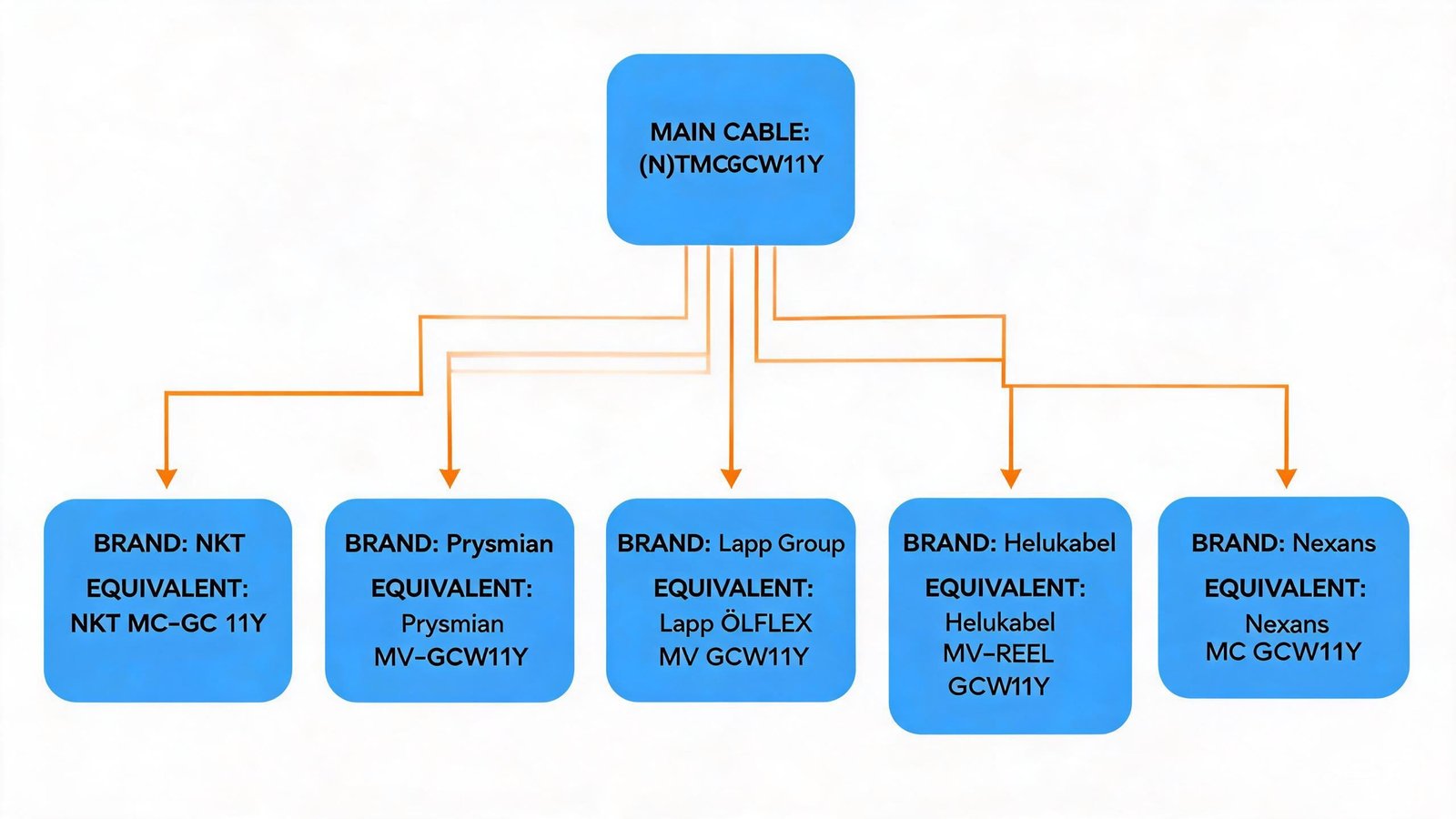
(N)TMCGCW11Y brand cross-reference: equivalent models from major manufacturers
European Cable Manufacturers
| Brand | Designation | (N)TMCGCW11Y Equivalent | Notes |
|---|---|---|---|
| NKT | (N)TMCGCWU | (N)TMCGCW11Y | PUR sheathed MV reeling cable; direct equivalent |
| Prysmian | RFEPR-CU/PUR | (N)TMCGCW11Y | EPR insulated PUR sheathed reeling cable |
| Nexans | RMPR-PUR | (N)TMCGCW11Y | Medium voltage PUR reeling cable |
| Lapp Group | ÖLFLEX-MV | (N)TMCGCW11Y (comparable) | Specify for equivalent voltage class and PUR sheath |
| Helukabel | PUR-MV-Reel | (N)TMCGCW11Y (comparable) | Verify voltage class and conductor size |
| SAB Bröckskes | SAB 580 PUR-MV | (N)TMCGCW11Y (comparable) | PUR sheathed MV reeling cable |
Related VDE 0250-813 Designations
| Designation | Sheath Material | (N)TMCGCW11Y Equivalence |
|---|---|---|
| (N)TMCGCW11Y | PUR (Polyurethane) | Base reference cable |
| (N)TMCGCWOEU | EPR/PCP rubber | Rubber-sheathed version — lower flex life |
| (N)TMCGCWU | PUR (Polyurethane) | Direct equivalent (generic designation) |
| (N)TSCGEWOU | PCP rubber | Rubber-sheathed equivalent — VDE 0250-813 |
| (N)TSKCGEWOEU | EPR rubber + fiber optic | Integrated FO version — rubber sheathed |
The key distinction between these designations is the sheath material: “11Y” indicates a PUR polyurethane sheath, while “OEU” indicates a rubber compound sheath. The PUR version (11Y) provides superior mechanical performance, while the rubber version (OEU) may be specified for cost-sensitive applications where flex life requirements are lower.
Technical Basis for Equivalence
Conductor Equivalence
The (N)TMCGCW11Y utilizes tinned copper IEC 60228 Class 5 conductors, equivalent to:
- ASTM B174: Class B or C stranding (comparable flexibility)
- VDE 0295: Class 5 — direct equivalence
- BS 6360: Class 5 — direct equivalence
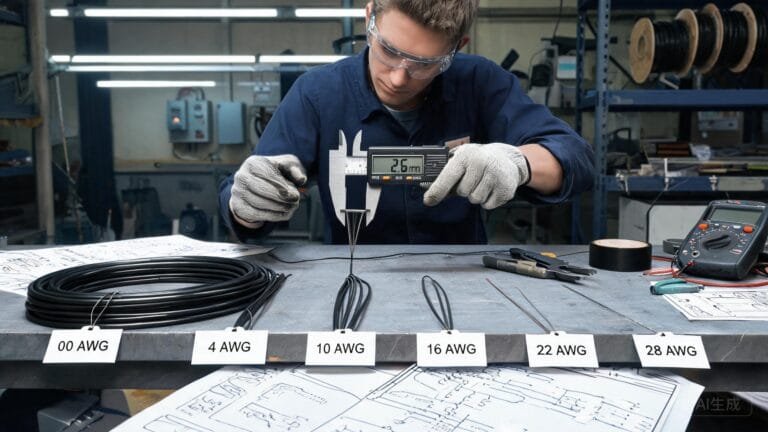
Metric to AWG conversion for conductor sizes:
| Metric (mm²) | Closest AWG | Actual AWG (mm²) |
|---|---|---|
| 25 | 4 | 21.2 |
| 35 | 2 | 33.6 |
| 50 | 1 | 42.4 |
| 70 | 2/0 | 67.4 |
| 95 | 3/0 | 85.0 |
| 120 | 4/0 | 107.2 |
| 150 | 250 kcmil | 126.7 |
| 185 | 350 kcmil | 177.3 |
| 240 | 500 kcmil | 253.4 |
| 300 | 600 kcmil | 304.0 |
Sheath Material Equivalence
When evaluating equivalence, verify that competing cables use polyester-based thermoplastic polyurethane (TPU) for the outer sheath. Different PUR formulations have significantly different properties:
| Polymer Type | Oil Resistance | Mechanical Strength | Hydrolysis Resistance |
|---|---|---|---|
| Polyester PUR (TMCGCW11Y) | Excellent | Excellent | Good |
| Polyether PUR | Good | Good | Excellent |
| PCP Rubber | Good | Moderate | Good |
Flex Life Equivalence
- Type A (high flex): Cables rated for 250,000+ cycles. (N)TMCGCW11Y falls in this category.
- Type B (moderate flex): Cables rated for 100,000-250,000 cycles.
- Type C (limited flex): Cables designed for occasional reeling.
When cross-referencing, verify the manufacturer’s flex life rating was determined under comparable test conditions (bend radius, travel speed, drum diameter).
Substitution Guidelines
When replacing an existing cable with (N)TMCGCW11Y:
- Verify voltage rating: Match or exceed the original cable’s U0/U rating (3.6/6kV through 18/30kV).
- Confirm conductor size: Match metric or AWG size, allowing for slight cross-section differences.
- Verify sheath material: If upgrading from rubber to PUR, verify the installation supports the cable’s outer diameter and bend radius.
- Check bend radius compatibility: Ensure the drum diameter accommodates 15×D flexing bend radius.
- Verify certifications: Confirm UL, VDE, or other certifications required for the project.
Quality and Certification
(N)TMCGCW11Y carries certifications equivalent to or exceeding competing brands:
- CE Marking — European market access
- VDE 0250-813 — German reeling cable standard
- UL Listing — North American market access (available)
- RoHS/REACH — Environmental compliance
Visit our certifications page to download compliance documentation.
MV reeling cable powering excavator in open-pit mining — (N)TMCGCW11Y equivalent application
Get a Personalized Cross-Reference Analysis
Provide us with your current cable specification. Our engineering team will deliver a detailed equivalence analysis within 24 hours.
When a cross-reference should be rejected
A similar cable name, nominal voltage or overall diameter is not enough to approve a substitute. Stop the cross-reference for further review when the original installation has a defined bending path, continuous travel, drum or reel duty, a mechanical pull, shielding needs, or a project-specific marking requirement that has not been compared.
Start with the installed duty
Compare the original marking and approved datasheet with the actual equipment duty, including cable routing, reel arrangement, guides, terminations and environmental contact. If any required information is unavailable, record the gap in the RFQ instead of treating a product name as proof of equivalence.
Document the approval basis
For mining and material-handling projects, procurement should retain the equipment requirement, cable data and the supplier’s technical response. This makes the selection review clearer for engineering, maintenance and project teams.
Technical information to include in a cross-reference request
A usable cross-reference request starts with the exact marking on the existing cable and the equipment in which it is installed. Include photographs of the marking and cable route where practical, but use the approved cable datasheet and equipment documentation as the primary technical source.
- Equipment type, circuit function and system voltage
- Core count, conductor size and any protective or control-core requirement
- Whether the cable is fixed, travelling, trailing or used on a reel or drum
- Drum and guide arrangement, travel path, termination method and observed mechanical issues
- Site exposure, project documentation and required quantity
With this information, the supplier can identify unanswered questions and propose a documented review path. It also helps maintenance and purchasing teams avoid ordering a visually similar cable that does not match the installed duty.
Information that cannot be assumed
Do not assume that matching conductor material, a similar jacket description or a shared nominal voltage establishes an equivalent cable. The original design may include construction details intended for the installed movement, handling method, screening function or project documentation. Those details should be verified from the approved data rather than inferred from a general product description.
When comparison information is incomplete, the correct next step is to request the missing data and keep the replacement decision open. A documented technical review is more useful than a fast name-to-name substitution when cable reliability affects equipment availability and maintenance planning.
Related Resources
A product name alone does not establish equivalence. Use these related resources for a documented review: