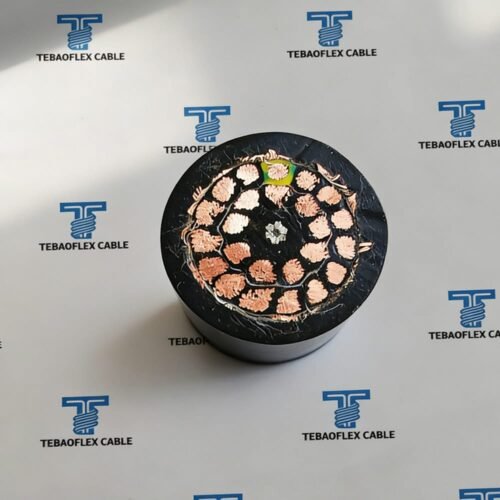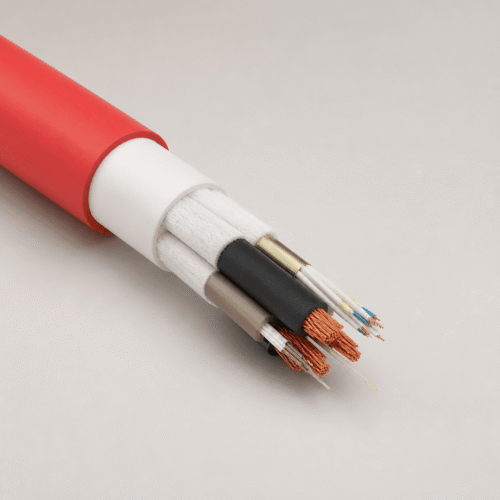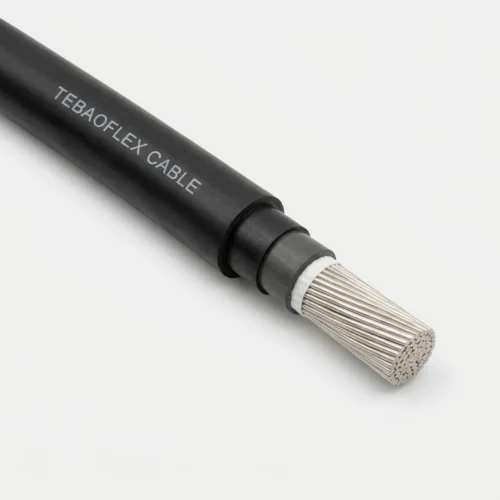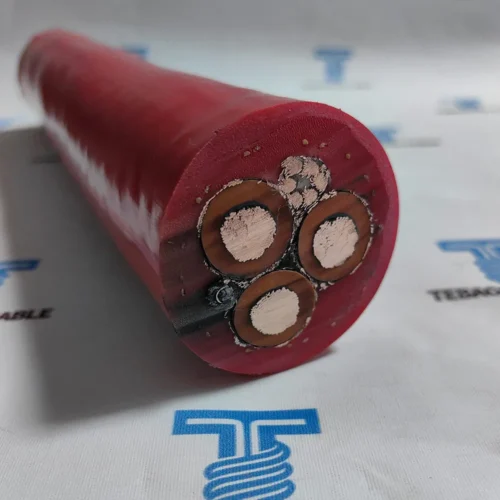
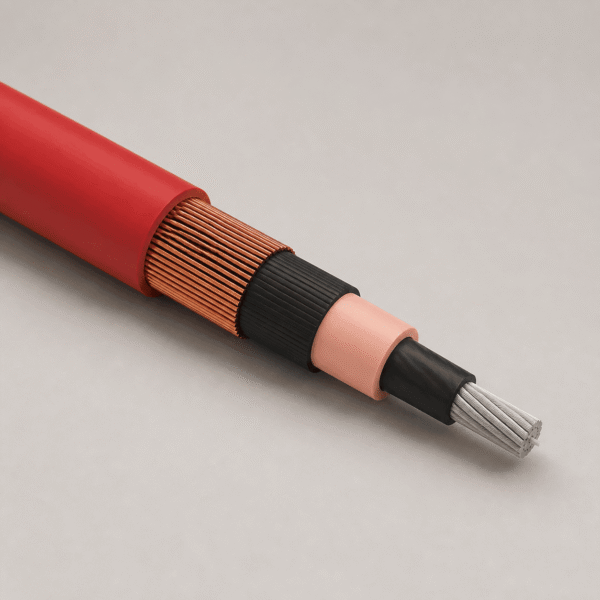




Product Overview: (N)TMCGCWOEU (German designation (N)TMCGCWÖU, referencing DIN VDE 0250-813) is a flexible, screened single-core medium-voltage rubber cable spanning 3.6/6 kV, 6/10 kV, 12/20 kV, and 18/30 kV for mobile mining substations, MV switchgear jumpers, transformer interconnections, and heavy industrial MV drives.
1. Application & Medium-Voltage Duty Scope
Where rigid XLPE MV distribution cables cannot accommodate tight switchgear bends, vibration, or equipment relocation, screened single-core (N)TMCGCWOEU provides elastomeric flexibility with full radial electric-field control:
- Mining & Tunnelling Substations: Flexible single-core phase connections between skid-mounted transformers, MV circuit breakers, and power centres.
- Switchgear, Containerized E-Houses & Drives: Short-radius MV busbar jumpers, generator leads, and large MV VFD/motor terminations.
- Relocatable Industrial MV Feeders: Trefoil or flat single-core runs requiring matched MV stress-cone terminations and metallic screen earthing (confirm any trailing, energy-chain, or reeling motion separately).
Related Medium-Voltage Options: Need a polyurethane (PUR) outer sheath for severe cut/abrasion exposure? Compare (N)TMCGCW11Y PUR Medium-Voltage Cable. For 3-core ground-check trailing up to 25 kV, see Type SHD-GC Mining Trailing Cable, or review our Mining Cable Application Guide.
2. Cable Construction (6-Layer MV Field-Control Anatomy)
Every medium-voltage (N)TMCGCWOEU build integrates radial dielectric stress control between the Class 5 conductor and concentric earth screen (final layer thicknesses and screen cross-sections are governed by the approved order drawing):
3. Technical Characteristics (Range-Level Reference)
Figures below represent range-level design parameters referencing DIN VDE 0250-813; the approved finished-cable drawing and test schedule govern each voltage and cross-section:
| Technical Parameter | Range-Level Engineering Guidance |
|---|---|
| Model Designation | (N)TMCGCWOEU / (N)TMCGCWÖU (DIN VDE 0250-813 construction reference) |
| Supported Voltage Classes (U0/U) | 3.6/6 kV, 6/10 kV, 12/20 kV, and 18/30 kV |
| Max. Conductor Temperature | Approx. 90°C continuous operation (confirm short-circuit thermal rating per conductor/screen size) |
| Ambient Temperature Guidance | Approx. -40°C to +80°C fixed installation; -25°C to +80°C moving/flexible routing |
| Minimum Bending Radius | Approx. 6 × cable OD fixed installation; 10 × cable OD moving installation (subject to exact build) |
| Max. Conductor Tensile Load | Up to 15 N/mm² static/pulling guidance (continuous reeling or energy-chain travel requires separate approval) |
4. Voltage-Class & Ordering Series Matrix (Single-Core Screened MV)
Specify both the phase conductor cross-section and the concentric copper screen cross-section (e.g., 1 × 95/16 mm² or 1 × 150/25 mm²) against your system fault calculation:
| Ordering Series | Rated Voltage U0/U (Um) | Typical Phase Cross-Sections | Screen Cross-Section Format | Primary Engineering Check |
|---|---|---|---|---|
TF-NTM-06KV | 3.6/6 kV (7.2 kV) | 1 × 25 mm² to 1 × 300 mm² | 1 × Phase / Screen mm² (e.g., /16, /25, /35) | MV motor/drive leads, 6 kV mine substation & switchgear jumpers |
TF-NTM-10KV | 6/10 kV (12 kV) | 1 × 25 mm² to 1 × 300 mm² | 1 × Phase / Screen mm² (per fault duty) | 10–11 kV mobile transformer, E-house & tunnel feeder interconnects |
TF-NTM-20KV | 12/20 kV (24 kV) | 1 × 35 mm² to 1 × 300 mm² | 1 × Phase / Screen mm² (per fault duty) | 20–22 kV substation bus jumpers & stress-cone termination OD match |
TF-NTM-30KV | 18/30 kV (36 kV) | 1 × 50 mm² to 1 × 300 mm² | 1 × Phase / Screen mm² (per fault duty) | 30–33 kV primary step-down mobile transformers & clearance radius |
5. Frequently Asked Questions
Is (N)TMCGCWOEU a single-core or three-core medium-voltage cable?
(N)TMCGCWOEU is a screened single-core MV rubber cable. Specify both phase conductor size and concentric copper screen size (for example, 1 × 120/16 mm²) for each phase run.
Can the 10 × OD moving bend radius be used automatically for continuous drum reeling?
No. Range guidance applies to standard flexible routing. Continuous trailing, festoon, or drum reeling requires engineering review of drum barrel diameter, speed, tension, and sheath/screen fatigue.
When should I compare (N)TMCGCW11Y or TRM-J?
Compare (N)TMCGCW11Y when a polyurethane (PUR) outer jacket is needed for extreme surface abrasion, or TRM-J 0.69/1.15 kV for multi-core low-voltage screened mining circuits.
Does every configuration carry third-party VDE or UL certification?
No blanket product mark is claimed across every voltage and cross-section—DIN VDE 0250-813 serves as the construction reference. State any mandatory routine test, HV partial-discharge test, or destination approval on your inquiry.
How should the metallic screen be terminated?
Use MV indoor/outdoor heat-shrink or cold-shrink stress-control terminations matched to the exact insulation OD, and bond the copper screen according to single-point or both-ends earthing calculations.
What project details are needed for an accurate quotation?
Send nominal/max system voltage, phase and screen cross-sections (mm²), short-circuit current/duration, installation mode (fixed, trefoil, relocatable, or dynamic), ambient environment, cut lengths, and required inspection documents (browse more in Mining & Tunneling Cables).
Request (N)TMCGCWOEU MV Drawing, OD Sheet & Factory Quote
Provide your voltage class (3.6/6 to 18/30 kV), phase/screen cross-section, installation route, and length. TEBAOFLEX will issue a project-specific MV construction drawing and quotation.