
(N)TMCGCW11Y Cable FAQ: Your Questions Answered
As a specialized medium voltage PUR reeling cable designed for heavy-duty industrial applications, the (N)TMCGCW11Y generates many technical questions from engineers, maintenance technicians, and procurement professionals. This comprehensive FAQ addresses the most common questions about installation, maintenance, troubleshooting, and application suitability.
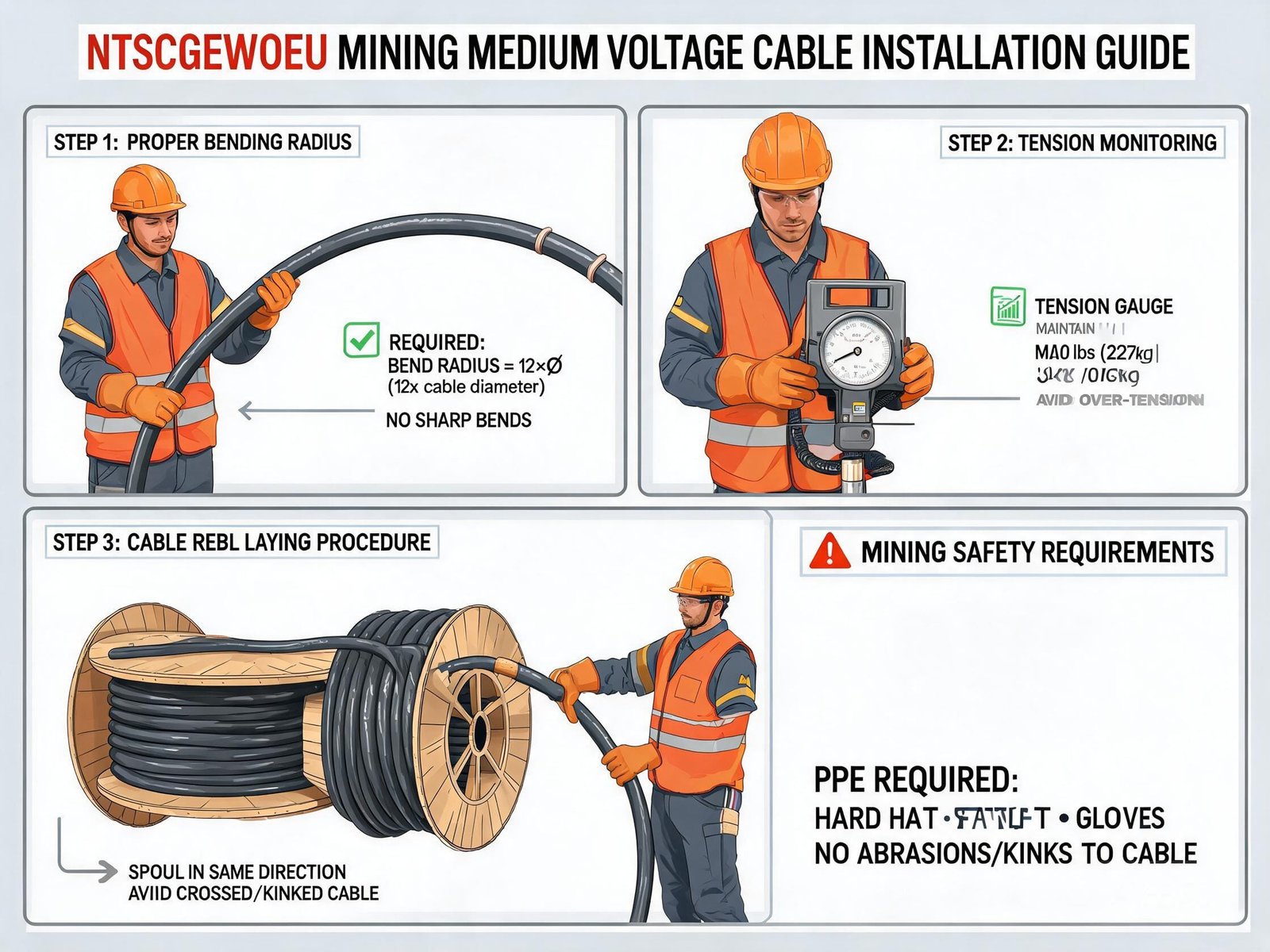
(N)TMCGCW11Y installation guide: bending radius, tension monitoring, and drum laying
Installation Questions
Q1: What is the minimum bending radius for (N)TMCGCW11Y?
The minimum bending radius depends on installation type:
- Fixed installation: 6× cable outer diameter (6×D)
- Flexing/reeling application: 15× cable outer diameter (15×D)
For a cable with 40mm outer diameter, the minimum drum barrel diameter for reeling would be 600mm. Using a larger drum diameter extends cable life significantly.
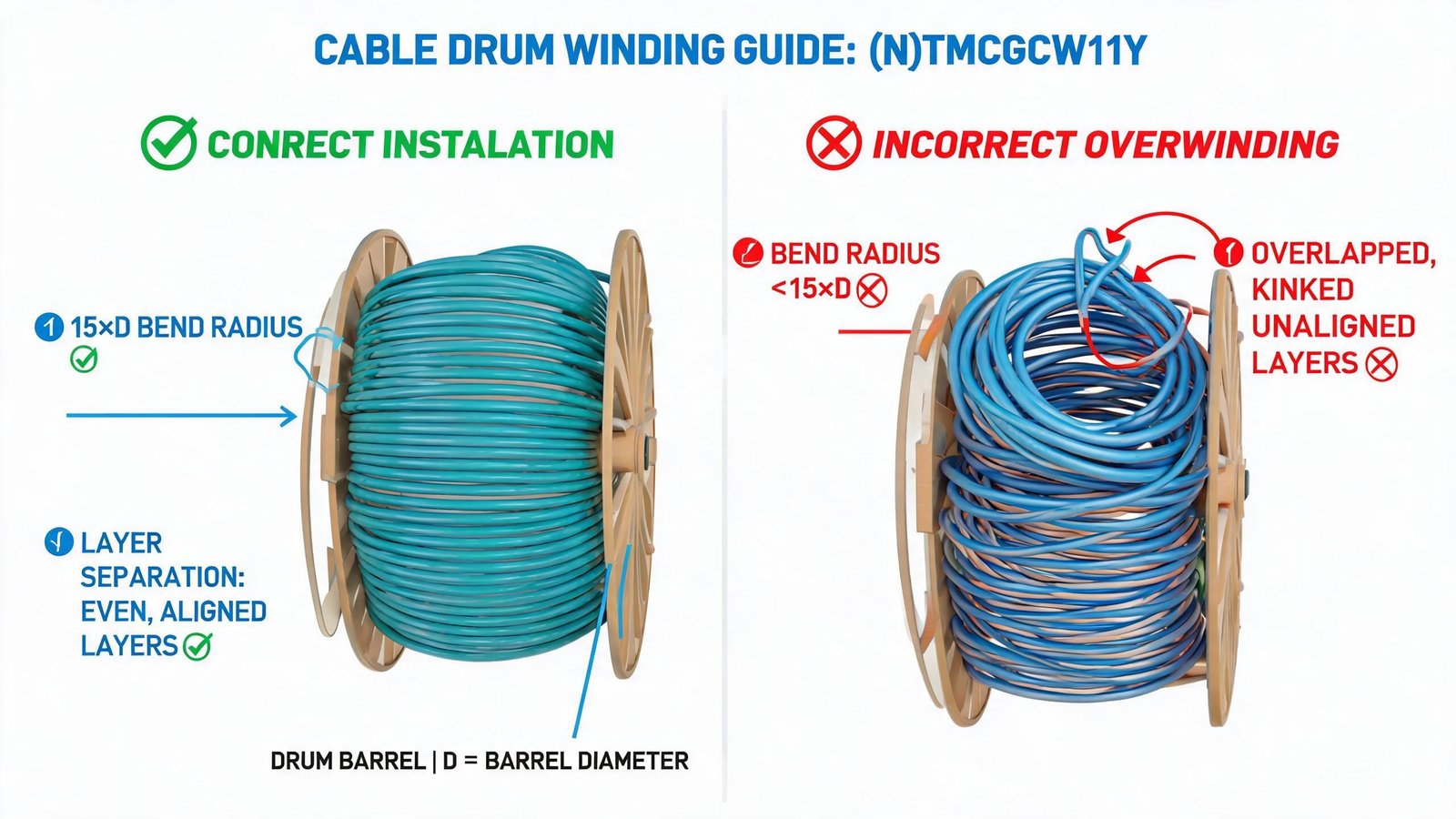
(N)TMCGCW11Y drum winding guide: correct 15×D bend radius and layer separation
Q2: Can (N)TMCGCW11Y be installed outdoors?
Yes. The polyurethane sheath is UV-stable and weather-resistant, making it suitable for both indoor and outdoor installations. The PUR formulation resists sunlight, rain, and temperature fluctuations without additional protection.
Q3: What is the maximum reeling speed for (N)TMCGCW11Y?
The (N)TMCGCW11Y is rated for reeling speeds up to 2 m/s at the specified minimum bend radius of 15×D. For applications requiring higher speeds, consult our engineering team for specialized configurations and recommendations.
Q4: How should (N)TMCGCW11Y cables be wound on the drum?
Proper drum winding is critical for cable life:
- De-stack without twist: Unroll the cable flat to eliminate built-in twist.
- First layer: Wind tightly with each turn touching the previous turn.
- Subsequent layers: Use monospiral winding for high-speed, high-cycle applications.
- Avoid cross-winding: Cross-winding causes point loading and abrasion damage.
- Maintain tension: Set reeling drive tension to 2-5% of cable breaking strength.
Q5: What voltage classes are available for (N)TMCGCW11Y?
The (N)TMCGCW11Y is available in voltage classes from 3.6/6kV to 18/30kV:
- 3.6/6kV — auxiliary power, small drives
- 6/10kV — medium drives, conveyor systems
- 8.7/15kV — large shovel drives, crane mains
- 12/20kV — heavy mining, port crane primary
- 18/30kV — high-power transmission, substation
Performance and Specifications
Q6: What is the flex life rating of (N)TMCGCW11Y?
Rated for a minimum of 250,000 reeling cycles at 15×D bend radius. Under optimized conditions (larger drum, lower speed, proper tension), flex life can exceed 350,000 cycles. Factors that reduce flex life include: tight bend radius, high travel speeds, excessive tension, extreme temperatures, and chemical contamination.
Q7: What is the maximum conductor temperature?
The EPR insulation is rated for 90°C continuous operation. The cable can withstand short-circuit temperatures up to 200°C for a maximum of 5 seconds. These ratings comply with IEC 60502-4 and VDE 0270 standards for medium voltage cables.
Q8: Is (N)TMCGCW11Y oil resistant?
Yes. The PUR sheath provides excellent oil resistance per EN 60811-404 (IRM 902 oil, 70°C, 4 hours). The cable is resistant to mineral oils, hydraulic fluids, greases, and diesel fuel — making it suitable for mining and port environments where oil exposure is common.
Q9: What is the temperature range?
- Fixed installation: -40°C to +90°C
- Flexing application: -25°C to +60°C
Flexing at temperatures below -25°C is not recommended, as the PUR sheath becomes stiffer at low temperatures, increasing the risk of cracking.
Maintenance and Troubleshooting
Q10: How often should (N)TMCGCW11Y cables be inspected?
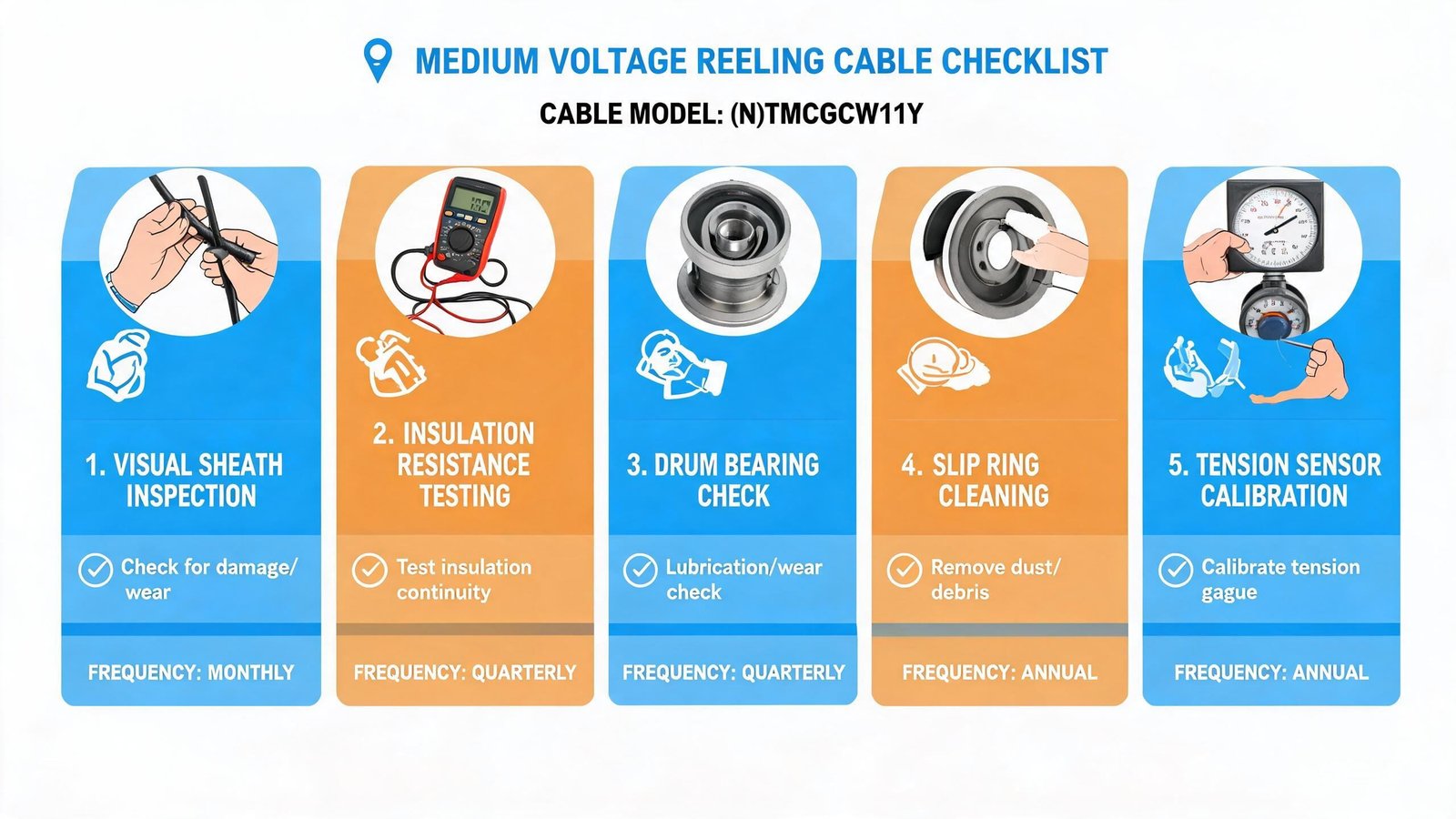
(N)TMCGCW11Y maintenance inspection checklist: monthly to annual schedule
| Inspection Type | Frequency | Key Points |
|---|---|---|
| Visual inspection | Monthly | Sheath damage, abrasion, oil contamination |
| Drum alignment check | Quarterly | Verify cable guide alignment and drum diameter |
| Insulation resistance test | Annually | Test at 2.5×U0 for 1 minute |
| Slip ring inspection | Semi-annually | Clean brushes, check for arcing damage |
| Tension calibration | Quarterly | Verify reeling drive tension settings |
Q11: What are the signs of impending cable failure?
- Sheath cracking: Small surface cracks indicate PUR aging from UV or thermal stress. Plan replacement within 3 months.
- Abrasion exposure: Visible conductor or insulation indicates severe sheath wear. Replace immediately.
- Insulation degradation: Decreasing insulation resistance readings indicate EPR degradation. Plan replacement.
- Drum track wear: Grooves worn into drum barrel indicate cable over-tension or misalignment.
- Slip ring arcing: Visible arcing or excessive brush wear indicates poor contact or contamination.
Q12: How can I extend the service life of (N)TMCGCW11Y?
- Maximize drum diameter: Increasing from 15×D to 20×D can extend flex life by 50-100%.
- Reduce reeling speed: Lower speeds reduce heat and mechanical stress.
- Maintain proper tension: Excessive tension dramatically reduces flex life.
- Use monospiral winding: Ensures even cable distribution and prevents cross-winding damage.
- Clean regularly: Remove abrasive debris and oil deposits from the cable and drum.
- Inspect slip rings: Clean and replace brushes regularly to prevent arcing damage.
Q13: Can damaged (N)TMCGCW11Y cables be repaired?
Minor sheath damage (small cuts <5mm deep) can be temporarily repaired using PUR-compatible heat shrink or self-amalgamating tape. However, this is temporary only — the cable should be replaced at the next maintenance window.
Cable splicing is not recommended for medium voltage reeling cables. Splices create stiff points that concentrate stress and represent potential insulation weak points. For safety and reliability, replace damaged sections entirely.
Application-Specific Questions
Q14: Can (N)TMCGCW11Y be used on electric rope shovels?
Yes. Electric rope shovels are one of the primary applications for (N)TMCGCW11Y. The cable’s PUR sheath provides the abrasion resistance needed for mining environments, while the EPR insulation delivers reliable medium voltage power transmission. Specify the appropriate voltage class (typically 8.7/15kV or 12/20kV) based on the shovel’s motor rating.
Q15: Can (N)TMCGCW11Y be used in subzero temperatures?
For fixed installations, the cable is rated to -40°C. For flexing applications, the minimum temperature is -25°C. Below this temperature, the PUR sheath becomes less flexible and may crack under bending stress. For applications in extreme cold climates, consult our engineering team for special low-temperature formulations.
Q16: What certifications are available?
- CE Marking — European LVD compliance
- VDE 0250-813 — German reeling cable standard
- UL Listing — Available for North American market
- IEC 60332-1-2 — Flame retardancy
- EN 60811-404 — Oil resistance
Visit our certifications page to download documentation.
Q17: How do I request a custom (N)TMCGCW11Y configuration?
TEBAOFLEX offers custom configurations including:
- Custom conductor sizes and configurations
- Integrated fiber optic elements for data transmission
- Custom sheath colors for application identification
- Reinforced anti-torsion braiding
- Custom length and packaging
To request a custom configuration, provide your requirements through our inquiry form. Our engineering team will provide a detailed proposal within 3-5 business days.
Still Have Questions?
This FAQ covers common questions about (N)TMCGCW11Y cables, but every application is unique. Our experienced engineering team is ready to provide personalized guidance for your specific installation, application, or specification challenge.
Get Expert Technical Support
Have a question not answered here? Our engineering team provides free technical consultation for all (N)TMCGCW11Y inquiries. Get expert answers within 24 hours.
What to record during an inspection
A useful inspection record helps distinguish a cable issue from a routing, reel, guide or termination issue. Record the equipment identifier, location of the observed condition, operating duty at the time, visible jacket changes, cable-path contact points and any recent change to the machine or environment.
Also retain the cable marking, available datasheet, termination details and photographs that show the complete route rather than only a close-up of the affected area. This information gives maintenance and engineering teams a clearer basis for deciding whether to adjust the installation, repair the system or request a replacement-cable review.
Related Resources
For a more complete installation and replacement review, see: