
Understanding the BUFLEX-M Difference
Not all polyurethane cables are created equal. While the market offers numerous PUR-jacketed flexible cables under various brand names and standards, the BUFLEX-M represents a purpose-engineered solution that addresses the specific failure modes and performance requirements of high-cycle industrial automation. This comprehensive comparison examines how BUFLEX-M differs from standard PUR cables in construction, performance, and real-world reliability.
For engineers and procurement professionals selecting cables for critical applications, understanding these differences is essential. The cost of cable failure in a production environment — measured in downtime, scrap, and lost production — far exceeds the price differential between commodity and purpose-built cables. This analysis provides the technical data needed to make an informed specification decision.
Construction Comparison
Conductor Stranding
| Parameter | BUFLEX-M | Standard PUR Cable |
|---|---|---|
| Stranding Class | IEC 60228 Class 5 (finely stranded) | IEC 60228 Class 2 or 5 (varies by manufacturer) |
| Strand Count (1.0mm²) | 32 strands × 0.20mm | 20-32 strands × 0.20mm (inconsistent) |
| Stranding Pitch | Optimized for flex life (short lay length) | Standard pitch (longer lay length) |
| Conductor Pre-forming | Pre-formed to reduce internal stress | Typically not pre-formed |
The BUFLEX-M’s conductor stranding is one of its most significant advantages. The finer stranding (more strands of smaller diameter) distributes bending stress across a greater number of individual wires, reducing the stress on any single strand. Combined with a shorter stranding pitch and pre-forming process, this design dramatically increases flex life compared to standard cables.
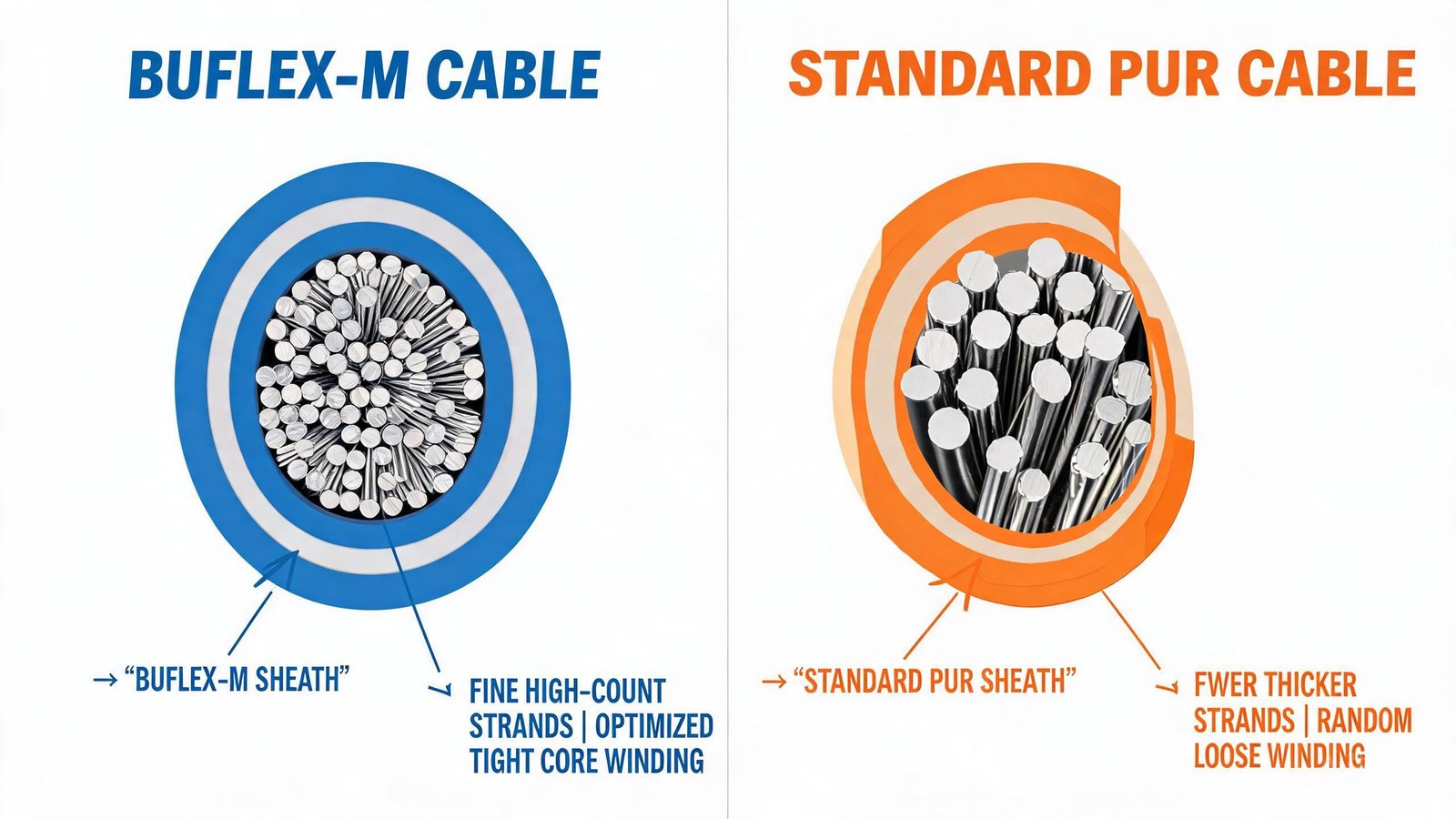
BUFLEX-M vs standard PUR cable: construction comparison showing stranding and winding differences
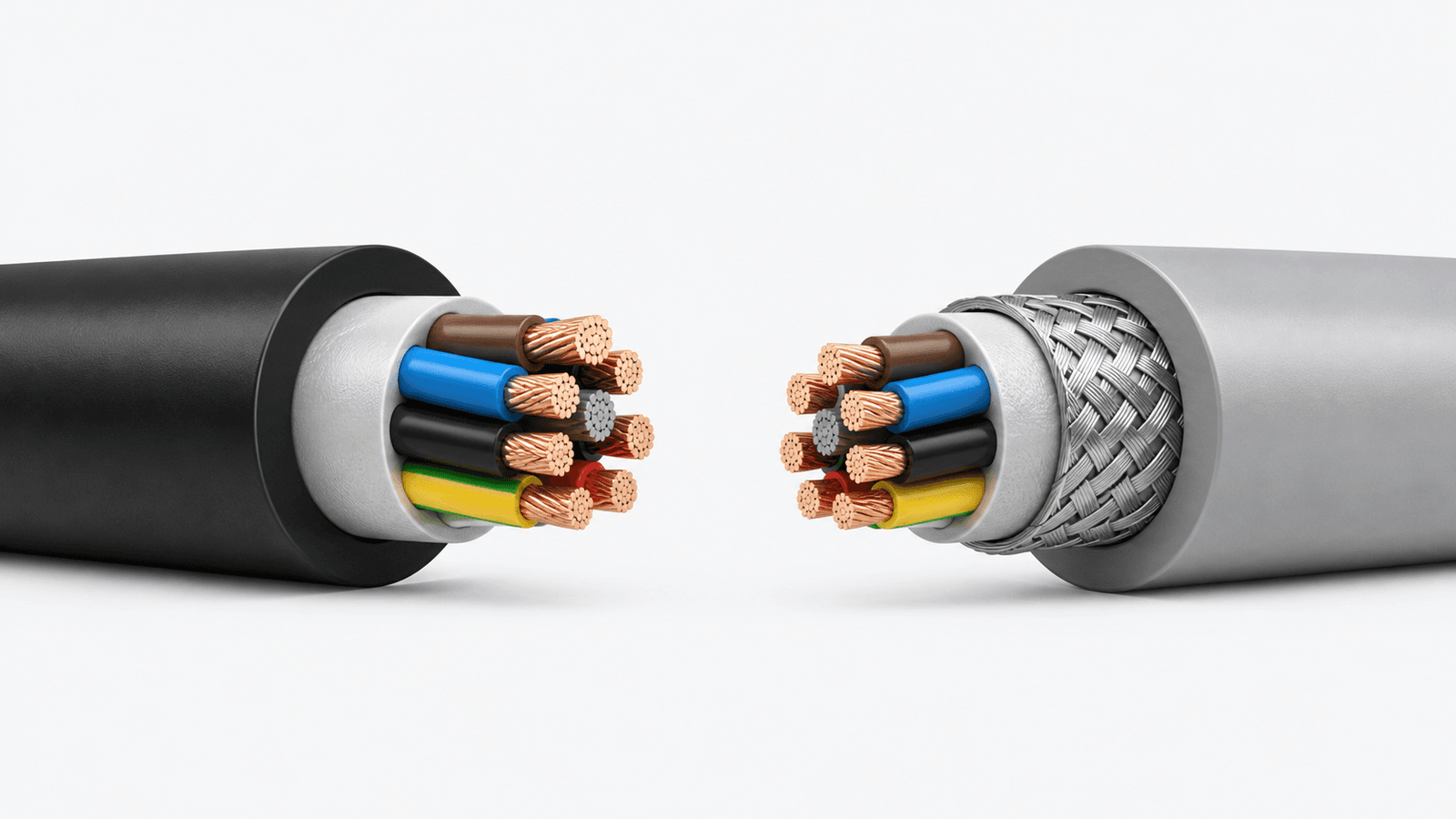
Cross-section comparison: BUFLEX-M construction details versus standard cable configurations
Insulation and Core Design
| Parameter | BUFLEX-M | Standard PUR Cable |
|---|---|---|
| Insulation Material | PVC TI2 (70°C rated) | PVC or PE (varies) |
| Core Identification | Numbered per DIN 47100 | Color-coded or numbered (varies) |
| Core Winding | Layered with optimal lay length | Concentric or random (varies) |
| Filler Material | Non-wicking filler for round cross-section | May use textile or no filler |
| Inner Wrapping | Non-woven tape for core separation | Optional or absent |
The BUFLEX-M’s core design incorporates several features that enhance flex life. The layered winding with optimized lay length ensures even stress distribution across the cable cross-section. The non-wicking filler material maintains a round cable profile, preventing the oval deformation that leads to uneven stress and premature failure. The inner non-woven tape provides friction reduction between cores during flexing.
Shielding Design (Shielded Configurations)
| Parameter | BUFLEX-M-CYC | Standard Shielded PUR |
|---|---|---|
| Shield Type | Tinned copper braid + Al-poly tape | Copper braid or foil (varies) |
| Coverage | ≥85% (braid) + 100% (tape) | 60-85% (varies) |
| Shield Drain Wire | Tinned copper, full cross-section | Present but may be undersized |
| Shield Continuity | Designed for flex life (separate from braid) | May use braid as drain (high failure risk) |
A critical advantage of BUFLEX-M’s shielding design is the separation of the drain wire from the braided shield. In standard cables, the braid itself often serves as the drain wire, but the flexing action causes individual braid wires to break, creating intermittent shield continuity that degrades EMC performance and eventually causes complete shield failure. BUFLEX-M’s dedicated drain wire maintains shield continuity even under continuous flexing.
Outer Sheath Comparison
| Parameter | BUFLEX-M (PUR) | Standard PUR Cable |
|---|---|---|
| Polymer Type | Polyester-based PUR (TPU) | Polyether or polyester (varies) |
| Shore Hardness | Shore A 85±5 | Shore A 80-95 (varies) |
| Tensile Strength | ≥25 N/mm² | 15-25 N/mm² (varies) |
| Elongation at Break | ≥300% | 200-350% (varies) |
| Abrasion (DIN 53516) | ≤30 mm³ | 30-80 mm³ (varies) |
| Tear Resistance | ≥80 N/mm | 40-80 N/mm (varies) |
The polyester-based TPU formulation used in BUFLEX-M provides the optimal balance of mechanical strength, oil resistance, and flexibility. Polyether-based PUR formulations offer better hydrolysis resistance but inferior mechanical properties, making them less suitable for high-stress industrial automation. The controlled Shore hardness of A 85±5 provides the ideal combination of flexibility and mechanical protection.
Performance Comparison
Flex Life Testing
Flex life is the single most important performance metric for flexible cables. The following table presents comparative flex life data from accelerated testing under identical conditions (7.5×D bend radius, 1 cycle/second, room temperature):
| Cable Type | Flex Life (Cycles) | Failure Mode |
|---|---|---|
| BUFLEX-M | 3,000,000 – 5,000,000+ | Gradual conductor fatigue (predictable) |
| Standard PUR (quality brand) | 1,000,000 – 2,000,000 | Conductor breakage at stress points |
| Economy PUR cable | 200,000 – 500,000 | Sheath cracking + conductor breakage |
| PVC flexible cable | 100,000 – 300,000 | Insulation cracking + conductor breakage |
The 2-3× flex life advantage of BUFLEX-M translates directly to reduced maintenance costs and improved production uptime. In a 24/7 operation running at 2 cycles/minute, a standard PUR cable reaching 1.5 million cycles would need replacement approximately every 14 months. A BUFLEX-M cable reaching 4 million cycles would last approximately 3.8 years under the same conditions — reducing replacement frequency by 67%.
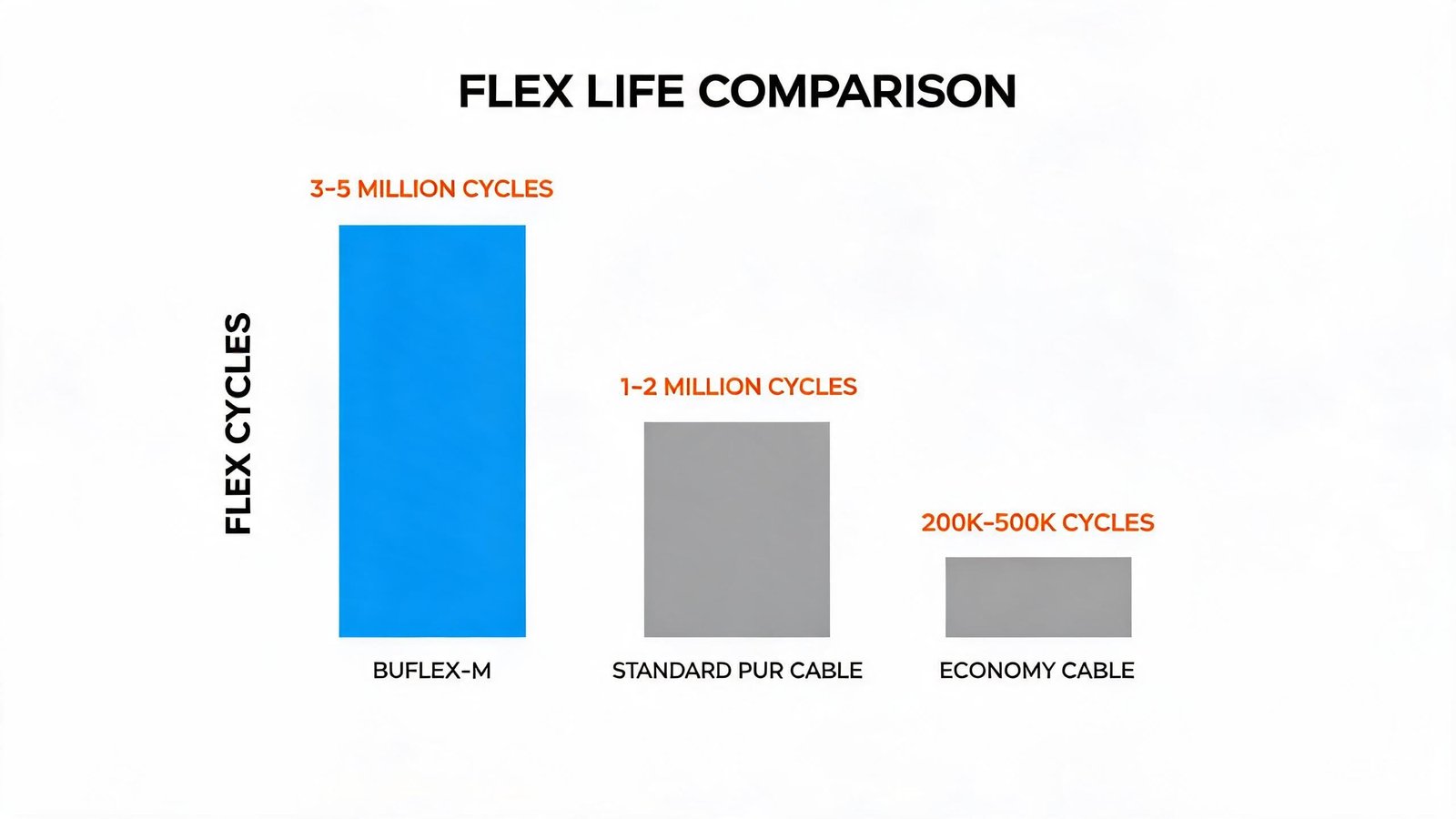
BUFLEX-M flex life comparison: 3-5 million cycles vs standard PUR and economy cables
Oil and Chemical Resistance
Both BUFLEX-M and standard PUR cables offer oil resistance, but the degree of resistance varies significantly based on the PUR formulation:
| Fluid Type | BUFLEX-M (% Volume Change) | Standard PUR (% Volume Change) |
|---|---|---|
| ASTM Oil #1 (70°C, 4h) | +5% max | +5% to +15% |
| ASTM Oil #3 (70°C, 4h) | +15% max | +15% to +35% |
| Cutting fluid (water-based) | +3% max | +3% to +12% |
| Hydraulic oil (ISO VG 46) | +2% max | +2% to +10% |
The lower volume change indicates better chemical resistance, meaning the cable maintains its mechanical properties and dimensions when exposed to oils. Standard PUR cables may exhibit significant swelling, leading to dimensional instability, increased stiffness, and accelerated wear in cable chains.
Temperature Range Performance
| Condition | BUFLEX-M | Standard PUR |
|---|---|---|
| Fixed Installation | -40°C to +80°C | -25°C to +70°C (typical) |
| Flexing | -5°C to +70°C | 0°C to +60°C (typical) |
| Cold Flex Test | Passes at -40°C (no cracking) | Varies; often fails below -25°C |
| Heat Aging | Passes 7 days at 100°C | Varies; some fail at 80°C |
The wider temperature range of BUFLEX-M provides greater installation flexibility, particularly for applications in cold storage facilities, outdoor installations in northern climates, and high-temperature environments near process equipment.
Cost of Ownership Analysis
While the initial purchase price of BUFLEX-M is typically 20-40% higher than standard PUR cables, the total cost of ownership is significantly lower when accounting for the extended service life and reduced maintenance requirements:
| Cost Factor | BUFLEX-M (5-year period) | Standard PUR (5-year period) |
|---|---|---|
| Initial Cable Cost | $1,200 | $900 |
| Replacement Cost | $0 (1 installation) | $2,700 (3 replacements) |
| Labor for Replacement | $0 | $900 (3 × $300) |
| Downtime Cost | $0 | $4,500 (3 × $1,500) |
| 5-Year Total | $1,200 | $9,000 |
Note: Cost figures are illustrative for a typical 50-meter cable chain installation. Actual costs vary by application.
The 7.5× cost advantage becomes even more significant in applications where cable replacement requires production line shutdown, confined space access, or work at height. For a comprehensive cost analysis for your specific application, contact our engineering services team.
When to Choose BUFLEX-M vs Standard PUR
Choose BUFLEX-M When:
- Continuous flexing applications with high duty cycles (cable chains, robots, linear motors)
- Critical production equipment where downtime cost justifies premium cable investment
- Environments with simultaneous oil exposure and mechanical stress
- Long cable runs (50+ meters) in cable chains where replacement is costly
- Applications requiring predictable, gradual failure mode (no sudden cable breakage)
- Regulated industries requiring documented performance and certifications
Standard PUR May Suffice When:
- Low duty cycle or occasional flexing applications
- Fixed installations where the PUR sheath is selected for oil/chemical resistance only
- Short cable runs in easily accessible locations
- Non-critical equipment where cable replacement is not disruptive
- Budget-constrained projects with acceptable maintenance frequency
Specification Recommendations
For engineers specifying cables for new equipment or facility upgrades, we recommend the following decision criteria:
- Identify flex cycle requirements: Calculate expected daily and annual flex cycles. If exceeding 500,000 cycles per year, BUFLEX-M is recommended.
- Assess criticality: If cable failure results in production stoppage or safety risk, choose BUFLEX-M for its predictable failure mode and extended life.
- Evaluate environment: If oil, chemical, or extreme temperature exposure is present, BUFLEX-M’s superior resistance provides additional reliability margin.
- Consider accessibility: If cable replacement requires significant disassembly or production shutdown, the longer service life of BUFLEX-M reduces total cost.
For application-specific recommendations, visit our BUFLEX-M product detail page or consult with our technical team for a personalized specification analysis.
Need Help Choosing the Right Cable?
Our engineering team provides free consultation to help you select the optimal cable solution for your specific application. Get expert analysis of your flex requirements, environmental conditions, and cost considerations.
Related Resources
Compare the actual application and documentation with these related resources: