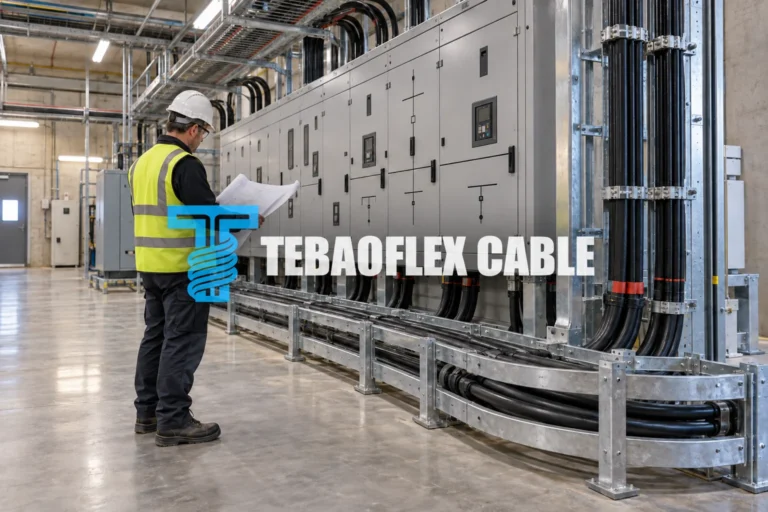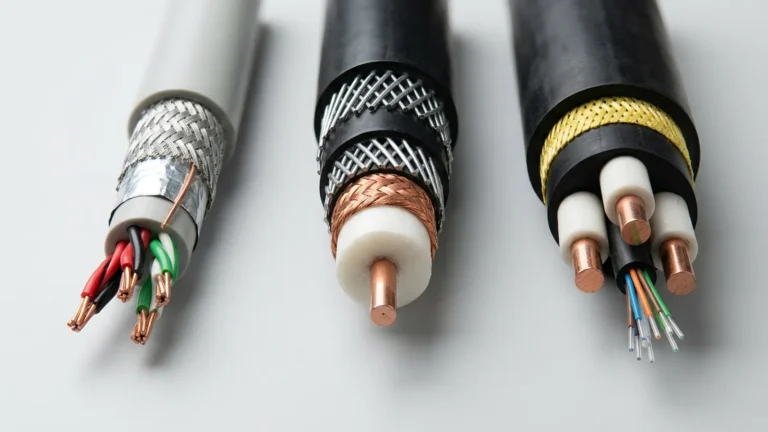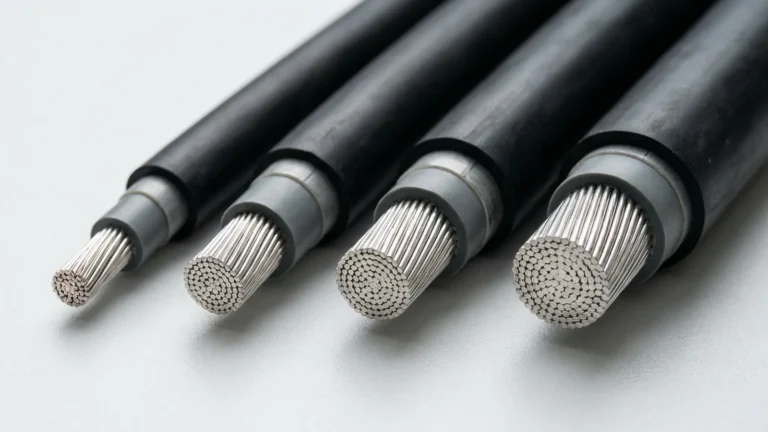

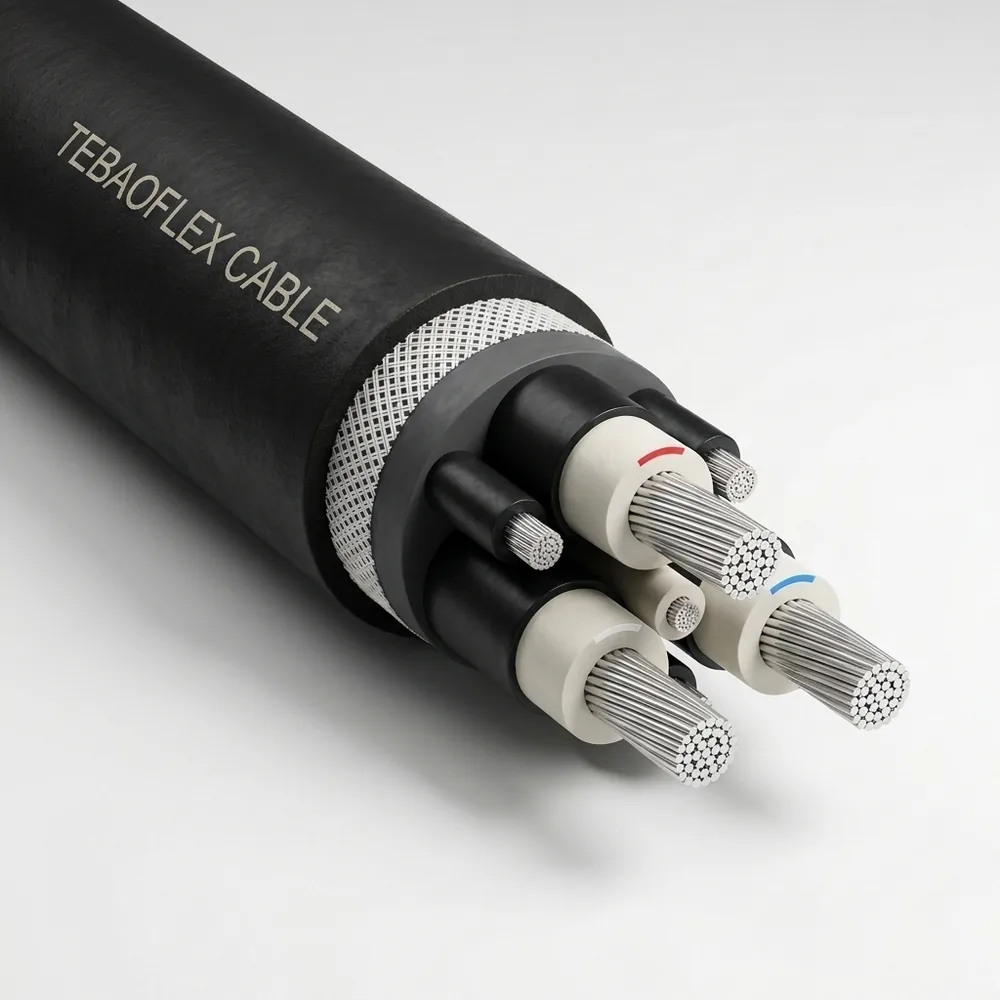
Quick answer: (N)TSCGEWOEU (also written (N)TSCGEWÖU) is a German DIN VDE 0250-813 flexible medium-voltage reeling and trailing mining cable (3.6/6 kV to 20/35 kV) built with a symmetrical 3-phase plus 3-split-earth Class 5 tinned copper core layout, triple-extruded 3GI3 EPR dielectric with semiconductive screens, an anti-torsion textile braid, and a heavy-duty 5GM5 polychloroprene (PCP) rubber sheath. Closest regional mining counterparts include North American ICEA S-75-381 Type SHD-GC, Australian AS/NZS 2802 Type 441 / Type 409, and British BS 6708 Type 730.
Applicable standards: DIN VDE 0250-813, DIN VDE 0207-20/21, IEC 60228 Class 5, ICEA S-75-381 / NEMA WC 58, AS/NZS 2802, BS 6708.
What Does the (N)TSCGEWOEU Designation Mean Under DIN VDE 0250-813?
Under DIN VDE 0250-813, the (N)TSCGEWOEU code specifies a screened three-phase elastomeric cable engineered for high-tension motorized reeling drums, bucket-wheel excavators, draglines, tunnel boring machines (TBMs), and ship-to-shore container cranes. Unlike fixed IEC 60502-2 power cables, its core pitch and double sheath resist continuous axial tension and bidirectional torsion.
Understanding every character in the VDE string is essential before evaluating a regional substitute because earth-fault screening in standard (N)TSCGEWOEU relies on elastomeric semiconductive layers combined with three split interstitial earth conductors rather than metallic copper braids over each phase.
| VDE Code Element | Cable Layer / Function | Engineering Specification (DIN VDE 0250-813) |
|---|---|---|
| (N) | Standard alignment | German national construction per DIN VDE 0250-813 for heavy mining and material-handling equipment. |
| TS | Duty class | Heavy-duty reeling drum and trailing cable (Trommelleitung schwer) rated for continuous dynamic tensile stress. |
| C | Field-control screens | Triple-extruded inner conductor semiconductive layer and outer semiconductive insulation screen controlling radial electrical stress. |
| G | Dielectric insulation | Ozone- and moisture-resistant ethylene propylene rubber (3GI3 EPR per DIN VDE 0207-20), rated 90 °C continuous and 250 °C short-circuit. |
| E | Core arrangement | Three phase cores laid around a semiconductive cradle with three split protective-earth (PE) conductors in the outer interstices (3 + 3). |
| W | Environmental duty | Rough outdoor, wet-pit, and underground mining service down to −40 °C fixed / −25 °C flexing (down to −50 °C in arctic compounds). |
| OEU (ÖU) | Double sheath & braid | Oil-resistant (Ölbeständig) and flame-retardant (Unbrennbar / IEC 60332-1-2) 5GM3/5GM5 PCP inner and outer sheaths encapsulating an anti-torsion polyester/polyaramid braid. |
View full cross-sections, ampacities, and permissible pulling forces on our (N)TSCGEWOEU 3+3 flexible medium-voltage trailing and reeling cable datasheet, and review field drum performance in our 12/20 kV mining reeling cable project in Poland.
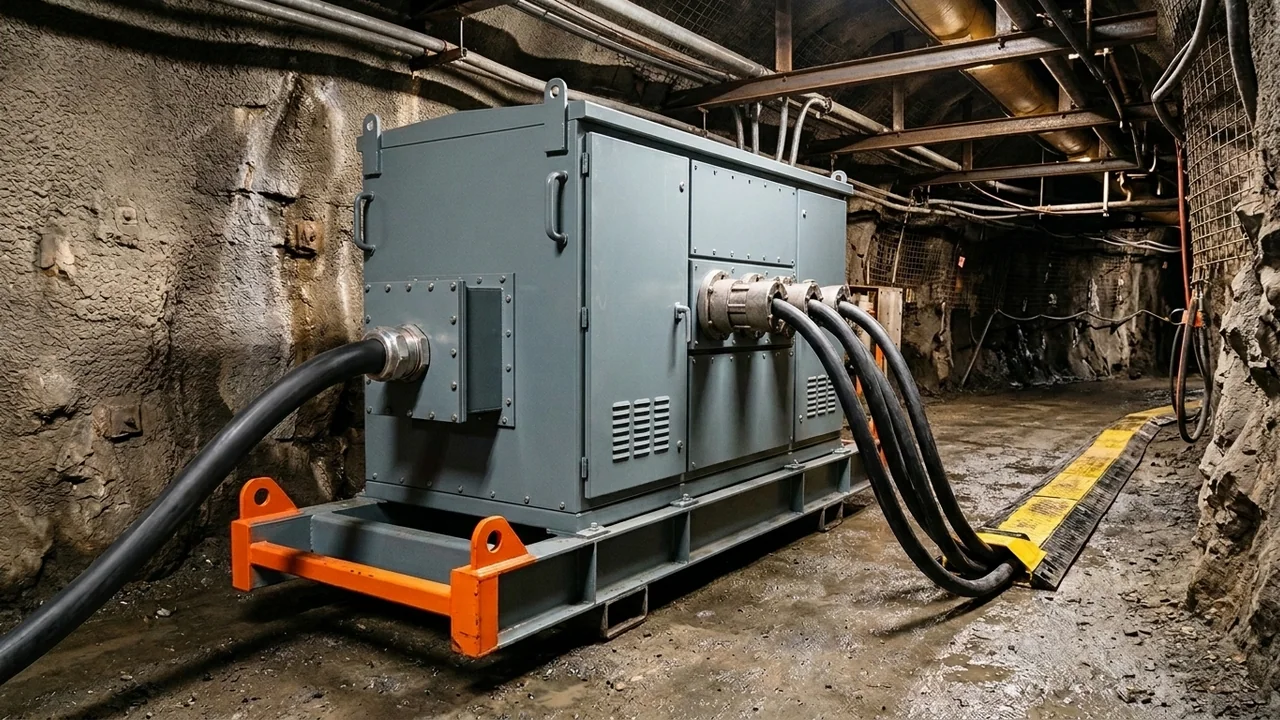
How Does (N)TSCGEWOEU Cross-Reference Across Global Mining Standards?
No two national mining authorities mandate identical earth-fault monitoring geometries. While German DIN VDE 0250-813 uses a symmetrical 3 + 3 split-earth core without a pilot wire in standard builds, North American MSHA, Australian AS/NZS 2802, and British BS 6708 standards incorporate dedicated ground-check or central pilot conductors for fail-safe breaker tripping.
| Standard / Region | Closest Public Designation | Voltage Range | Earth & Pilot Layout | Phase Screen Architecture | Key Substitution Constraints |
|---|---|---|---|---|---|
| DIN VDE 0250-813 (Germany / Global Cranes & Mines) | (N)TSCGEWOEU | 3.6/6 kV to 20/35 kV | 3 phase + 3 split interstitial earth cores (no pilot in standard 3+3) | Extruded inner/outer semiconductive elastomer screens (add metallic screen in (N)TSCGECEWOEU) | Superior torsional balance for high-speed monospiral cranes, reclaimers, and TBM tunnel reels up to 15–20 N/mm² tensile load. |
| ICEA S-75-381 / NEMA WC 58 (USA / Canada MSHA) | Type SHD-GC | 2 kV, 5 kV, 8 kV, 15 kV, 25 kV, 35 kV | 3 phase + 2 split ground + 1 insulated ground-check (GC) pilot | Tinned copper braid (or copper tape + braid) over semiconductive layer on each phase | Mandatory on North American mine substations using GC pilot loop relays; AWG/kcmil sizing and MSHA flame print required. |
| AS/NZS 2802 (Australia / New Zealand) | Type 441 (Reeling) / Type 409 | 1.1/1.1 kV to 19/33 kV | 3 phase + 3 interstitial earth + 1 central extensible pilot (Type 441) | Semiconductive elastomeric phase screens (Type 441) or composite metallic screens (Type 409/450) | Type 441 closely mirrors (N)TSCGEWOEU reeling mechanics while adding a central pilot for Australian earth-continuity relays. |
| BS 6708 (United Kingdom Coal & Tunnelling) | Type 730 / Type 630 | 3.3 kV, 6.6 kV, 11 kV | 3 phase + collective/earth screen + central pilot conductor | Individual copper/nylon composite phase screens or collective screen | Tailored to UK restrained/bolted flameproof couplers (3.8/6.6 kV and 6.35/11 kV) and underground coal shearer trailing duty. |
| SANS 1520-2 (Southern Africa) | Type 606 / Type 611 / Type 622 | 3.3 kV to 33 kV | 3 phase + 3 split earth or cradle-centre pilot | Elastomeric semiconductive or tinned copper/textile composite screens | Aligned closely with VDE and AS/NZS dimensions; check local mine earth-leakage protection scheme before cross-substituting. |
Compare all regional medium-voltage constructions directly in our mining and tunnelling cables catalog.
Which VDE or Regional Mining Variant Matches Your Equipment Duty?
Selecting the right medium-voltage flexible cable depends on three site variables: whether the cable winds onto a high-speed motorized drum or drags across bench rock, whether substation relays require a pilot continuity loop, and whether PLC telemetry runs inside the power umbilical.
| Public Model Designation | Core & Telemetry Geometry | Primary Mechanical Duty | Direct Specification Reference |
|---|---|---|---|
| (N)TSCGEWOEU (3+3) | 3 phase + 3 split PE | High-speed monospiral/cylindrical reeling drums, STS cranes, TBMs, and stacker-reclaimers. | DIN VDE 0250-813 standard elastomeric-screened reeling cable. |
| (N)TSCGEWOEU-LWL / FO | 3 phase + 2 PE + fibre-optic module (6–24 fibres) | Automated port cranes, driverless reclaimers, and smart TBM guidance requiring EMI-immune gigabit data. | DIN VDE 0250-813 hybrid MV power + single-mode/multimode optical bundle; also available in heavy-duty SR-FO. |
| Type SHD-GC | 3 phase + 2 GND + 1 GC pilot | Open-pit electric shovels, draglines, drills, and mobile substations in Americas mining operations. | ICEA S-75-381 / CSA C22.2 No. 96 with tinned copper braid phase shields; see our SHD-GC selection guide. |
| AS/NZS 2802 Type 441 | 3 phase + 3 earth + 1 central pilot | Reeling drums and stacker-reclaimers in Australian iron-ore, coal, and hard-rock mines. | AS/NZS 2802 semiconductive-screened reeling cable for pilot-monitored substations. |
| BS 6708 Type 730 | 3 phase + earth screen + central pilot | Underground longwall shearers, roadheaders, and bolted-coupler gate-end boxes. | BS 6708 3.8/6.6 kV flexible trailing cable with composite metallic screening. |
What Must Be Verified Before Approving an (N)TSCGEWOEU Substitute?
Cross-substituting a regional trailing cable for VDE (N)TSCGEWOEU—or installing (N)TSCGEWOEU into an IEEE/ICEA or AS/NZS mine—without reconciling ground-fault relay wiring and drum mechanics causes nuisance breaker lockouts or corkscrewing core failure within weeks.
Engineering boundary: ground-check pilot relays and monospiral drum tension
Standard 3+3 (N)TSCGEWOEU does not contain an insulated ground-check (GC) pilot wire; connecting it to a North American MSHA skid substation or Australian pilot-loop relay without a compatible pilot core or optical interlock will prevent the main vacuum contactor from closing. Conversely, heavy metallic-braided Type SHD-GC cables have larger bending stiffness and higher mass than semiconductive-screened (N)TSCGEWOEU, which can overload spring or torque-motor crane reels.
- 1. Earth-continuity protection scheme: Verify whether the upstream switchgear monitors earth continuity via an insulated GC/central pilot loop (requiring Type SHD-GC, Type 441, or custom pilot-equipped VDE cable) or via impedance/zero-sequence protection compatible with 3+3 split earths.
- 2. Semiconductive vs. metallic copper phase screens: Standard (N)TSCGEWOEU uses semiconductive elastomer screens suitable for restricted earth-fault mining systems; if local grid fault current exceeds elastomeric screen capacity, specify copper-wire-screened (N)TSCGECEWOEU.
- 3. Maximum dynamic tensile load and reel speed: Standard DIN VDE 0250-813 (N)TSCGEWOEU supports permanent tensile loads up to 15 N/mm² of total copper cross-section (up to 20–25 N/mm² in reinforced crane builds) and travel speeds up to 120–180 m/min; confirm drum barrel diameter (≥ 10 × D to 12 × D) and S-bend deflector sheaves.
- 4. Voltage class alignment (U0/U/Um): Match European nominal steps (3.6/6 kV, 6/10 kV, 8.7/15 kV, 12/20 kV, 18/30 kV) carefully against North American 5 kV, 8 kV, 15 kV, and 25 kV 100%/133% insulation levels.
- 5. Coupler, slip-ring, and stress-cone dimensions: Check exact outer diameter over sheath for reeling drum cable guides and slip-ring stuffing boxes, and confirm diameter over 3GI3 EPR insulation for cold-shrink indoor/outdoor termination kits.
Frequently Asked Questions About (N)TSCGEWOEU Cross-References
Mine electrical superintendents and OEM crane engineers frequently ask how (N)TSCGEWOEU compares with Type SHD-GC, (N)TSCGECEWOEU, and AS/NZS 2802 Type 441. Below are concise engineering answers for procurement sign-off.
Can (N)TSCGEWOEU replace Type SHD-GC on mining equipment?
Only if the site electrical standard accepts DIN VDE 0250-813 and does not require an insulated ground-check (GC) pilot wire or metallic phase braids for MSHA compliance. For North American mines governed by MSHA/CSA rules, specify true ICEA S-75-381 Type SHD-GC instead.
What is the difference between (N)TSCGEWOEU and (N)TSCGECEWOEU?
The extra CE in (N)TSCGECEWOEU adds a concentric composite copper wire/textile metallic screen over each individual EPR phase core in addition to the semiconductive elastomer layers, increasing phase-to-earth fault current capacity for high-fault-level networks.
How close is Australian AS/NZS 2802 Type 441 to (N)TSCGEWOEU?
AS/NZS 2802 Type 441 was developed specifically for reeling duty using semiconductive elastomer phase screens, three interstitial earths, and an anti-torsion reinforced PCP sheath—making it mechanically very close to (N)TSCGEWOEU, with the addition of a central extensible pilot core.
What parameters are needed to engineer a reeling or trailing cross-reference?
Submit the system voltage (U0/U/Um), phase cross-section, earth/pilot or fibre-optic count, reeling drum minimum barrel diameter, travel length and speed, maximum pulling tension, ambient temperature range, and coupler kit model.
Need an Engineered (N)TSCGEWOEU, SHD-GC, or Type 441 Cross-Reference?
Send your excavator, TBM, or port crane reeling parameters, existing cable code, voltage rating (3.6/6 kV to 20/35 kV), and coupler specifications. TEBAOFLEX mining cable engineers will verify tensile load, bend radius, and fault-screen compatibility and issue a complete datasheet and quote within 24 hours.
Request Mining Cable Engineering ReviewTechnical references & review record: Construction codes, mechanical tensile limits, and compound specifications referenced from DIN VDE 0250-813, DIN VDE 0207-20/21 (3GI3 EPR and 5GM3/5GM5 PCP), IEC 60228 Class 5, ICEA S-75-381 / NEMA WC 58 (Type SHD-GC), AS/NZS 2802 (Type 441 / Type 409), and BS 6708 (Type 730). Technical review updated October 2026 by TEBAOFLEX Engineering.