
(N)TSCGEWOEU Cable FAQ: Most Common Questions
The (N)TSCGEWOEU cable is a specialized medium voltage mining reeling cable, and engineers often have detailed questions about its installation, maintenance, and troubleshooting. This (N)TSCGEWOEU FAQ addresses the most frequently asked questions from TEBAOFLEX mining customers.
For complete specifications, see our (N)TSCGEWOEU product page and specifications guide.
Installation FAQ
Q1: What is the minimum bending radius for (N)TSCGEWOEU cable?
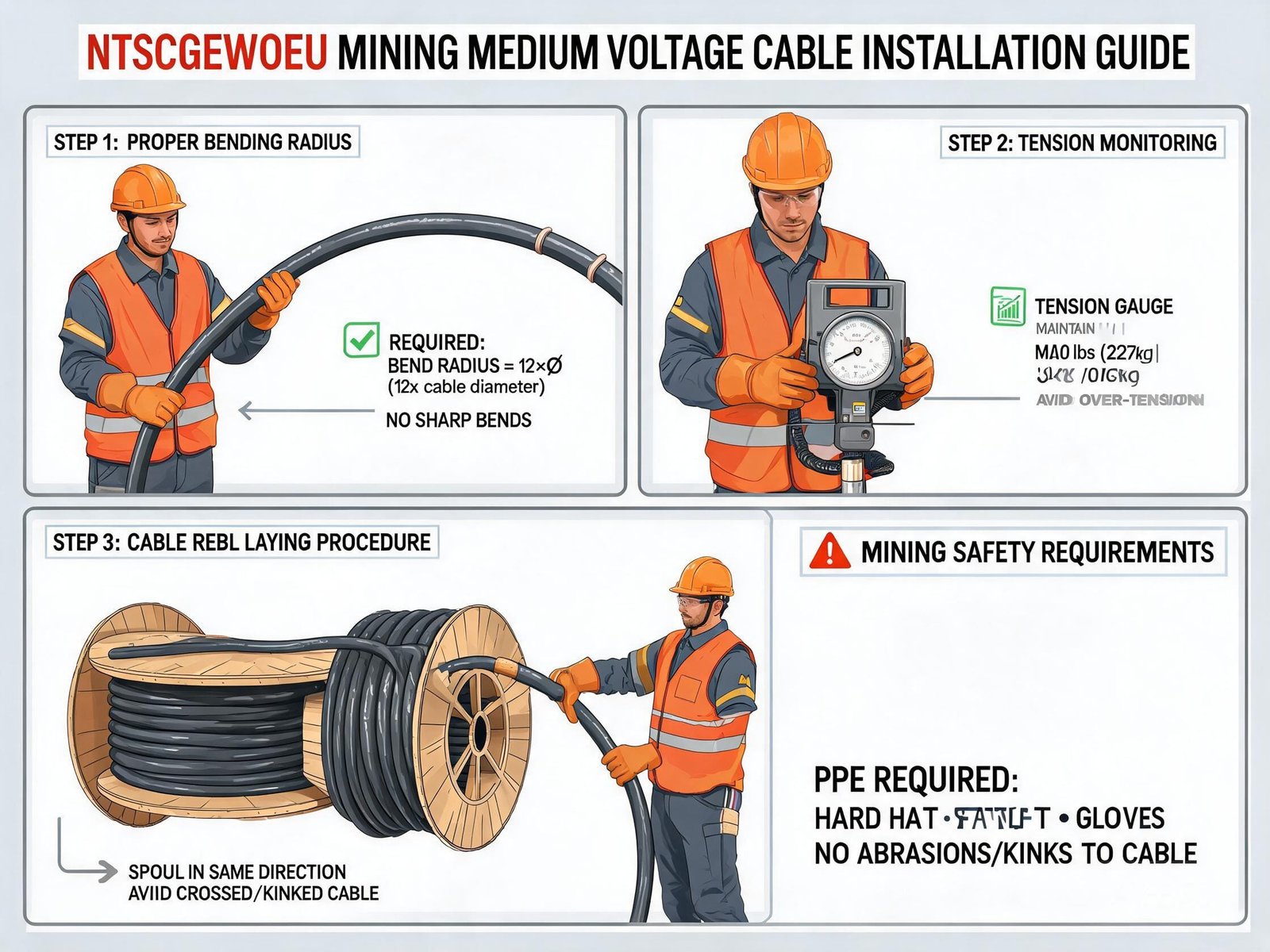
A: The minimum bending radius for (N)TSCGEWOEU is:
- Fixed installation: 8 × overall cable diameter (8D)
- Reeling / flexing applications: 12 × overall cable diameter (12D)
For example, a cable with 60mm overall diameter requires minimum 480mm radius for fixed installation and 720mm for reeling. Exceeding the minimum bending radius causes insulation damage and conductor fatigue. Ensure cable drum diameter meets this requirement.
Q2: How should (N)TSCGEWOEU be installed on a cable drum?
A: Proper drum installation is critical for MV reeling cables:
- Ensure drum barrel diameter exceeds 12× cable OD minimum
- Use random winding for standard applications; monospiral for precision
- Apply proper tension during winding to prevent loose layers and nesting
- Install cable guide rollers to ensure smooth winding and prevent abrasion
- The polyester anti-torsion braid prevents twist buildup during random winding
- Do not exceed the cable’s maximum tensile rating during reeling operations
Q3: What is the maximum pulling tension for (N)TSCGEWOEU?
A: Maximum pulling tension varies by conductor size and must be calculated for each cable. As a general rule, maximum tension should not exceed 50 N/mm² of total conductor cross-section. For example:
- 3+3 × 50mm² (6 cores total): max pull = 6 × 50 × 50 = 15,000 N (~1,530 kg)
- 3+3 × 95mm²: max pull = 6 × 95 × 50 = 28,500 N (~2,900 kg)
Always use a cable grip (mesh stocking) that distributes force over the cable sheath. Never pull by the conductors alone.
Q4: Can (N)TSCGEWOEU be used underground?
A: Yes. (N)TSCGEWOEU is suitable for underground mining applications. The rubber sheath is:
- Flame retardant per IEC 60332-1-2 — self-extinguishing
- Low smoke generation for confined spaces
- Resistant to water and humidity common in underground environments
For coal mine applications, ensure the cable carries Coal Mine Safety certification. Contact TEBAOFLEX for coal mine certified variants.
Performance FAQ
Q5: What is the difference between (N)TSCGEWOEU MT and MT PLUS?
A: The MT is the standard variant, while the MT PLUS features a compact construction with:
- Reduced overall diameter (typically 10-15% smaller)
- Lower weight per meter
- Smaller cable drum required for the same length
- Same voltage rating and electrical performance
MT PLUS is preferred when drum space is limited or weight reduction is important.
Q6: When should I use the EMV FC variant?
A: Use the (N)TSCGEWOEU EMV FC when the mining equipment is powered by a variable frequency drive (VFD). The EMV FC variant features:
- Enhanced EMC screening for superior EMI suppression
- Optimized impedance for VFD switching frequencies
- Reduced voltage reflections and transient overvoltage
- Prevents interference with nearby control and communication systems
For direct-on-line (DOL) starting motors, the standard MT or MT PLUS is sufficient.
Q7: What do the fibre optic variants offer?
A: The LWL WR and SR FO variants integrate optical fibres within the power cable, enabling:
- Real-time temperature monitoring of the cable and equipment
- Data transmission for equipment control and condition monitoring
- Elimination of separate data cables — single cable solution
- Simplified cable management on the drum
The SR FO variant adds heavy-duty reinforcement for the most demanding mining conditions.
Maintenance and Troubleshooting FAQ
Q8: How often should I test (N)TSCGEWOEU cable insulation?
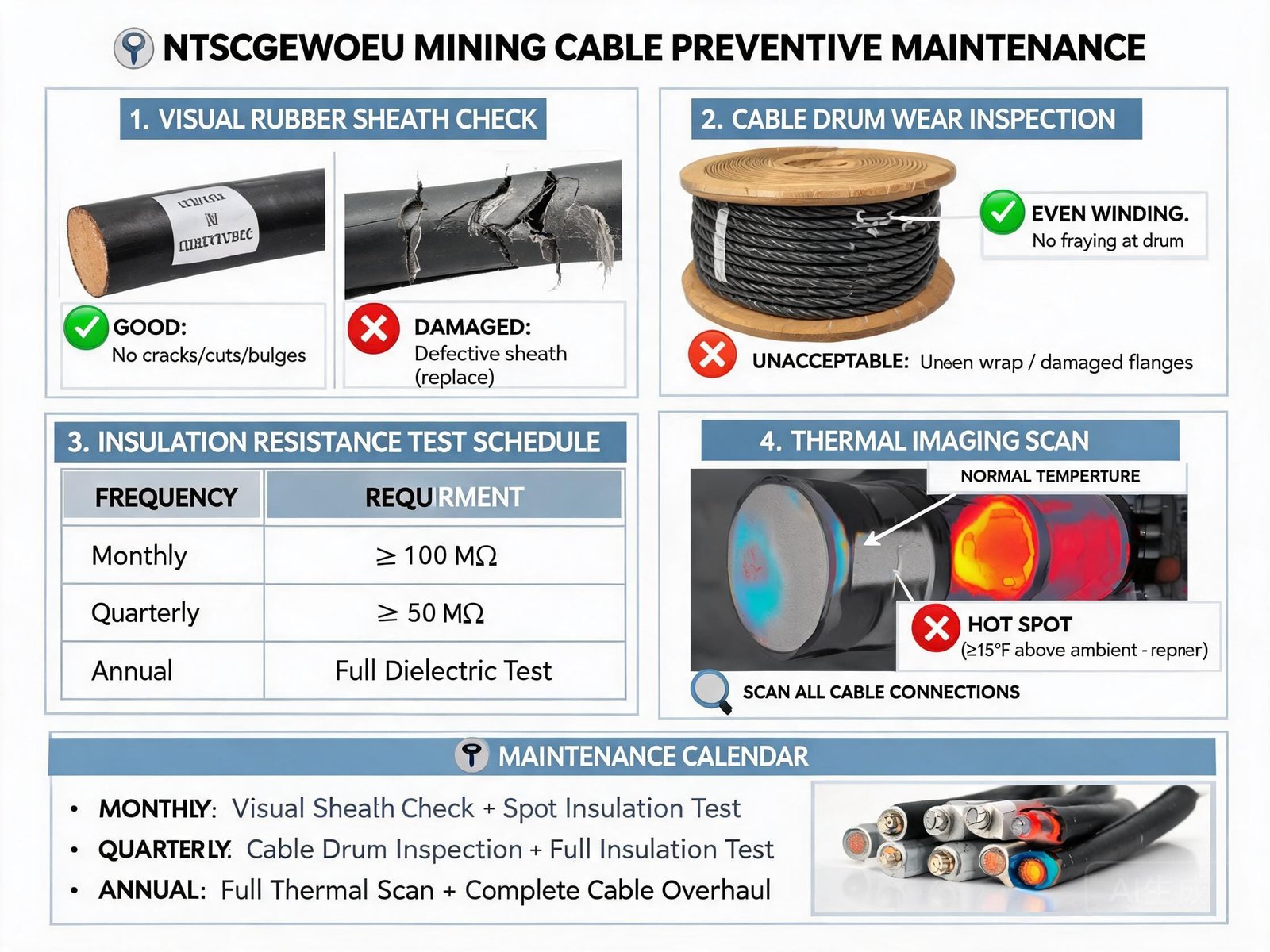
A: For MV mining cables, recommended testing intervals:
- New installation: Test before energizing (acceptance test)
- Monthly visual inspection: Check for sheath damage, abrasion, exposed screens
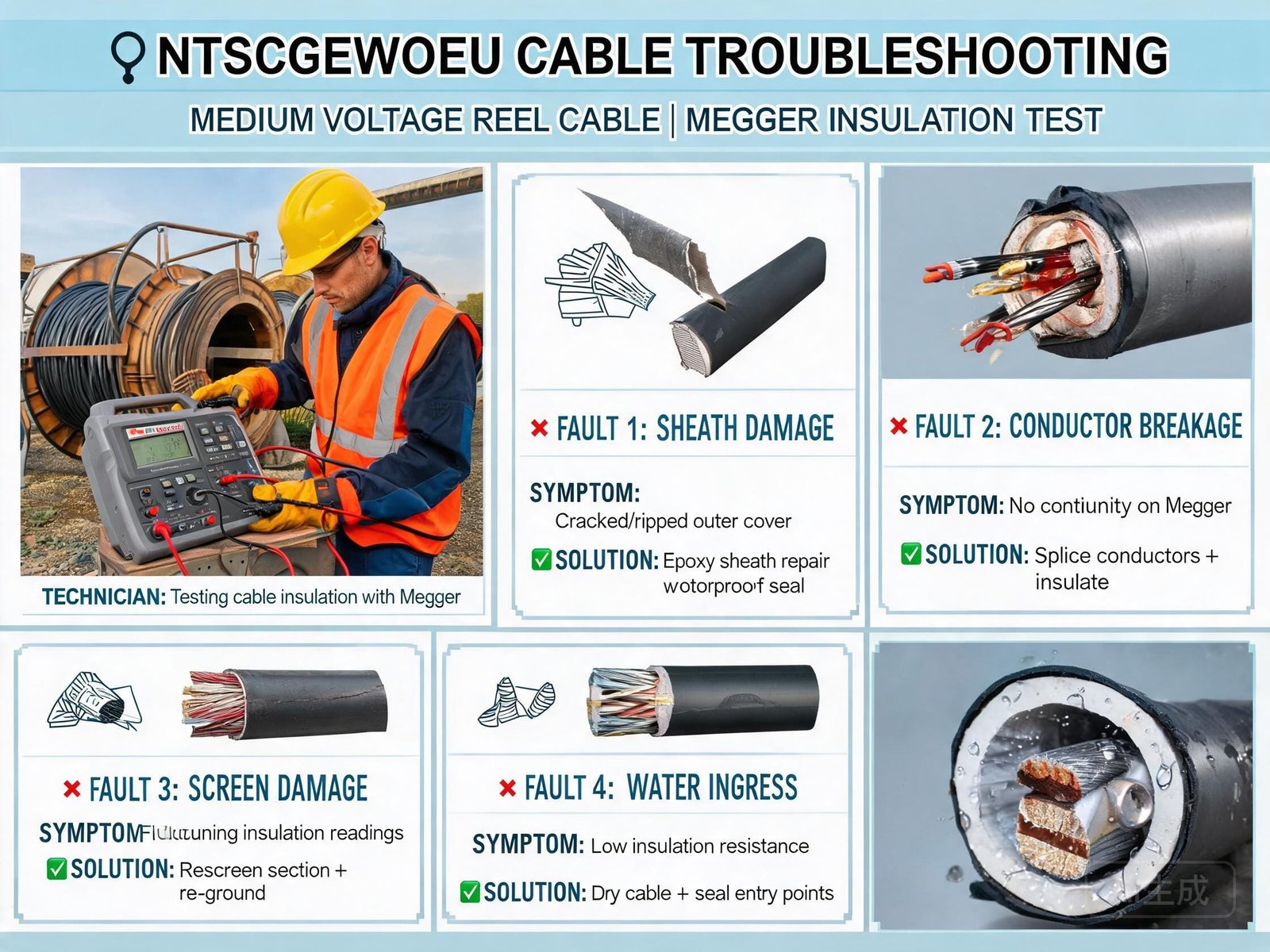
- Quarterly insulation test: 5kV Megger test on each core to ground and between phases
- Annual polarization index: Measure insulation resistance at 1 min and 10 min, calculate PI ratio
- After fault events: Test cable before re-energizing after any trip or overload
Minimum acceptable insulation resistance: 100 MΩ for new MV cable; >10 MΩ for in-service cable. A 50%+ drop from previous reading indicates degradation.
Q9: What are common causes of (N)TSCGEWOEU cable failure?
A: The most common failure modes for MV mining reeling cables:
- Sheath damage: Cuts and abrasion from mining equipment, rocks, and vehicles
- Cable drum damage: Improper winding causing pinch points and crushing
- Junction failure: MV cable joints are the weakest point — water ingress and partial discharge
- Conductor fatigue: Broken strands from excessive flexing beyond cable’s flex life
- Screen damage: Copper wire screen broken at drum entry/exit points
- Thermal degradation: Overloading beyond 90°C conductor temperature
- VFD-induced stress: Using non-EMC cable with VFD drives causes insulation breakdown
Q10: Can a damaged (N)TSCGEWOEU cable be repaired?
A: MV cable repair is more complex than LV cable and must be done by qualified personnel:
- Minor surface sheath damage: Temporary repair with self-amalgamating tape and HV overwrap
- Sheath + screen damage: Requires MV cable repair kit with screen restoration
- Insulation damage: Use factory-approved MV splice kit — must restore original insulation thickness
- Conductor damage: Install inline compression joint with MV-rated insulation and screen restoration
- Severe damage / multiple faults: Replace the cable section — do not attempt multiple field repairs on MV cable
All MV cable repairs must be hipot tested before re-energizing. Always follow VDE 0270 testing procedures.
Q11: What is the expected service life of (N)TSCGEWOEU?
A: Service life depends on operating conditions:
- Heavy-duty reeling (open-pit): 3-7 years depending on reeling cycles
- Fixed underground installation: 15-20+ years
- Semi-mobile equipment: 8-12 years
- Submersible operations: 5-10 years depending on depth and water conditions
Proper cable management, regular testing, and prompt repair of minor damage can significantly extend service life.
Q12: How do I identify genuine (N)TSCGEWOEU cable?
A: Check for:
- Cable marking: “(N)TSCGEWOEU” printed on sheath with voltage rating, manufacturer, and VDE 0250-813 standard reference
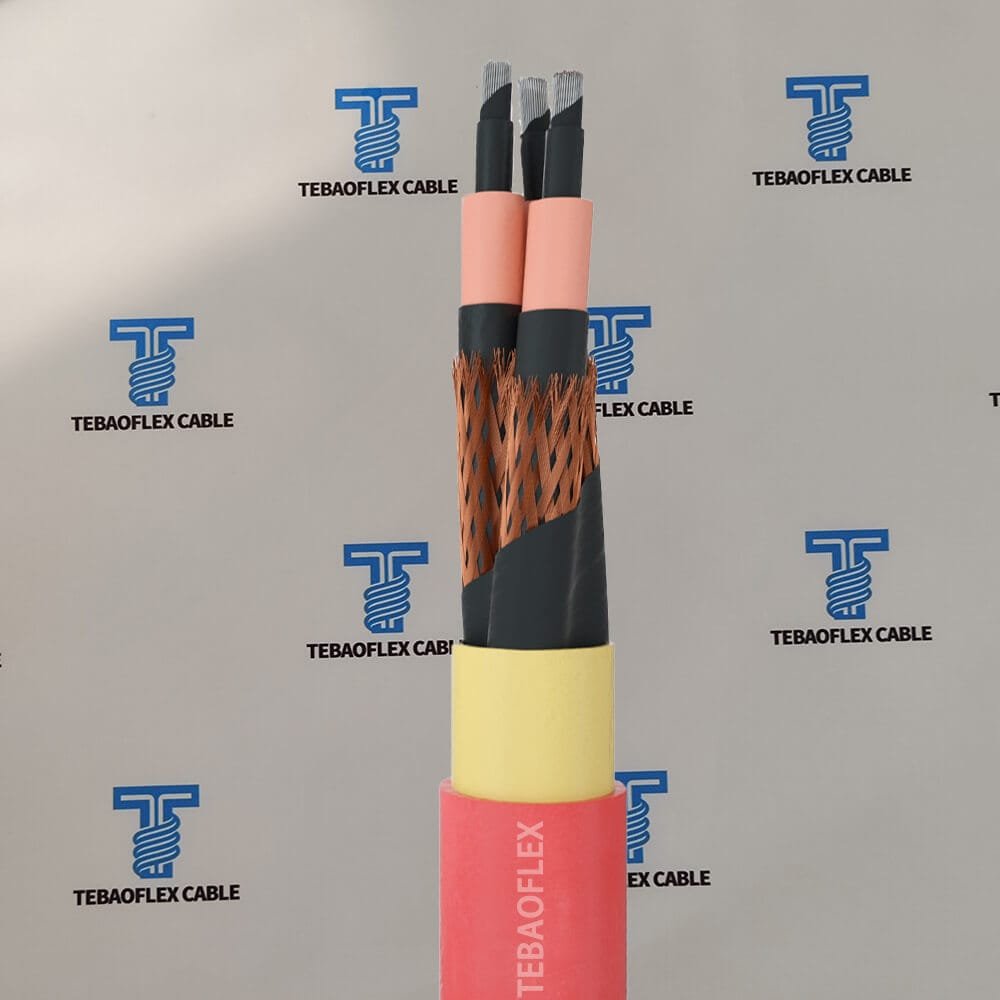
- Construction: 3 power cores + 3 earth cores with EPR insulation, copper wire screen, polyester braid
- Sheath color: Red (MT standard), Black (TR variant), or custom per specification
- Certifications: VDE mark, Coal Mine Safety, ISO 9001, factory type test certificates
- Datasheet: References VDE 0250-813 and specifies EPR insulation and Class 5 conductor
Still Have Questions?
TEBAOFLEX technical support is available for:
- MV cable sizing and selection for mining equipment
- Voltage level and variant selection (MT, MT PLUS, EMV FC, TR, FO)
- Installation planning and cable drum sizing
- Insulation testing procedures and interpretation
- Repair and maintenance programs
Contact TEBAOFLEX engineering for expert assistance and competitive pricing on (N)TSCGEWOEU mining cables.