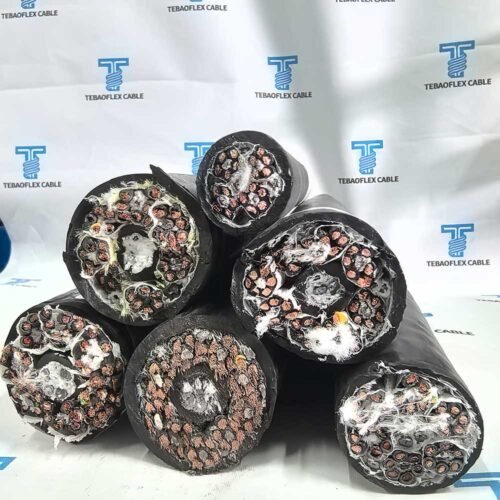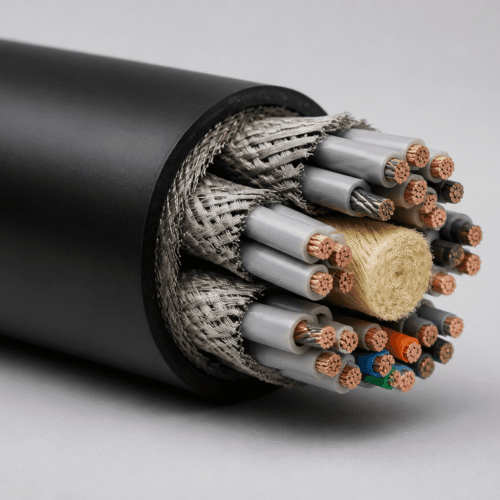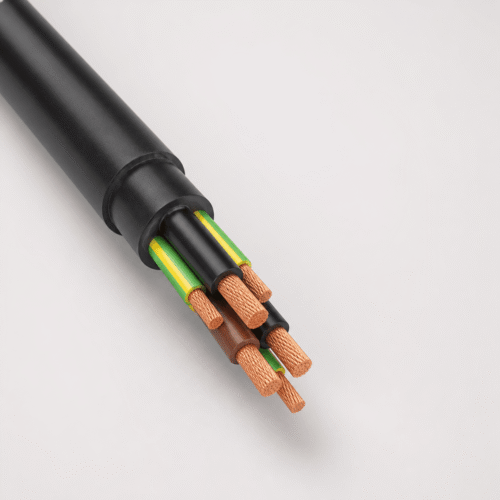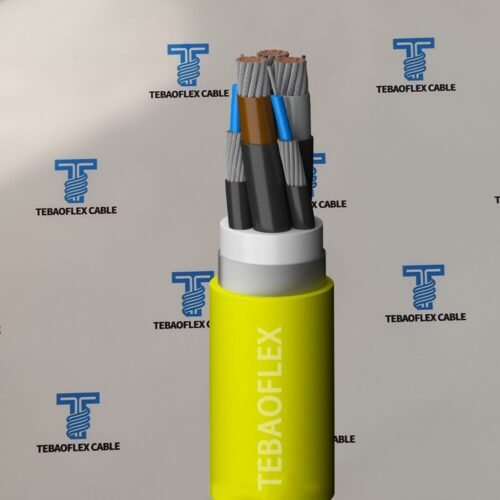
Product Overview: Baulift Cable (TF-BAULIFT-CABLE) is a 300/500 V flexible rubber vertical lift cable engineered for construction passenger/material lifts, rack-and-pinion hoists, tower shafts, and suspended crane control routes where a central load-bearing support element must carry the suspended cable dead weight.
1. Application & Vertical Suspension Scope
A Baulift cable supplies continuous electrical power and control signals between a stationary mast termination and a vertically travelling hoist car. Unlike general-purpose portable cord, the complete suspended loop weight and cyclic vertical travel govern its internal geometry:
- Construction Passenger & Material Lifts: Vertical travelling feeders along temporary or permanent building hoist masts.
- Material Hoists & Shaft Equipment: Freely suspended power and limit-switch control runs inside industrial towers, silos, and shafts.
- Crane Vertical Pendants: Suspended auxiliary power and control circuits matched with top-end strain-relief grips.
Freely Suspended vs. Cable-Basket Duty: Standard Baulift Cable is built for freely hanging vertical loops. If your hoist deposits slack cable into a bottom collecting pot or basket, compare Baulift-T Basket Crane Cable or Construction Lift-T Cable. For horizontal trolley loops, see Flat PNCT Festoon Rubber Cable.
2. Cable Construction (Load-Bearing Core Hierarchy)
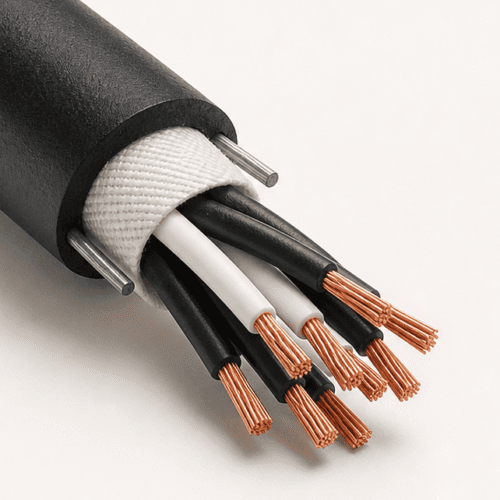
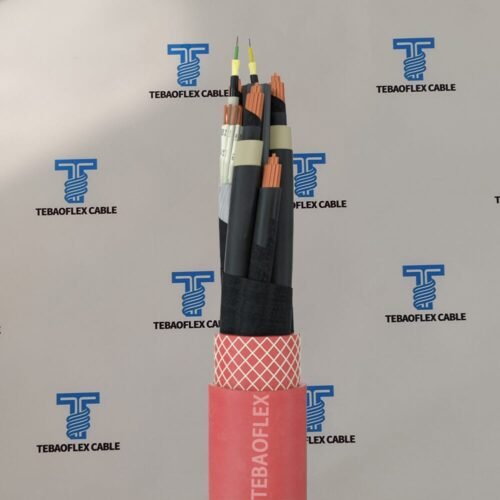
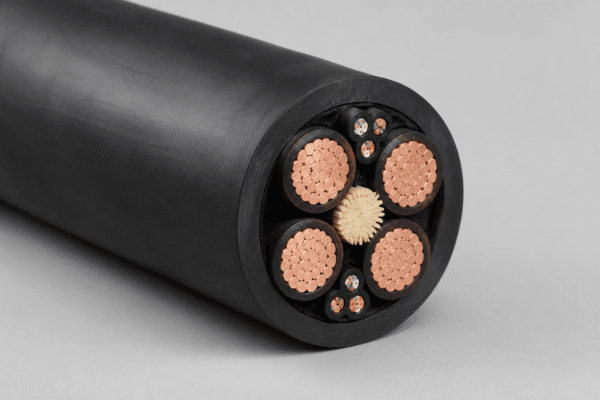
Each Baulift assembly is laid up symmetrically around a central tensile core so copper conductors remain mechanically unloaded during vertical travel:
3. Technical Characteristics & Operating Limits
Review voltage, suspended height, route clearance, and environmental exposure together before finalizing production drawings:
| Technical Parameter | Documented Engineering Specification |
|---|---|
| Product Model / Reference | TF-BAULIFT-CABLE (Baulift Vertical Lift Cable) |
| Rated Voltage (U0/U) | 300/500 V |
| Conductor Construction | Flexible stranded copper |
| Core Configuration | Multi-core control or hybrid power + control core schedule confirmed per equipment schematic |
| Tensile Support Member | Project-configured central support element matched to suspended cable mass |
| Outer Sheath Compound | Flexible heavy-duty rubber compound (confirm outdoor UV, low-temperature, oil, or flame test requirements on RFQ) |
| Approved Installation Mode | Freely suspended vertical hanging route (not for motorized drum reeling or drag-chain travel unless separately approved) |
4. Project Specification & Core-Schedule Engineering Matrix
Because construction hoists vary widely in mast height and drive/control circuitry, Baulift Cable should never be ordered from conductor cross-section alone. Submit the six engineering inputs below to lock in the exact SKU build:
| Engineering Input | What to Specify on Your RFQ | Design Parameter Controlled |
|---|---|---|
| 1. Lifting & Suspended Height | Total mast travel height (m) and maximum freely hanging loop length (m) | Sizes central support breaking load and permissible unit cable weight (kg/km) |
| 2. Power & Control Schedule | Core count × cross-section (mm²), earth conductor, and any screened signal pairs | Defines copper stranding, lay-up symmetry, and finished outside diameter |
| 3. Hoist Travel Speed & Duty | Rated vertical speed (m/min), acceleration, and daily lift cycles | Verifies loop stability, wind-guide spacing, and dynamic bending fatigue margin |
| 4. Strain-Relief Anchoring | Top fixed clamp / wedge grip and car-side suspension geometry | Ensures suspended load transfers directly into the central support rather than copper terminations |
| 5. Site & Weather Exposure | Ambient temperature range, outdoor UV/rain, oil/grease, or flame-retardant rules | Confirms final rubber sheath formulation and verification test standards |
| 6. Cut Length & Marking | Finished cut lengths per hoist, drum/coil packing, and sheath print text | Establishes manufacturing tolerances and site installation traceability |
5. Frequently Asked Questions
What equipment is Baulift 300/500V cable designed for?
It is engineered for freely suspended vertical power and control routes on construction passenger/material lifts, rack-and-pinion hoists, crane shafts, and vertical material-handling towers.
Why is a central support element required in vertical hoist cables?
Copper conductors elongate and corkscrew if forced to bear long vertical cable weight. The central support element carries the suspended dead load when terminated in proper strain-relief grips.
When should I choose Baulift-T instead of standard Baulift Cable?
Select standard Baulift Cable for freely hanging vertical loops. Select Baulift-T Basket Crane Cable when the slack cable coils under gravity into a collecting pot or cable basket.
Can power and control cores be combined inside one Baulift jacket?
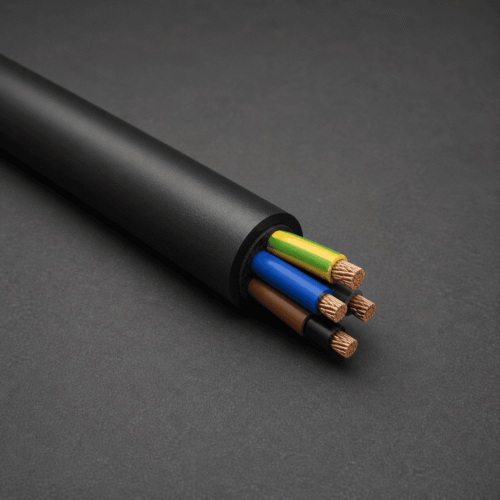
Yes. Hybrid power, protective earth, and multi-core control schedules are laid up symmetrically around the central support element subject to technical review.
Can Baulift Cable be installed on a cable reel or drag chain?
No—do not deploy it on motorized drums, horizontal drag chains, or festoon trolleys without a dedicated engineering evaluation. Browse our full Port, Crane & Festoon Cables range for those motions.
What details are needed for a fast technical quotation?
Send your lifting height, suspended loop length, travel speed, power/control core schedule, strain-relief arrangement, ambient conditions, and required cut lengths.
Request Baulift Cable Configuration Review & Factory Quote
Share your hoist lifting height, travel speed, and power/control core schedule. TEBAOFLEX engineers will size the central support element and return a verified drawing and quotation.