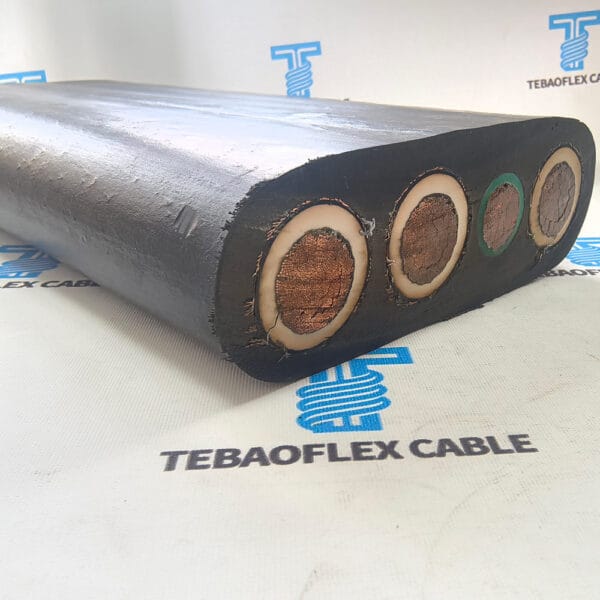
Flat PNCT Flexible Rubber Port Cable
Flat PNCT Flexible Rubber Port Cable – a high‑performance flat rubber flexible cable engineered for heavy‑duty mobile equipment such as port cranes, container handlers, stackers, reclaimers, and bulk material handling machines. Featuring EPR insulation and a durable neoprene (CR) jacket, it offers excellent flexibility, outstanding bending resistance, oil resistance, and low‑temperature performance (down to -40°C). The flat profile saves 15–20% storage and routing space compared to round cables of the same rating, while improving heat dissipation – making it the ideal choice for ports, mines, steel mills, and other harsh industrial environments.
Product Overview
The Flat PNCT Flexible Rubber Port Cable is a premium flat rubber flexible cable manufactured in compliance with Japanese JIS standards. It is specially designed for mobile machinery operating in demanding environments such as ports, harbours, mines, and metallurgical plants. Typical applications include port cranes, container cranes, stackers, reclaimers, bridge cranes, trolleys, and festoon systems for both power transmission and control circuits.
The suffix “-F” denotes the flat profile, which offers distinct advantages over conventional round cables in cable troughs, festoon tracks, and reeling systems.
Construction
| Component | Material / Specification | Remarks |
|---|---|---|
| Conductor | Stranded bare copper or tinned copper wire | Class 5 flexible conductor per VDE 0295 / IEC 60228 |
| Insulation | EPR (Ethylene Propylene Rubber) | Excellent electrical and thermal properties |
| Sheath / Jacket | Neoprene / Chloroprene Rubber (CR) | Oil‑resistant, abrasion‑resistant, weatherproof, flame‑retardant |
| Shape | Flat (parallel) construction | Smaller bending radius, prevents twisting and tangling |
Technical Specifications
| Parameter | Value / Range |
|---|---|
| Rated Voltage | 300/500V, 450/750V, 0.6/1kV |
| Test Voltage | 2500V – 3500V |
| Conductor Resistance | Complies with VDE 0295 and IEC 60228 Class 5 |
| Insulation Resistance | ≥ 50 MΩ/km (at 20°C) |
| Operating Temperature | Fixed installation: -40°C ~ +70°C Moving installation: -20°C ~ +70°C |
| Minimum Bending Radius | Fixed: 8 × cable outer diameter (OD) Moving: 10 × OD |
| Number of Cores | 2 to multi‑core (customisable) |
| Cross‑section | 0.75mm² up to 50mm² (larger sizes available on request) |
Key Features
High Flexibility – Finely stranded copper conductors and soft rubber compound ensure easy routing and repeated flexing.
Excellent Bending Resistance – Withstands continuous bending, coiling, and uncoiling in festoon and reeling applications.
Flat Profile Advantages:
Saves 15–20% in storage and installation space compared to round cables.
Better heat dissipation due to increased surface‑to‑volume ratio.
Lies flat and resists twisting in troughs and festoon systems.
Oil, Chemical & Abrasion Resistant – Neoprene jacket provides superior resistance to mineral oils, acids, alkalis, and mechanical wear.
Cold‑Resistant – Performs reliably at -40°C (fixed installation) – ideal for cold‑climate ports and outdoor yards.
UV & Weather Resistant – Suitable for long‑term outdoor exposure.
Tension‑Resistant – Optional strength members (galvanised steel wire or aramid yarn) can be added for vertical or long‑span installations.
Typical Applications
Ports & Harbours – Ship‑to‑shore cranes, rubber‑tyred gantry cranes, portal cranes, ship unloaders.
Mines & Metallurgy – Stackers, reclaimers, overhead cranes, trolleys.
Industry & Power – Cable reeling drums, festoon systems, energy chains, material handling machinery.
Others – Shipyards, storage yards, power plants, and any mobile equipment requiring flexible power/control connections.
Approvals & Standards
Design Standard – Complies with Japanese JIS C 3327 / CNS 10741.
International Certifications – Available with PSE (Japan), CE (Europe), EAC (Eurasian), CCC (China), and others upon request.
Flame Retardancy – Meets IEC 60332‑1 requirements.
Frequently Asked Questions (FAQ)
Q1: What does the “-F” in PNCT‑F stand for?
A: The “-F” stands for Flat Type. Compared to standard round PNCT cables, the flat profile offers advantages in storage space, heat dissipation, and cable management.
Q2: What are the main advantages of flat cable over round cable?
A: Flat cables save approximately 15–20% of routing and storage space. Their flat geometry increases surface area relative to volume, improving cooling. They also lie flatter in troughs and festoon paths, reducing twisting and tangling.
Q3: What is the lowest operating temperature for this cable?
A: For fixed installation, it can withstand -40°C; for moving installation, the minimum is -20°C. Cold‑resistant performance may vary by specific construction – please confirm with our sales team for your actual application.
Q4: What is the minimum bending radius?
A: For fixed installation: 8 × cable outer diameter. For moving installation: 10 × cable outer diameter.
Q5: Can the number of cores and conductor cross‑section be customised?
A: Yes. We support customisation for core count (2 to multi‑core) and conductor sizes (from 0.75mm² upward). Please provide your technical requirements and we will offer a tailored solution.
Q6: Which specific equipment is this cable suitable for?
A: It is widely used on port cranes, container cranes, stackers, reclaimers, overhead travelling cranes, trolleys, and ship unloaders – any heavy‑duty mobile machinery.