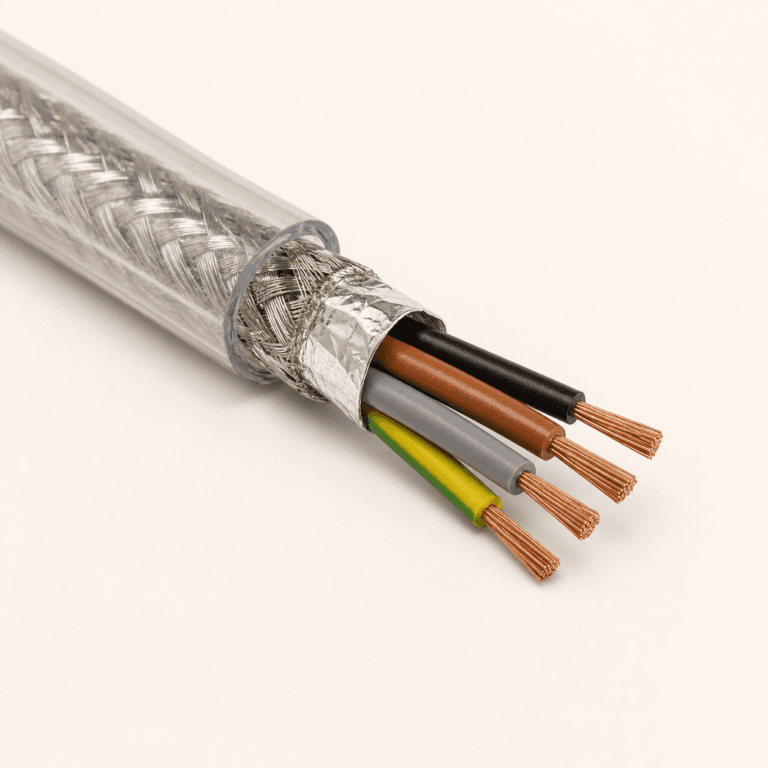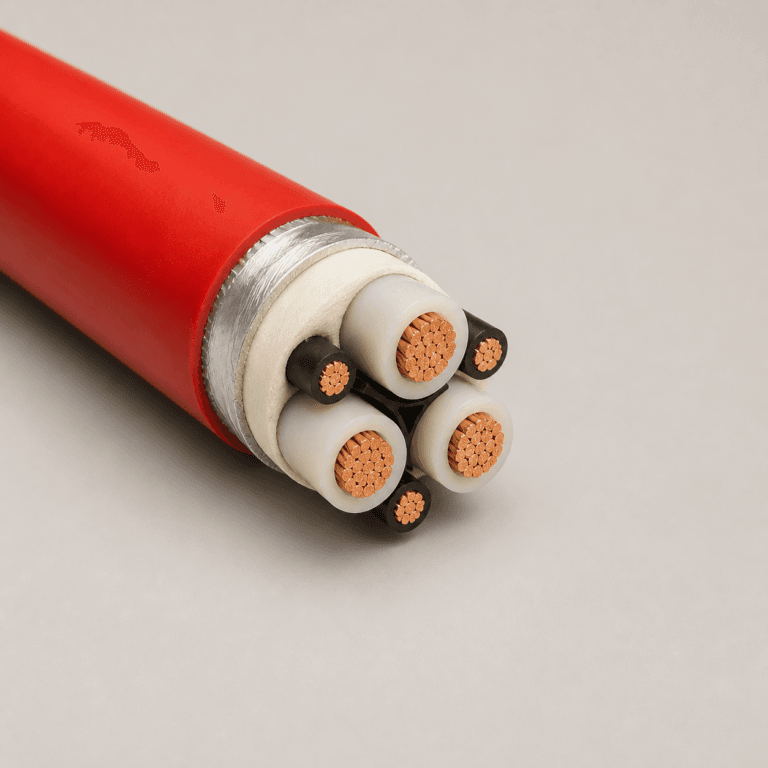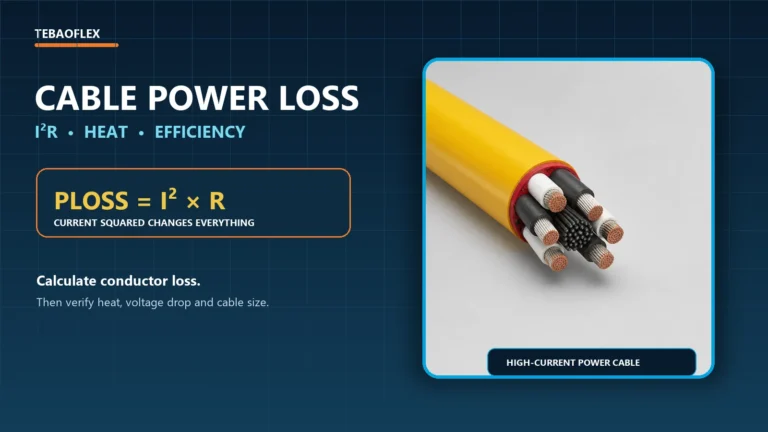

A 4/0 DLO cable is a large, flexible single-conductor power cable size that is often considered where substantial current must be carried through a route that is difficult for a rigid conductor to follow. Buyers commonly search for its ampacity, weight per foot and physical size before preparing a quote. Those are sensible starting questions, but they should be answered as a connected specification—not as three isolated numbers.
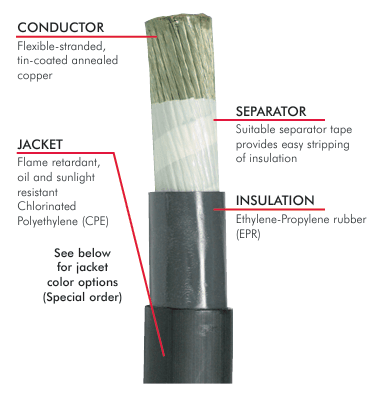
Quick answer: in the supplied TEBAOFLEX 2 kV DLO construction, 4/0 AWG corresponds to a nominal 107 mm² conductor, with an approximate overall diameter of 0.84 in (21.3 mm) and an approximate net weight of 845 lb/1,000 ft (0.845 lb/ft). The final allowable current is installation-dependent: ambient temperature, cable grouping, route, length, terminal temperature limits and the governing code all matter. For the product-level construction and available sizes, review the DLO 2 kV flexible diesel locomotive cable page.
What does 4/0 DLO cable mean?
“4/0” is an AWG size, also written as 0000 AWG. It is larger than 3/0, 2/0 and 1/0. “DLO” means Diesel Locomotive cable, a name that originated in diesel-electric locomotive power circuits and is now also used for flexible single-conductor industrial power connections when the cable marking and installation conditions permit the use.
The cable designation does not create a blanket approval for every application. A 4/0 DLO cable can be relevant to generator, motor, battery, switchgear and heavy-equipment connections, but the electrical system, route, termination and environmental exposure must be reviewed together. For the wider construction and application background, read what DLO cable means and where it is used.
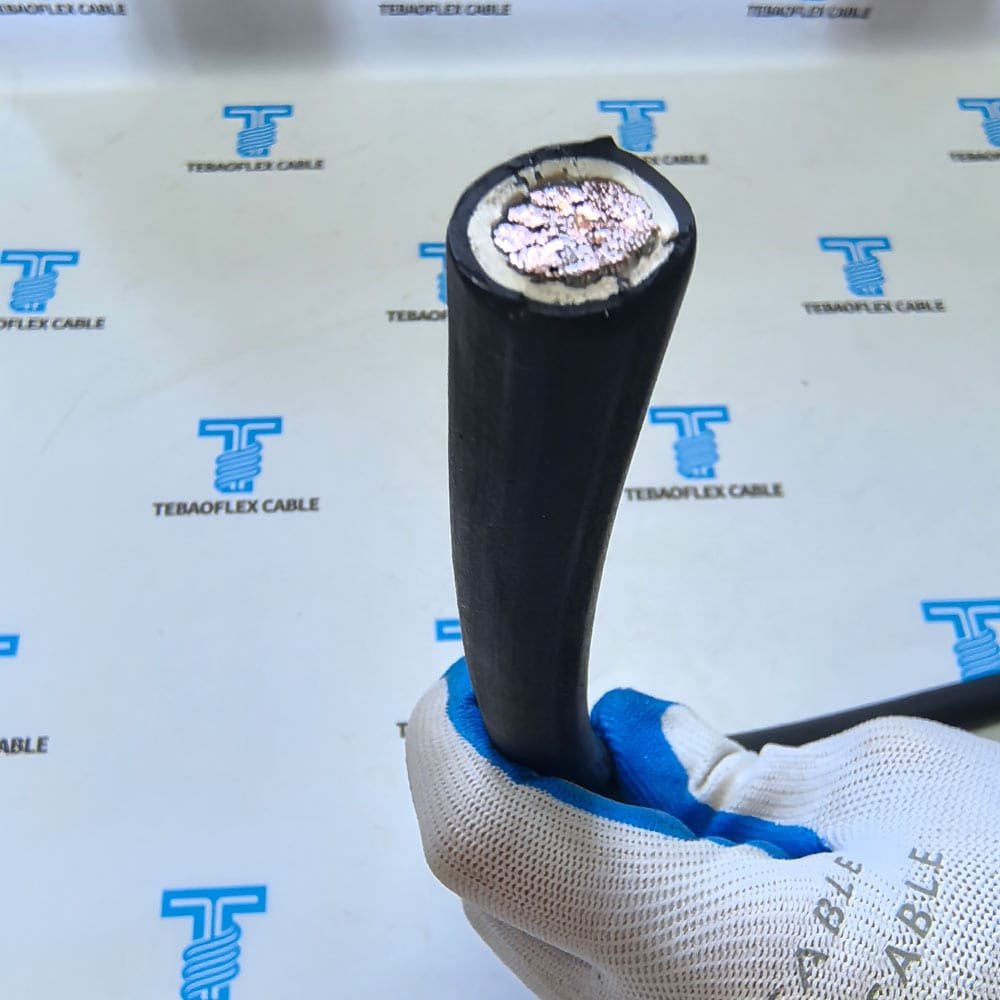
4/0 DLO cable size, dimensions and weight per foot
Weight affects more than freight planning. It influences reel handling, pull support, cable-tray loading, bend management and the amount of strain placed on lugs or supports. Outside diameter matters for gland openings, enclosure space, cleat selection and bend planning. These values should be taken from the exact construction being quoted, because another DLO construction may use different materials or layer thicknesses.
The following snapshot is drawn from the supplied TEBAOFLEX 2 kV DLO product construction. It is a sizing reference for this product, not a universal DLO cable chart.
| Item | Nominal 4/0 DLO value | How to use it |
|---|---|---|
| Conductor size | 4/0 AWG / 107 mm² | Use the engineered conductor size, not a visual comparison with another cable. |
| Conductor stranding | 551/24 | Confirm terminal and lug compatibility for the flexible stranded conductor. |
| Conductor diameter | 0.581 in / 14.8 mm | Useful for conductor preparation and compatible termination review. |
| Overall cable diameter | 0.84 in / 21.3 mm | Check route clearances, glands, guides and bend space. |
| Approximate net weight | 845 lb/1,000 ft / 1,258 kg/km | Equivalent to approximately 0.845 lb/ft before packaging and reel weight. |
A 100 ft length of this construction therefore has a nominal cable-only weight of about 84.5 lb. That is helpful for an early handling estimate, but it is not a shipment weight: drum, coil, pallet and protective packing must be added separately. For AWG-to-metric context and the limits of approximate conversions, see the cable size and cross-section selection guide.
4/0 DLO cable ampacity: why one internet number is not enough
“4/0 DLO cable ampacity” is a high-value search query because buyers need a quick indication of whether the size may suit their circuit. The correct engineering answer is that there is no single allowable-current figure that applies to every 4/0 DLO installation. Ampacity is a thermal result under stated conditions, not a permanent attribute of the AWG label.
Before confirming a current rating, the designer should establish the conductor material and construction, insulation temperature rating, maximum ambient temperature, installation in free air/tray/conduit/bundle, number of adjacent loaded cables, length and voltage-drop allowance, terminal temperature limitations, protective device and applicable electrical code. Large flexible conductors also need compatible lugs, tooling and enclosure space; a cable may be thermally adequate while the termination arrangement remains unsuitable.
Use the cable ampacity calculation guide to understand the derating inputs. For a project review, send TEBAOFLEX the installation method and maximum operating conditions rather than requesting an unqualified “4/0 ampacity” value. This produces a result that can be checked against the actual system instead of a generic chart.
Questions to resolve before comparing ampacity
- Is the cable in free air, a tray, a conduit, a bundle, or another enclosed route?
- What is the highest ambient temperature expected at the cable and at the terminals?
- How many loaded conductors share the same thermal space?
- What circuit length and voltage-drop limit apply?
- Is the installation stationary after routing, occasionally flexed, vibrated or repeatedly moved?
- Which code, customer specification and equipment limits control the final selection?
4/0 vs 3/0 vs 2/0 DLO cable
Size comparison is useful when the design is still open. It should not be used to downsize a circuit after the fact. In the same supplied DLO construction, 2/0 and 3/0 have smaller nominal dimensions and lower nominal cable-only weight than 4/0. Whether either is acceptable depends on the complete electrical and installation calculation.
| DLO size | Nominal conductor area | Nominal overall diameter | Approximate net weight | Selection note |
|---|---|---|---|---|
| 2/0 AWG | 67.4 mm² | 0.73 in / 18.5 mm | 587 lb/1,000 ft / 0.587 lb/ft | Consider only after validating load, voltage drop and installation conditions. |
| 3/0 AWG | 85 mm² | 0.80 in / 20.3 mm | 718 lb/1,000 ft / 0.718 lb/ft | Intermediate option; do not assume it is a direct substitute for 4/0. |
| 4/0 AWG | 107 mm² | 0.84 in / 21.3 mm | 845 lb/1,000 ft / 0.845 lb/ft | Confirm thermal, voltage-drop, route and termination requirements. |
When should 2/0 DLO cable be mentioned? Include it when the buyer is considering several engineered conductor sizes for the same duty. It is not enough to say that 2/0 is lighter or easier to route. The system current, route length, ambient conditions, grouping and terminal limits must support the smaller size. This approach also applies to searches for 3/0 DLO ampacity: a size comparison is a design input, not a final approval.
Can 4/0 DLO cable replace 4/0 welding cable?
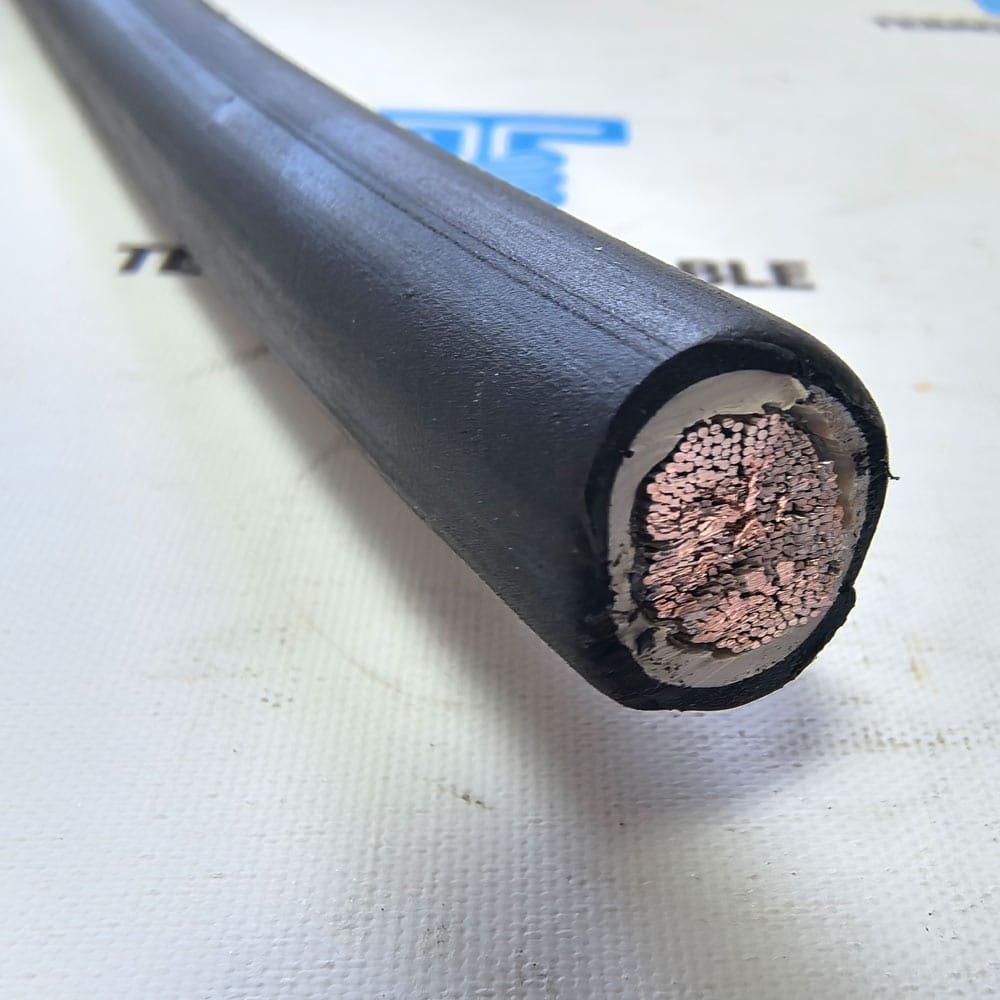
Not automatically. Both may be flexible, single-conductor copper cables in the same AWG size, but matching gauge does not establish equivalence. Compare the printed marking, voltage requirement, insulation and jacket construction, permitted installation method, environmental exposure, flexibility demand, lug compatibility and the customer or authority requirements. A cable should be selected for the actual power circuit and its documentation—not because it looks similar in a catalogue or on a job site.
Where the project involves welding equipment, review the application separately with the heavy-duty welding cable selection guide. Where the decision is between a single-conductor DLO connection and a multi-conductor portable power cable, the Type W versus DLO comparison helps clarify the different cable formats.
Installation and termination checks for large flexible conductors
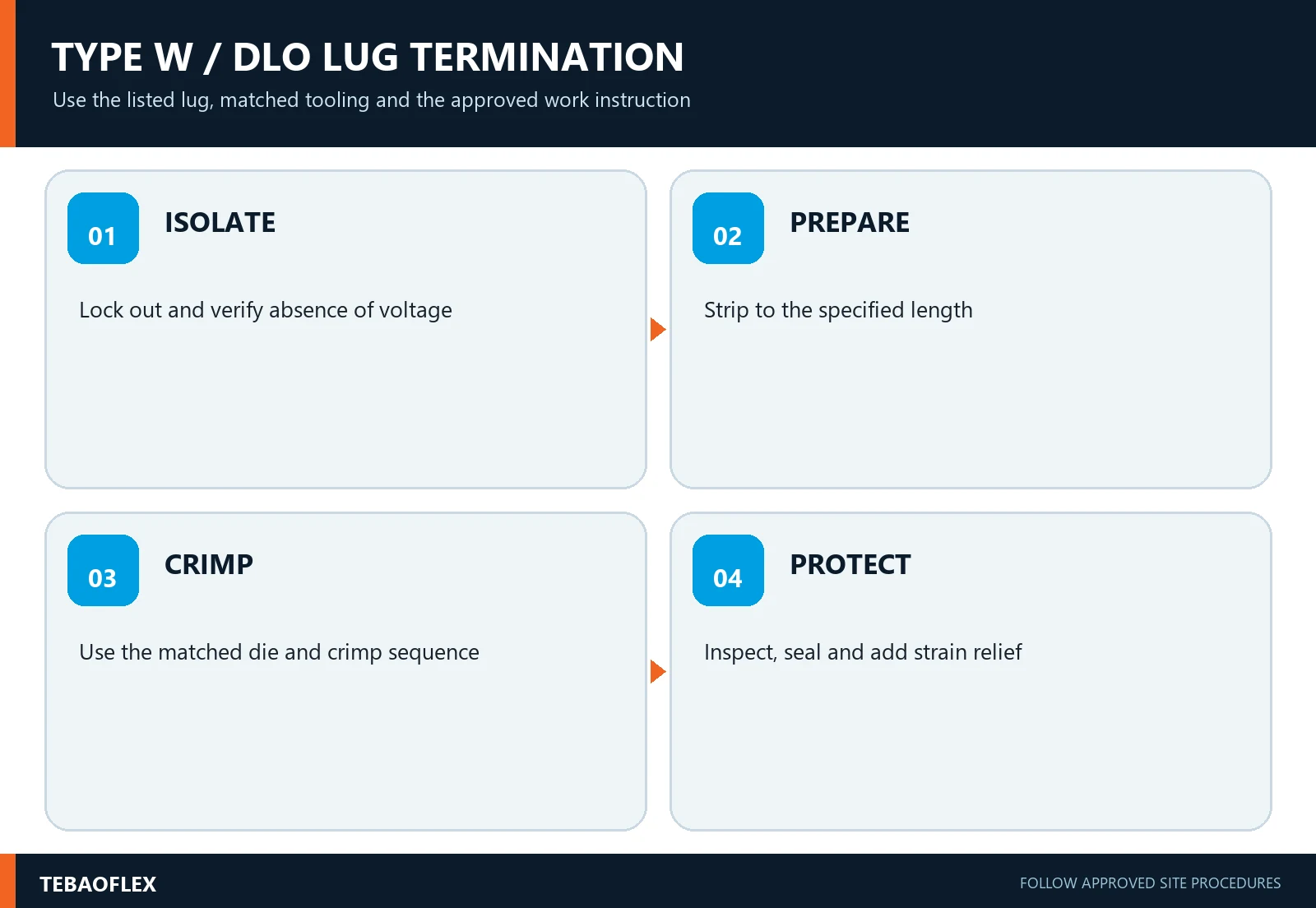
Large DLO cable is often selected because it can be routed through equipment connections more easily than a rigid conductor. Flexibility does not remove the need for careful mechanical planning. Confirm the route, supports, bend restrictions supplied by the equipment manufacturer, strain relief, terminal space, lug barrel type, conductor preparation method, crimp tooling and inspection process.
For field teams, cable condition and connection quality are as important as the original size selection. Look for jacket damage, contamination at the termination area, inadequate strain relief, unsuitable lug selection, overheating indications and changes to the installed route. See the Type W / DLO installation and troubleshooting FAQ for maintenance-focused questions that should be addressed before a fault becomes a shutdown.
What to include in a 4/0 DLO cable RFQ
A complete RFQ makes technical review faster and prevents quotes based on different assumptions. Send the following information:
- Application and equipment type
- System voltage, expected load current and circuit length
- Requested 4/0 AWG size or the design inputs needed to evaluate 2/0, 3/0 and 4/0 options
- Installation method, movement profile, ambient temperature and environmental exposures
- Required marking, standards, certificates or customer documentation
- Terminal/lug requirements, required cut lengths, packing preference and quantity
- Delivery destination and project schedule
FAQ
How much does 4/0 DLO cable weigh per foot?
For the supplied TEBAOFLEX 2 kV DLO construction, the nominal cable-only value is 845 lb per 1,000 ft, or approximately 0.845 lb per foot. Confirm the product data sheet for the quoted construction and add packaging or reel weight for logistics planning.
What is the ampacity of 4/0 DLO cable?
There is no one correct universal value. Confirm the cable construction, applicable code, route, ambient temperature, grouping, termination limits and voltage-drop requirement before selecting an allowable current.
Is 2/0 DLO cable a direct replacement for 4/0?
No. It is a smaller conductor size. It may be evaluated for a different engineered duty, but it should not replace 4/0 unless the full electrical and installation review supports the change.
Is 4/0 AWG the same as 444.4 kcmil?
No. AWG 4/0 and kcmil are separate conductor-size designations. Confirm the exact requested size from the drawing, cable legend or approved specification before quoting.
Can 4/0 DLO cable be used as welding cable?
Do not assume so based on size alone. Compare the exact marking, ratings, intended installation and project requirements before any substitution.
Specify the conditions, not just the cable size
4/0 DLO cable is best selected by linking its verified dimensions and nominal weight to the actual electrical duty, route and termination system. Start with the cable size, then validate current-carrying conditions, voltage drop, environmental exposure and required documentation. That produces a purchase specification that is technically comparable and easier to approve.
Need help selecting a 4/0 DLO cable or comparing it with 2/0 and 3/0 options? Send TEBAOFLEX CABLE your project requirements: application, voltage, current, length, installation method, movement, environment, required documents and quantity. Our engineering team can review the information and recommend a suitable flexible cable construction for quotation.