
BUFLEX-M Cable FAQ: Your Questions Answered
As a specialized polyurethane flexible control cable designed for high-performance industrial automation, the BUFLEX-M generates many technical questions from engineers, maintenance technicians, and procurement professionals. This comprehensive FAQ addresses the most common questions about installation, maintenance, troubleshooting, and application suitability.
Whether you are specifying BUFLEX-M for a new project, troubleshooting an existing installation, or evaluating it as a replacement cable, this guide provides practical, field-tested answers based on our extensive experience in industrial cable applications.
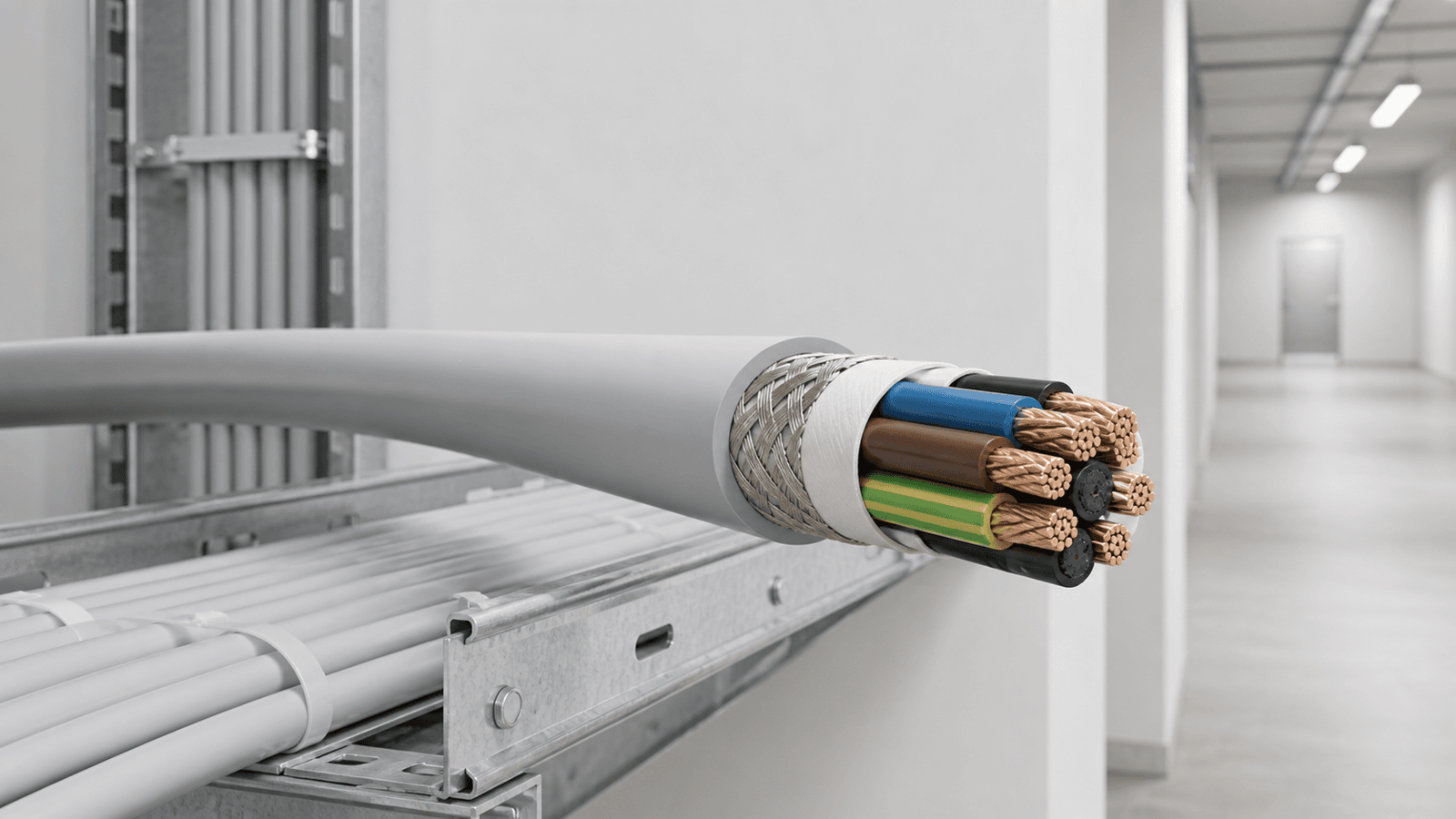
BUFLEX-M polyurethane cable installation in industrial drag chain and cable tray systems
Installation Questions
Q1: What is the minimum bending radius for BUFLEX-M cables?
The minimum bending radius depends on the installation type:
- Fixed installation: 4× cable outer diameter (4×D)
- Flexing application (continuous flex): 7.5× cable outer diameter (7.5×D)
- Torsional flex (robotic applications): 10× cable outer diameter (10×D)
For example, a BUFLEX-M cable with an outer diameter of 12mm would have a minimum bend radius of 48mm for fixed installation and 90mm for flexing applications. Exceeding these minimum radii will significantly reduce cable life. Always verify the outer diameter from the product datasheet for your specific configuration.
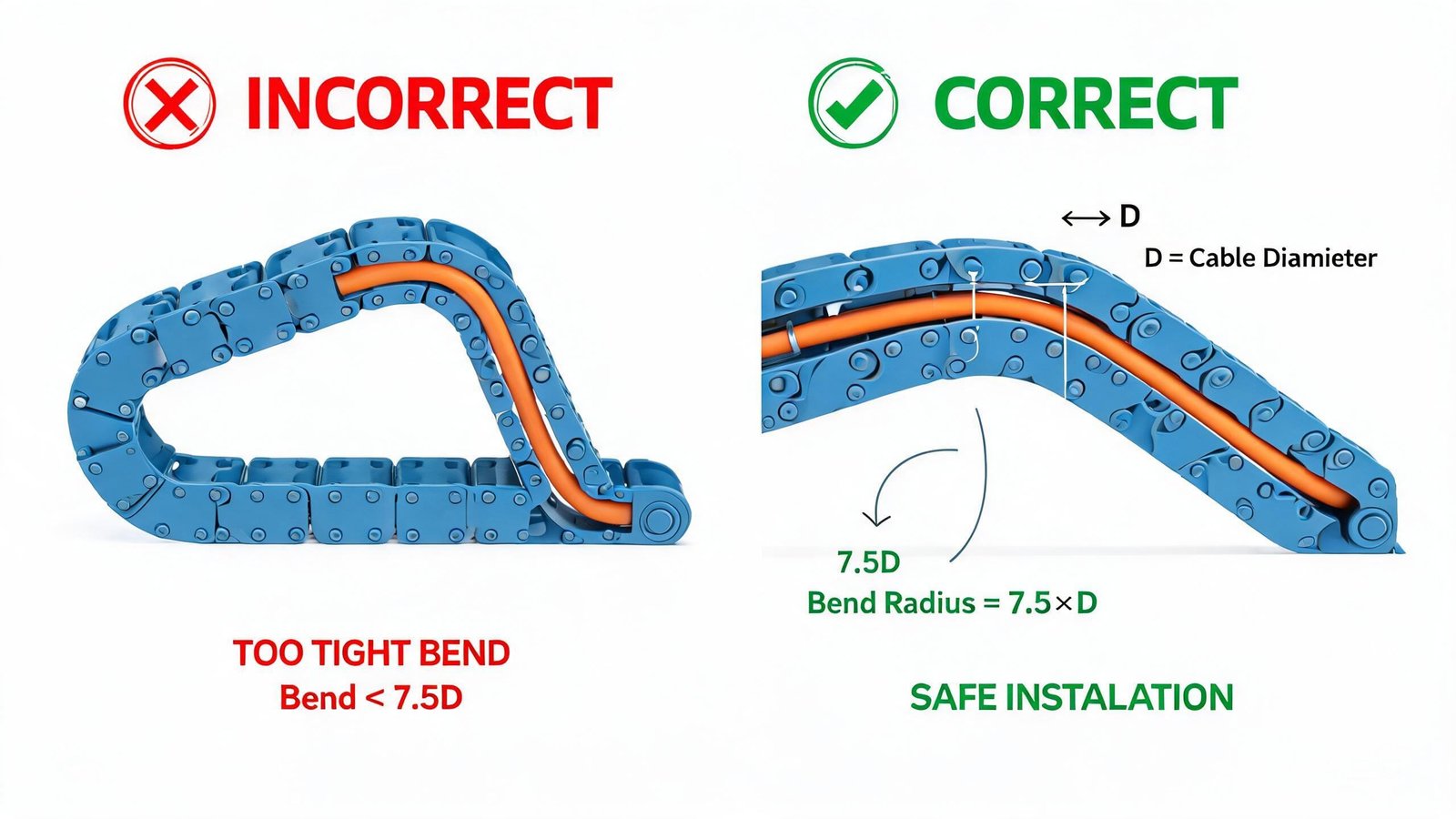
BUFLEX-M bend radius guide: correct 7.5×D vs incorrect tight bend installation
Q2: Can BUFLEX-M be installed outdoors?
Yes. The polyurethane sheath of BUFLEX-M is UV-stable and weather-resistant, making it suitable for both indoor and outdoor installations. The PUR formulation resists degradation from sunlight exposure, rain, and temperature fluctuations. However, for applications involving continuous water submersion or underground burial, contact our engineering services team for specialized configurations.
Q3: How should BUFLEX-M cables be routed in cable chains?
Proper cable chain installation is critical for achieving maximum flex life. Follow these key principles:
- De-stack cables: Remove the cable from the drum without pulling it over the flange. Unroll it flat to eliminate built-in twist.
- Distribute weight: Place heavier power cables on the outside and lighter signal cables on the inside of the chain.
- Maintain spacing: Ensure at least 10% of cable diameter spacing between adjacent cables to prevent cross-abrasion.
- Secure ends: Use appropriate strain relief clamps at both chain ends. The cable should be neutral (zero tension) at mid-stroke.
- Use dividers: For mixed cable bundles, use chain dividers to separate cables of different diameters.
Q4: What is the maximum travel length for BUFLEX-M in cable chains?
BUFLEX-M is suitable for cable chain travel lengths up to 100 meters without glider systems. For applications exceeding 50 meters, a glider or roller system is recommended to reduce friction and wear. For travel distances beyond 100 meters, consult our technical team for application-specific recommendations, as additional considerations for cable weight, tension, and support become critical.
Q5: Can BUFLEX-M be used in conduit?
BUFLEX-M can be installed in conduit for fixed installations where additional mechanical protection is required. However, using conduit for flexing applications is not recommended, as the conduit walls introduce friction that accelerates cable wear. For flexing applications, always use open cable carriers that allow free cable movement.
Performance and Specifications
Q6: What is the flex life rating of BUFLEX-M?
BUFLEX-M is rated for a minimum of 3 million flex cycles at the rated minimum bend radius of 7.5×D, tested at 1 cycle per second at room temperature. Under optimized conditions (larger bend radius, lower speed, lower temperature), flex life can exceed 5 million cycles.
It is important to note that flex life is application-dependent. Factors that reduce flex life include:
- Bend radius at or below the minimum rating
- High travel speeds (>1 m/s)
- High acceleration/deceleration forces
- Elevated ambient temperatures
- Pulling tension during flexing
- Exposure to incompatible chemicals
Q7: What voltage ratings are available for BUFLEX-M?
BUFLEX-M is available in two voltage ratings:
- 300/500V: For control, signal, and instrumentation circuits. Available in configurations from 2 to 60 cores (unshielded) and 2 to 24 cores (shielded).
- 450/750V: For power distribution circuits within machinery and equipment. Available in configurations from 2 to 12 cores.
The dual voltage rating means the cable is suitable for both control and power applications, simplifying cable specification for machine builders who need both in a single cable management system.
Q8: Is BUFLEX-M available in halogen-free (LSZH) versions?
Yes. The BUFLEX-M-HF version features halogen-free insulation and sheath materials that meet IEC 60754-1/2 standards. This version is recommended for applications in public buildings, transportation tunnels, and confined spaces where smoke emission and toxic gas generation during fire must be minimized.
Note that the halogen-free version may have slightly different mechanical properties (lower tensile strength, higher cost) compared to the standard PUR version. Consult the product datasheet for specific performance characteristics.
Q9: What is the temperature range of BUFLEX-M?
BUFLEX-M is rated for the following temperature ranges:
- Fixed installation: -40°C to +80°C
- Flexing application: -5°C to +70°C
- Short-term exposure: Up to +90°C (maximum 24 hours)
The -40°C rating for fixed installation makes BUFLEX-M suitable for cold climate installations, including outdoor applications in northern regions and refrigerated warehouse environments. However, flexing at temperatures below -5°C is not recommended, as the PUR sheath becomes stiffer at low temperatures, increasing the risk of cracking under bending stress.
Oil and Chemical Resistance
Q10: What oils and chemicals is BUFLEX-M resistant to?
The polyurethane sheath of BUFLEX-M provides excellent resistance to:
- Mineral oils and lubricants (per IEC 60811-2-1)
- Aliphatic hydrocarbons
- Greases and lubricating pastes
- Water-based cutting fluids and coolants
- Mild acids (pH 4+) and alkalis (pH 10-)
- Alcohol and glycol solutions
Limited resistance (short-term exposure acceptable):
- Aromatic hydrocarbons (toluene, xylene)
- Ketones (acetone, MEK)
- Strong acids and alkalis
Not recommended for: esters, strong solvents, and chlorinated hydrocarbons. For specific chemical compatibility verification, contact our technical team with the SDS (Safety Data Sheet) of the chemicals in your application.
Q11: Can BUFLEX-M be cleaned with industrial cleaning agents?
Yes. BUFLEX-M’s smooth PUR sheath is easily cleaned with standard industrial cleaning agents. For food and pharmaceutical applications, the sheath can be washed with common sanitizers including:
- Quaternary ammonium compounds
- Chlorine solutions (up to 200 ppm)
- Isopropyl alcohol
- Hydrogen peroxide solutions (3-6%)
Avoid using strong organic solvents (acetone, MEK, toluene) for cleaning, as prolonged exposure can soften the PUR sheath. Always rinse with water after cleaning to remove chemical residue.
Maintenance and Troubleshooting
Q12: How often should BUFLEX-M cables be inspected?
For continuous flexing applications, we recommend the following inspection schedule:
| Inspection Type | Frequency | Key Points |
|---|---|---|
| Visual inspection | Monthly | Sheath damage, abrasion, oil contamination |
| Bend radius check | Quarterly | Verify cables maintain proper bend radius in chains |
| Continuity test | Annually | Insulation resistance and conductor continuity |
| Full assessment | Every 2 years | Remove cables from chain for detailed examination |
More frequent inspections may be needed in environments with extreme temperatures, heavy oil contamination, or high-cycle applications.
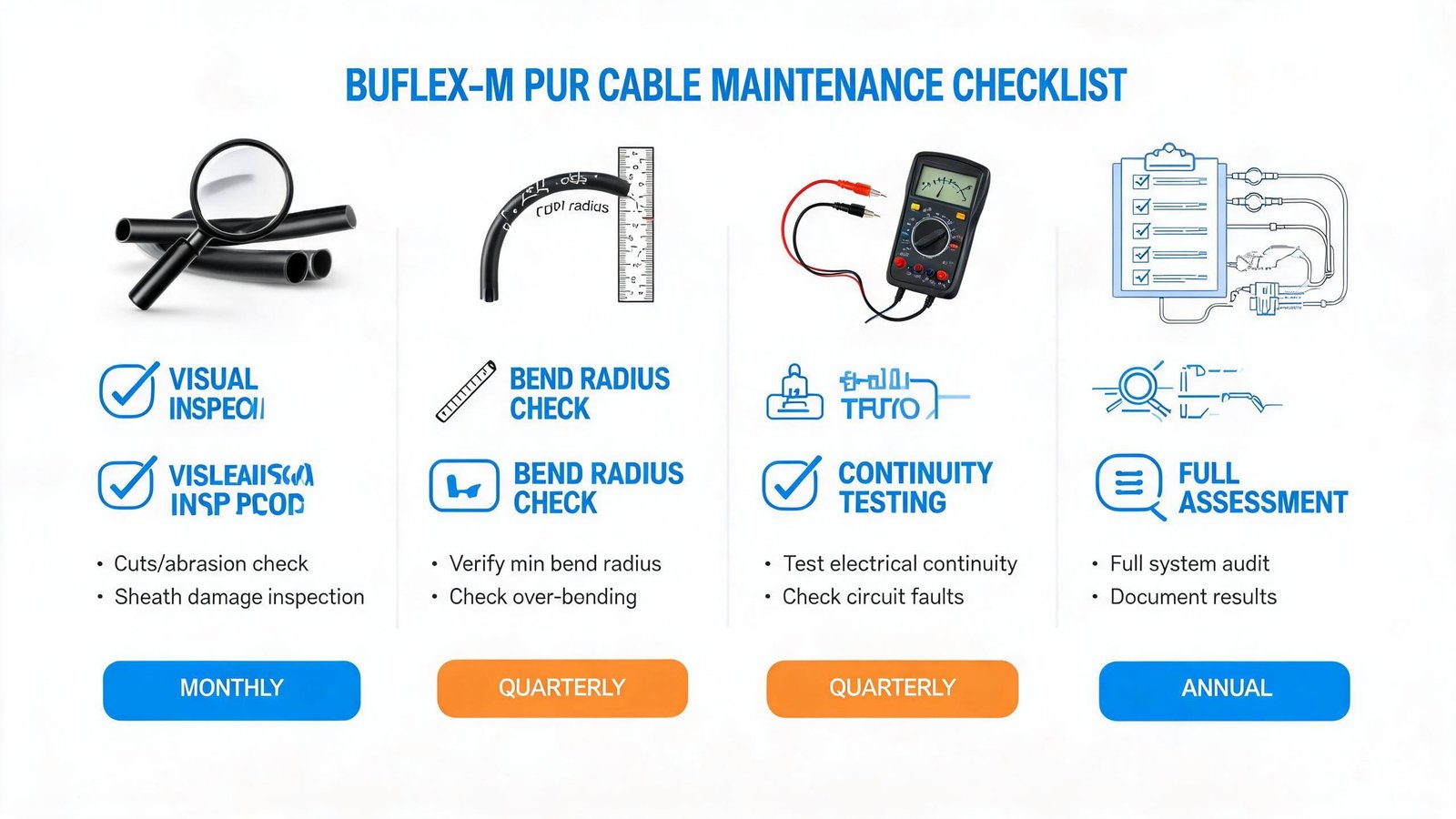
BUFLEX-M cable maintenance inspection checklist: monthly to annual schedule
Q13: What are the signs of impending cable failure?
Early detection of cable degradation allows planned replacement before catastrophic failure occurs. Watch for these warning signs:
- Sheath cracking: Small surface cracks indicate PUR aging from UV, heat, or chemical exposure. Plan replacement within 3 months.
- Deformation: Flattened or oval cable cross-section in the chain indicates compression fatigue. Replace the cable and investigate chain issues.
- Intermittent signals: In shielded cables, intermittent signal or continuity issues may indicate broken shield strands. Use a continuity tester to verify.
- Stiffness increase: If the cable becomes noticeably stiffer, chemical exposure or thermal aging may have occurred. Plan replacement.
- Discoloration: Yellowing or darkening of the orange sheath indicates UV or thermal aging. Test insulation resistance to verify cable integrity.
Q14: How can I extend the service life of BUFLEX-M cables?
Implement these practices to maximize cable life:
- Maximize bend radius: Whenever possible, use a bend radius larger than the 7.5×D minimum. Increasing to 10×D can extend flex life by 50-100%.
- Reduce travel speed: Lower cycle speeds reduce heat generation and mechanical stress. Even a small speed reduction can significantly extend life.
- Eliminate tension: Ensure cables are installed with zero tension at mid-stroke. Even slight tension dramatically reduces flex life.
- Use proper chain size: An oversized cable chain allows cable movement and tangling; an undersized chain causes compression and abrasion.
- Maintain chain hardware: Worn chain links, broken dividers, and damaged chain ends all accelerate cable wear. Replace chain components as needed.
- Clean regularly: Remove accumulated debris, metal chips, and oil deposits from cable chains to prevent abrasion and chemical degradation.
Q15: Can damaged BUFLEX-M cables be repaired?
Minor sheath damage (small cuts or abrasions less than 5mm deep) can be temporarily repaired using PUR-compatible heat shrink tubing or self-amalgamating tape. However, this is a temporary measure only — the cable should be replaced at the next scheduled maintenance window.
Cable splicing is not recommended for flexing applications. Splices create a stiff point in the cable that concentrates stress, leading to rapid failure at the splice location. For fixed installations, splices may be acceptable if properly performed and protected in a junction box.
Application-Specific Questions
Q16: Can BUFLEX-M be used in food processing applications?
Yes. BUFLEX-M’s smooth, non-porous PUR sheath is suitable for food processing environments where hygiene is critical. The sheath is:
- Easy to clean and sanitize
- Resistant to common food-grade cleaning chemicals
- Non-toxic and non-contaminating
- Available in FDA-compliant material formulations upon request
For direct food contact zone applications, request the FDA-compliant version and specify the cleaning agents used in your facility for chemical compatibility verification.
Q17: Is BUFLEX-M suitable for cleanroom applications?
Yes, with proper specification. The halogen-free version (BUFLEX-M-HF) is recommended for cleanroom applications because it generates minimal particulate and does not release halogen gases. Specify:
- BUFLEX-M-HF configuration for halogen-free materials
- Cleanroom-compatible cable chain with smooth interior surfaces
- Proper sealing at cable entry points to maintain cleanroom integrity
Q18: Can BUFLEX-M handle torsional motion in robotic applications?
For multi-axis robotic applications involving torsional (twisting) motion, specify the BUFLEX-M-TR (torsional flex) version. This variant features a specialized stranding design that distributes torsional stress more evenly across the cable cross-section, extending service life in multi-axis robot installations.
The standard BUFLEX-M is designed for bending flex (single-axis) and is not recommended for torsional applications. Using the wrong cable type in a robotic application is a common cause of premature failure.
Q19: What certifications are available for BUFLEX-M?
BUFLEX-M carries the following certifications as standard:
- CE Marking — European LVD and EMC Directives
- RoHS — Restriction of Hazardous Substances
- REACH — European chemical regulation compliance
- IEC 60332-1-2 — Flame retardancy
Additional certifications available upon request:
- UL 758 — North American listing
- CSA C22.2 No. 49 — Canadian approval
Visit our certifications page to download certificates and compliance documentation.
Q20: How do I request a custom BUFLEX-M configuration?
TEBAOFLEX offers custom cable design services for applications with specialized requirements. Common customizations include:
- Hybrid designs combining power, signal, and data pairs
- Custom sheath colors for application identification
- Special conductor materials (tinned copper, silver-plated)
- Non-standard core counts and configurations
- Custom print legends for identification
- Reinforced aramid or steel strength members
To request a custom configuration, provide your requirements through our inquiry form. Our engineering team will review your specification and provide a detailed proposal within 3-5 business days.
Still Have Questions?
This FAQ covers the most common questions about BUFLEX-M cables, but every application is unique. Our experienced engineering team is ready to provide personalized guidance for your specific installation, application, or specification challenge.
Whether you need help with cable selection, installation planning, troubleshooting, or custom design, we provide responsive technical support backed by decades of experience in industrial cable applications.
Get Expert Technical Support
Have a question not answered here? Our engineering team provides free technical consultation for all BUFLEX-M inquiries. Get expert answers within 24 hours.
Related Resources
For selection data and related checks, see: