
Application & Operating Conditions
G62.5/125, G50/125 & E9/125 Fiber-Optic Spreader & Crane Cable is an all-dielectric polychloroprene (PCP) rubber optical cable built for continuous dynamic flexing, reversed S-bends, and torsional stress (±50 °/m) on STS/RTG/RMG container cranes, automated stacking cranes, cable tenders, and bulk-material reclaimers.
Automated STS, RMG & RTG Cranes
Transmits high-bandwidth LiDAR anti-collision scans, OCR container-number video streams, and deterministic PROFINET/EtherCAT safety protocols with complete immunity to MV/VFD electromagnetic noise.
Gantry Reels & Cable Tenders (120 m/min)
Tested for repeated bending and S-type reversed deflection (20 × D pulley spacing, 250 mm reeling radius) under 500 N axial tension and ±50 °/m torsional twist.
High-Speed Trolley Festoons (240 m/min)
Compact 14.9–17.0 mm outer diameter and 280 kg/km mass support 125 mm festoon bend radii down to -35°C flexible (-40°C fixed) in coastal port environments.
S-Bend Pulley Spacing Rule: On motorized crane reels and spreader deflection sheaves where the optical cable undergoes reversed S-type bending, maintain a minimum center-to-center guide distance of 20 × D (≥340 mm) and a reeling bend radius of at least 250 mm to prevent micro-bending attenuation.
All-Dielectric Optical Cable Construction (DIN VDE 0888 Reference)
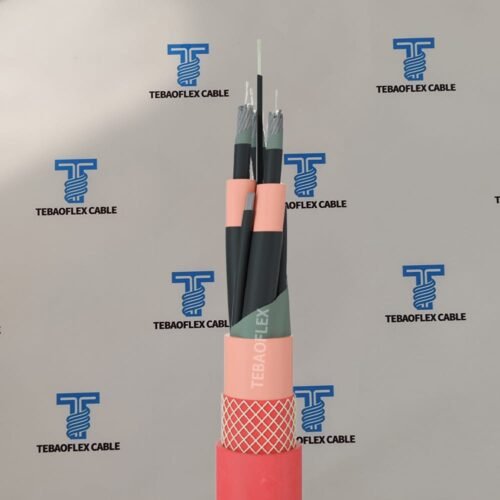
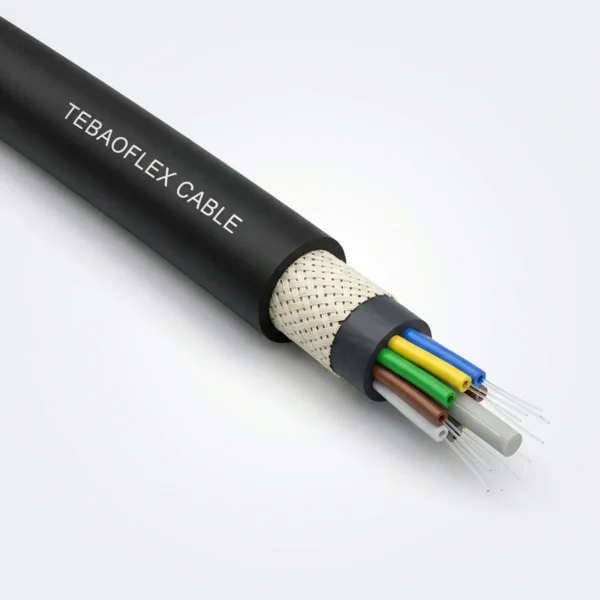
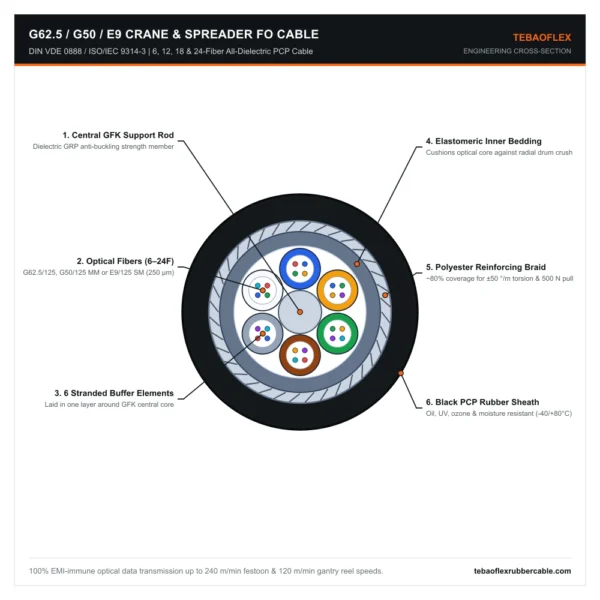
Constructed around a rigid non-metallic GFK (fiberglass-reinforced plastic) anti-buckling central rod, buffered optical sub-units, an 80%-coverage anti-torsion polyester braid, and an oil/UV-resistant black PCP rubber jacket.
| Layer / Component | Material & DIN VDE 0888 / ISO/IEC 9314-3 Engineering Specification |
|---|---|
| 1. Optical Fibers | Primary-coated silica glass fibers (250 μm coating / 125 μm cladding) in graded-index multimode G62.5/125 μm, G50/125 μm, or singlemode E9/125 μm |
| 2. Central Support Element | Dielectric fiberglass-reinforced plastic (GFK / GRP) rod absorbing thermal contraction and preventing optical fiber buckling during sub-zero flexing |
| 3. Core Arrangement | Six buffered optical elements (housing 1, 2, 3, or 4 fibers per element for 6, 12, 18, or 24 total fibers) laid up in a single torsion-balanced layer around the GFK rod |
| 4. Inner Bedding | Flexible elastomeric inner bedding sheath isolating optical buffer elements from radial drum-crushing forces |
| 5. Anti-Torsion Reinforcement | High-tenacity special polyester braid (~80% surface coverage) vulcanized between inner bedding and outer sheath for ±50 °/m torsional stability |
| 6. Outer Sheath | Heavy-duty black polychloroprene (PCP) rubber compound — resistant to mineral oils, ozone, UV radiation, salt mist, and moisture |
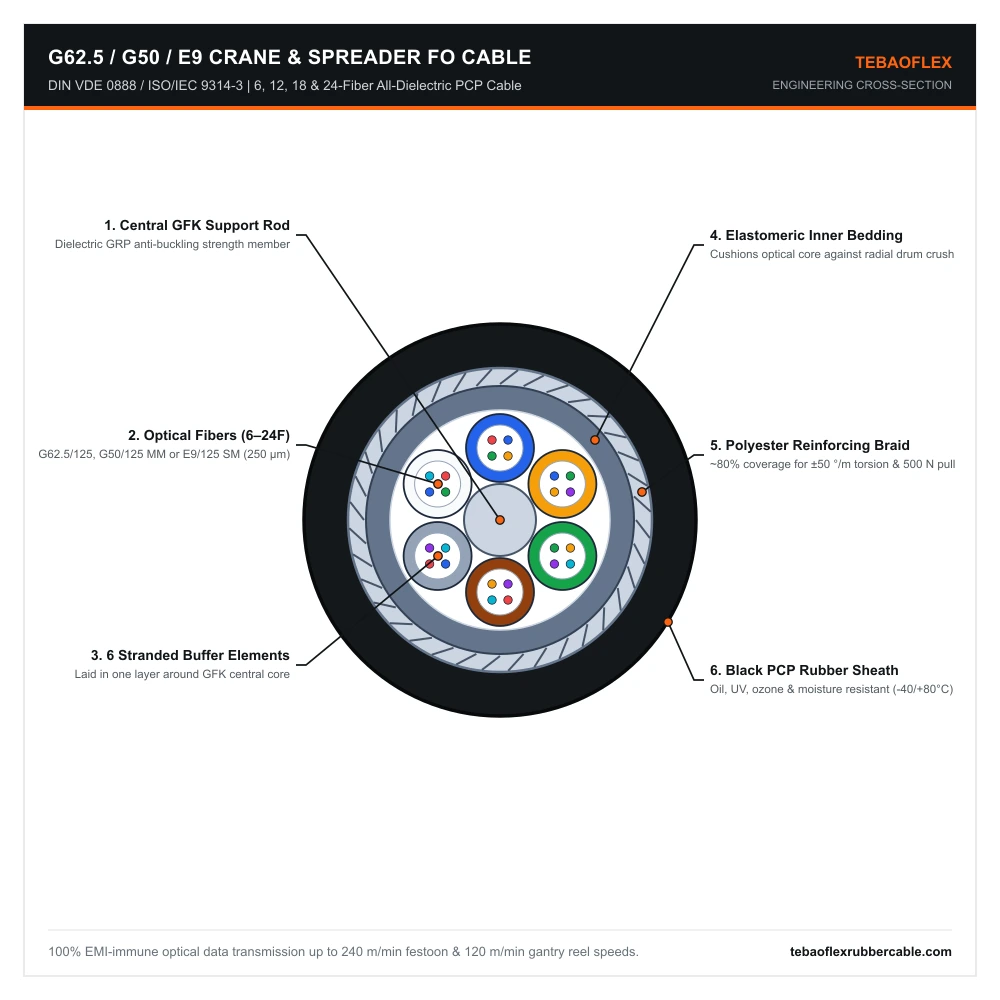
All-dielectric crane optical design: 6 stranded buffer elements around a central GFK rod, ~80% polyester anti-torsion braid, and black PCP jacket.
Technical Characteristics
Mechanical, thermal, and optical operating limits verified through dynamic bending and reversed-bending crane endurance tests.
| Parameter | DIN VDE 0888 / ISO/IEC 9314-3 Rated Value |
|---|---|
| Reference Standards | Based on DIN VDE 0888, FDDI, and ISO/IEC 9314 Part 3 |
| Fiber Core / Cladding / Coating | 62.5 μm, 50 μm, or 9 μm core / 125 μm cladding / 250 μm primary acrylate coating |
| Ambient Temperature (Flexible) | -35°C to +80°C (reeling, festoon trolleys & spreader cable tenders) |
| Ambient Temperature (Fixed) | -40°C to +80°C |
| Max. Dynamic Tensile Load | 500 N |
| Permissible Torsional Stress | ±50 °/m |
| Min. Bending Radius | 125 mm (fixed installation & festoon loops) | 250 mm (dynamic reeling) |
| Min. S-Type Guide Distance | 20 × D between counter-bending sheaves |
| Max. Travel Speed | Up to 120 m/min (gantry reel) | Up to 240 m/min (crane trolley / festoon) |
| Environmental Resistance | Oil, ozone, UV, and moisture resistant; 100% metal-free dielectric immunity to lightning & EMI |
Optical & Dimensional Schedule — G62.5/125, G50/125 & E9/125 (6–24 Fibers)
Complete 12-configuration optical transmission and mechanical schedule across multimode G62.5/125, multimode G50/125, and long-haul singlemode E9/125 crane builds.
1. G62.5/125 Multimode Graded-Index Series (850 nm / 1300 nm)
| Configuration | Min. OD (mm) | Max. OD (mm) | Weight (kg/km) | Atten. 850 nm (dB/km) | Atten. 1300 nm (dB/km) | BW 850 nm (MHz·km) | BW 1300 nm (MHz·km) | Numerical Aperture |
|---|---|---|---|---|---|---|---|---|
| 6G62.5/125 | 14.9 | 17.0 | 280 | ≤ 3.3 | ≤ 0.9 | ≥ 400 | ≥ 600 | 0.275 |
| 12G62.5/125 | 14.9 | 17.0 | 280 | ≤ 3.3 | ≤ 0.9 | ≥ 400 | ≥ 600 | 0.275 |
| 18G62.5/125 | 14.9 | 17.0 | 280 | ≤ 3.3 | ≤ 0.9 | ≥ 400 | ≥ 600 | 0.275 |
| 24G62.5/125 | 14.9 | 17.0 | 280 | ≤ 3.3 | ≤ 0.9 | ≥ 400 | ≥ 600 | 0.275 |
2. G50/125 Multimode Graded-Index Series (850 nm / 1300 nm)
| Configuration | Min. OD (mm) | Max. OD (mm) | Weight (kg/km) | Atten. 850 nm (dB/km) | Atten. 1300 nm (dB/km) | BW 850 nm (MHz·km) | BW 1300 nm (MHz·km) | Numerical Aperture |
|---|---|---|---|---|---|---|---|---|
| 6G50/125 | 14.9 | 17.0 | 280 | ≤ 2.8 | ≤ 0.8 | ≥ 400 | ≥ 1,200 | 0.20 |
| 12G50/125 | 14.9 | 17.0 | 280 | ≤ 2.8 | ≤ 0.8 | ≥ 400 | ≥ 1,200 | 0.20 |
| 18G50/125 | 14.9 | 17.0 | 280 | ≤ 2.8 | ≤ 0.8 | ≥ 400 | ≥ 1,200 | 0.20 |
| 24G50/125 | 14.9 | 17.0 | 280 | ≤ 2.8 | ≤ 0.8 | ≥ 400 | ≥ 1,200 | 0.20 |
3. E9/125 Singlemode Series (1300 nm / 1550 nm Long-Run Port Telemetry)
| Configuration | Min. OD (mm) | Max. OD (mm) | Weight (kg/km) | Atten. 1300 nm (dB/km) | Atten. 1550 nm (dB/km) | Dispersion 1300 nm ps/(nm·km) | Dispersion 1550 nm ps/(nm·km) | Numerical Aperture |
|---|---|---|---|---|---|---|---|---|
| 6E9/125 | 14.9 | 17.0 | 280 | ≤ 0.4 | ≤ 0.3 | ≤ 3.5 | ≤ 18.0 | 0.14 |
| 12E9/125 | 14.9 | 17.0 | 280 | ≤ 0.4 | ≤ 0.3 | ≤ 3.5 | ≤ 18.0 | 0.14 |
| 18E9/125 | 14.9 | 17.0 | 280 | ≤ 0.4 | ≤ 0.3 | ≤ 3.5 | ≤ 18.0 | 0.14 |
| 24E9/125 | 14.9 | 17.0 | 280 | ≤ 0.4 | ≤ 0.3 | ≤ 3.5 | ≤ 18.0 | 0.14 |
Crane & Spreader Fiber-Optic Cable Selection Matrix
Compare TEBAOFLEX dedicated all-dielectric optical crane cables and hybrid copper + fiber-optic spreader/reeling cables.
| Optical / Hybrid Cable | Jacket Material, Fiber Capacity & Primary Port Crane Application |
|---|---|
| G62.5 / G50 / E9 FO (This Page) | 6, 12, 18 & 24-fiber all-dielectric PCP rubber cable (14.9–17.0 mm OD, 500 N, ±50 °/m) — for crane gantry reels (120 m/min), trolley festoons (240 m/min), and spreader tenders. |
| Rubber Crane FO 2×12/125 | Compact 11.4 mm 2×12 bundle-core rubber optical cable for small spring-driven and compact motorized crane reels. |
| Festoon PUR FO 2×12/125 | Halogen-free matte black PUR 2×12 fiber-optic cable engineered specifically for high-abrasion drag chains and trolley festoons. |
| SYSLTOE-J FO / 3GSLTOE-J FO | 0.6/1 kV hybrid copper control + 6–24 optical fiber PUR gravity-basket spreader cables for STS container cranes. |
Frequently Asked Questions (FAQ)
Technical guidance on selecting and installing flexible fiber-optic cables on port cranes, reels, and spreaders.
Should I choose G62.5/125, G50/125 multimode, or E9/125 singlemode for port crane automation?
Select E9/125 singlemode (1300/1550 nm, <=0.4/0.3 dB/km) for long quay-crane gantry runs, automated yard RMGs exceeding 300–500 m, and uncompressed 4K camera backhaul; select G50/125 multimode for high-bandwidth 1G/10G short-reach trolley and spreader transceivers; and select G62.5/125 when retrofitting legacy crane PLCs, drive rings, or FDDI/PROFIBUS optical modules.
Why does every fiber count (6, 12, 18, and 24 fibers) share the same 14.9–17.0 mm outer diameter?
All four configurations use the identical six-element concentric core geometry around the central GFK rod (housing 1, 2, 3, or 4 primary-coated 250-micron fibers per buffer element). Maintaining a constant 14.9–17.0 mm outer diameter lets OEMs standardize reel grooves, cable glands, and trolley clamps across 6F to 24F crane models.
Can this optical cable handle torsional twisting in crane cable tenders and vertical guides?
Yes. Its single-layer concentric core lay around the central GFK rod combined with an 80%-coverage special polyester braid between the inner bedding and black PCP jacket supports dynamic torsional stress up to +/-50 degrees per meter alongside 500 N pulling tension.
How is an all-dielectric crane fiber-optic cable anchored at reel hubs and junction boxes?
Use a long-mesh woven cable grip (Kellems-type sock) over the black PCP outer sheath at deflection points and clamp the internal GFK central strength rod inside the splice box strain-relief post before routing buffer tubes into the splice tray.
Specify Your Crane or Spreader Fiber-Optic Cable Today
Tell us your fiber mode (G62.5, G50, OM3/OM4, or E9/125), fiber count (6–24F), reel/festoon speed, and run length—get an engineering quote within 24 hours.
Explore All Port, Crane & Festoon Cables