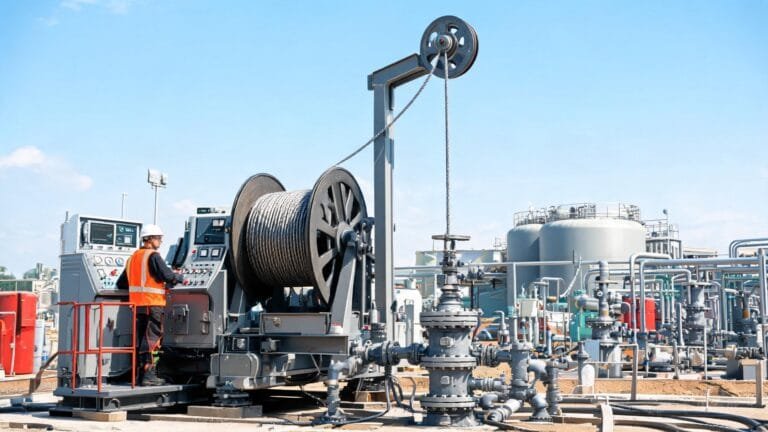

Mobile machines do not treat cable like a fixed installation. Reeling drums, festoon systems, trailing equipment and moving assemblies repeatedly bend, pull and sometimes twist the cable while it carries power, control signals or data. A sound mobile equipment cable selection process therefore begins with the complete duty profile—not only voltage and conductor size.
This engineering checklist helps purchasing teams, equipment builders and project engineers organize the information a cable supplier needs before recommending a construction. It also reduces the risk of comparing products that look similar on a datasheet but are intended for different movement patterns.
1. Define How the Cable Moves
“Flexible” is not a complete operating specification. The movement mode determines how mechanical stress travels through the conductor, core assembly, shielding and outer sheath.
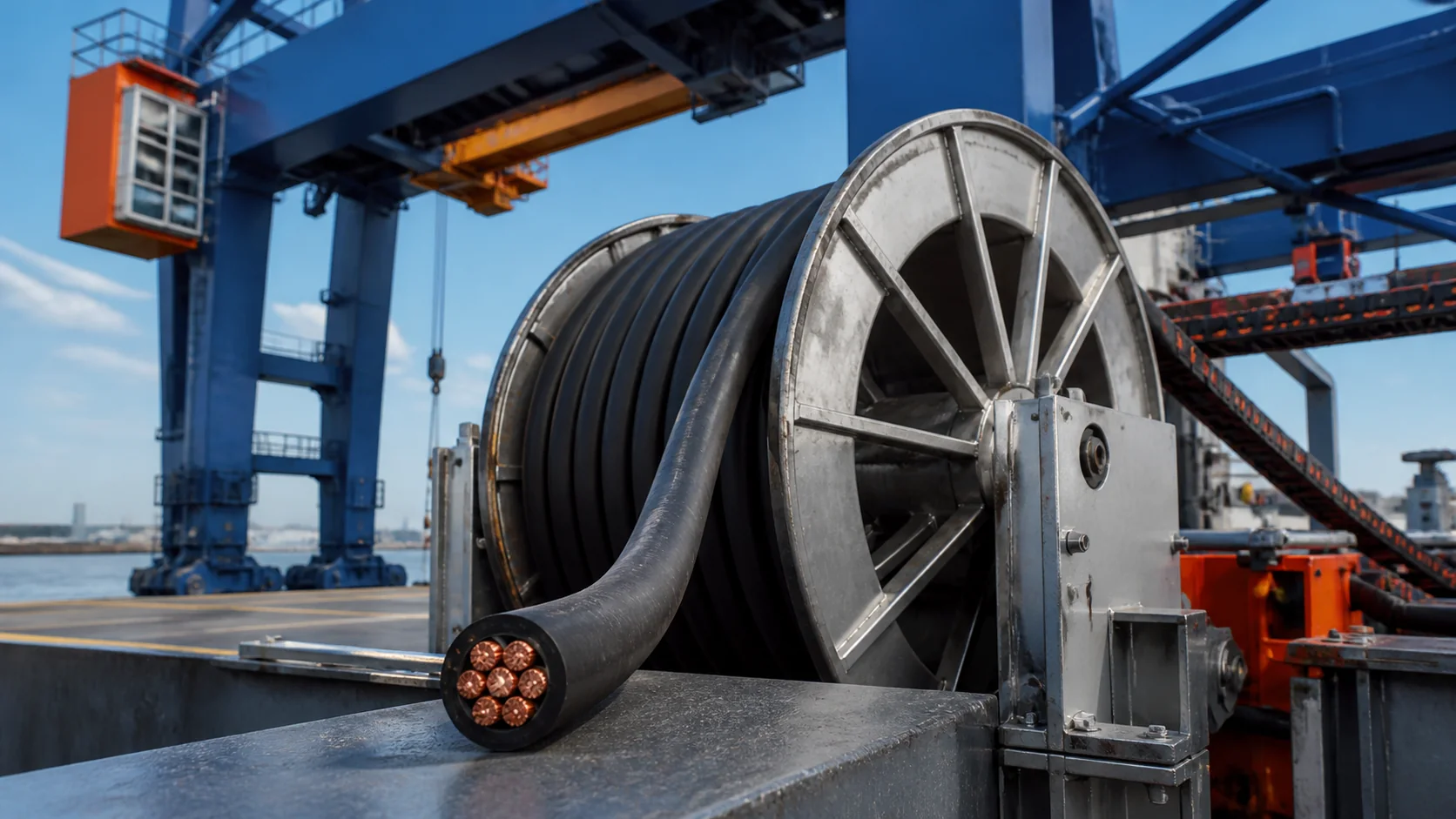
- Reeling: Record the drum type, winding arrangement, travel length, operating speed, acceleration, number of cycles and any pulling force.
- Festoon movement: Define loop depth, trolley spacing, travel speed, clamp arrangement and whether the cable is round or flat.
- Trailing service: Identify dragging surfaces, possible crushing or impact, equipment travel and the risk of sharp bends.
- Torsional or robotic movement: State the permitted twist, cycle length, axis of movement and installation space.
- Occasional movement: Distinguish maintenance flexing from continuous operation; the two duties may need different constructions.
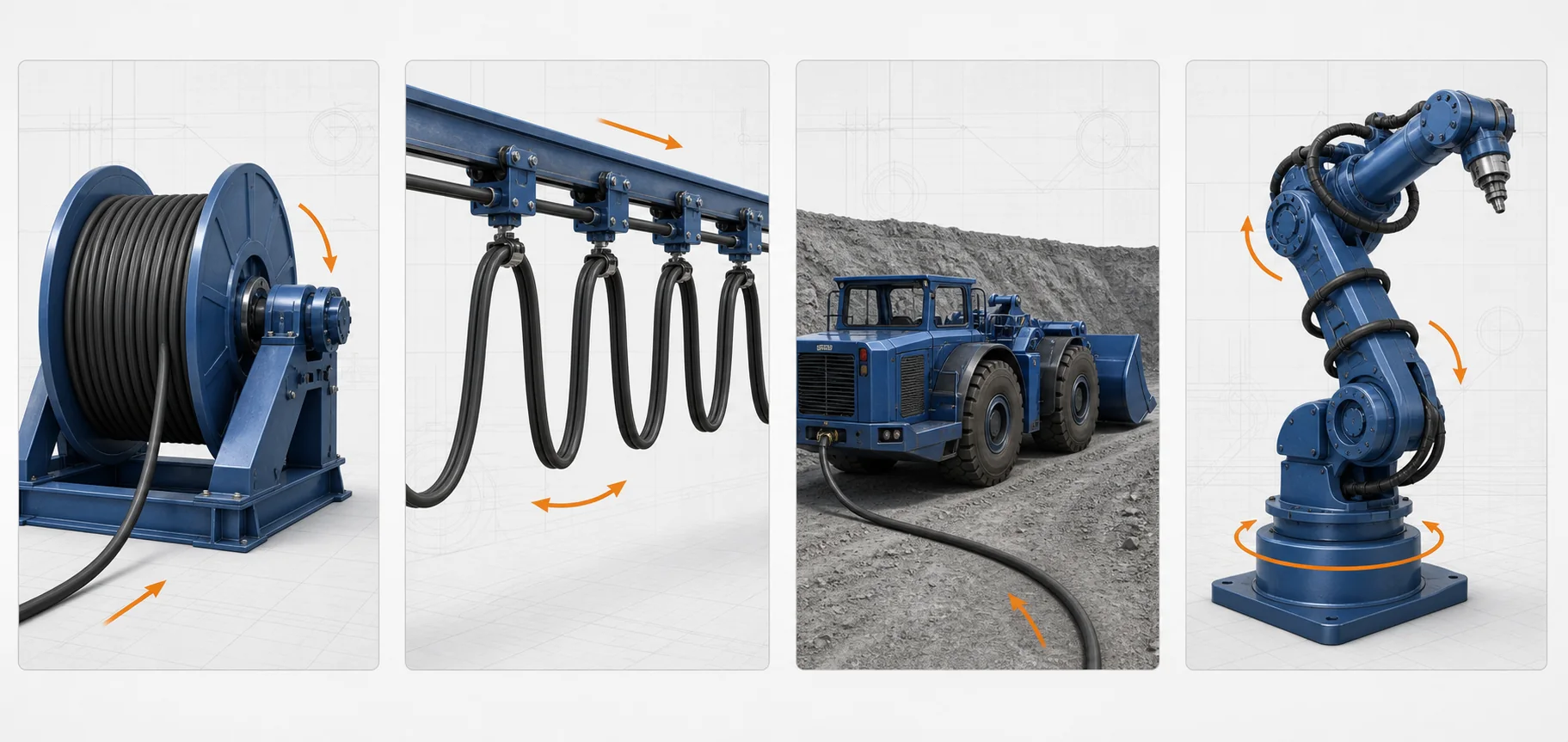
| Movement profile | Key system data | Cable design priorities | Common selection mistake |
|---|---|---|---|
| Reeling | Drum and sheave diameter, winding arrangement, speed, travel length and tensile load | Balanced core construction, repeated bending performance and controlled tensile stress | Choosing by minimum bending radius alone |
| Festoon | Loop depth, trolley spacing, clamp arrangement, travel speed and acceleration | Controlled flexing, stable loop geometry and suitable round or flat construction | Ignoring clamp pressure and load distribution |
| Trailing | Travel distance, ground surface, impact, crushing and dragging conditions | Abrasion resistance, mechanical reinforcement and a robust outer sheath | Using a fixed-installation cable for moving service |
| Torsional | Twist angle per cycle, axis length, speed and available installation space | Torsion-capable conductor, core lay, shielding and sheath construction | Assuming bending flexibility also guarantees torsional life |
Include the actual sheave, pulley and drum dimensions in the request. The minimum bending radius specified for the selected cable must be respected in the installed system, but bending radius alone does not describe speed, tension, torsion or expected cycle life.
2. Confirm the Electrical Requirements
Mechanical suitability cannot compensate for incorrect electrical sizing. Record the system voltage, continuous and peak current, duty cycle, conductor cross-section, number of power and control cores, protective conductor arrangement and allowable voltage drop. For combined power, signal or communication designs, define pair construction, impedance or protocol needs and shielding expectations.
The official IEC 60228:2023 conductor standard covers nominal cross-sectional areas, conductor resistance and conductor constructions including flexible copper conductors. Conductor class is useful input, but it does not by itself prove that a finished cable is suitable for continuous reeling, trailing or torsional service.
If the system includes sensitive control circuits, describe nearby drives, motors and other potential electromagnetic interference sources. This allows the supplier to evaluate an individual screen, an overall screen or another shielding arrangement instead of adding shielding without a defined purpose.
3. Describe the Operating Environment
The outer sheath and the complete cable construction must match the real environment. A useful project specification covers:
- minimum and maximum operating temperature, including heat generated by the load;
- indoor, outdoor, submerged or intermittent-water exposure;
- oil, fuel, hydraulic fluid, chemicals, ozone and ultraviolet exposure;
- abrasion, impact, crushing and edge-contact risks;
- required flame, smoke or halogen performance;
- installation restrictions, connectors, glands and available routing space.
Terms such as “oil resistant” or “waterproof” should be supported by a defined test method, rating or project requirement for the exact cable design. Avoid assuming that one sheath material will deliver the same performance in every compound formulation and construction.
4. Match the Construction to the Duty
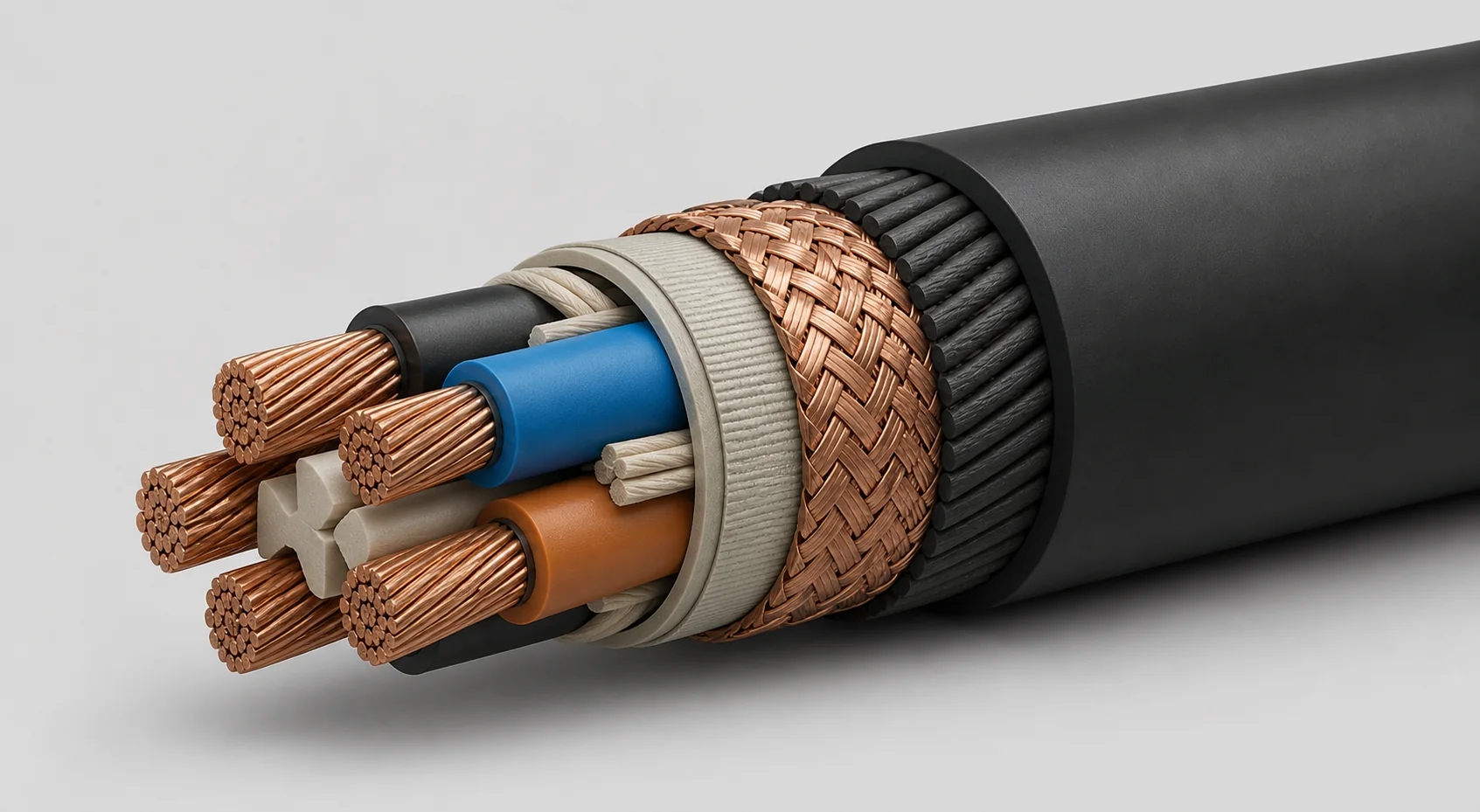
A mobile cable is a coordinated system. Conductor stranding, insulation, core lay, fillers, strength members, shielding and sheath materials must work together. Increasing conductor flexibility without controlling the core assembly and mechanical load can leave other elements exposed to stress.
Rubber compounds are widely used for robust flexible power cables, while PUR constructions are often considered where abrasion resistance and a compact flexible design are priorities. PVC can be appropriate for many industrial control applications with a well-defined environment. Material selection should be based on the whole requirement rather than a material name alone.
Buyers can review TEBAOFLEX rubber and flexible cable options, port, crane and festoon cable solutions, and mining and tunneling cables as starting points. The final construction should be checked against the equipment duty and project specification.
5. Identify Standards and Verification Needs
Applicable standards depend on the cable type, voltage, market, installation and customer specification. For example, IEC 60245-1:2026 gives general requirements for rubber-insulated rigid and flexible cables with rated voltages up to and including 450/750 V. The IEC 60811 series provides test methods for non-metallic cable materials.
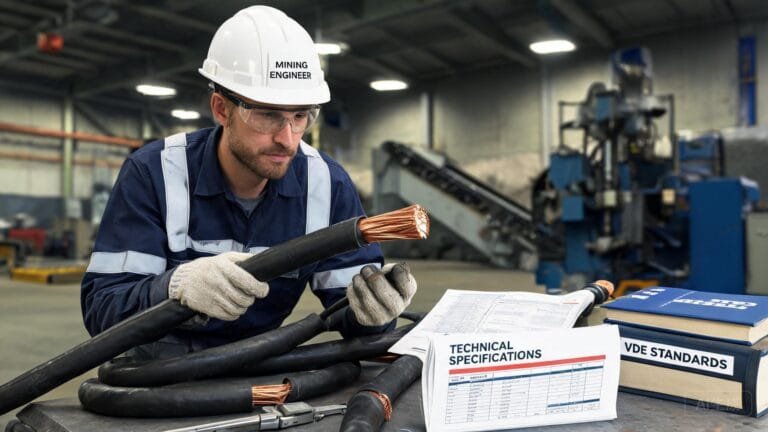
These references do not replace an application-specific review. Confirm the required standard edition, product designation, test report, certification scope and marking before placing an order. Do not treat a component test or a similar cable family as evidence for an unverified finished product.
Mobile Equipment Cable Selection RFQ Checklist
A clear request for quotation should include the following information:
- equipment type and application;
- movement mode: reeling, festoon, trailing, torsion or occasional flexing;
- travel length, speed, acceleration and expected cycles;
- drum, sheave, pulley and cable-carrier dimensions;
- system voltage, current, conductor size and core count;
- power, control, signal, data and shielding requirements;
- temperature, water, oil, chemical, UV and abrasion exposure;
- tensile load, hanging length and any required strength members;
- applicable standards, approvals and test documentation;
- required length, termination method, delivery schedule and sample needs.
TEBAOFLEX supports cable selection for a range of industrial cable applications and can evaluate custom conductor, shielding, reinforcement and sheath requirements through its custom cable services. Recommendations are based on the technical information available for each project.
Frequently Asked Questions
Is minimum bending radius enough to select a moving cable?
No. Bending radius is important, but the selection also needs movement type, speed, acceleration, tensile load, torsion, cycle expectations and environmental conditions.
Should I choose rubber or PUR for mobile equipment?
Neither material is automatically best for every application. Rubber and PUR compounds can serve different combinations of flexibility, abrasion, weather, oil and temperature requirements. Compare the exact compound and finished cable construction against the duty profile.
What information helps TEBAOFLEX prepare a cable recommendation?
Send the equipment description, movement data, electrical requirements, environmental conditions, relevant standards, cable length and delivery needs. Drawings or photos of the routing system can also help clarify the application.
Planning a mobile cable project? Send your requirements to TEBAOFLEX for a technical review and quotation.