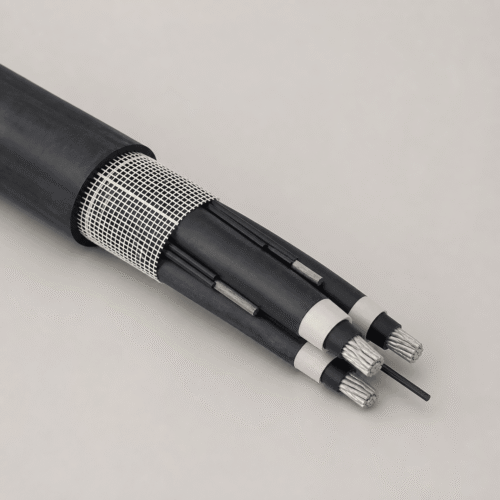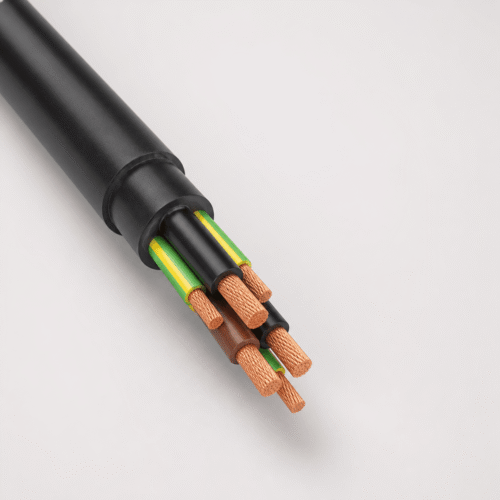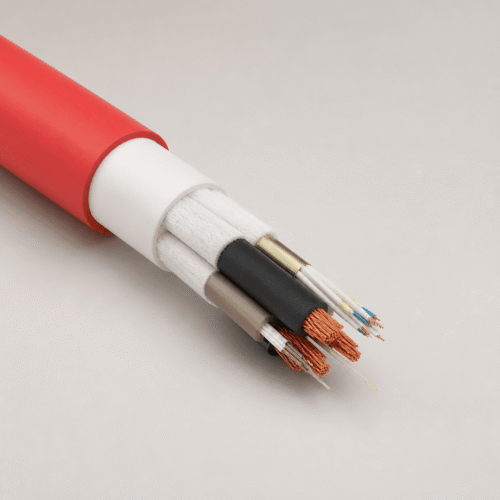
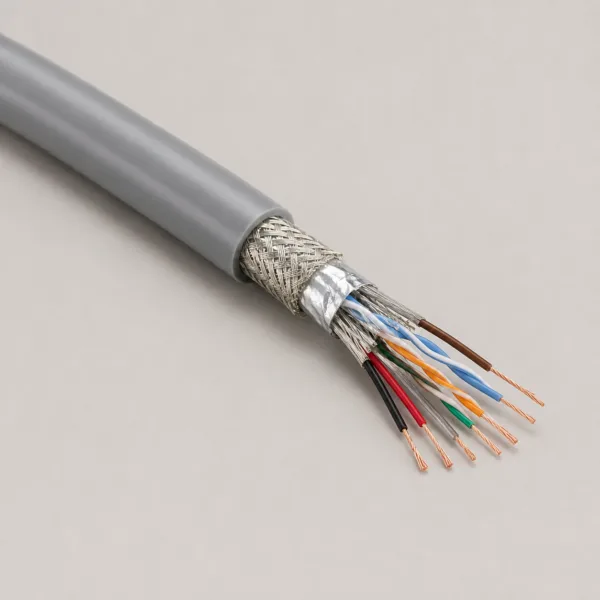
TEBAOFLEX Li9Y(C)C11Y Incremental Transmission & Servo Feedback Cable is a continuous-flex, composite multi-gauge polyurethane drag-chain cable built for closed-loop servo axes, CNC machining gantries, linear motors, and automated assembly robotics. Combining low-capacitance polypropylene (9Y) differential signal pairs (0.14 mm² to 0.25 mm²) with heavier 0.50 mm² or 1.0 mm² DC supply/sense conductors inside dual foil-and-braid EMC shielding, it preserves zero-jitter encoder counting alongside high-dV/dt PWM motor power cables.
1. Application Scope & Servo Feedback Architecture Comparison
Closed-loop servo drives depend on microsecond-accurate feedback pulses from optical rotary encoders, magnetic linear scales, tachogenerators, and brushless resolvers. When feedback cables share energy chains with PWM inverter motor cables switching at 4-16 kHz, capacitive ground-loop currents and ohmic supply voltage drop are the primary causes of position-count errors. TEBAOFLEX Li9Y(C)C11Y eliminates both failure modes through low-permittivity PP pair insulation, dual metallic screening, and dedicated larger-gauge power/sense cores.
- Incremental & SinCos Optical Encoders: Differential
RS-422 TTL (5 V),HTL (10-30 V)ABZ quadrature pulse channels, and analog1 Vpp SinCosinterpolation signals on 5-axis CNC milling/turning centers. - Digital Absolute Multi-Turn Feedback: High-baud synchronous serial feedback protocols including
EnDat 2.1 / 2.2,Hiperface,BiSS-C, andSSIrequiring tight characteristic impedance and remoteUp / 0Vvoltage-sense loops. - Brushless Resolvers & Motor Thermal Monitoring: Individually screened pair variants (such as
3×(2×0.14C)+2×1.0 mm²) isolating reference excitation, sine/cosine feedback, andPTC / KTY84 / PT1000stator temperature sensors.
| TEBAOFLEX Drag-Chain Data Series | Conductor Schedule | EMC Shielding Architecture | Primary Automation Interface |
|---|---|---|---|
| Li9Y(C)C11Y Feedback (This Page) | Composite pairs (0.14-0.25 mm²) + supply cores (0.5-1.0 mm²) | Al/PET foil or element braid + ≥85% tinned Cu braid | Incremental, SinCos, EnDat, Hiperface & resolver feedback |
| Li9YC11Y-TP Twisted Pair | Uniform twisted pairs (2×2×0.14 to 12×2×0.50 mm²) | Non-woven wrap + overall tinned Cu braid (≥85%) | RS-422 / RS-485 fieldbus, differential I/O & load cells |
| Li9YC11Y Multi-Core | Uniform single cores (2×0.14 to 36×0.50 mm², DIN 47100) | Overall tinned Cu braid (≥85%) | PLC digital/analog sensors, valve islands & pick-and-place axes |
2. Cable Construction (Verified Multi-Layer Cutaway)
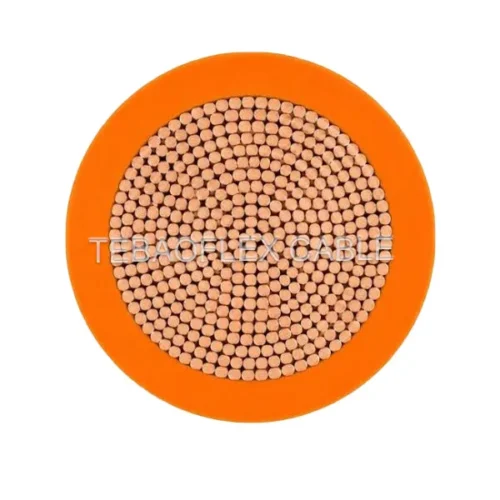
Built from inner Class 6 conductor strands outward to withstand multi-million-cycle continuous bending in horizontal and vertical cable tracks:
0.05 mm to 0.10 mm wire filaments) for high flex-fatigue life at tight chain radii.70-75 nF/km for crisp square-wave and sine-wave edges.(2×0.14C) resolver/sensor pairs, to block internal crosstalk.10 kHz to 100 MHz.3. Technical & Dynamic Drag-Chain Specifications
Electrical, thermal, and mechanical ratings for continuous-motion encoder and servo feedback duty:
| Parameter | Engineering Specification | Test Method / System Design Note |
|---|---|---|
| Nominal Operating Voltage | 250 V (peak 350 V) | Suitable for SELV / PELV 5 V, 12 V & 24 V DC encoder circuits |
| AC Test Voltage (50 Hz) | 2,000 V AC (core/core) | 1,500 V AC (core/screen) | Routine dielectric spark and high-voltage factory verification |
| Mutual Pair Capacitance | Approx. 65 – 75 nF/km (at 800 Hz) | Low-permittivity 9Y PP insulation preserves high-frequency pulses |
| Insulation Resistance | ≥ 200 MΩ×km at +20°C | Maintains signal amplitude stability on high-impedance SinCos inputs |
| Temperature Range | -30°C to +80°C (continuous flexing) | -40°C to +80°C fixed; +150°C short-circuit max. (5 s) |
| Minimum Bending Radius | 7.5 × overall diameter (flexing) | 4 × overall diameter for fixed cabinet/conduit routing |
| Drag-Chain Speed & Accel. | Up to 300 m/min (5 m/s) | Up to 20 m/s² | Self-supporting horizontal travel; separate from heavy motor cables |
| Chemical & Flame Rating | Oil-resistant, halogen-free, flame-retardant | EN 60811-2-1 / 404 oil test; IEC 60332-1-2 vertical flame; IEC 60754-1 |
360-Degree EMC Grounding Practice: Terminate the overall tinned-copper braid circumferentially at both the servo drive cabinet entry (via EMC clamping rail or 360° brass EMC gland) and the metallic circular M23 / M12 encoder connector shell. Pigtail ground wires longer than 15 mm degrade high-frequency PWM noise rejection above 1 MHz.
4. Specification & SKU Schedule (Composite Encoder & Resolver Builds)
Standard composite feedback core schedules matching widespread European and Asian servo drive/encoder pinouts (zero proprietary third-party catalog prefixes):
| Part No. / SKU | Composite Core & Pair Schedule (mm²) | Typical Encoder / Feedback Protocol | Nominal OD (mm) | Min. Flex Radius 7.5×D (mm) | Copper Index (kg/km) | Approx. Weight (kg/km) |
|---|---|---|---|---|---|---|
LI9YCC11Y-4P014-4X05 | 4 × 2 × 0.14 + 4 × 0.50 | TTL / HTL Incremental + 5V Sense | 8.2 | 62 | 58 | 109 |
LI9YCC11Y-4P025-2X10 | 4 × 2 × 0.25 + 2 × 1.0 | Long-Run Incremental / EnDat / SSI | 8.8 | 66 | 75 | 134 |
LI9YCC11Y-10X014-4X05 | 10 × 0.14 + 4 × 0.50 | Multi-Channel Pulse / Tachometer | 8.0 | 60 | 60 | 85 |
LI9YCC11Y-3PC014-2X10 | 3 × (2 × 0.14C) + 2 × 1.0 | Brushless Resolver + Motor PTC/KTY | 8.4 | 63 | 84 | 108 |
LI9YCC11Y-3PC014-4X014-2X05 | 3 × (2 × 0.14C) + 4 × 0.14 + 2 × 0.50 | 1 Vpp SinCos + Commutation Tracks | 8.9 | 67 | 79 | 118 |
LI9YCC11Y-4P014-4X014-4X10 | 4 × 2 × 0.14 + 4 × 0.14 + 4 × 1.0 | Extended-Run SinCos / EnDat 2.2 | 9.6 | 72 | 96 | 146 |
LI9YCC11Y-4P018-2P050 | 4 × 2 × 0.18 + 2 × 2 × 0.50 | Hiperface / BiSS-C Digital Feedback | 8.6 | 65 | 68 | 115 |
LI9YCC11Y-12X022-2X05 | 12 × 0.22 + 2 × 0.50 | Compact Multi-Track Linear Scale | 8.3 | 63 | 64 | 102 |
Custom hybrid feedback layouts, UL Style 20233 / 20236 AWM dual-marked PUR jackets, and DESINA Signal Green (RAL 6018) outer sheaths are available across our Industrial & Control Cables production line.
5. Frequently Asked Questions (Servo Feedback Selection & EMC)
Why do incremental encoder feedback cables combine 0.14/0.25 mm² signal pairs with larger 0.50/1.0 mm² cores?
Optical incremental and SinCos encoders typically operate from a tightly regulated 5 V DC (±5%) supply while drawing 100-300 mA. Over drag-chain cable lengths of 15 to 80 m, 0.14 mm² wires create excessive ohmic voltage drop. Enlarging the DC supply and remote-sense conductors to 0.50 mm² or 1.0 mm² keeps encoder supply voltage within tolerance while keeping differential pulse pairs (A, /A, B, /B, Z, /Z) compact and low-capacitance.
Why is polypropylene (9Y) core insulation preferred over PVC for high-frequency servo feedback?
Polypropylene (PP / VDE code 9Y) has a relative permittivity near 2.2-2.3 compared with 3.5-4.5 for PVC, cutting mutual pair capacitance below 70-75 nF/km. Low capacitance prevents square-wave edge rounding on 200 kHz to 2 MHz HTL/TTL and EnDat/BiSS-C clock/data channels when routed parallel to PWM servo motor cables.
When should we specify individually shielded pairs such as 3×(2×0.14C)+2×1.0 mm²?
Individually braided or foil-screened pairs (denoted C inside parentheses) are required for analog 1 Vpp SinCos resolvers, motor NTC / KTY84 / PT1000 thermal sensors, and multi-megabaud serial encoder interfaces where near-end crosstalk (NEXT) between excitation and sine/cosine return channels must be isolated inside the cable core.
Can TEBAOFLEX supply DESINA green (RAL 6018) or grey (RAL 7001) PUR outer sheaths?
Yes. Standard builds are supplied in oil- and coolant-resistant Matte Grey (RAL 7001) or DESINA Measurement-System Green (RAL 6018) 11YM1 polyurethane, suitable for CNC machining centers, metalworking coolant splash zones, and export automation machinery.
Match Your Servo Encoder Pinout & Drag-Chain Duty
Send your pair/core cross-section schedule, encoder protocol (TTL, SinCos, EnDat, Hiperface, Resolver), run length, bend radius, and sheath colour (RAL 7001 Grey or RAL 6018 Green) for engineering datasheet verification and quotation.