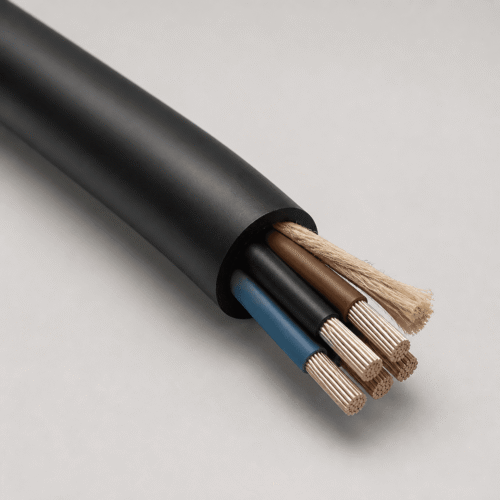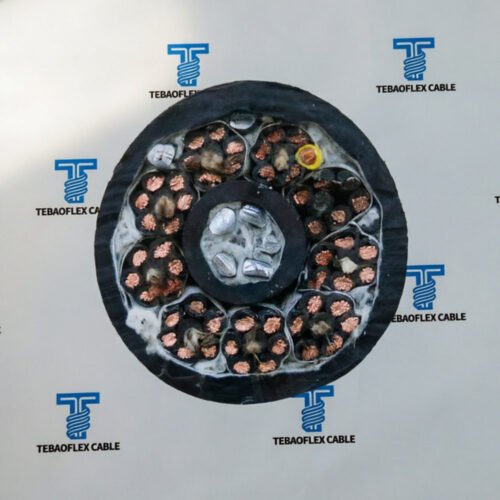
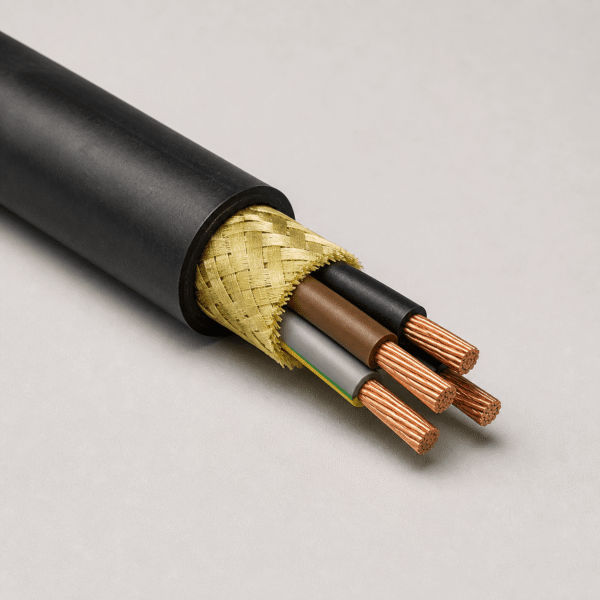
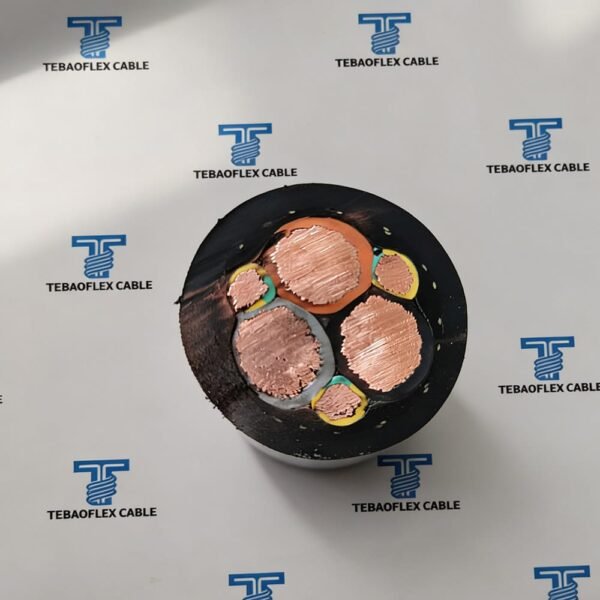
(N)GRDGOEU (German umlaut designation (N)GRDGÖU) is a 0.6/1 kV heavy-duty round rubber crane festoon cable engineered in reference to DIN VDE 0250-814 for high-speed trolley power and control loops up to 240 m/min. Built with short-pitch Class 5 copper conductors, EPR 3GI3 insulation, a pressure-extruded GM1b inner rubber sheath, an open-weave aramid fibre anti-torsion braid, and a black 5GM3 polychloroprene (PCP) outer jacket, it resists loop whipping, coastal salt spray, ozone, and cold flexing down to -35°C.
1. Application Scope & Crane Festoon Selection
On long-travel outdoor gantry cranes and high-acceleration ship-to-shore (STS) container bridges, hanging cable loops experience continuous cyclic bending at trolley saddles alongside crosswind sway and sudden braking deceleration. Round (N)GRDGOEU is engineered specifically for these multi-cable festoon and heavy energy-chain duties:
- Ship-to-Shore (STS), RMG & RTG Port Cranes: Motorized and towed C-rail / I-beam festoon trolleys supplying main hoist drives, trolley motors, spreader power, and multi-core PLC control in port and container crane installations.
- Steelwork Ladle Cranes & Bulk Shiploaders: Dust-, oil-, and heat-exposed overhead crane festoons, reclaimers, and conveyor tripper cars operating in
-35°Cto+80°Cdynamic ambients. - Heavy-Duty Energy Chains: Horizontal and vertical steel/polymer drag chains requiring low-torsion round rubber cables with standard metric gland sealing.
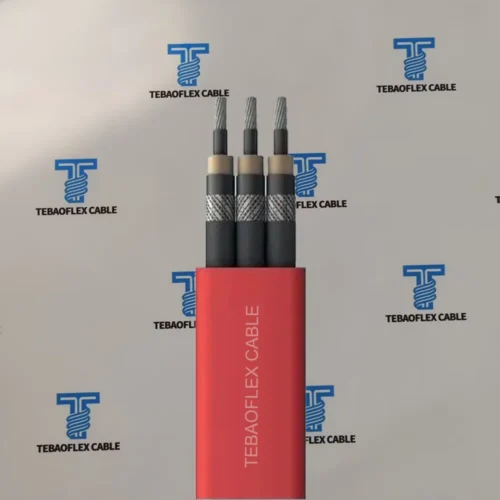
Compare project drawings with our (N)GRDGÖU 0.6/1 kV rubber festoon series, EMC-screened (N)GRDGCGOEU screened energy-chain cable, or flat indoor (N)GFLGOEU flat festoon cable across our port, crane and festoon cable catalog.
Festoon Saddle Diameter & Clamp Spacing Rule: Even a true DIN VDE 0250-814 festoon cable will corkscrew if clamped twisted or bent tighter than its saddle radius. Ensure trolley support saddles provide a minimum crown diameter of 12–15 × D (minimum bend radius 6–7.5 × D), leave 10%–15% length reserve at full trolley extension so conductors never absorb impact shock, and verify drum duty separately if reeling is planned.
2. Cable Construction (DIN VDE 0250-814 Physical Layers)
Each layer of (N)GRDGOEU-J (with green/yellow PE) and (N)GRDGOEU-O (without green/yellow PE) is balanced to prevent core migration over millions of trolley gather-and-extend cycles:
+90°C continuous conductor temperature.3 + 3G split earth in outer interstices on ≥25 mm² power sizes); ≥6 control cores black with white numbers plus G/Y earth, laid in short pitch around a resilient core filler.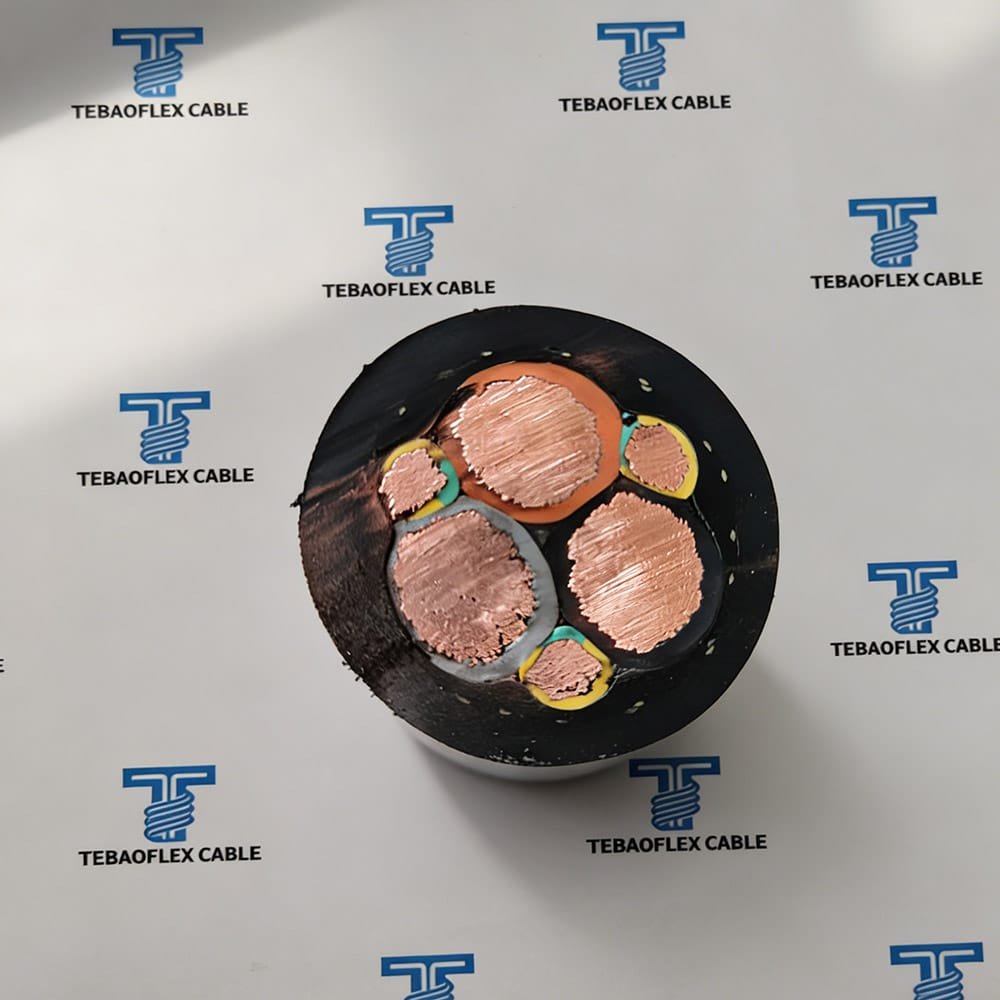
3. Technical Characteristics
Electrical, thermal, and dynamic mechanical ratings for (N)GRDGOEU / (N)GRDGÖU 0.6/1 kV round festoon cables are detailed below:
| Parameter | Engineering Rating / Standard Basis |
|---|---|
| Design Basis | Engineered in reference to DIN VDE 0250-814; operational guidance per DIN VDE 0298-3 |
| Rated Voltage U0/U | 0.6/1 kV (600/1000 V); Max AC operating voltage 0.7/1.2 kV; Max DC 0.9/1.8 kV |
| Routine AC Test Voltage | 3,500 V AC (5 min) |
| Conductor Temperature Limit | +90°C max continuous operation; +250°C max short-circuit (up to 5 s) |
| Ambient Temperature Window | Dynamic festoon / energy chain: -35°C to +80°C; fixed installation: -50°C to +80°C |
| Permissible Travel Speed | Festoon trolley systems: up to 240 m/min; occasional drum duty check: up to 60 m/min |
| Max Permissible Tensile Stress | 15 N/mm² of total copper power/control cross-section |
| Minimum Bending Radius | Fixed: 4–5 × D; festoon loop & saddle support: 6–7.5 × D; energy chain: 7.5–10 × D |
| Oil, Weather & Flame Resistance | Oil-resistant to EN 60811-404; flame-retardant to IEC 60332-1-2; UV, ozone & marine atmosphere resistant |
4. Representative Core Configurations & Dimension Table
Typical single-core, split-earth three-phase power, four-core power, and multi-core control constructions from the (N)GRDGOEU production schedule are listed below for crane saddle groove and gland planning:
| Duty Category | Model & Core Schedule (mm²) | Approx. Min. OD (mm) | Approx. Max. OD (mm) | Copper Weight (kg/km) | Approx. Cable Weight (kg/km) |
|---|---|---|---|---|---|
| Single-Core Power (-O) | 1 × 50 | 16.2 | 18.2 | 480 | 680 |
| Single-Core Power (-O) | 1 × 95 | 21.0 | 23.2 | 912 | 1,210 |
| Single-Core Power (-O) | 1 × 150 | 25.4 | 28.0 | 1,440 | 1,830 |
| Single-Core Power (-O) | 1 × 240 | 31.0 | 34.0 | 2,304 | 2,820 |
| Split-Earth Power (-J) | 3 × 35 + 3 × 16/3 | 27.5 | 30.2 | 1,162 | 1,760 |
| Split-Earth Power (-J) | 3 × 50 + 3 × 25/3 | 31.5 | 34.5 | 1,680 | 2,420 |
| Split-Earth Power (-J) | 3 × 70 + 3 × 35/3 | 35.8 | 39.0 | 2,352 | 3,260 |
| Split-Earth Power (-J) | 3 × 95 + 3 × 50/3 | 40.5 | 44.0 | 3,216 | 4,310 |
| 4-Core Power (-J) | 4G6 | 15.8 | 17.8 | 230 | 450 |
| 4-Core Power (-J) | 4G16 | 21.5 | 24.0 | 614 | 980 |
| 4-Core Power (-J) | 4G35 | 28.8 | 31.8 | 1,344 | 1,940 |
| Multi-Core Control (-J) | 7G1.5 | 13.6 | 15.4 | 101 | 305 |
| Multi-Core Control (-J) | 12G1.5 | 17.2 | 19.4 | 173 | 475 |
| Multi-Core Control (-J) | 18G1.5 | 19.8 | 22.2 | 259 | 640 |
| Multi-Core Control (-J) | 24G1.5 | 22.8 | 25.5 | 346 | 835 |
| Multi-Core Control (-J) | 36G1.5 | 26.8 | 29.8 | 518 | 1,160 |
| Multi-Core Control (-J) | 12G2.5 | 19.6 | 22.0 | 288 | 660 |
| Multi-Core Control (-J) | 24G2.5 | 26.2 | 29.2 | 576 | 1,190 |
Additional core schedules—including 5G4 to 5G35 mm², 42G1.5 mm², hybrid power + screened bus pairs, or integrated single-mode/multi-mode fibre-optic elements—are engineered against your crane circuit diagram.
5. Frequently Asked Engineering Questions
Are (N)GRDGOEU and (N)GRDGÖU the same cable type?
Yes in German DIN VDE 0250-814 transliteration: OE replaces the umlaut Ö in international procurement databases, so (N)GRDGOEU and (N)GRDGÖU both designate a 0.6/1 kV round rubber crane festoon/trolley cable with oil-resistant elastomer sheathing. Always confirm exact conductor stranding, anti-torsion braid specification, and saddle bend radius on the order drawing.
When should crane engineers specify round (N)GRDGOEU instead of flat (N)GFLGÖU festoon cable?
Flat festoon cables stack neatly for single-plane indoor overhead cranes, whereas round (N)GRDGOEU is preferred on outdoor ship-to-shore (STS) container cranes, bulk unloaders, and high-wind coastal gantries where round aerodynamic profiles resist wind twist, accept multi-cable motorized festoon saddles, and seal cleanly inside standard metric cable glands.
Why use 3+3 split protective-earth cores on larger (N)GRDGOEU-J power cables?
On three-phase power cross-sections from 25 mm² upward (such as 3×35+3×16/3 or 3×70+3×35/3), splitting the green/yellow earth conductor into three equal cores laid in the outer interstices produces a smaller, truly circular bundle that flexes evenly over festoon saddles and reduces high-frequency VFD common-mode impedance.
Can (N)GRDGOEU be used in energy chains or on cable reels as well as festoon trolleys?
Thanks to its short-pitch core lay, GM1b inner bedding, and aramid anti-torsion braid, (N)GRDGOEU handles festoon trolley speeds up to 240 m/min, heavy-duty energy chains, and moderate reeling up to 60 m/min when loop depth and drum diameter satisfy DIN VDE 0298-3. For dedicated high-speed motorized drums (>120 m/min), specify (N)SHTÖU-J.
How cold can (N)GRDGOEU operate on outdoor winter port cranes?
Its EPR 3GI3 / PCP 5GM3 elastomer system remains flexible down to -35°C under dynamic trolley movement and down to -50°C in fixed routing, with a +90°C maximum conductor temperature.
What crane festoon data should be submitted for quotation?
Provide -J or -O core configuration and mm² cross-section, crane trolley travel speed (m/min) and acceleration (m/s²), festoon saddle support diameter, hanging loop depth, ambient coastal/industrial exposure, and required cut lengths.
Match (N)GRDGOEU 0.6/1 kV Round Festoon Cable to Your Crane Trolley
Share your core schedule, trolley travel speed, saddle diameter, and loop depth for a verified outer-diameter drawing and factory quotation within 24 hours.