
Introduction to Cable Standardization Systems
The global cable industry operates under two dominant standardization frameworks: the IEC (International Electrotechnical Commission) system used in most of the world, and the NEC (National Electrical Code, NFPA 70) system used primarily in North America. These two systems use different designation conventions, testing methods, and installation rules, which can create significant challenges for engineers working on international projects or sourcing cables from different regions.
TEBAOFLEX manufactures cables compliant with both IEC and NEC/UL standards, serving global markets. This guide helps engineers and procurement professionals navigate the differences between these two standardization systems.
Understanding the IEC Standard System
The IEC (International Electrotechnical Commission) is the global organization that prepares and publishes international standards for electrical, electronic, and related technologies. IEC standards are adopted by most countries outside North America, either directly or through national equivalents (e.g., BS, DIN/VDE, AS/NZS).
Key IEC Standards for Cables:
- IEC 60228: Conductors of insulated cables (Class 1 solid, Class 2 stranded, Class 5 flexible, Class 6 extra-flexible)
- IEC 60227: PVC insulated cables up to 450/750V
- IEC 60245: Rubber insulated cables up to 450/750V
- IEC 60502-1: Power cables with extruded insulation from 1kV to 30kV (XLPE and EPR)
- IEC 60502-2: Power cables from 30kV to 150kV
- IEC 60332: Flame retardant and fire resistance tests
- IEC 60754: Smoke and acid gas emission tests
- IEC 61034: Smoke density measurement
- IEC 60840/62067: HV and EHV cables from 30kV to 500kV
IEC cable designations follow a standard pattern (e.g., N2XY = XLPE insulated PVC sheathed power cable). TEBAOFLEX offers a wide range of IEC standard cables.
Understanding the NEC Standard System
The NEC (National Electrical Code, formally NFPA 70) is the electrical code used in the United States and adopted in Canada (with CSA modifications). The NEC defines installation requirements, while UL (Underwriters Laboratories) defines product standards. Together, NEC and UL form the North American cable standardization system.
Key UL/NEC Standards for cables:
- UL 44: Thermoset-insulated wires and cables (rubber/EPR/XLPE)
- UL 83: Thermoplastic-insulated wires (PVC, PE)
- UL 62: Flexible cords and fixture wires
- UL 1063: TC (Tray Cable) types
- UL 1072: Medium voltage cables
- UL 1276: Armored cable types (AC, MC)
- NEC Article 310: Conductors for general wiring
- NEC Article 318: Open wiring and cable trays
- NEC Article 400: Flexible cords and cables
- NEC Article 501-505: Hazardous (classified) locations
UL cable types use letter designations (e.g., THHN, THWN, XHHW, RHW, TC) that encode insulation material and temperature rating.
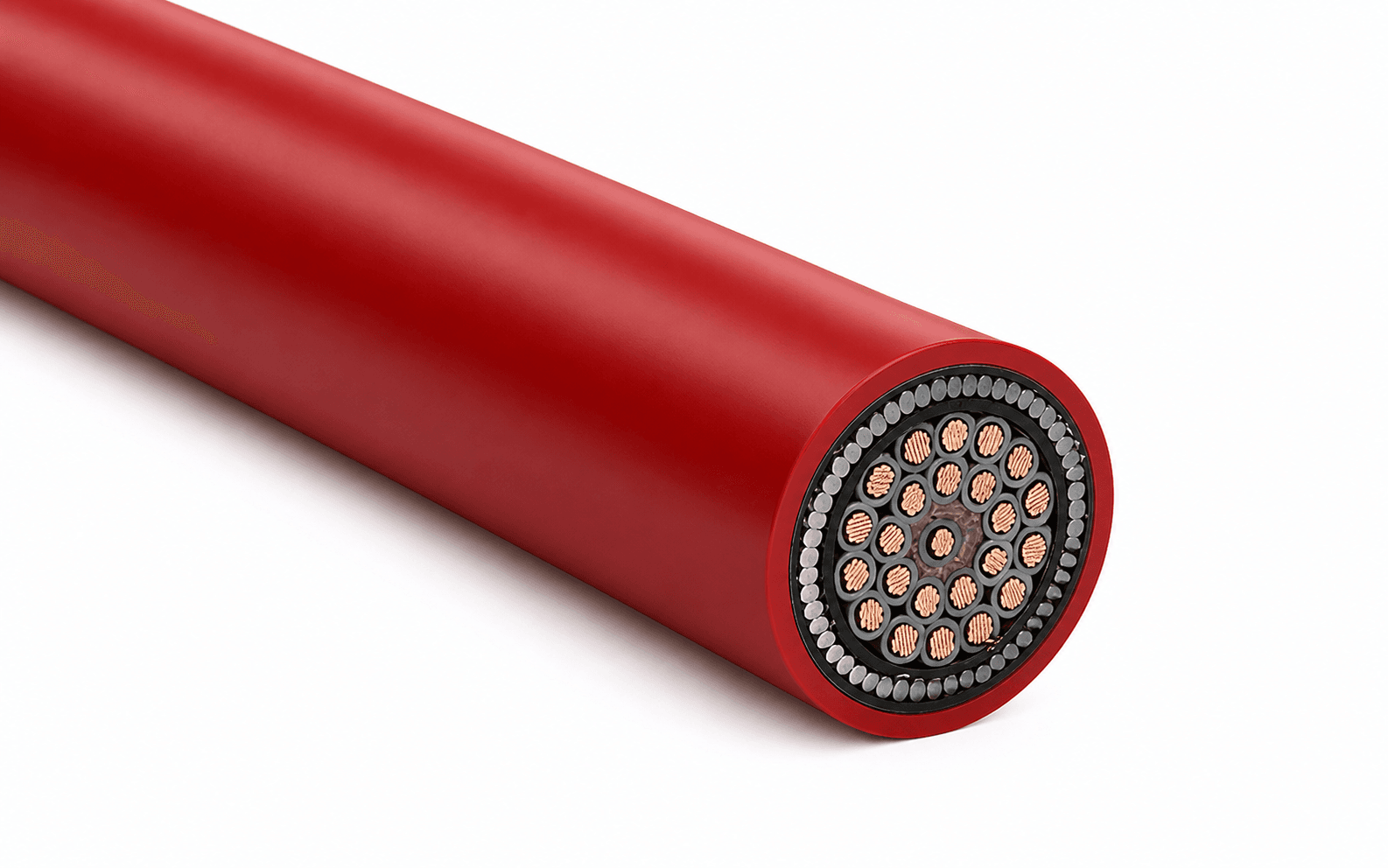
Key Differences: IEC vs NEC/UL
| Aspect | IEC System | NEC/UL System |
|---|---|---|
| Geographic Scope | Global (Europe, Asia, Africa, Oceania) | USA, Canada (CSA modified) |
| Standard Body | IEC (international) | UL + NFPA (national) |
| Voltage Designation | U0/U (e.g., 0.6/1kV, 3.6/6kV) | Voltage rating (e.g., 600V, 2kV, 5kV, 15kV) |
| Conductor Classification | Class 1-6 (IEC 60228) | AWG/kcmil sizes (ASTM B8/B3) |
| Cable Designation | Alphanumeric (N2XY, RG7H1OR) | Letter types (THHN, RHW, TC) |
| Insulation Materials | PVC, XLPE, EPR, HEPR | THHN (PVC/Nylon), XLPE, EPR |
| Temperature Ratings | 70°C, 90°C, 110°C (material-based) | 60°C, 75°C, 90°C, 105°C (type-based) |
| Flame Test | IEC 60332-1/3 (categories A, B, C, D) | UL 1581 (VW-1, FT-1, FT-4, FT-6) |
| Installation Rules | Local national codes | NEC chapters/articles |
| Testing Authority | National labs (e.g., KEMA, BASEC) | UL listing/certification |
Voltage Rating Systems
One of the most significant differences is how voltage ratings are expressed:
- IEC U0/U system: U0 is the phase-to-earth voltage, U is the phase-to-phase voltage. For example, 0.6/1kV means 600V to earth, 1000V phase-to-phase. Medium voltage ratings follow the same pattern: 3.6/6kV, 6/10kV, 8.7/15kV, 12/20kV, 18/30kV.
- NEC/UL system: Cables are rated by a single voltage value representing the maximum phase-to-phase voltage. Common ratings: 600V, 1kV, 2kV, 5kV, 8kV, 15kV, 25kV, 35kV, 46kV.
When converting between systems, the IEC U0/U designation maps approximately to UL ratings: IEC 0.6/1kV ≈ UL 600V; IEC 8.7/15kV ≈ UL 15kV; IEC 18/30kV ≈ UL 25-35kV.
Conductor Standards and Sizing
The two systems use entirely different conductor sizing conventions:
- IEC: Conductors specified in mm² cross-section (e.g., 1.5mm², 2.5mm², 4mm², 6mm², 10mm², 16mm², 25mm², 35mm², 50mm², 70mm², 95mm², 120mm², 150mm², 185mm², 240mm², 300mm²). IEC 60228 defines conductor classes 1-6 based on flexibility.
- NEC/UL: Conductors specified in AWG (American Wire Gauge) or kcmil (thousand circular mils). Common sizes: 18 AWG, 16 AWG, 14 AWG, 12 AWG, 10 AWG, 8 AWG, 6 AWG, 4 AWG, 2 AWG, 1/0, 2/0, 4/0, 250 kcmil, 350 kcmil, 500 kcmil, 750 kcmil. ASTM B8 (stranded) and B3 (solid) define conductor constructions.
Approximate size equivalents: 1.5mm² ≈ 16 AWG; 2.5mm² ≈ 14 AWG; 4mm² ≈ 12 AWG; 6mm² ≈ 10 AWG; 10mm² ≈ 8 AWG; 16mm² ≈ 6 AWG; 25mm² ≈ 4 AWG; 50mm² ≈ 1/0 AWG; 95mm² ≈ 4/0 AWG; 120mm² ≈ 250 kcmil.
Insulation Material Designations
Material designations differ significantly between IEC and UL:
| Material | IEC Designation | UL/NEC Type |
|---|---|---|
| PVC 70°C | PVC (IEC 60227) | TW (60°C), THW (75°C) |
| PVC 90°C | PVC HR (IEC 60227) | THHN (90°C, nylon jacket) |
| XLPE 90°C | XLPE (IEC 60502) | XHHW, XHHN (90°C) |
| EPR 90°C | EPR (IEC 60502) | RHW, RHH (90°C) |
| EPR 110°C | HEPR | Not standard in UL |
| Silicone 200°C | SIAF/GL (IEC) | SIS, SA (200°C) |
Flame and Fire Performance Standards
Flame retardancy and fire performance testing differ significantly between the two systems:
IEC Flame Tests
- IEC 60332-1-2: Single vertical flame test (1kW pre-mixed flame)
- IEC 60332-3 (categories A, B, C, D): Bunched cable vertical flame test with different fuel volumes
- IEC 60331: Fire resistance test for circuit integrity under fire conditions
- IEC 61034: Smoke density measurement (3m cube method)
- IEC 60754: Acid gas emission and pH/corrosivity measurement
UL/NEC Flame Tests
- UL 1581 VW-1 (FT-1): Vertical wire flame test (equivalent to IEC 60332-1)
- UL 1581 FT-4: Vertical cable tray flame test (roughly equivalent to IEC 60332-3 Category C)
- UL 1581 FT-6: Horizontal cable tray flame and smoke test
- UL 1666: Vertical cable tray fire and smoke test (for larger cables)
- NEC Categories: CMP (plenum), CL2/CL3 (class 2/3), CM/CMG/CMX (communications)
Installation Practices and Codes
The NEC provides detailed installation requirements that have no direct IEC equivalent:
- NEC Article 318: Cable tray installation rules, including fill ratios and spacing
- NEC Article 501-505: Hazardous location classifications (Class I, II, III; Division 1, 2; Zones) with specific cable types for each classification
- NEC Article 300: General wiring methods, including protection from physical damage
- NEC ampacity tables: Specific current-carrying capacity tables based on installation method, temperature rating, and ambient conditions
In the IEC system, installation practices are defined by national wiring regulations (e.g., BS 7671 in the UK, AS/NZS 3000 in Australia, DIN VDE 0100 in Germany). While the principles are similar, specific requirements differ by country.
Compliance and Certification Pathways
For cables to be legally installed, they must carry the appropriate certification:
- IEC markets: CE marking (Europe), national marks (BSI, VDE, NF, KEMA), third-party verification from BASEC or LPCB
- North American markets: UL listing mark (US), CSA certification (Canada). Products must be listed by a Nationally Recognized Testing Laboratory (NRTL)
- Dual certification: TEBAOFLEX can manufacture cables certified to both IEC and UL standards for projects requiring multi-standard compliance
View TEBAOFLEX certifications for current compliance details.
Practical Considerations for International Projects
- Determine the project location and applicable code: Most countries adopt IEC; USA uses NEC/UL; Canada uses CSA/NEC. Some projects (e.g., US-funded projects abroad) may require dual compliance
- Specify cable designations correctly: Use IEC designations (N2XY, RG7H1OR) for IEC markets; UL type letters (THHN, RHW, TC) for North American markets
- Convert conductor sizes: Use mm² for IEC projects; AWG/kcmil for North American projects. Always verify ampacity calculations under the applicable code
- Verify voltage ratings: Ensure the cable voltage rating (U0/U for IEC; single rating for UL) meets or exceeds the system voltage
- Check flame ratings: Specify IEC 60332 category or UL flame test as required by local fire codes
- Confirm certification marks: CE for Europe; UL for USA; CSA for Canada. Some markets require additional local marks
- Consult with manufacturer: For dual-standard projects, contact TEBAOFLEX for cables compliant with both IEC and UL standards
Why Choose TEBAOFLEX
TEBAOFLEX’s dual-standard manufacturing capability gives you flexibility in global projects:
- IEC standard cables: N2XY, RG7H1OR, H07RN-F, YY/YSLY series for international markets
- UL/NEC standard cables: RHW, THHN, TC, DLO, SOOW types for North American markets
- CSA certified cables for Canadian installations
- Hazardous location cables for NEC Class I/II/Division 1 and 2
- Custom cables with dual certification for cross-standard projects
Our engineering team helps you navigate standardization requirements for any global project. Browse our product catalog or request a consultation.
Request a Quote
Need IEC or NEC compliant cables? Our technical team will respond within 24 hours with specifications, certification details, and pricing. Submit your cable inquiry to TEBAOFLEX.