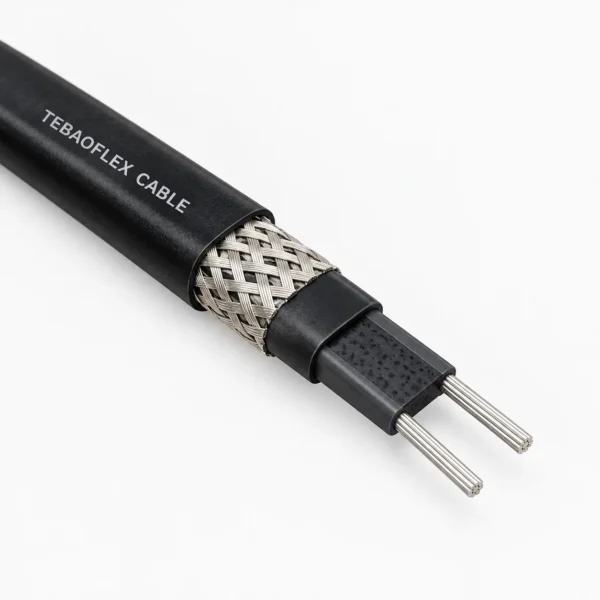
HTS-6 style self-regulating heating cable is a parallel-bus heat-trace construction intended for designed roof, gutter, downspout and water/drain-pipe freeze-protection systems. Its reference output is 6 W/ft at 40°F (about 19.7 W/m at 4.4°C), with 120 V and 208–277 V AC supply versions. The conductive polymer core varies output as local temperature changes; this does not replace a circuit design, protective devices or an installation review. TEBAOFLEX can assess the requested construction and provide an approved project drawing before supply.
What is the HTS-6 style cable construction?
Two 16 AWG nickel-coated copper bus wires run through an irradiation-crosslinked self-regulating conductive core. A modified-polyolefin inner jacket separates the core from a tinned-copper metallic braid; a modified-polyolefin outer jacket protects the assembly. This is a flat heat-trace cable, not a conventional single-conductor power cable. The visible cutaway is an illustration of the reference layer sequence, not a certified production cross-section.
| Selection point | Reference specification | What to confirm |
|---|---|---|
| Output | 6 W/ft at 40°F (4.4°C) reference condition | Required heat loss and actual supply voltage |
| Supply versions | 120 V AC; 208–277 V AC | Exact project voltage and electrical design |
| Bus conductors | Two 16 AWG nickel-coated copper wires | Approved build drawing |
| Heating element | Irradiation-crosslinked self-regulating conductive polymer | Output curve for the ordered configuration |
| Inner / outer jacket | Modified polyolefin | Exposure, routing and accessory compatibility |
| Metallic overshield | Tinned-copper braid | Grounding and terminations in the system design |
| Continuous maintenance | Up to 65°C (150°F) reference | Actual surface and ambient temperatures |
| Intermittent exposure | Up to 85°C (185°F) reference | Duration and location of exposure |
How do the voltage versions differ?
The source distinguishes a 120 V version from a 208–277 V AC version. Its 208–277 V version also lists output adjustment factors of 0.86 at 208 V and 1.16 at 277 V relative to the nominal-voltage reference; these factors should not be treated as a complete system performance guarantee. The correct circuit length depends on the minimum start temperature, breaker size, voltage and project protection scheme. A supplied circuit-length table contains an inconsistent entry, so this page does not reproduce it as a TEBAOFLEX maximum.
| Reference version | Supply | Selection note |
|---|---|---|
| HTS-6-1R style | 120 V AC | Confirm start temperature, circuit length and protective-device design |
| HTS-6-2R style | 208–277 V AC | Confirm exact voltage, adjusted output and circuit-length calculation |
Where can a roof and gutter heat-trace cable be considered?
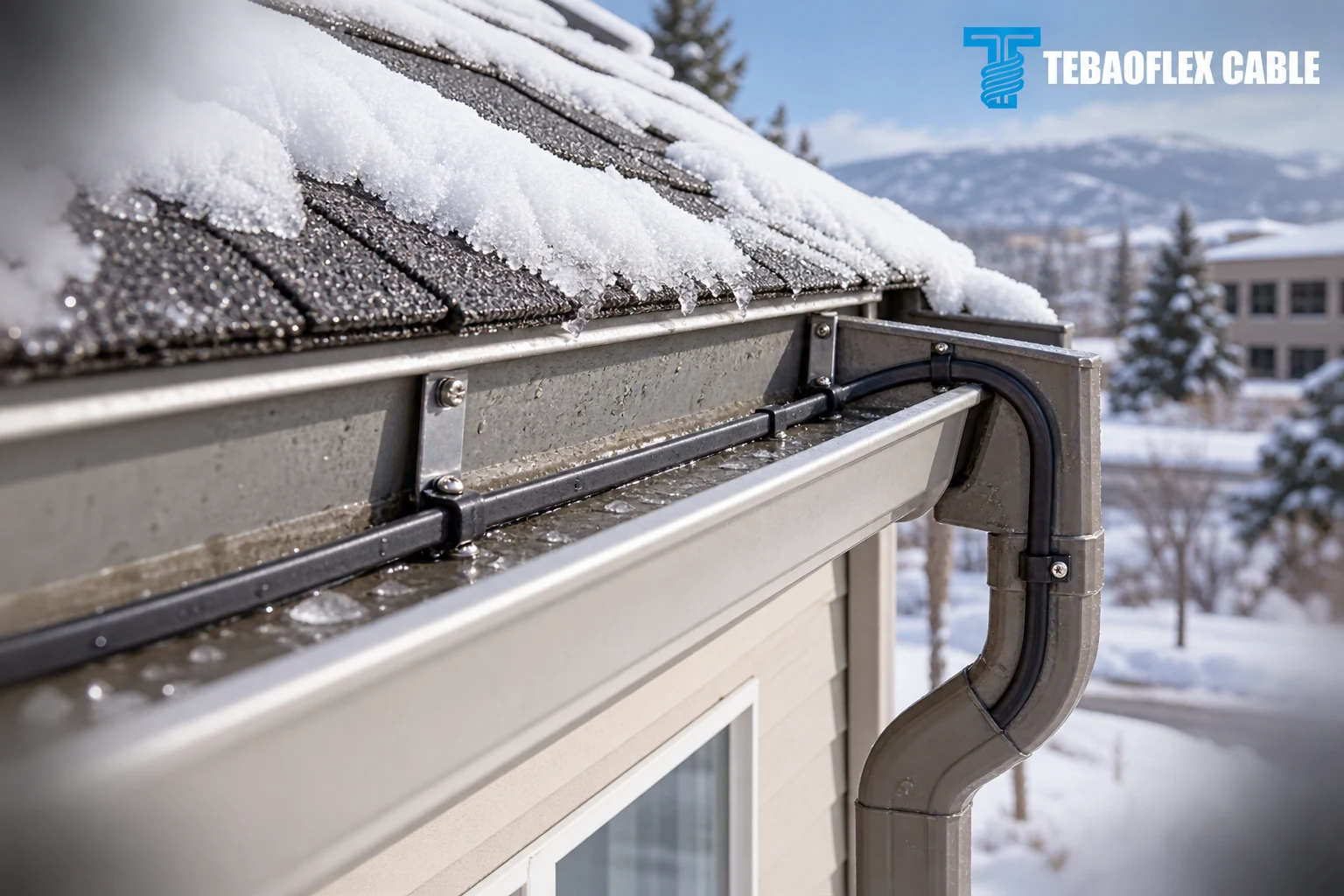
Typical design contexts include a roof-edge meltwater path, gutter and downspout de-icing, and freeze protection for water or drain pipes in residential or commercial projects. The goal is to maintain a path for meltwater to move away before it refreezes; the cable alone does not promise an ice-free roof. The illustration below shows one possible gutter-to-downspout route, not a documented installation. Layout, weather exposure, routing, clips, power connections, end seals and equipment protection all require project review.
What information is needed for selection and quotation?
Send the roof, gutter, downspout or pipe drawings; heated path length; supply voltage; minimum expected start temperature; ambient and surface conditions; desired controls; power-connection and end-seal requirements; quantity; and delivery format. TEBAOFLEX can review the requested bus-wire, matrix, braid and jacket configuration, then confirm buildability, test scope and project-specific circuit design. MOQ, lead time, circuit maxima and any certification status are confirmed separately and are not inferred from the reference sheet.
- Do not copy another project’s circuit length or breaker selection without recalculation.
- Self-regulating output varies with temperature; 6 W/ft is tied to a stated reference condition.
- Use qualified installation and locally required electrical protection; confirm accessory and rooftop exposure suitability for the approved build.
Explore the high-temperature and specialty cable range or TEBAOFLEX cable solutions when comparing other constructions.
Frequently asked questions
Is the cable always 6 W/ft?
No. The supplied output figure is 6 W/ft at 40°F. A self-regulating matrix changes heat output with local temperature, and the exact voltage affects the output of the 208–277 V version.
Can the same version run on 120 V and 240 V?
No. The reference distinguishes a 120 V version and a separate 208–277 V AC version. Specify the actual supply voltage before selecting the build.
Does the cable eliminate the need for controls or circuit protection?
No. Self-regulation describes the heating matrix response; protective-device, control, termination and circuit-length choices still require a project-specific electrical design.
Send your heat-trace requirements
Share the project drawings, supply voltage, route length, startup temperature, installation environment and quantity. TEBAOFLEX will review the specified build and respond with an engineering-led quotation.