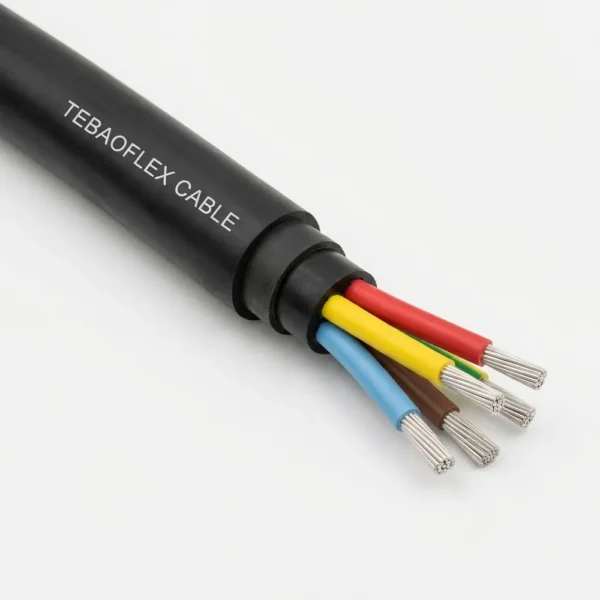

Application & Operating Conditions
BS 6708 Type 43 is a 125/72 V non-metallic-screened handheld drilling machine cable designed for deep underground coal seams and gassy headings where sensitive core-balance earth-leakage relays protect face operators and extreme torsional twisting would prematurely fatigue conventional wire-braided screens.
Zero Metallic Braid Fatigue
Replaces woven copper wire braids with an extruded semiconducting elastomeric cradle and 1.5 mm conducting inner sheath—completely eliminating broken screen wire strands under constant hand-drill twisting.
130 kg/km Lighter Handling Mass
At 1020 kg/km (150 kg/km copper weight), BS 6708 Type 43 is over 11% lighter than wire-braided Type 44 (1150 kg/km), reducing operator fatigue when hauling long drill leads across inclined faces.
Full Radial Core Segregation
All five 6 mm² EPR-insulated cores sit in dedicated flutes of the semiconducting cradle without contacting each other, ensuring any phase insulation puncture immediately contacts the conducting rubber path to earth.
Protection Relay Compatibility Note: BS 6708 Type 43 relies on semiconducting elastomeric screening and must be paired with sensitive earth-fault (SEF) drill gate-end panels designed for conducting-rubber cables. Where low-impedance metallic screen fault paths are mandated, select BS 6708 Type 44.
Cable Construction (BS 6708 Type 43 Semiconducting Elastomer Design)
Manufactured in exact compliance with BS 6708 Type 43: five 6 mm² Class 5 tinned copper EPR cores housed inside a semiconducting cradle and conducting elastomeric inner sheath with zero metallic braid or steel wire armour.
| Layer / Component | Material & BS 6708 Engineering Specification |
|---|---|
| 1. Conductors (5 × 6 mm²) | Electrolytic flexible stranded tinned copper wire, IEC 60228 Class 5 (84/0.30 mm stranding, 3.30 mm diameter) for 3 phases, 1 pilot, and 1 earth core. |
| 2. Core Insulation | Ethylene Propylene Rubber (EPR) dielectric, 1.00 mm nominal radial thickness. |
| 3. Semiconducting Cradle & Lay-Up | All five insulated cores laid up without contacting each other in the flutes of a central semiconducting elastomeric cradle. |
| 4. Conducting Inner Sheath / Bedding | Conducting elastomeric compound extruded around the cabled assembly (1.5 mm nominal radial thickness), encapsulating every core in an earthed semiconducting matrix. |
| 5. Outer Sheath | Heavy-duty black polychloroprene (PCP / chloroprene) outer jacket, 2.5 mm nominal radial thickness, resistant to rock abrasion, mine water, mineral oils, and flame propagation. |
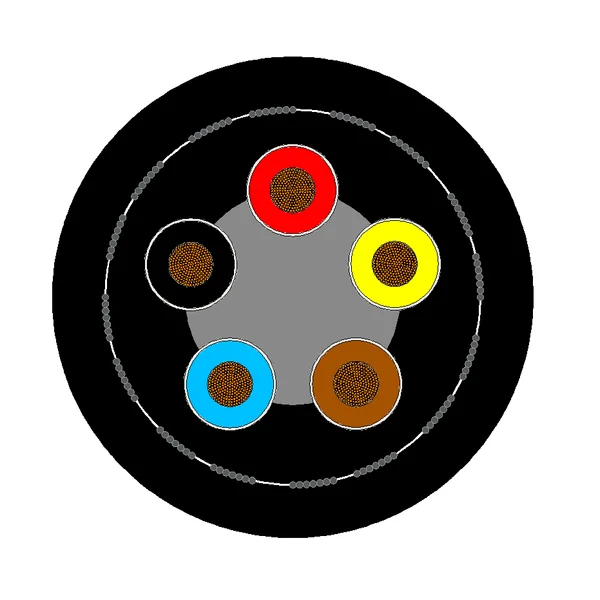
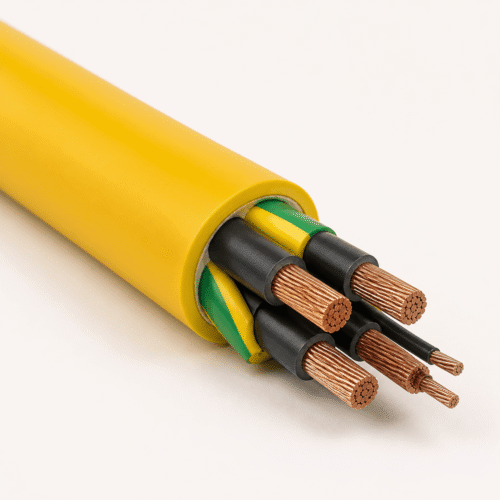
BS 6708 Type 43 Cross-Section: Five non-contacting 6 mm² EPR cores positioned inside a fluted semiconducting cradle and 1.5 mm conducting elastomeric inner sheath, protected by a 2.5 mm black PCP outer sheath.
Technical Characteristics
Electrical, thermal, and dimensional specifications in accordance with British Standard BS 6708 Type 43.
| Parameter | BS 6708 Rated Value |
|---|---|
| Reference Standard | BS 6708 (Type 43 Conducting-Elastomer Handheld Drilling Machine Cable) |
| Rated Voltage (U / Uo) | 125 / 72 V AC |
| Routine AC Test Voltage | 1.5 kV AC |
| Nominal Cross-Section | 5×6 mm² (3 Phase Cores + 1 Pilot Core + 1 Earth Core) |
| Screen Architecture | Non-Metallic Semiconducting Cradle + 1.5 mm Conducting Elastomeric Inner Sheath |
| Minimum Bending Radius | 268 mm |
| Continuous Current Rating (@ 25 °C) | 46 A |
| Conductor Max. DC Resistance (@ 20 °C) | 3.48 Ω/km |
BS 6708 Type 43 Specification & Electrical Data Table
Complete dimensional, sheath thickness, weight, current, and resistance specifications for BS 6708 Type 43 (5×6 mm²).
1. Core, Conducting Sheath & Overall Cable Dimensions (5×6 mm²)
| Nominal Size (mm²) | Conductors | Stranding (No./mm) | Cond. Dia. (mm) | Insul. Thick. (mm) | Conducting Inner Sheath (mm) | Outer Sheath (mm) | Min. OD (mm) | Max. OD (mm) | Min. Bend Radius (mm) | Approx. Weight (kg/km) | Copper Weight (kg/km) |
|---|---|---|---|---|---|---|---|---|---|---|---|
| 5×6 | 5×6 | 84/0.30 | 3.30 | 1.00 | 1.5 | 2.5 | 24.8 | 26.8 | 268 | 1020 | 150 |
2. Current Rating & Conductor DC Resistance
| Nominal Size (mm²) | Continuous Current @ 25 °C (A) | Conductor Max. DC Res. @ 20 °C (Ω/km) |
|---|---|---|
| 5×6 | 46 | 3.48 |
Selection Guide: BS 6708 Drill, Catenary & Auxiliary Mining Cables
Compare BS 6708 Type 43 conducting-elastomer drill cable against Type 44 composite-braided drill cable and other BS 6708 auxiliary models.
| BS 6708 Model | Core & Pilot Architecture, Earth Design & Primary Duty |
|---|---|
| BS 6708 Type FS4 (640/1100V Flat) | BS 6708 Type FS4 (640/1100V Flat): Flat parallel 4-core geometry (4×2.5 & 4×4 mm²) with tinned copper braided screens on all phase and pilot cores for monorail festoon and overhead catenary loops (100–120 mm bend radius). |
| BS 6708 Type 44 (125/72V Screened Drill) | BS 6708 Type 44 (125/72V Screened Drill): 5×6 mm² handheld drilling machine cable with composite copper/nylon braided screens on 3 phase cores + unscreened pilot & earth cores around an elastomeric cradle. |
| BS 6708 Type 43 (125/72V Conducting Rubber Drill) (This Product) | 5×6 mm² metal-braid-free drilling cable with cores separated around a semiconducting elastomeric cradle and 1.5 mm conducting rubber inner sheath for non-fraying flex fatigue resistance. |
| BS 6708 Type 70 & Type 71 (320/550V Armoured) | BS 6708 Type 70 & Type 71 (320/550V Armoured): 4-core (Type 70, 4×4 mm²) and 5-core (Type 71, 5×4 mm²) unscreened EPR power & coalface lighting cables protected by 7/0.45 mm galvanized steel pliable wire armour. |
| BS 6708 Type 506 / 512 / 518 / 524 (320/550V Control) | BS 6708 Type 506 / 512 / 518 / 524 (320/550V Control): 6-, 12-, 18-core (1.34 mm²) and 24-core (0.93 mm²) individually composite-screened & pliable wire armoured control cables for inter-segment mining machine telemetry and pilot interlocks. |
| BS 6708 Type 7 (640/1100V Trailing) | BS 6708 Type 7 (640/1100V Trailing): Primary 640/1100 V unarmoured coalcutter trailing feeder (16–150 mm²) with 3 composite-screened phase cores, 1 unscreened pilot core, and central bare earth. |
Frequently Asked Questions (FAQ)
Key engineering considerations when specifying and terminating BS 6708 Type 43 conducting-rubber drilling cables.
What is the main structural difference between BS 6708 Type 43 and Type 44?
Both cables are 5×6 mm² 125/72 V handheld drill cables with 46 A continuous current capacity and virtually identical outer diameters (24.8–26.8 mm vs 24.7–26.7 mm). Type 44 uses metallic tinned-copper/nylon braided screens over the three phase cores, whereas Type 43 omits all metallic braids and instead surrounds all five separated cores with a semiconducting elastomeric cradle and a 1.5 mm conducting rubber inner sheath.
What precaution is required when stripping and terminating BS 6708 Type 43 inside a drill plug?
During plug or coupler termination, the black conducting elastomeric inner sheath and semiconducting cradle webs must be cleanly pared back from the insulated phase and pilot core tails so semiconducting rubber does not bridge across phase pins or lower pilot-to-earth insulation resistance.
Does BS 6708 Type 43 still include a full-size metallic copper earth conductor?
Yes. One of the five 6 mm² Class 5 tinned copper conductors (3.48 Ω/km max DC resistance) serves as the dedicated main protective earth core in intimate contact with the semiconducting elastomeric matrix.
Need BS 6708 Type 43 Conducting-Rubber Drill Cable?
Send your required meterage and delivery schedule to receive direct factory pricing and BS 6708 compliance documentation.
Explore All Mining & Tunneling Cables