Application & Operating Conditions
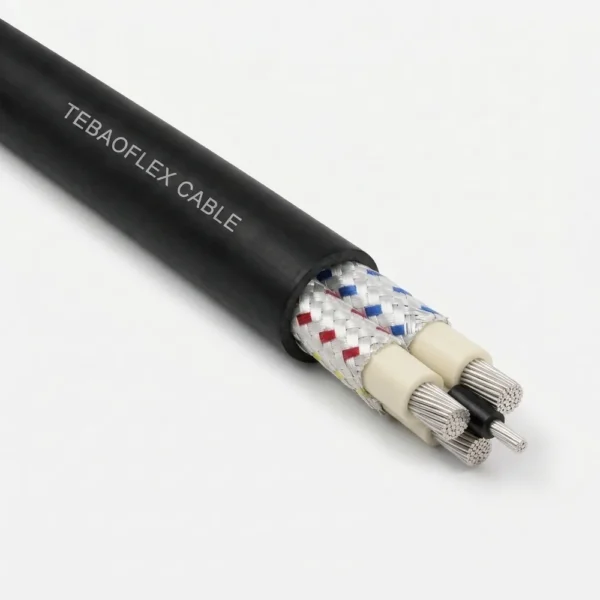
AS/NZS 1802 Type 210 is a 1.1/1.1 kV composite screened flexible rubber trailing cable with a single extensible central pilot core, designed primarily to power hand-held rotary coal and rock boring machines and portable underground mining tools requiring operator touch-safety and high flex-fatigue endurance.
Hand-Held Boring & Bolting Drills
Engineered specifically as a compact 25.6–26.8 mm OD trailing lead for operator-held underground coal face boring machines, roof bolting drills, and portable face tools connected to drill control panels.
Individual Phase Fault Containment
Each 1.5 mm² or 2.5 mm² phase core is enclosed in a 6.2 mm² or 6.9 mm² tinned copper/polyester composite earth screen, intercepting mechanical punctures to trigger earth-leakage tripping before phase-to-phase arcing.
Wet Face, Duct & Portable Machine Leads
Protected by a 3.0 mm heavy-duty HD-85-PCP polychloroprene sheath offering oil resistance, water immersion stability, C1 flame retardancy, and manual handling suppleness down to −25 °C.
Cross-Section Scope Notice: Under AS/NZS 1802, Type 210 (Sub-Type 210.1) covers small-gauge 1.5 mm² and 2.5 mm² hand-held equipment leads at 1.1/1.1 kV. For larger 10–300 mm² composite screened feeder cables up to 11/11 kV, specify AS/NZS 1802 Type 209 or 3-pilot Type 240.
Cable Construction (AS/NZS 1802 Type 210)
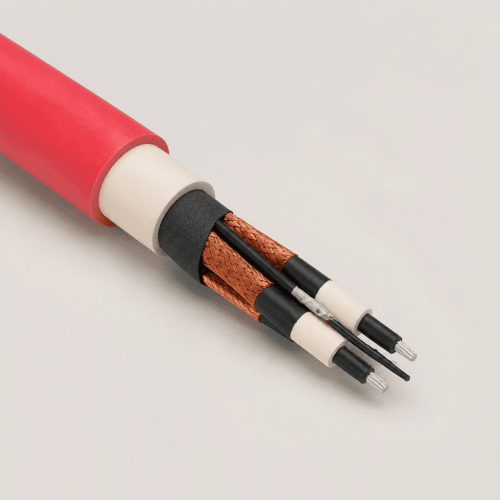
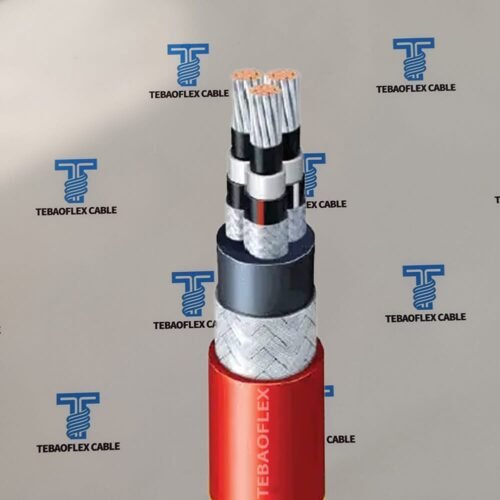
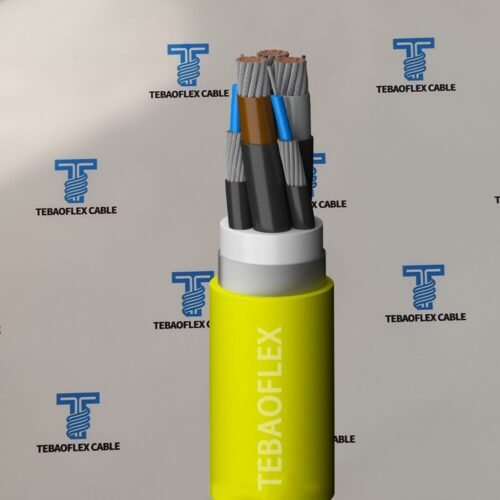
Type 210 arranges three composite-screened tinned copper power cores in trefoil around a single central extensible pilot, balancing high earth-fault conductivity (6.2–6.9 mm² per screen) with repeated axial stretching and torsional recoil during manual drill operation.
| Layer / Element | Material & AS/NZS 1802 Specification |
|---|---|
| 1. Phase Conductors | Finely stranded flexible tinned annealed copper, three phase cores (1.5 mm² or 2.5 mm²) |
| 2. Core Insulation | Ethylene-propylene rubber thermosetting compound (R-EP-90 EPR), 1.4 mm (1.5 mm²) or 1.5 mm (2.5 mm²) radial wall |
| 3. Composite Earth Screen | Individual composite braid of tinned annealed copper wire and polyester yarn over each phase core (6.2 mm² / 6.9 mm² effective copper area) |
| 4. Phase Identification | Red, white, and blue braid tracers woven directly into the three composite earth screens |
| 5. Central Pilot Core | Single extensible central pilot core located on the neutral axis; maximum DC resistance 5.5 Ω/100m |
| 6. Outer Sheath | Heavy-duty polychloroprene elastomer (HD-85-PCP), 3.0 mm nominal radial thickness, abrasion, tear, oil, and C1 flame resistant |
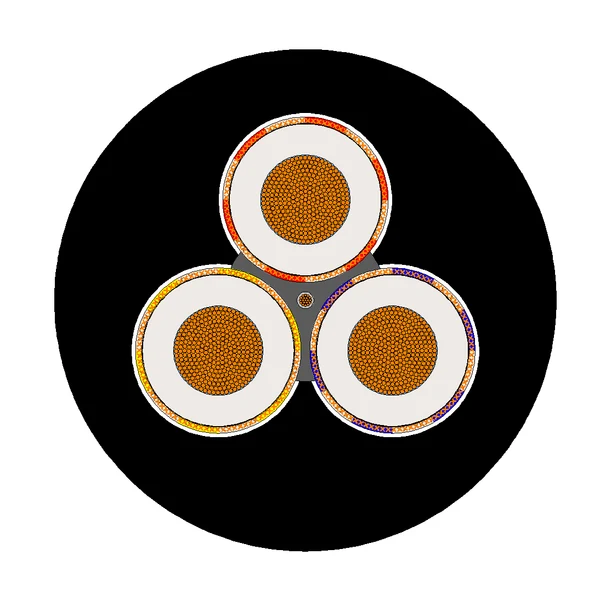
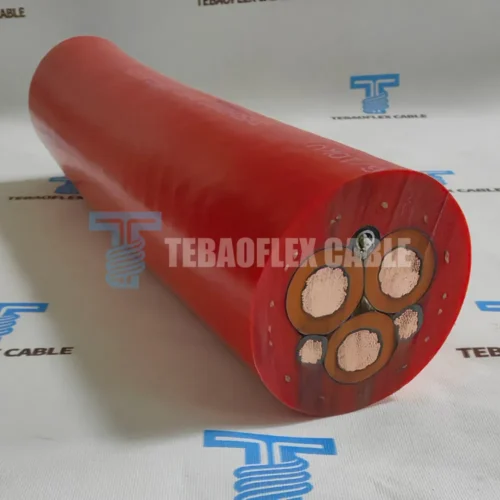
Type 210 Cross-Section Geometry: Three R-EP-90 insulated phase cores with composite tinned-copper/polyester screens cradle an extensible central pilot inside a thick 3.0 mm HD-85-PCP jacket.
Technical Characteristics
Electrical, thermal, and environmental parameters for Type 210 (Sub-Type 210.1) comply with AS/NZS 1802 at 1.1/1.1 kV, delivering +90 °C continuous conductor operation, low pilot loop resistance (≤5.5 Ω/100m), and C1 flame performance.
| Parameter | AS/NZS 1802 Rated Value |
|---|---|
| Manufacturing Standard | AS/NZS 1802 (Reeling and trailing cables for underground coal mining) |
| Sub-Type & Rated Voltage | Type 210.1 — 1.1/1.1 kV AC |
| Central Pilot DC Resistance | Maximum 5.5 Ω/100m at 20 °C |
| Max. Continuous Conductor Temperature | +90 °C |
| Minimum Installation Temperature | −25 °C |
| Installation Conditions | In free air, in underground cable ducts, and as flexible leads to hand-held / portable machines |
| Oil & Water Immersion Performance | Excellent oil/water immersion resistance and high manual flexibility |
| Flame Retardancy Classification | C1 (AS/NZS 1660.5.6 single vertical flame propagation) |
Specification & Dimensional Data (Type 210.1 — 1.1/1.1 kV)
Complete nominal dimensional, electrical impedance, composite screen cross-section, and mass specifications for AS/NZS 1802 Type 210.1 (1.1/1.1 kV) hand-held mining cables in 1.5 mm² and 2.5 mm² conductor sizes.
| Nominal Area (mm²) | Cond. Dia. (mm) | Insul. Thickness (mm) | AC Res. (Ω/km) | Reactance (Ω/km) | Volt Drop (mV/A·m) | Capacitance (µF/km) | Screen Area (mm²) | Sheath Wall (mm) | Cable OD (mm) | Mass (kg/100m) |
|---|---|---|---|---|---|---|---|---|---|---|
| 1.5 | 1.6 | 1.4 | 17.5 | 0.187 | 30.3 | 0.165 | 6.2 | 3.0 | 25.6 | 100 |
| 2.5 | 2.1 | 1.5 | 10.5 | 0.174 | 18.2 | 0.184 | 6.9 | 3.0 | 26.8 | 110 |
Engineering Note: Notice that the composite earth screen area per core (6.2 mm² and 6.9 mm²) intentionally exceeds the 1.5 mm² and 2.5 mm² phase conductor areas to guarantee low fault-loop impedance and rapid earth-fault clearance on hand-held boring circuits.
Selection, Pilot Protection & AS/NZS 1802 Model Comparison
Selecting the right AS/NZS 1802 trailing cable depends on equipment mobility, conductor cross-section, and pilot-loop protection distance between the drill control panel or gate-end box and the underground load.
| Selection Criterion | Engineering Guidance |
|---|---|
| 1.5 mm² vs. 2.5 mm² Voltage Drop | Upgrading from 1.5 mm² (30.3 mV/A·m) to 2.5 mm² (18.2 mV/A·m) cuts three-phase voltage drop by 40% while increasing outer diameter by only 1.2 mm (25.6 mm to 26.8 mm), preventing drill motor stalling on longer face leads. |
| Extensible Pilot Continuity Check | With a maximum pilot resistance of 5.5 Ω/100m, verify total drill cable length plus composite earth return resistance stays well within the intrinsic safety / earth-continuity relay trip threshold of your AS/NZS 2081 drill control unit. |
| Larger Feeder & Miner Alternatives | For 10–300 mm² composite screened feeders, select Type 209 (single pilot) or Type 240 (3 interstitial pilots for long runs); for highly flexible continuous miner trailing duty, see Type 241. |
Frequently Asked Questions (FAQ)
Technical answers for mine electrical engineers and procurement teams specifying AS/NZS 1802 Type 210 hand-held equipment cables.
How does AS/NZS 1802 Type 210 differ from Type 209?
Both share a 3-core composite earth screen plus central extensible pilot architecture, but Type 210 (210.1) is engineered specifically at 1.1/1.1 kV in small 1.5 mm² and 2.5 mm² cross-sections with oversized 6.2–6.9 mm² phase screens for hand-held coal drills and portable face tools, whereas Type 209 covers 10–300 mm² feeders across 1.1 kV to 11 kV.
Why is the central pilot core designed to be extensible in Type 210?
Hand-held boring leads undergo constant manual pulling, coiling, and snatch loads at the coal face. Placing an extensible pilot core along the neutral center axis allows the pilot conductor to elongate elastically with the power cores without work-hardening or snapping prematurely.
Can TEBAOFLEX supply Type 210 cables in custom cut lengths or fitted with mining plugs?
Yes. We supply Type 210.1 (1.5 mm² and 2.5 mm²) on export fumigated wooden drums in continuous lengths or project-specific cut lengths, complete with routine factory test certificates (conductor/pilot resistance, high-voltage test, and insulation resistance).
Need a Factory Quotation for AS/NZS 1802 Type 210 Drill Cables?
Send us your required cross-section (1.5 mm² or 2.5 mm²), drum lengths, and destination port for direct factory pricing and technical datasheet sign-off.
Explore All Mining & Tunneling Cables