
Understanding the (N)TMCGCW11Y Difference
Not all medium voltage reeling cables are created equal. While the market offers numerous rubber-sheathed reeling cables under various designations, the (N)TMCGCW11Y with its polyurethane sheath represents a purpose-engineered solution that addresses the specific failure modes and performance requirements of high-cycle industrial reeling applications. This comprehensive comparison examines how (N)TMCGCW11Y differs from standard rubber reeling cables in construction, performance, and real-world reliability.
For engineers and procurement professionals selecting cables for critical mining and port applications, understanding these differences is essential. The cost of cable failure in a production environment — measured in downtime, lost production, and safety incidents — far exceeds the price differential between standard and purpose-built cables.
Construction Comparison
Conductor and Insulation
| Parameter | (N)TMCGCW11Y | Standard Rubber (e.g., (N)TSCGEWOU) |
|---|---|---|
| Conductor Material | Tinned copper (Class 5) | Bare copper (Class 5) |
| Insulation | EPR (90°C rated) | EPR (90°C rated) |
| Semiconductor Screen | Extruded semiconducting | Extruded semiconducting |
| Metallic Screen | Tinned copper braid (≥85%) | Tinned copper braid (≥85%) |
The conductor and insulation systems are similar between the two cable types, as both comply with DIN VDE 0250-813. The key difference is the use of tinned copper conductors in the (N)TMCGCW11Y, providing enhanced corrosion resistance for outdoor and marine environments. The insulation and screening systems are functionally equivalent in both cable types.
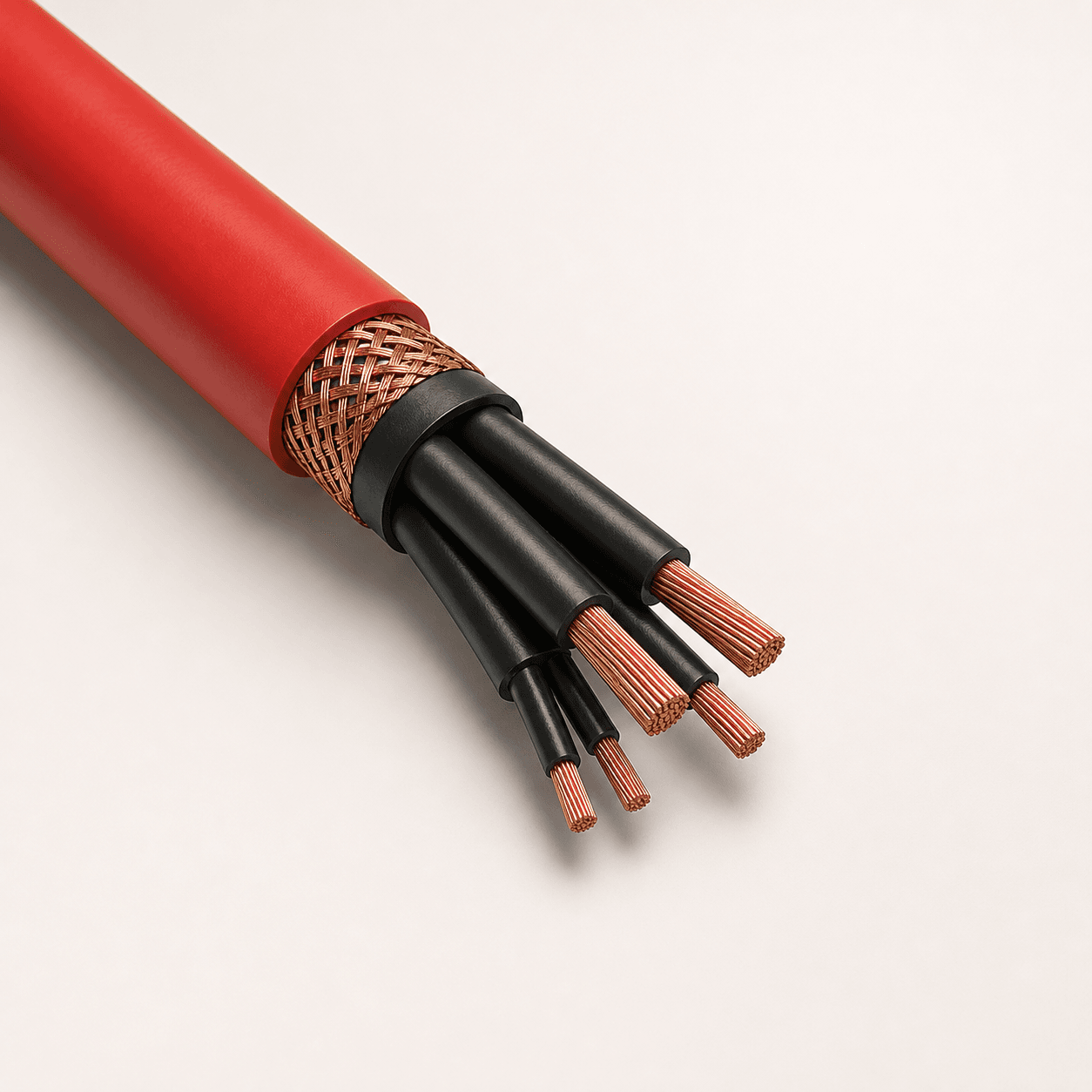
Standard rubber-sheathed MV reeling cable for comparison with (N)TMCGCW11Y PUR cable
Outer Sheath: The Critical Difference
| Parameter | (N)TMCGCW11Y (PUR) | Standard Rubber (PCP/5GM3) |
|---|---|---|
| Sheath Material | Polyurethane (PUR) | Polychloroprene (PCP) or EPR compound |
| Color | Red (RAL 3002) | Red (RAL 2003) |
| Tensile Strength | ≥25 N/mm² | ≥12.5 N/mm² |
| Elongation at Break | ≥300% | ≥200% |
| Abrasion (DIN 53516) | ≤30 mm³ | ≤80 mm³ |
| Tear Resistance | ≥80 N/mm | ≥30 N/mm |
| Oil Resistance | Excellent (EN 60811-404) | Good (per VDE 0270) |
| UV Resistance | Excellent | Moderate (requires carbon black) |
| Low-Temp Flexibility | -40°C (fixed) | -25°C (fixed) |
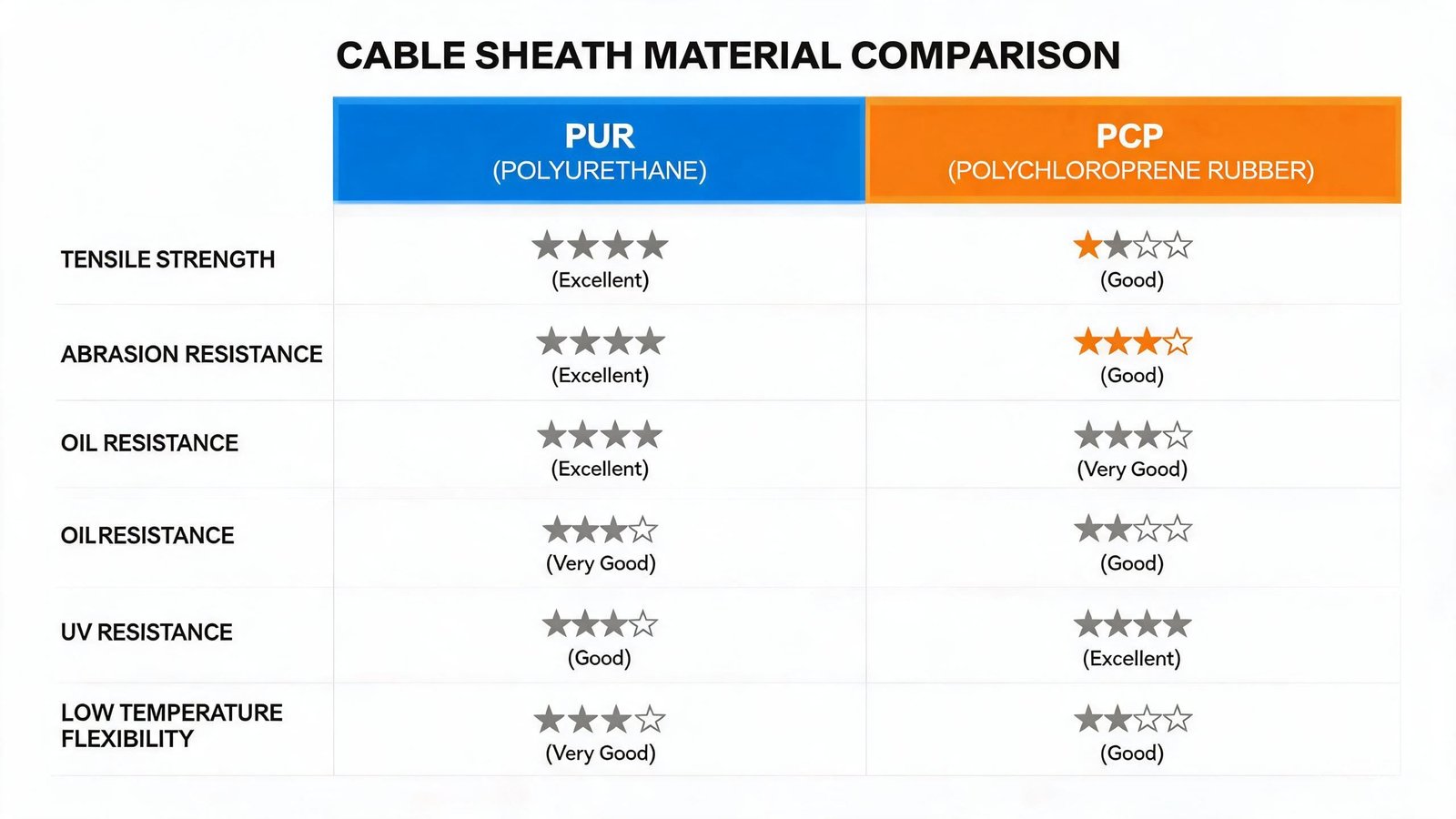
PUR vs rubber sheath material comparison: tensile, abrasion, oil, UV, and temperature ratings
The outer sheath is where the (N)TMCGCW11Y dramatically outperforms standard rubber cables. The polyurethane sheath provides 2× the tensile strength, 2.7× better abrasion resistance, and 2.7× greater tear resistance compared to standard PCP rubber compounds. These mechanical advantages translate directly to extended cable life in the abrasive, high-stress environments typical of mining and port operations.
Performance Comparison
Flex Life
Flex life is the single most critical performance metric for reeling cables. The following table presents comparative flex life data from accelerated testing under identical conditions:
| Cable Type | Flex Life (Cycles) | Failure Mode |
|---|---|---|
| (N)TMCGCW11Y (PUR) | 250,000 – 350,000 | Gradual sheath wear (predictable) |
| Standard PCP rubber | 100,000 – 150,000 | Sheath cracking + conductor fatigue |
| EPR compound rubber | 80,000 – 120,000 | Sheath abrasion + insulation degradation |
| PVC sheathed | 50,000 – 80,000 | Sheath hardening + cracking |
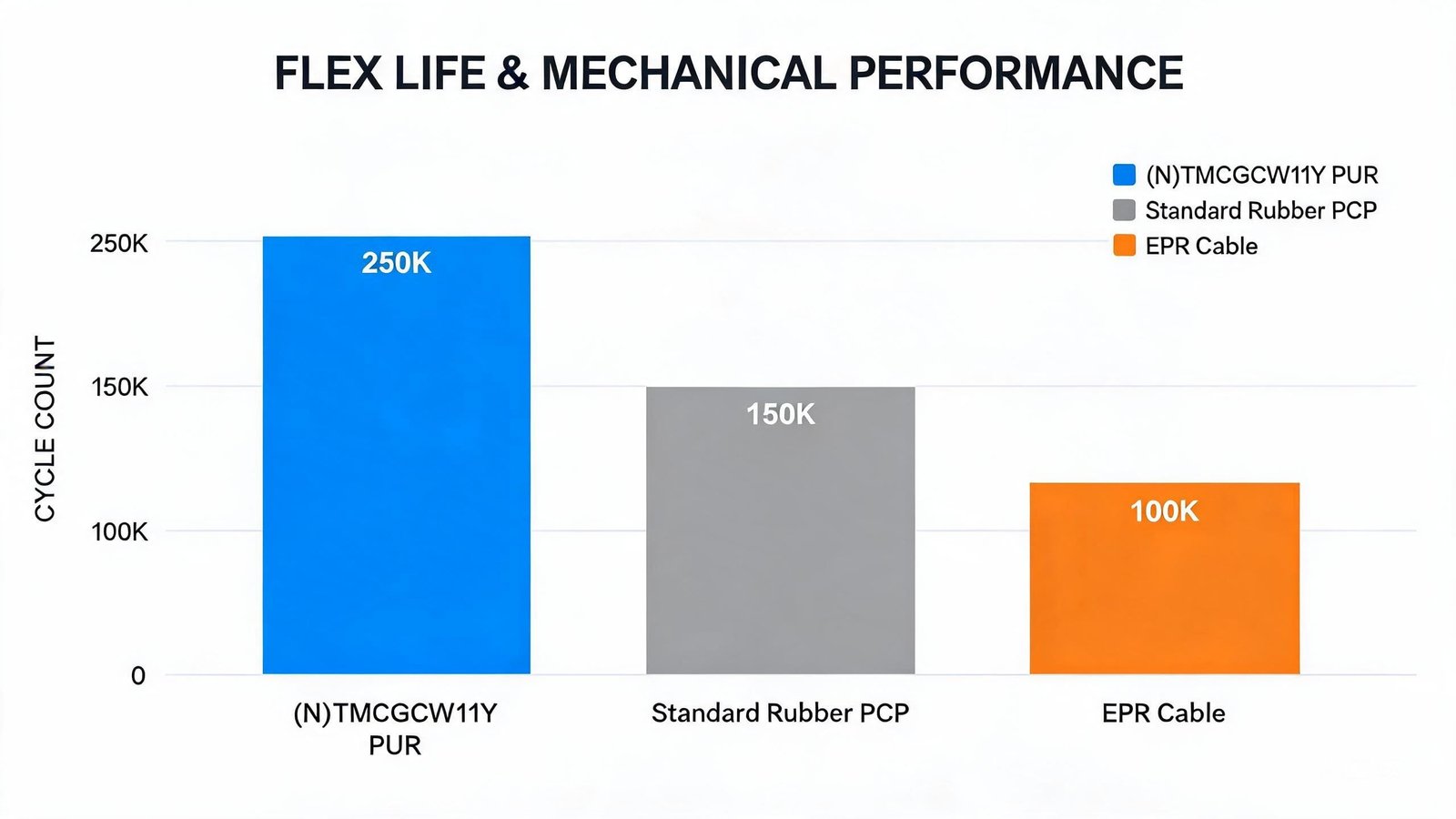
(N)TMCGCW11Y flex life: 250K+ cycles vs standard rubber and EPR cables
The 1.7-2× flex life advantage of the (N)TMCGCW11Y translates to significant cost savings. In a 24/7 operation running at 10 cycles/hour, a standard rubber cable reaching 120,000 cycles would need replacement approximately every 15 months. A (N)TMCGCW11Y cable reaching 300,000 cycles would last approximately 3.1 years — reducing replacement frequency by 60%.
Oil and Chemical Resistance
| Fluid Type | (N)TMCGCW11Y (PUR) | Standard Rubber (PCP) |
|---|---|---|
| ASTM Oil #1 (100°C, 4h) | +5% max | +10% to +20% |
| Hydraulic oil (ISO VG 46) | +2% max | +5% to +15% |
| Diesel fuel | +5% max | +10% to +25% |
| Cutting fluid (water-based) | +3% max | +5% to +12% |
Lower volume change indicates better chemical resistance. The PUR sheath maintains its mechanical properties and dimensions when exposed to oils, while rubber cables may swell significantly, leading to dimensional instability and accelerated wear on reeling drums.
Environmental Performance
| Environmental Factor | (N)TMCGCW11Y (PUR) | Standard Rubber (PCP) |
|---|---|---|
| UV Resistance | Excellent (UV-stable formulation) | Moderate (requires carbon black filler) |
| Ozone Resistance | Excellent | Good |
| Cold Flexibility | -40°C (fixed), -25°C (flexing) | -25°C (fixed), -10°C (flexing) |
| Heat Aging | Passes 7 days at 100°C | Passes 7 days at 80°C |
| Flame Retardancy | IEC 60332-1-2 (self-extinguishing) | IEC 60332-1-2 (self-extinguishing) |
The superior UV resistance of the PUR sheath is a significant advantage for outdoor mining and port applications. Standard rubber cables rely on carbon black filler for UV protection, which can deplete over time, leading to sheath cracking and moisture ingress.
Total Cost of Ownership Analysis
| Cost Factor (5-Year Period) | (N)TMCGCW11Y (PUR) | Standard Rubber |
|---|---|---|
| Initial Cable Cost | $8,500 | $6,000 |
| Replacement Cost | $0 (1 installation) | $12,000 (2 replacements) |
| Labor for Replacement | $0 | $4,000 (2 × $2,000) |
| Downtime Cost | $0 | $20,000 (2 × $10,000) |
| 5-Year Total | $8,500 | $42,000 |
Note: Cost figures are illustrative for a typical 100-meter MV reeling cable installation on an electric shovel. Actual costs vary by application.
The 5× cost advantage becomes even more significant when considering that cable replacement in mining operations often requires production shutdown, crane access, and work at height. For a comprehensive cost analysis, contact our engineering services team.
When to Choose (N)TMCGCW11Y vs Standard Rubber
Choose (N)TMCGCW11Y When:
- High-cycle reeling applications (>100,000 cycles annually)
- Environments with simultaneous oil exposure and mechanical stress
- Outdoor installations with continuous UV exposure
- Critical production equipment where downtime cost justifies premium cable investment
- Cold climate operations (-25°C or below during flexing)
- Applications requiring predictable, gradual failure mode
- Marine environments with saltwater corrosion risk
Standard Rubber May Suffice When:
- Low duty cycle or occasional reeling (<50,000 cycles annually)
- Indoor installations without UV exposure
- Environments with minimal oil and chemical exposure
- Budget-constrained projects with acceptable maintenance frequency
- Temperate climate applications (above -10°C during flexing)
Need Help Choosing the Right Cable?
Our engineering team provides free consultation to help you select the optimal medium voltage reeling cable for your specific application.
Selection checklist before changing cable type
Before changing from an existing cable to another reeling-cable design, treat the decision as an application review rather than a material-only comparison. The same equipment may combine electrical, mechanical and environmental demands that are not visible from the cable name alone.
- Confirm the equipment circuit, including voltage, conductor size, core count and control or power functions.
- Document the drum or reel geometry, cable guide arrangement, travel path and operating cycle.
- Identify tensile forces, routing restraints, abrasion points and termination method.
- Record oil, moisture, dust, outdoor exposure, temperature conditions and cleaning or process-media contact.
- Compare the original marking, approved datasheet and any project-specific documentation before approval.
Where these details differ between the original and candidate cable, obtain a technical recommendation based on the complete duty. This approach gives engineering and procurement teams a clearer basis for evaluating a reeling-cable replacement.
How to run a fair cable comparison
Start with the same electrical and mechanical duty for both candidates. A comparison is incomplete if one cable is described by its material while the other is evaluated against the full machine operating conditions. Review the existing installation, including the reel or drum, cable guide, travel path, termination arrangement and all locations where the cable can contact equipment.
Next, compare supplier documentation line by line against the project requirement. The decision should cover circuit design, core configuration, movement duty, environmental exposure, marking and any customer approval process. If the candidate cable is intended for a different use case, treat that difference as a technical question rather than an assumed upgrade or downgrade.
This comparison method provides a practical record for engineering, maintenance and procurement teams before a replacement order is released.
Related Resources
Compare the installed duty with the product documentation and these related resources: