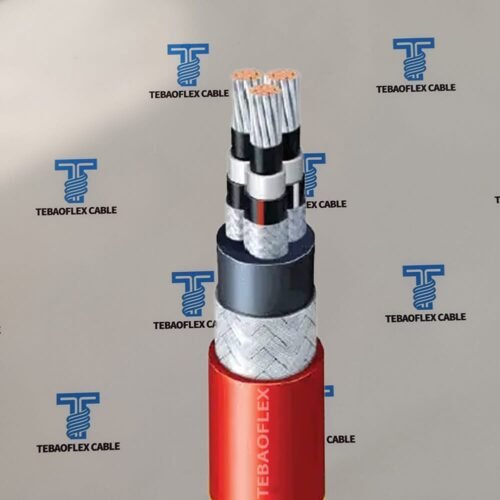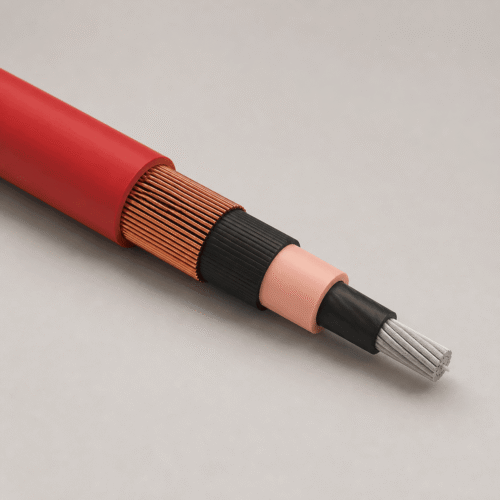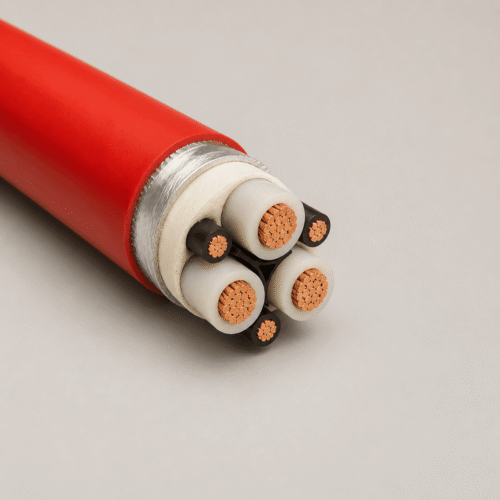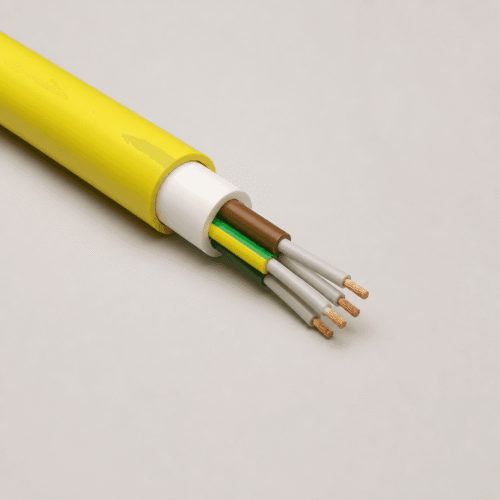
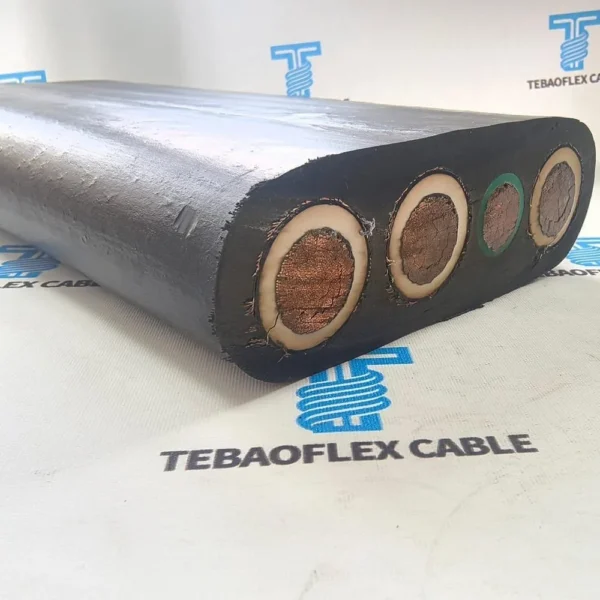
Product Overview: Flat PNCT cable is an application-engineered flexible rubber cable designed for port crane festoon trolleys, overhead hoist loops, and space-restricted transfer tracks. Arranging flexible copper conductors side by side inside ethylene propylene rubber (EPR) insulation and a polychloroprene (CR) outer sheath allows orderly single-plane bending across 300/500 V, 450/750 V, and 0.6/1 kV systems.
1. Application & Dynamic Crane Duty Matrix
Flat PNCT rubber cables serve moving industrial equipment where parallel flat stacking prevents core corkscrewing on I-beam or C-rail festoon trolleys:
- Ship-to-Shore (STS) & Container Cranes: High-cycle festoon power and multi-core control loops along boom and girder tracks.
- RMG / RTG & Overhead Travelling Cranes: Multi-layer flat cable packs clamped on festoon saddles where vertical loop clearance is limited.
- Bulk Port Unloaders & Stacker-Reclaimers: Weather-, salt-mist-, and oil-splash-resistant flexible transfer loops in coastal terminals.
| Operating Duty | Project Inputs Required | TEBAOFLEX Engineering Review Focus |
|---|---|---|
| Festoon / Trolley Travel | Travel distance, speed, acceleration, loop depth & trolley saddle radius | Flat width-to-thickness ratio, core grouping symmetry, and bending fatigue life |
| Long Vertical Suspension | Unsupported drop height, dynamic start/stop load & clamp spacing | Whether integrated strain-relief reinforcement or a round vertical-lift build is required |
| Motorized Drum Reeling | Drum barrel diameter, winding layers, tension & guide rollers | Dedicated reeling check (compare PNCT, 2PNCT & 3PNCT rubber cable series) |
| Mixed Power + Signal Pack | Main motor voltage/current plus encoder, PLC, or safety-bus channels | Core segregation, individual/collective EMC braid screening, and saddle stacking order |
Selection Boundary: Do not specify a flat PNCT cable by model name alone for continuous multi-layer drum reeling, torsional twisting, or long unsupported vertical drops without engineering confirmation. Review our port and crane cable selection guide and port crane cable solutions when comparing festoon vs. reeling architectures.
2. Cable Construction (Inside-to-Outside Physical Hierarchy)
Because PNCT denotes an engineered Japanese/industrial port-cable family rather than a single fixed stock item, each layer is matched to the approved project datasheet:
3. Electrical & Mechanical Design Envelope
The design envelope below defines the customizable range; exact outer width × thickness, net weight, minimum bending radius, and temperature limits are issued on the order-specific approval drawing.
| Technical Parameter | Available Engineering Envelope & Verification Rule |
|---|---|
| Rated Voltage Classes | 300/500 V, 450/750 V, or 0.6/1 kV (confirmed per circuit duty and project standard) |
| Conductor Cross-Sections | 0.75 mm² to 50 mm² reference range; cross-sections above 50 mm² available upon technical review |
| Core Count Range | 2-core to multi-core power, multi-core control (e.g., 4C–24C+), or hybrid power + control flat builds |
| Operating Temperature & Bend Radius | Construction-specific; confirmed against conductor size, finished flat thickness, trolley saddle diameter, and cycle rate |
| Standards & Documentation | Project-specific standard, surface print legend, routine test report, and third-party inspection confirmed per order (no blanket certification assumed) |
4. Reference Ordering Families & Configuration Matrix
Use the reference series codes below when preparing crane festoon cable schedules or requesting cross-sectional drawings from TEBAOFLEX (explore additional options in our Port, Crane & Festoon Cables catalog):
| Reference Series | Functional Duty | Typical Voltage | Typical Core & Gauge Examples | Optional Engineered Features |
|---|---|---|---|---|
TF-PNCT-F-PWR | Main Hoist / Trolley Power Festoon | 0.6/1 kV | 3C, 4C, or 5C × 4 mm² to 50 mm² (+ custom >50 mm²) | Tinned Cu conductors, heavy CR sheath, strain-relief members |
TF-PNCT-F-CTL | Multi-Core Crane Control Festoon | 300/500 V or 450/750 V | 4C, 7C, 12C, 16C, 19C, or 24C × 0.75–2.5 mm² | Numbered EPR cores + green/yellow PE, compact flat stacking |
TF-PNCT-F-EMC | Screened VFD / Signal Festoon | 300/500 V – 0.6/1 kV | Screened power cores or screened control pairs (0.75–16 mm²) | Copper braid EMC screening for inverter-fed crane drives |
TF-PNCT-F-HYB | Composite Power + Control Festoon | 0.6/1 kV | Power cores (6–35 mm²) + auxiliary control cores (1.5–2.5 mm²) | Custom sub-grouped flat geometry matched to trolley clamp width |
5. Frequently Asked Questions
What is Flat PNCT cable and why is a flat profile used on port cranes?
Flat PNCT cable arranges EPR-insulated flexible copper cores in parallel inside a flat polychloroprene (CR) rubber jacket. Compared with round cables, the flat geometry bends cleanly along a single plane, stacks in multi-cable packs on festoon trolley saddles without twisting, and minimizes loop depth where vertical clearance under crane girders is tight.
What is the difference between flat PNCT and round PNCT / 2PNCT / 3PNCT cables?
Flat PNCT is optimized for single-plane suspended festoon loops and trolley tracks. Round PNCT, 2PNCT, and 3PNCT cables use concentric core lay-up (often with anti-torsion braids) for multi-plane deflection, spreader baskets, or motorized reeling drums.
Can Flat PNCT cable be specified for high-speed STS crane festoon systems?
Yes, when sized for the complete dynamic profile. Share trolley travel speed, acceleration, loop depth, trolley spacing, cycle frequency, and suspended weight so our engineers can confirm conductor stranding, strain support, and minimum saddle radius.
Can standard Flat PNCT festoon cable be wound onto a motorized cable reel?
Do not apply a flat festoon construction to a motorized drum without separate engineering verification. Drum winding introduces radial crushing and tension that may require a reinforced flat build or a dedicated round reeling cable.
What voltage ratings, core counts, and conductor sizes can TEBAOFLEX supply?
We engineer Flat PNCT cables across 300/500 V, 450/750 V, and 0.6/1 kV from 2-core power leads to multi-core control and composite packs (0.75–50 mm² reference range; larger cross-sections reviewed against crane specifications).
What operating data is needed for an engineered Flat PNCT quotation?
Provide system voltage, core count and mm² cross-sections, individual cut lengths, festoon travel distance, speed/acceleration, trolley saddle dimensions, coastal/environmental conditions, and required inspection documents.
Request Engineered Flat PNCT Cable Drawing & Factory Quote
Send your crane festoon schedule—voltage, core arrangement, conductor sizes, travel speed, loop depth, and saddle clamp width. TEBAOFLEX will issue a confirmed flat cross-section drawing, width × thickness dimensions, and quotation.