Application & Operating Conditions
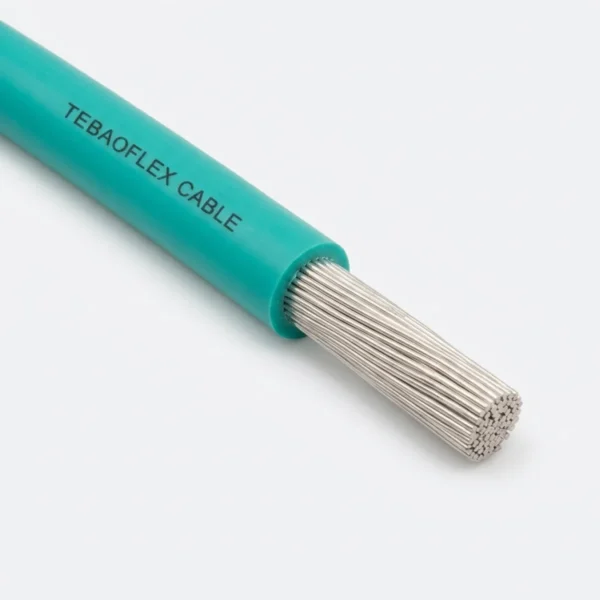
UL 3132 silicone rubber hook-up wire delivers flexible internal point-to-point wiring for enclosed electrical appliances, precision sensors, Class B/F motor leads, and lighting fixtures operating from -60°C to +150°C at 300 V AC. Its thin 0.40 mm braid-free elastomer wall strips cleanly without glass-fiber fraying on automated harness lines.
Compact Household & Commercial Appliances
Internal control and sensor lead wiring for espresso machines, induction cooktops, convection ovens, hair dryers, and steam irons where tight routing radii meet +150°C ambient heat.
LED Luminaires, Ballasts & Power Supplies
Compact 1.10–2.30 mm outer diameters route cleanly through narrow PCB headers, potted LED drivers, dry-type control transformers, and enclosed electronic instrumentation.
Clean-Room & Automated Harness Processing
Unlike fiberglass-braided wires that shed airborne glass fibers during cutting, single-layer thermoset silicone rubber enables dust-free high-speed blade stripping and ultrasonic termination.
Mechanical Protection Note: UL 3132 utilizes a thin 16 mil (0.40 mm) unbraided silicone wall designed for protected internal enclosures free from sharp sheet-metal abrasion. Where leads pass across rough metal edges or require +200°C braided cut-through protection, specify UL 3122 Fiberglass-Braided Silicone Wire (200°C / 300V).
Wire Construction (UL AWM Style 3132)
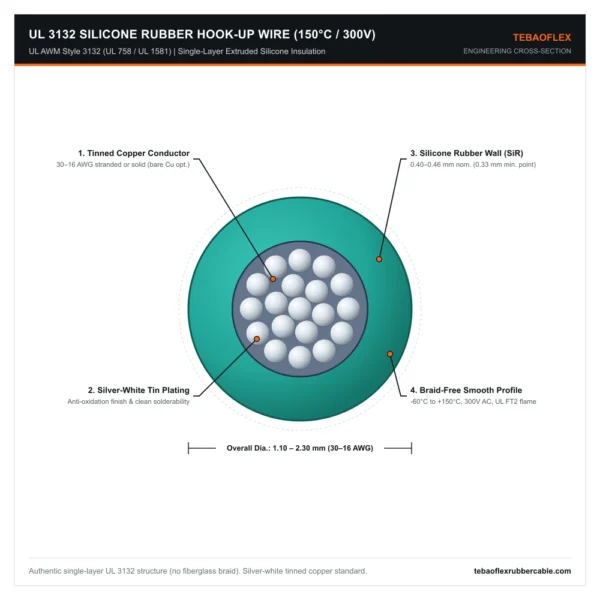
Manufactured strictly to UL 758 Style 3132 and UL 1581 requirements, this single-conductor lead wire pairs anti-oxidant tin-plated copper (stranded, ultra-flexible 133-strand, or solid) with a homogeneous extruded thermoset silicone rubber wall. No inner tape, textile braid, or halogen plasticizer is used, ensuring permanent low-smoke elasticity.
| Layer / Component | Material & UL 758 / UL 1581 Engineering Specification |
|---|---|
| 1. Conductor | Annealed tinned copper (silver-white tin plating standard to prevent copper oxidation up to +150°C and ensure rapid solder wetting; bare copper available on request), 30 AWG to 16 AWG in flexible 7/17/19-strand, 133/0.05 mm ultra-flex, or solid constructions. |
| 2. Insulation Material | Extruded high-purity thermoset Silicone Rubber (SiR), odorless, non-toxic, halogen-free, and resistant to thermal hardening, ozone, moisture, and solder-iron melt-back during PCB rework. |
| 3. Wall Thickness | 0.40 mm to 0.46 mm nominal wall thickness (15 mil min. average / 0.33 mm minimum at any single point per UL 758 Style 3132). Single-layer homogeneous extrusion (braid-free). |
| 4. Standard Color Code | Black, White, Red, Yellow, Green, Blue, Brown, Grey, Orange, Violet, and Green/Yellow (custom RAL stripes or cut-and-stripped harness leads available). |
| 5. Surface Marking | UL AWM STYLE 3132 150°C 300V VW-1/FT2 TEBAOFLEX CABLE (or unprinted smooth surface for ultra-fine 28–30 AWG gauges per UL tag reel marking rules). |
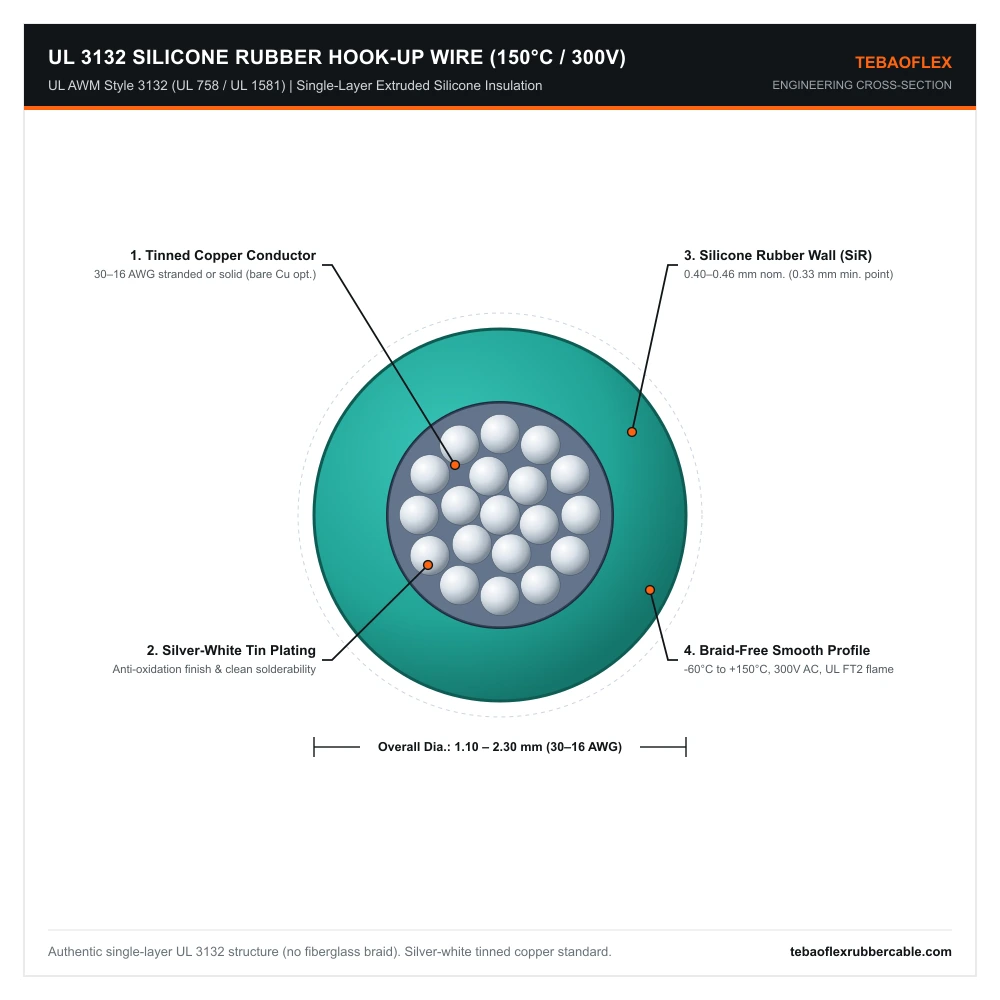
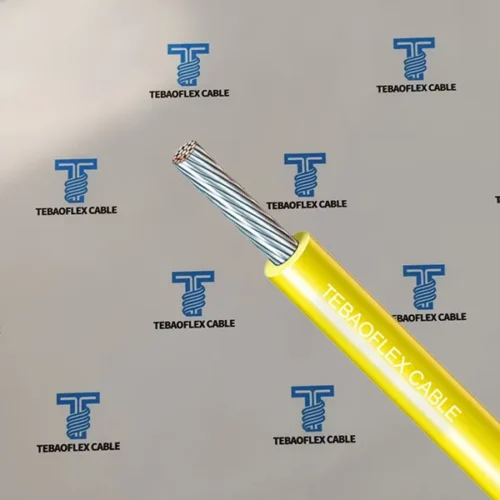
UL 3132 Cross-Section: Single-layer extruded thermoset silicone rubber insulation (0.40–0.46 mm nom. wall, no fiberglass braid) over silver-white tinned copper strands.
Technical Characteristics
Every production reel of UL 3132 silicone wire undergoes 6,000 V AC inline spark testing and 2,000 V AC dielectric withstand verification under UL 1581. Thermoset silicone insulation preserves dielectric stability and cold-bend suppleness down to -60°C without cracking or plasticizer migration.
| Parameter | UL 758 / UL 1581 Rated Value |
|---|---|
| Reference Standard | UL 758 Appliance Wiring Material (AWM Style 3132) & UL 1581 |
| Nominal Operating Voltage | 300 V AC RMS |
| Dielectric Withstand & Spark Test | 2,000 V AC (1 min dielectric test) / 6,000 V AC inline spark test |
| Continuous Temperature Rating | -60°C to +150°C (UL 150°C thermal class) |
| Flame Retardancy | UL 1581 Horizontal Flame Test (FT2) |
| Minimum Bending Radius | 4 × Overall Diameter (fixed internal routing) / 6 × OD (flexing assembly) |
| Chemical & Thermal Stability | Resistant to soldering iron contact heat, ozone, UV, moisture, and mild industrial cleaning agents |
| Environmental Compliance | EU RoHS 2 (2011/65/EU + 2015/863) & REACH SVHC compliant, low-smoke halogen-free elastomer |
UL 3132 Dimensional & Conductor Resistance Schedule (30–16 AWG)
The dimensional table below covers all 15 standard UL 3132 constructions from 16 AWG down to 30 AWG, including standard 7-strand, flexible 17/19-strand, 133/0.05 mm ultra-flexible robotic sensor stranding, and solid hook-up variants, with verified nominal/minimum wall thickness and 20°C DC conductor resistance.
UL AWM Style 3132 — 30 AWG to 16 AWG Tinned Copper Schedule (300V / 150°C)
| AWG Size | Nom. Area (mm²) | Stranding (No./mm) | Cond. Dia. (mm) | Wall Nom./Min. (mm) | Nom. OD (mm) | Max. DC Res. @ 20°C (Ω/km) |
|---|---|---|---|---|---|---|
| 16 AWG | 1.32 | 7/0.49 | 1.50 | 0.40 / 0.33 | 2.30 | 14.60 |
| 18 AWG | 0.84 | 7/0.39 | 1.19 | 0.40 / 0.33 | 1.97 | 23.20 |
| 20 AWG | 0.49 | 7/0.30 | 0.92 | 0.46 / 0.33 | 1.85 | 36.70 |
| 22 AWG (Flex) | 0.34 | 17/0.16 | 0.76 | 0.46 / 0.33 | 1.70 | 59.40 |
| 22 AWG | 0.35 | 7/0.254 | 0.76 | 0.46 / 0.33 | 1.70 | 59.40 |
| 22 AWG (Solid) | 0.33 | 1/0.65 (Solid) | 0.65 | 0.46 / 0.33 | 1.57 | 56.40 |
| 24 AWG (Ultra-Flex) | 0.26 | 133/0.05 (Ultra-Flex) | 0.67 | 0.40 / 0.33 | 1.47 | 94.20 |
| 24 AWG (Flex) | 0.21 | 19/0.12 | 0.60 | 0.40 / 0.33 | 1.40 | 94.20 |
| 24 AWG (Semi-Flex) | 0.22 | 11/0.16 | 0.61 | 0.40 / 0.33 | 1.41 | 94.20 |
| 24 AWG | 0.22 | 7/0.20 | 0.61 | 0.40 / 0.33 | 1.41 | 94.20 |
| 24 AWG (Solid) | 0.20 | 1/0.51 (Solid) | 0.51 | 0.40 / 0.33 | 1.31 | 89.30 |
| 26 AWG | 0.14 | 7/0.16 | 0.48 | 0.40 / 0.33 | 1.28 | 150.00 |
| 26 AWG (Solid) | 0.13 | 1/0.40 (Solid) | 0.40 | 0.40 / 0.33 | 1.20 | 143.00 |
| 28 AWG | 0.089 | 7/0.127 | 0.38 | 0.40 / 0.33 | 1.18 | 239.00 |
| 30 AWG | 0.055 | 7/0.10 | 0.30 | 0.40 / 0.33 | 1.10 | 381.00 |
UL Silicone Hook-Up Wire Selection Matrix (300V vs 600V & Braided)
Selecting the right UL 758 silicone hook-up wire depends on circuit voltage (300V vs 600V), peak enclosure temperature (150°C vs 200°C), and mechanical abrasion exposure. Compare UL 3132 against our heavy-wall 600V and fiberglass-braided silicone lead wires below before finalizing your BOM.
| UL AWM Style | Rated Temp / Voltage, Wall Structure & Recommended Engineering Use |
|---|---|
| UL 3132 (This Page) | 150°C / 300V AC | Thin 0.40 mm braid-free silicone wall (30–16 AWG, 1.10–2.30 mm OD) for space-constrained electronic modules, sensors, and enclosed appliance harnesses. |
| UL 3223 Silicone Wire | 150°C / 300V AC | Thicker 0.76 mm (30 mil) braid-free silicone wall (26–10 AWG) when 300V circuits require higher cut-through margin and larger conductor sizes. |
| UL 3135 Ultra-Flex Wire | 200°C / 600V AC | Heavy 0.78 mm (30 mil) braid-free silicone wall over fine-stranded tinned copper (26–12 AWG) for 600V power leads, battery packs, and 200°C enclosures. |
| UL 3122 Braided Silicone | 200°C / 300V AC | Silicone rubber core + outer silicone-varnished fiberglass braid for commercial ovens, heating elements, and sharp chassis pass-throughs. |
| UL 3530 Silicone Wire | 150°C / 600V AC | 0.76 mm wall 600V unbraided silicone hook-up wire for 480V/600V industrial motor control cabinets operating up to +150°C. |
Frequently Asked Questions (FAQ)
Review engineering and procurement answers covering UL 3132 conductor stranding selection (solid vs 7-strand vs 133/0.05 ultra-flex), 350°C soldering iron contact resistance, mechanical differences against fiberglass-braided UL 3122, and automated harness spool packaging options for high-volume OEM appliance production lines.
What is the difference between UL 3132 and UL 3135 silicone hook-up wire?
UL 3132 is rated 150°C / 300V AC with a thin 0.40–0.46 mm (16 mil) silicone wall covering fine signal gauges from 30 AWG to 16 AWG (OD 1.10–2.30 mm). UL 3135 upgrades thermal and voltage capability to 200°C / 600V AC using a nearly doubled 0.78 mm (30 mil) silicone wall over ultra-fine tinned copper strands from 26 AWG to 12 AWG.
Why choose tinned copper over bare copper in UL 3132 150°C applications?
Sustained operation between +105°C and +150°C accelerates surface oxidation on bare copper strands, increasing crimp contact resistance and impeding solder flow. Silver-white tin plating protects each individual copper filament against thermal darkening and enables fast, flux-clean soldering on PCB pads.
Does UL 3132 melt or shrink back during manual or wave soldering?
No. Unlike PVC (UL 1007 / UL 1015) or irradiated PE hook-up wires that soften and shrink back under soldering heat, crosslinked thermoset silicone rubber does not melt or flow when briefly contacted by a 350°C soldering iron tip.
What packaging, MOQ, and harness pre-processing options does TEBAOFLEX supply?
Standard 30–16 AWG colors ship on 305 m (1,000 ft) or 610 m (2,000 ft) plastic spools for automated Komax/Schleuniger processing, with trial MOQs from 1,000 m per gauge/color and optional cut-to-length or pre-tinned lead delivery.
Need UL 3132 Spools, Custom Stranding, or Pre-Cut Appliance Leads?
Send your AWG gauge, stranding preference (7-strand, 17/19-strand, 133/0.05 ultra-flex, or solid), insulation color code, and target order volume for factory-direct pricing and UL datasheet documentation.
Explore All High-Temp & Specialty Wires