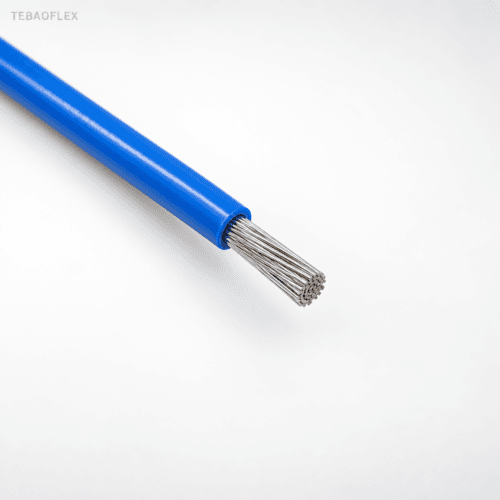
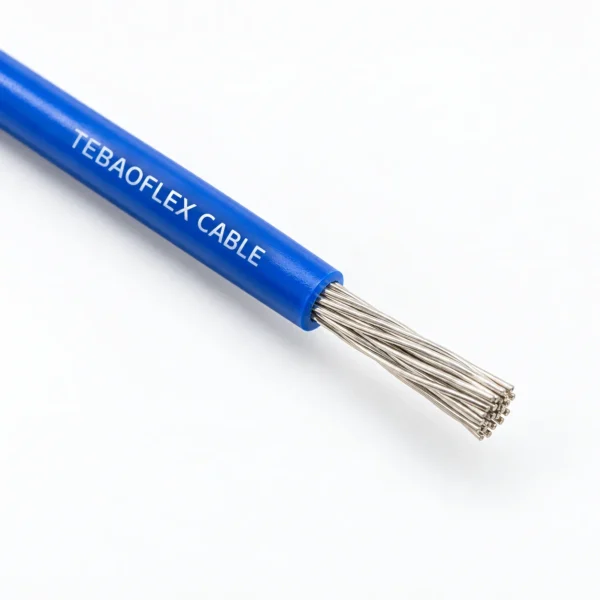
UL 1860 PFA wire is a compact single-core, 150 V high-temperature hook-up wire with PFA fluoropolymer insulation. The reference construction covers 16–30 AWG and a conductor temperature up to 200°C, making it suitable for protected internal wiring in appliances and electronic equipment where thin insulation, electrical stability and heat resistance are required.
TEBAOFLEX can review nickel-plated, tinned or bare copper conductors, solid or stranded designs, insulation colour, printed marking, cut length and packaging. The exact conductor finish and stranding are selected for the operating temperature, termination method and equipment environment.
UL 1860 PFA Wire at a Glance
| Selection point | Reference specification |
|---|---|
| Style reference | UL 1860 |
| Product type | Single-core PFA insulated high-temperature hook-up wire |
| Rated voltage | 150 V |
| Rated temperature | 200°C |
| Conductor options | Nickel-plated, tinned or bare copper; solid or stranded construction |
| Conductor range | 16–30 AWG |
| Insulation | PFA fluoropolymer |
| Insulation thickness | 0.25 mm nominal; 0.23 mm minimum |
| Primary use | Protected internal wiring of appliances and electronic equipment |
What Is UL 1860 Wire?
UL 1860 is a style reference for small-gauge appliance wiring material using PFA insulation. Its basic construction consists of one copper conductor covered directly by a thin PFA layer. There is no braid, metallic shield, filler or secondary outer sheath in the standard single-core design.
Buyers may search for this product as UL 1860 wire, PFA 200°C wire, 150V hook-up wire, PFA insulated appliance wire, high-temperature electronic wire, fluoropolymer hook-up wire, small-gauge high-temperature wire or 16–30 AWG PFA wire. These phrases describe the same general need, but conductor finish, stranding, colour and installation conditions must still be confirmed.
Construction and Material Options
| Component | Material or option | Engineering purpose |
|---|---|---|
| Conductor | Nickel-plated, tinned or bare copper; solid or stranded | Carries current. The finish and strand design are chosen for temperature, flexibility, termination and assembly processing. |
| Insulation | PFA fluoropolymer | Provides thin-wall electrical insulation with a 200°C temperature reference and a low-friction surface. |
| Identification | Colour and customer-specific printed marking | Supports circuit identification, production traceability and assembly control. |
16–30 AWG Reference Specifications
The table below reproduces the conductor, resistance, insulation and finished-diameter values from the supplied technical reference. These figures describe the listed constructions only; an alternative copper finish or strand design can change conductor diameter, resistance and finished size.
| AWG | Stranding (No./mm) | Max. conductor resistance at 20°C (Ω/km) | Conductor diameter (mm) | Insulation nom./min. (mm) | Nominal OD (mm) | OD tolerance (mm) |
|---|---|---|---|---|---|---|
| 16 | 19/0.287 | 14.60 | 1.50 | 0.25 / 0.23 | 2.00 | ±0.10 |
| 18 | 19/0.235 | 23.20 | 1.18 | 0.25 / 0.23 | 1.68 | ±0.10 |
| 20 | 19/0.190 | 36.70 | 0.95 | 0.25 / 0.23 | 1.45 | ±0.10 |
| 22 | 19/0.150 | 59.40 | 0.76 | 0.25 / 0.23 | 1.26 | ±0.10 |
| 24 | 7/0.200 | 94.20 | 0.61 | 0.25 / 0.23 | 1.11 | ±0.10 |
| 26 | 7/0.160 | 150.00 | 0.48 | 0.25 / 0.23 | 0.98 | ±0.10 |
| 28 | 1/0.320 | 227.00 | 0.32 | 0.25 / 0.23 | 0.82 | ±0.10 |
| 30 | 1/0.254 | 361.00 | 0.254 | 0.25 / 0.23 | 0.76 | ±0.10 |
How to Choose the Conductor Finish
| Conductor option | Typical reason to consider it | Information required |
|---|---|---|
| Nickel-plated copper | High-temperature terminations or assemblies where a nickel-plated surface is part of the specified design. | Maximum conductor temperature, terminal type, crimp or connection process and heat exposure. |
| Tinned copper | Compatible soldered or crimped assemblies requiring a tinned conductor surface. | Operating temperature, solder or terminal process, storage and surrounding environment. |
| Bare copper | Protected applications where an unplated conductor is specified and compatible with the thermal duty. | Conductor temperature, terminal design and atmosphere around the connection. |
The 200°C insulation rating does not automatically establish the allowable temperature of every conductor finish or terminal. Evaluate the complete connection system rather than selecting the conductor surface from insulation temperature alone.
Why Use PFA Insulation?
PFA is a melt-processable fluoropolymer used where compact wall thickness, stable electrical insulation and high-temperature operation are needed. Its smooth, low-friction surface can assist routing through compatible equipment channels, while its chemical and weather resistance make it useful in demanding protected equipment environments.
Material performance still depends on exposure concentration, duration, temperature, mechanical load and the selected compound. Radiation, chemicals, fuels, oils and cleaning agents must be identified before compatibility is confirmed. A general PFA description should not replace application testing.
Typical Applications
- Internal wiring of electronic equipment and compact high-temperature assemblies.
- Protected appliance wiring near warm components where 150 V meets the circuit requirement.
- Control, sensing and signal leads in ovens, heaters, laboratory instruments and thermal-process equipment.
- Small-gauge wiring in lighting, power supplies, instrumentation and control panels operating at elevated temperature.
- Equipment leads requiring a thin, smooth PFA insulated wire for controlled routing and assembly.
Application names are examples, not blanket suitability statements. Current, voltage, conductor temperature, bend duty, terminations, protection, ventilation and the completed equipment determine final selection.
Application Conditions to Confirm
| Condition | Selection question | Why it matters |
|---|---|---|
| Electrical load | What are the operating current, voltage and allowable voltage drop? | Determines conductor size and thermal loading. |
| Temperature | What are the continuous, peak and terminal temperatures? | Confirms insulation, conductor finish and connection compatibility. |
| Movement | Is the wire fixed, occasionally moved or continuously flexed? | Determines whether solid or stranded construction is appropriate. |
| Chemicals | Which oils, fuels, cleaning agents or process chemicals are present? | Allows the actual concentration and exposure time to be reviewed. |
| Mechanical protection | Are sharp edges, abrasion, vibration or pulling loads present? | May require protection or a different cable design. |
UL 1860 PFA Wire vs. Other High-Temperature Wires
| Wire family | Typical selection reason | Key difference |
|---|---|---|
| UL 1860 PFA wire | Compact 16–30 AWG internal equipment wiring at 150 V and up to 200°C. | Thin 0.25 mm nominal PFA wall and small finished diameters. |
| Higher-voltage PFA wire | Equipment requiring 600 V or 1000 V PFA insulation systems. | Different wall thickness, diameter and style requirements. |
| FEP high-temperature wire | 200°C fluoropolymer hook-up wire where the specified FEP construction meets the project. | Material processing and style dimensions differ from PFA. |
| Silicone hook-up wire | Flexible high-temperature equipment wiring with silicone rubber insulation. | Surface friction, wall thickness, mechanical behaviour and chemical resistance differ. |
Installation Limits and Engineering Notes
- Use the wire within the confirmed 150 V and 200°C limits of the ordered construction.
- Protect the thin PFA insulation from sharp edges, cut-through, unsupported tension and unsuitable stripping tools.
- Do not assume suitability for direct burial, outdoor exposure, immersion, continuous flexing, cable chains, torsion or reeling.
- Confirm the conductor finish with the terminal, crimp, soldering process and maximum connection temperature.
- Derate current for ambient temperature, bundling, enclosure and ventilation conditions as required by the equipment design.
- The completed equipment is limited by its lowest-rated component and must be evaluated as a system.
How to Request the Correct Construction
| RFQ detail | Why it is needed |
|---|---|
| AWG size and current | Defines conductor area, resistance, voltage drop and heat generation. |
| Conductor finish | Determines compatibility with temperature and termination processing. |
| Solid or stranded design | Affects routing flexibility, finished diameter and termination. |
| Operating temperature | Confirms insulation and connection-system margin. |
| Application environment | Identifies chemical, abrasion, moisture, vibration and movement conditions. |
| Colour, marking, length and quantity | Defines identification, manufacturing and packaging requirements. |
Colour and Customisation Options
Reference colour options include black, white, red, yellow, green, blue, brown, grey, orange and violet. TEBAOFLEX can also review conductor finish, strand design, insulation colour, printed marking, cut length, coil or reel format and export packaging. Availability is confirmed against the selected AWG size, construction and quantity.
Related PFA and High-Temperature Wire Options
- UL 10371 PFA 250°C 1000V high-temperature wire
- UL 10362 PFA 250°C 600V high-temperature wire
- UL 1330 FEP 200°C 600V high-temperature wire
- High-temperature and specialty cable range
Frequently Asked Questions
What is UL 1860 PFA wire used for?
It is used for protected internal wiring in appliances and electronic equipment requiring a compact, single-core 150 V wire operating up to 200°C.
What conductor sizes are available?
The supplied reference covers 16, 18, 20, 22, 24, 26, 28 and 30 AWG. The table lists stranding, resistance, conductor diameter, insulation wall and nominal finished diameter.
Which conductor finishes can be supplied?
Nickel-plated, tinned and bare copper constructions can be reviewed. The correct option depends on conductor temperature, termination and assembly environment.
How thick is the PFA insulation?
The reference construction uses a nominal wall of 0.25 mm and a minimum wall of 0.23 mm across the listed 16–30 AWG range.
Is UL 1860 suitable for 600 V equipment?
No. This product is specified as a 150 V construction. Select a suitable higher-voltage PFA or other high-temperature wire when the circuit requires 600 V or 1000 V.
What information is needed for a quotation?
Provide AWG size, conductor finish, solid or stranded design, current, voltage, maximum temperature, environment, colour, print, length, quantity and required production documents.
Send Your UL 1860 Wire Requirements
Send the AWG size, conductor finish, strand design, circuit conditions, operating temperature, environment, colour, length and quantity. The TEBAOFLEX technical team will review the construction and confirm the production specification before quotation.