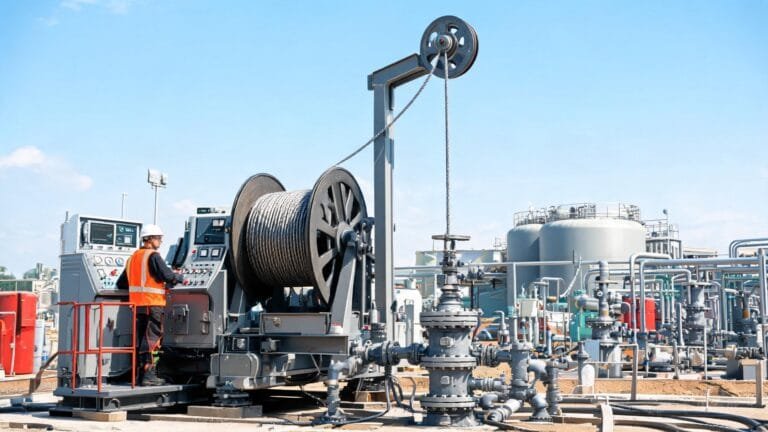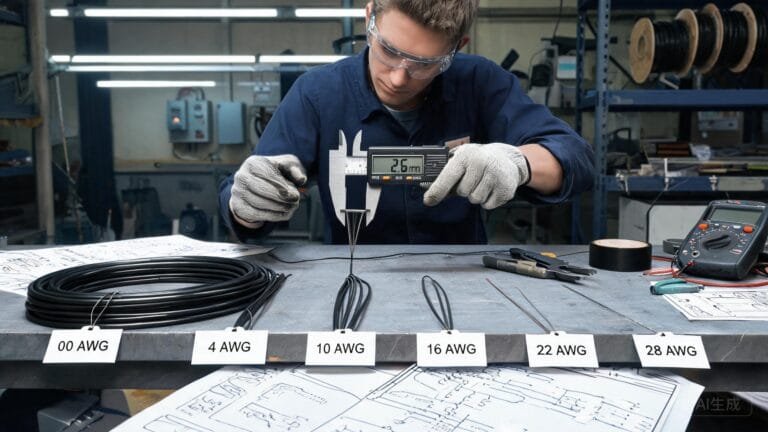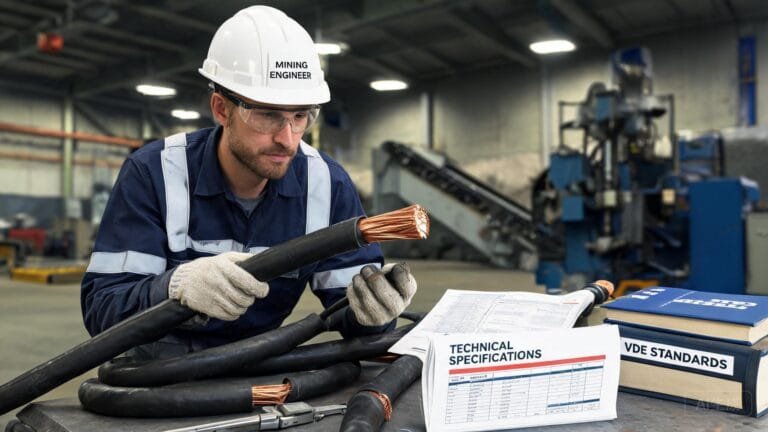

Overview: (N)TMCGCW11Y in Heavy-Duty Industrial Applications
The (N)TMCGCW11Y cable has established itself as the premier medium voltage reeling cable solution for the most demanding industrial applications worldwide. From electric rope shovels in open-pit copper mines to ship-to-shore cranes at major port terminals, the (N)TMCGCW11Y delivers the mechanical resilience, electrical reliability, and environmental resistance that heavy industry demands.
Unlike standard rubber-sheathed cables that deteriorate under the combined assault of mechanical stress, oil exposure, UV radiation, and continuous reeling, the (N)TMCGCW11Y’s polyurethane sheath and EPR insulation system provide a purpose-engineered solution that extends cable life and reduces unplanned downtime. This article explores the key application areas and provides practical installation guidance for each.
Key Application Areas
1. Electric Rope Shovels and Mining Excavators
Electric rope shovels represent one of the most demanding applications for medium voltage reeling cables. These massive machines operate in open-pit mines where they are subjected to constant movement, extreme mechanical stress, and exposure to abrasive rocks, dust, and chemicals. The (N)TMCGCW11Y is specified for:
- Main hoist drives: Primary power supply for the main hoist motor requiring continuous reeling on motorized drums
- Slew drives: Rotational power supply for the shovel house rotation mechanism
- Auxiliary power: Supplying lighting, control systems, and ancillary equipment
- Crowd drives: Power for the crowd motor that controls dipper handle movement
The PUR sheath’s superior abrasion resistance is critical in mining environments where cables contact sharp rocks and abrasive surfaces. The cable’s tinned copper conductors resist corrosion in the damp, mineral-rich environments typical of open-pit mining operations.
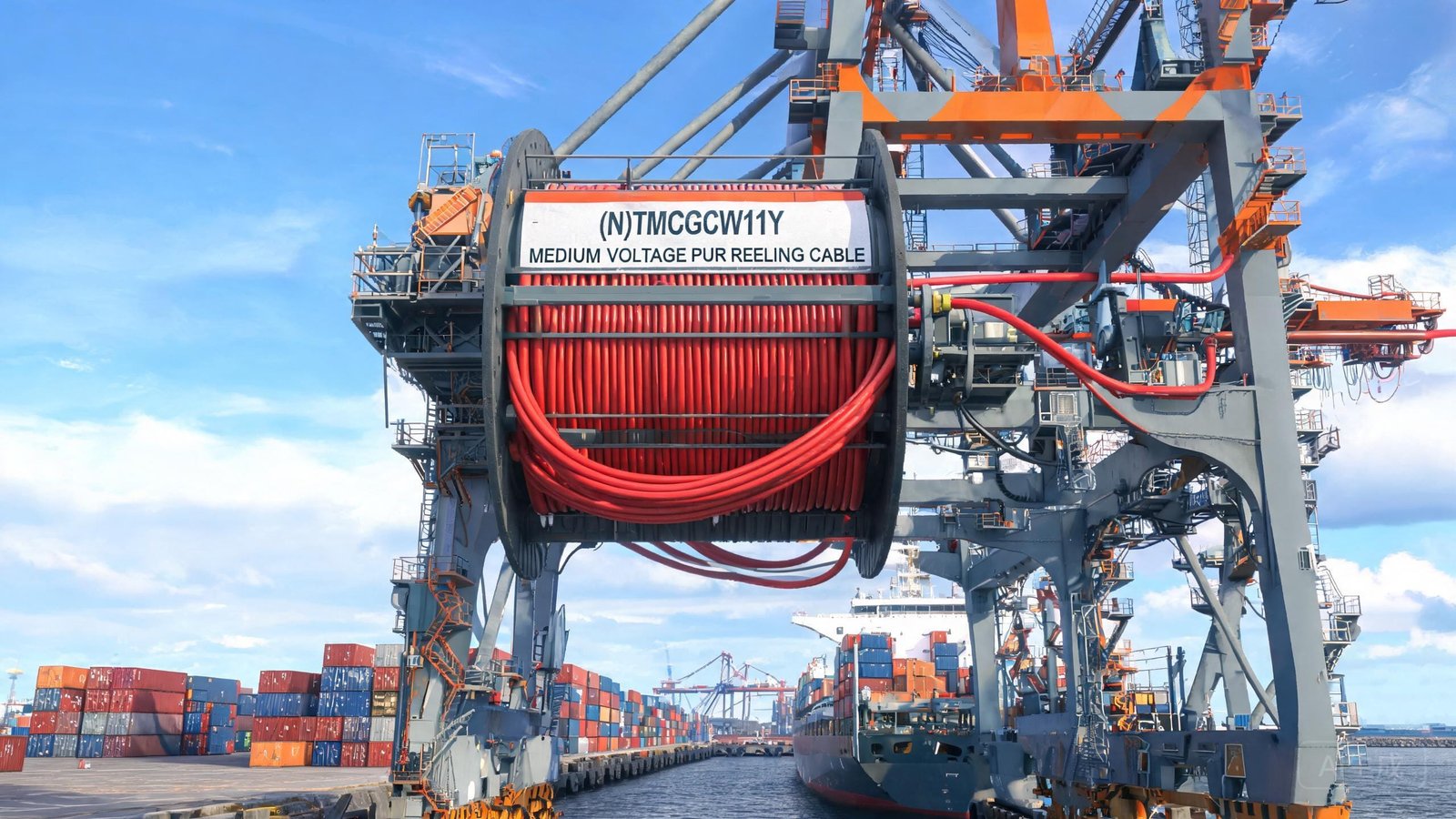
(N)TMCGCW11Y PUR cable on motorized drum powering port crane operations
2. Port Cranes and Container Handling
Ship-to-shore (STS) cranes, rubber-tired gantry (RTG) cranes, and rail-mounted gantry (RMG) cranes all require reliable medium voltage power supply via reeling cables. The (N)TMCGCW11Y excels in port environments due to:
- Saltwater corrosion resistance: The tinned copper conductors and PUR sheath resist saltwater spray and atmospheric corrosion
- UV stability: Port cranes operate outdoors with continuous sun exposure — the UV-stable PUR formulation prevents sheath degradation
- Oil and fuel resistance: Port environments expose cables to hydraulic oils, diesel fuel, and lubricants that would rapidly degrade standard cables
- High flex life: Continuous crane operation demands cables rated for 250,000+ reeling cycles
3. Mining Draglines and Bucket Wheel Excavators
Massive draglines and bucket wheel excavators represent the heaviest-duty reeling cable applications in the mining industry. These machines require medium voltage cables that can withstand extreme mechanical loads, including:
- High-tension reeling on large-diameter drums
- Exposure to abrasive overburden and coal dust
- Vibration and mechanical shock from walking mechanisms
- Temperature extremes from arctic cold to desert heat
The (N)TMCGCW11Y’s combination of high-tensile PUR sheath, tinned copper braid reinforcement, and EPR insulation provides the robustness needed for these extreme applications.
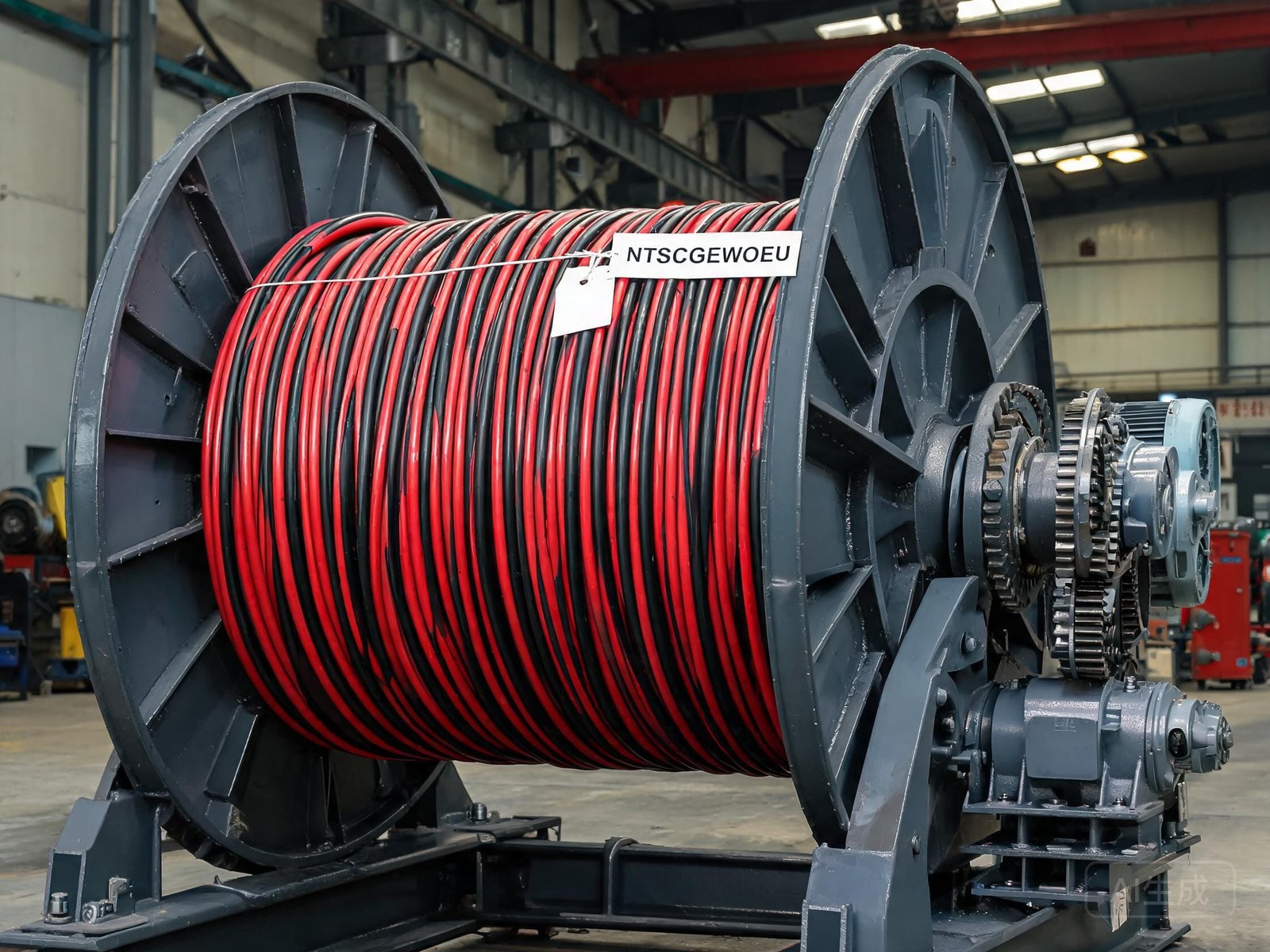
Medium voltage reeling cable on motorized drum for mining equipment power supply
4. Industrial Reeling Systems and Cable Drums
Beyond mining and ports, the (N)TMCGCW11Y serves a broad range of industrial reeling applications including:
- Conveyor systems: Mobile and shift-adjustable conveyors in mining and bulk material handling
- Water treatment plants: Traveling bridge cranes and clarifier mechanisms requiring medium voltage
- Steel mills: Hot mill auxiliary equipment and ladle cranes
- Cement plants: Kiln drives and material handling systems
- Renewable energy: Wind turbine nacelle power supply and solar tracking systems
Cable Drum Reeling System Design
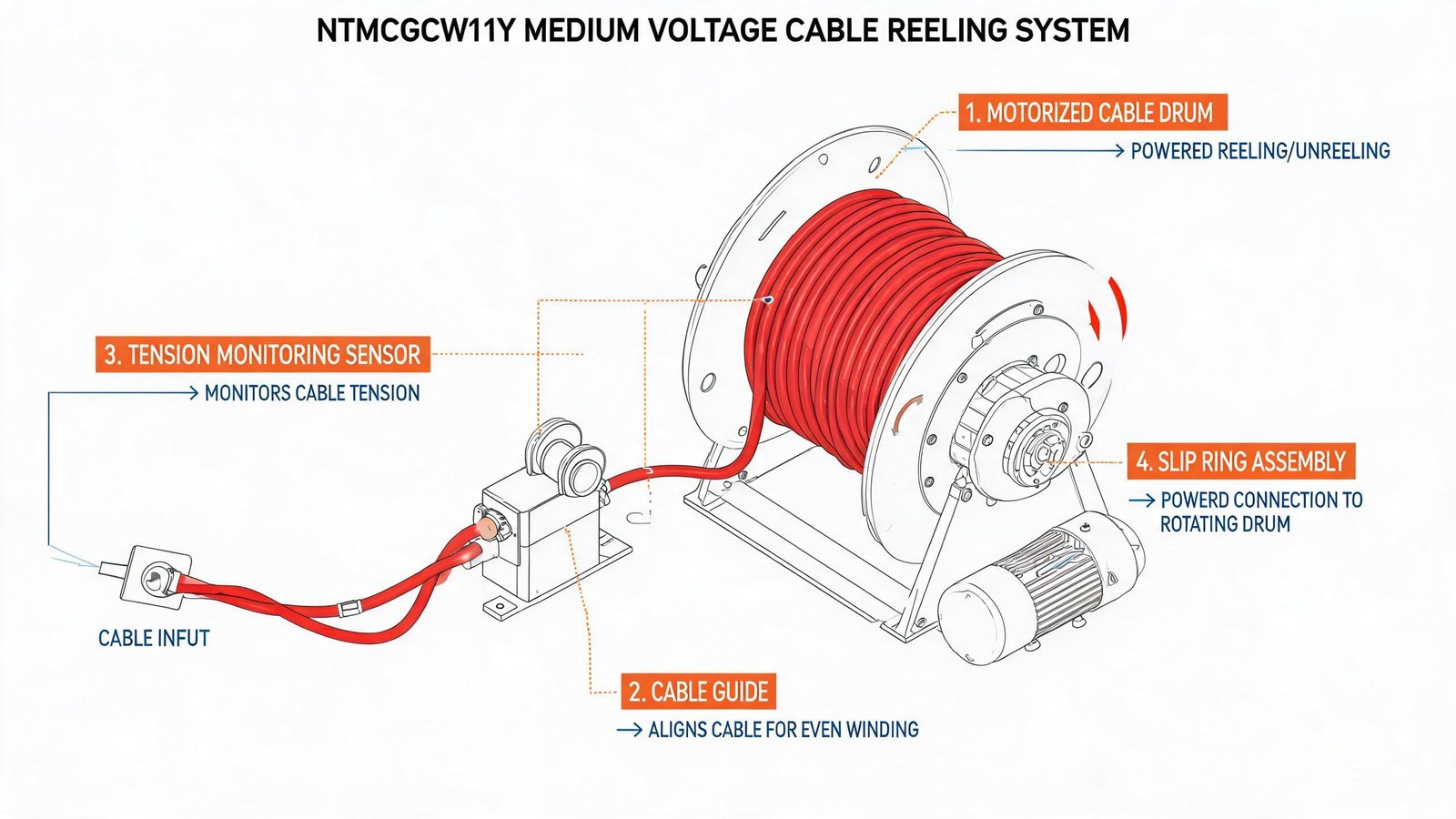
(N)TMCGCW11Y drum reeling system: motorized drum, cable guide, tension monitoring, and slip ring
Proper reeling system design is critical to achieving maximum cable life. The following design principles apply to (N)TMCGCW11Y installations:
Drum Selection
The drum diameter must be sized to maintain the cable’s minimum bending radius of 15×D for flexing applications. For a cable with an outer diameter of 40mm, the minimum drum barrel diameter would be 600mm. Using a larger drum diameter extends cable life by reducing bending stress.
Cable Guide Systems
Cable guides ensure proper winding alignment and prevent cross-winding. Two primary types are used:
- Random winding: Cable winds freely on the drum without guidance. Suitable for low-speed, low-cycle applications.
- Monospiral winding: Cable is guided by a mechanical spooling device that ensures even layer-by-layer winding. Essential for high-speed, high-cycle reeling.
Tension Control
Maintaining proper cable tension during reeling is critical. Too much tension causes conductor fatigue; too little tension results in loose winding and cable damage during subsequent unwinding. Typical tension ranges from 2-5% of the cable’s breaking strength. Motorized drums with active tension control systems are recommended for continuous-duty applications.
Slip Ring Assemblies
For reeling systems requiring continuous power transmission during rotation, slip ring assemblies are essential. The slip ring must be rated for the full medium voltage of the cable and should feature silver-graphite brushes for reliable current transfer with minimal maintenance.
Installation Guidelines
Reeling System Installation
Follow these essential guidelines for successful (N)TMCGCW11Y reeling installations:
- Verify drum diameter: Ensure the drum barrel diameter meets or exceeds 15× the cable outer diameter.
- Check tension settings: Set the reeling drive tension to 2-5% of cable breaking strength. Verify with a calibrated tension sensor.
- Install cable guide: For monospiral winding, install and align the spooling guide according to the manufacturer’s specifications.
- Secure cable ends: Use appropriate cable termination kits rated for the cable’s voltage class. Ensure proper shield grounding.
- Test insulation: After installation, perform insulation resistance testing at 2.5×U0 for 1 minute before energizing.
Environmental Considerations
- Temperature: For flexing applications, ensure ambient temperature is above -25°C. For fixed installations, the cable can withstand temperatures as low as -40°C.
- Chemical exposure: While PUR provides excellent oil resistance, verify compatibility with specialized chemicals. Contact our engineering services team for chemical compatibility data.
- UV exposure: The PUR formulation is UV-stable, making it suitable for outdoor applications without additional protection.
- Moisture: The EPR insulation and tinned copper construction provide inherent moisture resistance suitable for damp environments.
Specialized Industry Applications
Open-Pit Mining
Open-pit mining operations represent the largest market for (N)TMCGCW11Y cables. The cable’s superior abrasion resistance, oil resistance, and flex life make it the preferred choice for electric rope shovels, draglines, and mobile crushing equipment. Major mining operations in Australia, Chile, Indonesia, and Mongolia rely on (N)TMCGCW11Y-type cables for their primary production equipment.
Port and Terminal Operations
Modern container terminals operate at high duty cycles with continuous crane movement, placing extreme demands on reeling cable reliability. The (N)TMCGCW11Y’s saltwater corrosion resistance and UV stability make it ideal for port applications worldwide.
Tunnel Construction
Tunnel boring machines (TBMs) and associated ventilation and material handling systems require medium voltage cables that can withstand constant movement in confined spaces. The (N)TMCGCW11Y provides the mechanical durability and electrical reliability needed for these challenging applications.
Maintenance Recommendations
- Visual inspection: Monthly checks for sheath damage, abrasion, or oil contamination
- Bend inspection: Quarterly verification of drum diameter and cable guide alignment
- Insulation testing: Annual insulation resistance and continuity testing
- Slip ring maintenance: Semi-annual inspection and cleaning of slip ring assemblies
- Tension verification: Quarterly check of reeling drive tension settings
Get Application-Specific Cable Recommendations
Our engineering team can analyze your specific application requirements — including voltage class, reeling parameters, and environmental conditions — and recommend the optimal (N)TMCGCW11Y configuration.
Selection Reference
| Application | System data to define | Selection reason |
|---|---|---|
| Mining equipment | Equipment function, circuit voltage, travel and site conditions | Builds an application-specific specification. |
| Crane systems | Motion path, routing arrangement and mechanical restraints | Identifies the movement and installation duty. |
| Reeling systems | Drum geometry, operating cycle and guide arrangement | Supports a reel-duty review before cable selection. |
| Heavy industrial machinery | Core functions, environment and termination details | Helps procurement provide complete RFQ information. |
Related Resources
Continue the selection review with these related resources: