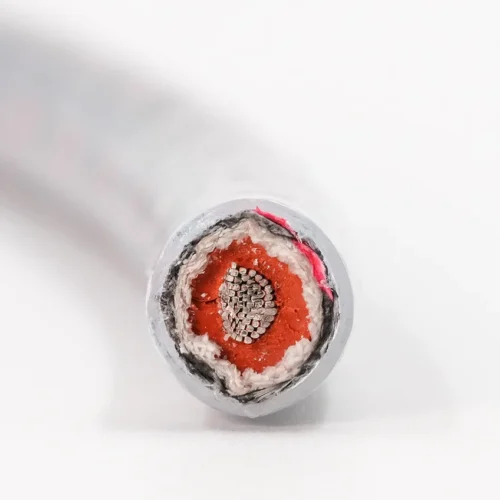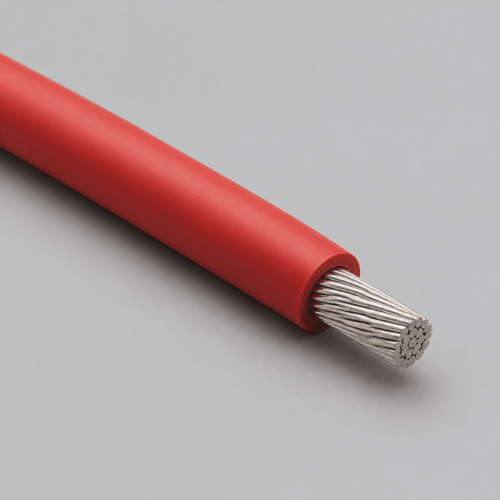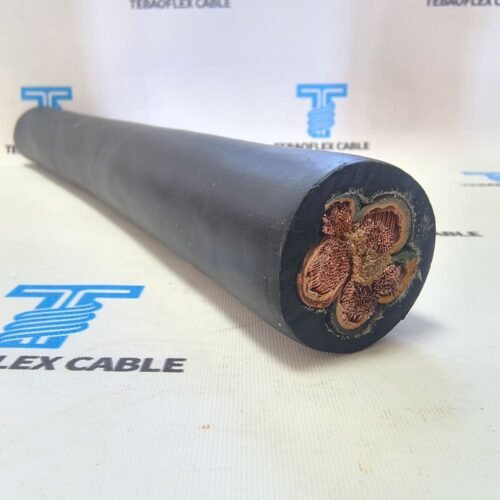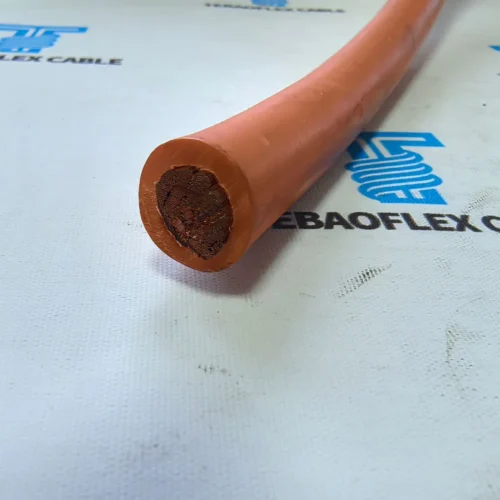
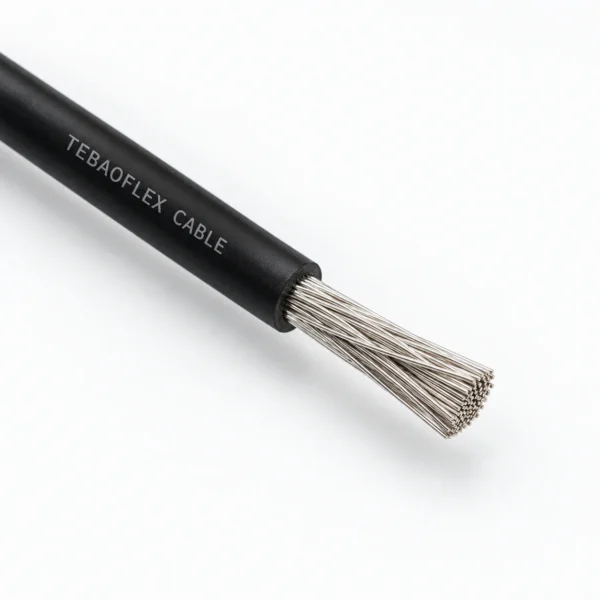
UL 3512 silicone wire is a single-core, 600 V high-temperature hook-up wire with a tinned copper conductor and silicone rubber insulation. It is designed for protected internal wiring in enclosed equipment requiring operation up to 200°C, including heated appliances, dryers, industrial ovens and thermal-process machinery.
TEBAOFLEX can review metric sizes from 0.50 to 240 mm² and AWG constructions from 22 AWG to 4/0, with solid or finely stranded conductors, multiple insulation colours, printing, cut length and packaging options. The lower temperature limit, finished diameter and electrical data are confirmed for the exact conductor and silicone compound selected.
UL 3512 Silicone Wire at a Glance
| Selection point | Reference specification |
|---|---|
| Style reference | UL 3512 |
| Product type | Single-core silicone insulated high-temperature hook-up wire |
| Rated voltage | 600 V AC |
| Maximum operating temperature | +200°C |
| Lower temperature limit | Depends on the selected silicone compound and installation mode; confirm with the order specification |
| Conductor | Tinned copper; solid or finely stranded according to size and order |
| Size range | 0.50–240 mm²; reference AWG range 22–4/0 |
| Insulation | Silicone rubber |
| Reference test voltage | 3000 V |
| Minimum bending radius | Flexible: 10 × outer diameter; fixed: 8 × outer diameter |
| Installation | Protected internal wiring of enclosed appliances and industrial equipment |
What Is UL 3512 Wire?
UL 3512 is a style reference for heat-resistant appliance wiring material. The construction is intentionally simple: one tinned copper conductor covered directly with silicone rubber insulation. There is no external fiberglass braid, metallic shield, filler or additional sheath in the basic design.
Engineers and buyers may also search for this product as UL 3512 wire, 200°C silicone wire, 600V high-temperature wire, silicone hook-up wire, single-core heat-resistant cable, tinned copper high-temperature wire, appliance lead wire or high-temperature equipment wire. These terms describe the general requirement, but the conductor size, strand design, insulation wall and installation environment must still be specified.
Cable Construction
| Component | Material or option | Engineering purpose |
|---|---|---|
| Conductor | Tinned copper, solid or finely stranded | Carries current. Fine stranding supports routing flexibility, while solid construction may be selected for compatible fixed assemblies. |
| Insulation | Silicone rubber | Provides the primary electrical insulation and high-temperature capability. |
| Identification | Colour and customer-specific printing | Supports circuit identification, assembly control and production traceability. |
Metric Size Reference: 0.50–240 mm²
The following table gives one finely stranded metric reference series. AWG equivalents are approximate because the conductors are designed in metric cross-sections. Final strand count, outer diameter and weight are confirmed for the ordered TEBAOFLEX construction.
| Nominal cross-section (mm²) | Approx. AWG | Outer diameter min.–max. (mm) | Copper weight (kg/km) | Approx. cable weight (kg/km) |
|---|---|---|---|---|
| 0.50 | 20 | 2.4–2.8 | 4.8 | 11.1 |
| 0.75 | 19 | 2.5–2.9 | 7.2 | 14.0 |
| 1.00 | 18 | 2.7–3.1 | 9.6 | 16.2 |
| 1.50 | 16 | 3.1–3.5 | 14.4 | 21.6 |
| 2.50 | 14 | 3.5–3.9 | 24.0 | 32.6 |
| 4.00 | 12 | 4.0–4.4 | 38.4 | 49.7 |
| 6.00 | 10 | 5.5–5.9 | 57.6 | 79.4 |
| 10 | 8 | 7.1–7.7 | 96.0 | 133.0 |
| 16 | 6 | 8.8–9.4 | 153.6 | 207.2 |
| 25 | 4 | 10.3–11.1 | 240.0 | 308.8 |
| 35 | 2 | 11.5–12.3 | 336.0 | 413.2 |
| 50 | 1 | 14.4–15.2 | 480.0 | 616.1 |
| 70 | 2/0 | 16.2–17.0 | 672.0 | 826.9 |
| 95 | 3/0 | 18.3–19.3 | 912.0 | 1116.6 |
| 120 | 4/0 | 20.6–21.8 | 1152.0 | 1402.1 |
| 150 | 300 kcmil | 22.8–24.0 | 1440.0 | 1740.6 |
| 185 | 350 kcmil | 25.0–26.2 | 1776.0 | 2132.7 |
| 240 | 500 kcmil | 27.7–28.9 | 2304.0 | 2699.2 |
AWG Construction Reference: 22 AWG–4/0
This table presents a second reference series using AWG conductor designations. It is useful when a drawing or bill of materials is written in AWG rather than mm². Do not mix dimensions from the metric table and AWG table without confirming the intended conductor design.
| AWG | Stranding (No./mm) | Nominal wall (mm) | Nominal OD (mm) | Max. conductor resistance at 20°C (Ω/km) | Approx. weight (kg/km) |
|---|---|---|---|---|---|
| 22 | 1/0.648 | 0.76 | 2.6 | 56.4 | 9.6 |
| 20 | 10/0.255 | 0.76 | 2.8 | 37.2 | 12 |
| 18 | 16/0.255 | 0.76 | 3.1 | 23.4 | 15 |
| 16 | 26/0.255 | 0.76 | 3.4 | 14.7 | 21 |
| 14 | 41/0.255 | 0.76 | 3.8 | 9.2 | 29 |
| 12 | 65/0.255 | 0.76 | 4.3 | 5.82 | 42 |
| 10 | 104/0.255 | 1.14 | 5.7 | 3.66 | 71 |
| 8 | 168/0.255 | 1.14 | 6.5 | 2.35 | 104 |
| 6 | 266/0.255 | 1.52 | 8.5 | 1.48 | 170 |
| 4 | 133/0.455 | 1.52 | 9.7 | 0.918 | 250 |
| 2 | 259/0.405 | 1.52 | 11.2 | 0.580 | 366 |
| 1 | 259/0.455 | 2.03 | 13.1 | 0.460 | 477 |
| 1/0 | 259/0.511 | 2.03 | 14.2 | 0.357 | 584 |
| 2/0 | 259/0.573 | 2.03 | 15.3 | 0.284 | 717 |
| 3/0 | 259/0.644 | 2.03 | 16.6 | 0.224 | 886 |
| 4/0 | 259/0.723 | 2.03 | 18.1 | 0.179 | 1095 |
Understanding the Temperature Range
The supplied references agree on a maximum operating temperature of 200°C but list different lower temperature limits because the silicone formulation and installation method differ. One reference series lists -25°C for flexible use and -40°C for fixed installation, while another lists operation down to -60°C. TEBAOFLEX therefore confirms the lower limit against the selected compound, conductor design, bend duty and installation rather than applying one value to every variant.
For fixed installation at temperatures above 90°C, routing should allow ventilation around the silicone insulation. Enclosed, unventilated conduit can affect the mechanical properties of silicone at sustained high temperature, so the installation design must be reviewed with the equipment manufacturer.
Typical Applications
- Internal wiring of enclosed electric clothes dryers and heated household or commercial appliances.
- High-temperature leads inside ovens, heaters, furnaces and temperature-control equipment.
- Protected power and control wiring in iron, steel, rolling, foundry, cement, glass and ceramic processing equipment.
- Motor, transformer and generator leads where a flexible 200°C silicone insulation system is specified.
- Industrial lighting, thermal chambers and machinery routed near hot components.
These are typical use cases rather than blanket suitability statements. Current, conductor temperature, enclosure, ventilation, abrasion, chemicals, flexing, terminals and the completed equipment determine final selection.
Material and Environmental Selection Notes
Silicone rubber is selected for flexibility and heat resistance across a broad temperature range. Reference material data also describes resistance to ozone, oxygen, alcohols, dilute acids, alkalis, saline solutions and oxidising agents. Actual exposure concentration, duration and temperature must be provided before compatibility is confirmed.
This single-core silicone wire is not automatically suitable for outdoor weathering, direct burial, immersion, cable chains, continuous torsion or reeling. Where abrasion, oil contact or mechanical impact is significant, a protected routing method or another cable construction may be required.
UL 3512 vs. Other High-Temperature Wire Types
| Wire family | Typical reason to select it | Key difference |
|---|---|---|
| UL 3512 silicone wire | Flexible single-core 600 V wiring up to 200°C with a smooth silicone insulation surface. | No external fiberglass braid in the basic construction. |
| UL 3513 fiberglass braided silicone wire | 200°C, 600 V silicone-insulated wire requiring an external textile braid. | Additional fiberglass braid changes the surface, finished diameter and handling. |
| UL 3530 silicone wire | 600 V silicone hook-up wire where a 150°C construction meets the project requirement. | Lower maximum temperature reference. |
| PTFE or FEP high-temperature wire | Projects requiring a fluoropolymer insulation system or different dimensional and environmental characteristics. | Material behaviour, processing, flexibility and termination differ from silicone. |
How to Specify UL 3512 Wire
| RFQ detail | Why it matters |
|---|---|
| Metric cross-section or AWG size | Defines conductor area and identifies the correct dimensional table. |
| Solid or stranded conductor | Affects flexibility, termination and processing. |
| Current and voltage | Supports conductor sizing, voltage-drop and thermal review. |
| Maximum and minimum temperature | Allows the silicone compound and installation duty to be confirmed. |
| Fixed or flexible routing | Determines bending requirements and expected mechanical duty. |
| Environment and ventilation | Identifies heat, chemicals, abrasion, moisture and conduit conditions. |
| Colour, print, length and quantity | Defines identification, production and packaging requirements. |
Installation Limits and Engineering Notes
- Use within the confirmed 600 V and temperature limits of the ordered construction.
- Observe a minimum bending radius of 10 × OD for flexible routing and 8 × OD for fixed routing unless the final data sheet states otherwise.
- Protect silicone insulation from sharp edges, unsupported loads, repeated abrasion and excessive tension.
- For sustained fixed operation above 90°C, use a routing method that provides suitable ventilation.
- Terminals, sleeves and connectors must match the conductor size, strand design and operating temperature.
- The completed equipment is limited by its lowest-rated component and must be evaluated as a complete system.
Colour and Customisation Options
Common insulation colours include black, green-yellow, blue, brown, red, white, grey, violet, yellow, orange, green, pink and beige. TEBAOFLEX can also review conductor size, strand design, insulation colour, printed marking, cut length, reel or coil format and export packaging. Availability is confirmed against the exact construction and order quantity.
Related High-Temperature Wire Options
- UL 3513 fiberglass braided silicone wire 200°C 600V
- UL 3530 silicone wire 150°C 600V
- UL 1659 PTFE 250°C 600V high-temperature wire
- High-temperature and specialty cable range
Frequently Asked Questions
What is UL 3512 silicone wire used for?
It is used as protected internal wiring in enclosed appliances and industrial equipment requiring a single-core 600 V silicone wire operating up to 200°C.
What is the difference between UL 3512 and UL 3513 wire?
UL 3512 has silicone insulation as its outside surface. UL 3513 adds an external fiberglass braid over the silicone-insulated core, so the finished diameter and handling differ.
Is UL 3512 available in metric and AWG sizes?
Yes. The supplied references cover a metric series from 0.50 to 240 mm² and an AWG reference series from 22 AWG to 4/0. Use the table matching the specified conductor system.
What is the minimum operating temperature?
It depends on the silicone compound and installation duty. The references include -25°C flexible, -40°C fixed and another construction down to -60°C, so the lower limit is confirmed for the ordered design.
Can the colour and printing be customised?
Yes. Insulation colour, printed marking, cut length and packaging can be reviewed against the required conductor size, quantity and production specification.
What information is needed for a quotation?
Provide mm² or AWG size, solid or stranded conductor, current, voltage, temperature range, routing mode, environment, colour, print, length, quantity and required production documents.
Send Your UL 3512 Wire Requirements
Send the conductor size, strand design, current, operating temperatures, routing conditions, colour, length and quantity. The TEBAOFLEX technical team will review the construction and confirm the product specification before quotation.